
Will Medicare Part B Hikes Erase Your 2026 Social Security COLA? Two weeks from now, about 75 million Americans will learn how big their Social Security raise is for 2027. The Social Security Administration is scheduled to announce the cost-of-living adjustment on October 14 at 8:30 a.m. Eastern, right after the Bureau of Labor Statistics releases September inflation data. The two leading forecasters, The Senior Citizens League and policy analyst Mary Johnson, both expect a 3.5% COLA. That would lift the average retirement check from $1,940.08 to about $2,007.98. The catch is familiar: the Medicare Part B premium comes out of the same check, so the raise you see on paper is rarely the raise you get.
The 2026 numbers explain why people are nervous. Last January the Social Security COLA was 2.8%, worth roughly $56 a month on the average benefit. The Medicare Part B premium jumped 9.7%, from $185.00 to $202.90, a $17.90 increase that took about a third of the average raise before it reached a bank account. For 2027 the Medicare Trustees project a much smaller increase, to $209.50. The official figure won’t arrive until November, and some analysts think it could land higher. We’ll be updating this article monthly as new numbers are confirmed.
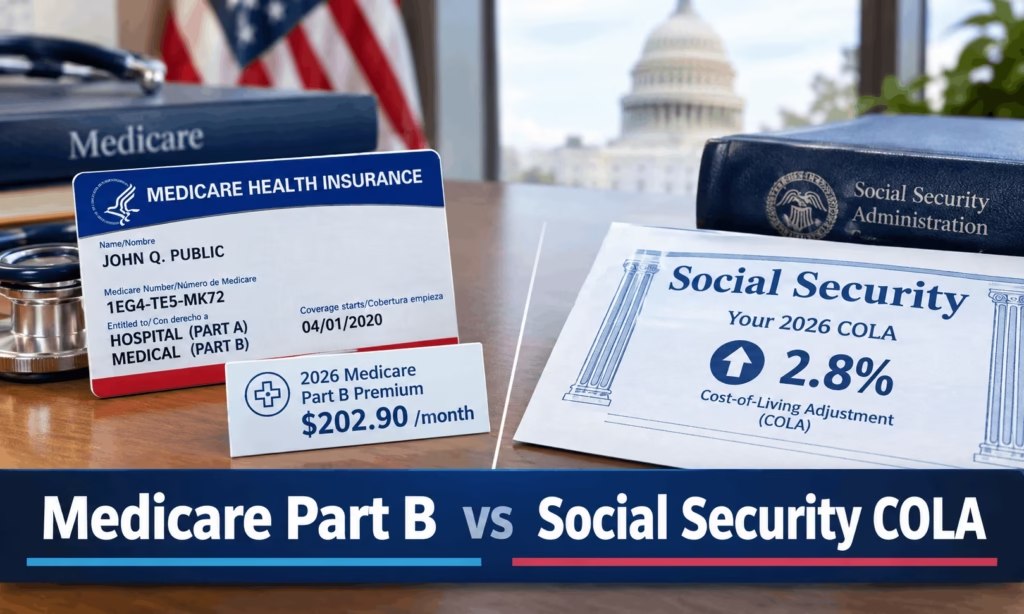
Medicare Part B vs Social Security COLA Key Dates and Numbers
| Item | Latest figure | Status |
|---|---|---|
| 2026 Social Security COLA | 2.8% | Official |
| 2026 standard Part B premium | $202.90 a month | Official |
| 2025 standard Part B premium | $185.00 a month | Official |
| 2026 Part B annual deductible | $283 | Official |
| 2027 COLA forecast | 3.5% (AARP is closer to 3.6%) | Estimate |
| 2027 Part B premium projection | $209.50 a month | Trustees projection |
| Average retirement benefit now | About $1,940 a month | TSCL figure |
| COLA announcement | October 14, 8:30 a.m. ET | Scheduled |
| Medicare open enrollment | October 15 to December 7 | Official |
| Official 2027 Part B premium | Expected in November | Pending |
| New COLA takes effect | January 2027 benefits | Scheduled |
Medicare Part B vs Social Security COLA: The 2026 Scorecard
The last full year of data is the best guide to what can go wrong. In 2026 the raise and the premium moved in opposite directions, and the premium won the percentage race by a wide margin. A 2.8% COLA on a $2,000 benefit adds $56. The $17.90 Part B increase leaves $38.10 in extra monthly income, or about $457 over twelve months.
The shortfall mattered most for people with smaller checks. The hold harmless rule, covered below, protected those whose benefit is under roughly $640 a month. Everyone else absorbed the full hike. Retirees on moderate incomes felt the squeeze because food, insurance and utilities also kept rising.
The Trustees tied the 2026 jump to higher spending on physician-administered drugs, outpatient hospital services and new expensive treatments, including GLP-1 medications. Those cost drivers haven’t gone away, which is why the projected path beyond 2027 still points upward.
What the Medicare Part B Premium Looks Like for 2027
The 2026 Medicare Trustees Report, released in June, projects the standard Medicare Part B premium at $209.50 for 2027. That is $6.60 higher than today, or 3.25%. If the COLA comes in at 3.5%, it would be the first year since 2023 that the raise outpaces the premium in percentage terms.
| Year | Standard monthly premium | Change | Notes |
|---|---|---|---|
| 2023 | $164.90 | Down 3.1% | The last year premiums fell |
| 2024 | $174.70 | Up 5.9% | Return to trend |
| 2025 | $185.00 | Up 5.9% | Rising drug costs |
| 2026 | $202.90 | Up 9.7% | Biggest jump in years |
| 2027 | $209.50 | Up 3.25% | Trustees projection |
Two cautions apply. First, the Trustees figure is an estimate, and CMS normally publishes the final premium, deductible and IRMAA brackets in November. Second, some analysts expect the final number to exceed the projection, so budgeting a small cushion is reasonable.
How Much of Your COLA Will Part B Take in 2027?
On a $2,000 monthly benefit, a 3.5% COLA adds $70. After a $6.60 premium increase, you keep $63.40. That means Part B absorbs about 9.4% of the raise, compared with 32% in 2026. The table shows the same math for other benefit levels, using a 3.5% COLA and a $6.60 premium hike.
| Current benefit | Gross COLA raise | Part B increase | Net monthly gain | Share taken by Part B |
|---|---|---|---|---|
| $1,500 | $52.50 | $6.60 | $45.90 | 12.6% |
| $2,000 | $70.00 | $6.60 | $63.40 | 9.4% |
| $2,500 | $87.50 | $6.60 | $80.90 | 7.5% |
| $3,000 | $105.00 | $6.60 | $98.40 | 6.3% |
For comparison, here is what the same benefit levels actually got in 2026, with a 2.8% COLA and a $17.90 premium increase.
| Benefit in 2025 | Gross COLA raise | Part B increase | Net monthly gain | Share taken by Part B |
|---|---|---|---|---|
| $1,500 | $42.00 | $17.90 | $24.10 | 42.6% |
| $2,000 | $56.00 | $17.90 | $38.10 | 32.0% |
| $2,500 | $70.00 | $17.90 | $52.10 | 25.6% |
| $3,000 | $84.00 | $17.90 | $66.10 | 21.3% |
Calculator goes here.
Use the calculator to plug in your own benefit and see the result. It has preset buttons for the real 2026 numbers and the 2027 estimate. You can also enter a different COLA or premium if the official announcements differ from the forecasts. Your real net change can still differ because of Part D premiums, IRMAA surcharges, tax withholding and other deductions.
Hold Harmless Rule: Who Is Protected From a Smaller Check
The hold harmless provision stops the dollar amount of your Medicare Part B premium increase from shrinking your Social Security payment below what you received the year before. In plain terms, the premium hike can’t be larger than your COLA raise. It matters mostly for people with low benefits.
It does not protect everyone. You are generally not covered if you are newly enrolled in Part B, if you pay your premium directly instead of through your benefit, or if you pay an income-related surcharge. Federal retirees under the old CSRS system who don’t receive Social Security also fall outside the rule. If you think you might be affected, check your letter from SSA each December.
With the 2027 projection, the protection would only matter for benefits below about $189 a month. With a 3.5% COLA and a $6.60 increase, a larger check absorbs the premium hike comfortably. In 2026, when the premium rose $17.90, the cutoff was much higher, around $640.
IRMAA: The Income Surcharge Many Retirees Forget
High earners pay more than the standard premium through the income-related monthly adjustment amount, known as IRMAA. The surcharge is based on your modified adjusted gross income from two years earlier, so your 2027 premium is set by your 2025 tax return. That return has already been filed, which means the main number driving your 2027 bill is locked in.
For 2026, surcharges begin at $109,000 of income for single filers and $218,000 for married couples filing jointly. Independent estimates put the 2027 starting points near $112,000 and $224,000, but CMS hasn’t confirmed them. If you had a big one-time event in 2025, such as a pension payout, a Roth conversion, a home sale or a large stock gain, you could face a surcharge that has little to do with your current income.
You can ask SSA to reconsider an IRMAA decision if you’ve had a life-changing event, such as retirement, marriage, divorce or the death of a spouse. The request is made with Form SSA-44, and SSA will want documentation.
The Longer Outlook: Why the Premium Keeps Climbing
A gentle 2027 increase doesn’t change the larger trend. The Trustees project the standard premium rising to around $224.50 in 2028 and $238.50 in 2029. By 2035 they see it reaching roughly $360.60, which would be about 78% above the 2026 level. COLAs have to outrun that pace every year just to keep retirees even.
This is why many analysts describe the Medicare Part B premium as a recurring drag on the Social Security COLA rather than a one-time problem. Retirees who budget for a premium growing faster than general inflation will be better prepared than those who plan around the most recent year.
How to Apply for Medicare Part B?
Most people become eligible at 65. If you already collect Social Security or Railroad Retirement benefits, you’re usually enrolled in Parts A and B automatically. If you’re not collecting yet, you need to sign up yourself.
Your Initial Enrollment Period lasts seven months: the three months before the month you turn 65, your birthday month, and the three months after. Signing up early starts coverage sooner. If you enroll during your birthday month or later, coverage begins the following month.
You can apply for Part B in three ways:
- Online through your my Social Security account at ssa.gov. This is the quickest option for most people.
- By phone at 1-800-772-1213 (TTY 1-800-325-0778).
- In person at a local Social Security office, ideally by appointment.
Have your Social Security number, date of birth and proof of any current employer coverage ready. If you are still working and covered by an employer plan, a form from your employer showing that coverage can help you avoid a late penalty.
If you miss your window and have no qualifying coverage, you can enroll during the General Enrollment Period from January 1 to March 31. Coverage starts the month after you sign up. The late penalty adds 10% to your premium for each full 12-month period you could have had Part B but didn’t, and it lasts as long as you have the coverage.
Processing Time: How Long Enrollment Takes
There’s no single guaranteed timeline. Automatic enrollments usually happen without any action on your part, and you receive your Medicare card in the mail about three months before your 65th birthday. Online applications are often reviewed faster than paper or in-person ones, but processing can take a few weeks depending on SSA workload and whether more documents are needed.
To check the status of an application, sign in to your my Social Security account or call SSA. If you don’t receive your card after a reasonable wait, you can request a replacement through your account or at medicare.gov. Apply early in your enrollment window so a slow review doesn’t delay coverage.
Payment Schedule: When Benefits Arrive and When Premiums Come Out
If you collect Social Security, your Part B premium is deducted from your monthly benefit before the deposit reaches you. The amount shown as your benefit is usually the gross figure, so your bank deposit will be smaller.
The Social Security payment date depends on your birth date:
| Birthday | Payment day | October 2026 date |
|---|---|---|
| 1st to 10th | Second Wednesday | October 14 |
| 11th to 20th | Third Wednesday | October 21 |
| 21st to 31st | Fourth Wednesday | October 28 |
| Started benefits before May 1997 | 3rd of the month | October 3 |
If you don’t receive Social Security, Medicare bills you for Part B directly, either quarterly or through Medicare Easy Pay, which takes the amount from a bank account. The COLA will be reflected in benefits paid in January 2027, which are for December, and the new Part B premium normally starts at the same time.
Smart Moves Before the New Premium Takes Effect
Open enrollment for Medicare Advantage and Part D runs from October 15 to December 7, and it’s the best chance to reduce costs. Compare plan premiums, drug formularies and out-of-network rules using the Medicare Plan Finder. A drug plan that looks cheap can become costly if your medications aren’t covered.
Some Medicare Advantage plans offer a Part B premium giveback, which returns part of your premium. These plans can come with narrower provider networks, so weigh the trade-offs carefully. Your State Health Insurance Assistance Program counselor can review options free of charge.
Also check your December notice from SSA for the confirmed COLA and your exact deduction. If you believe your premium is wrong, contact SSA promptly. Finally, build a modest buffer into your 2027 budget in case the final premium exceeds the projection.
Will Part B Eat Your COLA? Quick Calculator
Will Part B Eat Your COLA? Quick Calculator
Social Security COLA 2027: How Much More Will You Get in January?
Official Resources and Links
| Resource | What you can do | Official website |
|---|---|---|
| Social Security Administration | Benefits, COLA news, applications | ssa.gov |
| my Social Security (login and registration) | Sign in, create an account, check application status, view benefit letters | ssa.gov/myaccount |
| Sign up for Medicare | Apply for Part B online | ssa.gov/medicare/sign-up |
| COLA information | Current and past COLAs | ssa.gov/cola |
| Medicare.gov | Coverage, costs, enrollment | medicare.gov |
| Medicare Plan Finder | Compare Advantage and Part D plans | medicare.gov/plan-compare |
| Medicare account login | View claims and coverage | medicare.gov/account/login |
| CMS | Premium announcements and fact sheets | cms.gov |
| Medicare Trustees Report | Premium projections | cms.gov (Trustees Report section) |
| Bureau of Labor Statistics CPI | Inflation data used for the COLA | bls.gov/cpi |
| SHIP counseling | Free local Medicare help | shiphelp.org |
| SSA phone line | Enrollment and benefit questions | 1-800-772-1213 |
FAQs
Will the Medicare Part B premium increase wipe out my 2027 Social Security COLA?
Based on current forecasts, no. A 3.5% COLA is expected to be far larger than a $6.60 premium hike for nearly everyone. The situation could change if the final premium comes in well above the Trustees’ projection or if September inflation pulls the COLA lower.
How much is the Medicare Part B premium in 2026?
The standard premium is $202.90 a month, with a $283 annual deductible. Higher earners pay more through IRMAA.
What will the Part B premium be in 2027?
The Trustees project $209.50 a month. CMS is expected to publish the official number in November.
When will the 2027 COLA be announced?
October 14 at 8:30 a.m. Eastern, alongside the September CPI report.
When does the new COLA show up in my check?
It takes effect with benefits paid in January 2027. Most beneficiaries receive a notice in December and can view it in their my Social Security account.
Is the Part B premium taken out of my Social Security automatically?
Yes, if you collect benefits. If you don’t, Medicare bills you directly.
Can I skip Part B to save money?
You can, but you may owe a lifetime late penalty if you later enroll without qualifying coverage. Delaying is generally safe only if you have creditable employer coverage.
How much of my Social Security COLA goes to Medicare?
It depends on the premium increase and your benefit. In 2026 the premium took about 32% of the raise on a $2,000 check. In 2027, if the forecasts hold, it would take closer to 9%.
Does Medicare Part B go up every year?
Almost always. The one recent exception was 2023, when the standard premium fell 3.1%.
Why did Medicare Part B go up so much in 2026?
Mainly because of higher spending on outpatient care and physician-administered drugs, including GLP-1 medications, and the Trustees’ decision to fund reserves against that risk.
Who pays the IRMAA surcharge?
Individuals with income above about $109,000 and couples above $218,000, based on their tax return from two years earlier.
What is the hold harmless provision in Medicare?
It prevents a Part B premium increase from reducing your Social Security check below the prior year’s amount, for eligible people whose premium is deducted from their benefit.
What happens if I’m late enrolling in Part B?
You may pay a 10% penalty for each full 12-month period you were eligible but not enrolled, for as long as you keep Part B.
How do I check my Medicare application status?
Sign in to your my Social Security account, or call SSA at 1-800-772-1213.
Will Social Security pay more in 2027?
Yes. Forecasts point to a COLA between 3.2% and 3.6%, with 3.5% the most widely cited estimate.
Conclusion
The Medicare Part B vs Social Security COLA debate comes down to timing and size. In 2026 the premium took a painful bite out of a modest raise. For 2027, the early numbers favour retirees, with a forecast COLA of 3.5% against a projected premium increase of 3.25%. That would leave the typical beneficiary about $63 a month ahead on a $2,000 benefit, but nothing is final until October 14 and November.
Use the next few weeks to run your own numbers, compare plans during open enrollment and keep an eye on the official announcements. Premium growth is projected to outpace most household budgets over the next decade, so careful planning matters beyond this single year. We’ll be updating this article monthly as SSA and CMS release confirmed figures.
Social Security COLA Buying Power: Will the Raise Beat Inflation?
What Happens If Alberta Votes Yes? Inside Canada’s October 19 Independence Referendum
2027 COLA Increase Announcement Date, Estimated Raise, Payment Schedule & Calculator