The Federal Solar Tax Credit 2026 situation has changed dramatically for homeowners, and most people searching for this topic are working from outdated information. For over a decade, the federal government offered a 30% Residential Clean Energy Credit under Section 25D of the tax code, but that credit officially expired on December 31, 2025, after the One Big Beautiful Bill Act (OBBBA) was signed into law on July 4, 2025. This means homeowners who install solar panels in 2026 receive zero federal tax credit on a cash or loan purchase, a major shift from what solar companies were promising just a year earlier.
This guide explains exactly what changed, who still qualifies for a credit, what options remain in 2026, and how to avoid misleading sales pitches that still advertise a “30% federal credit” that no longer applies to residential purchases. All information below reflects the official text of the One Big Beautiful Bill Act and IRS guidance current as of 2026. We’ll be updating this article monthly as new IRS guidance, state programs, or legislative developments emerge.
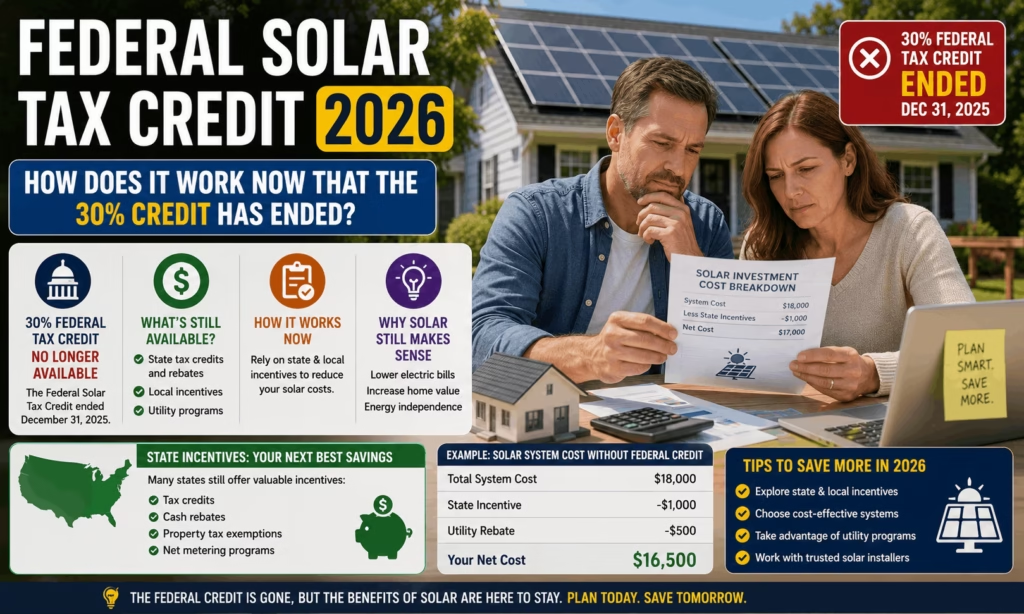
Federal Solar Tax Credit 2026 Status Overview
| Key Detail | Latest 2026 Data |
|---|---|
| Residential Solar Credit (Section 25D) status | Expired December 31, 2025 |
| Law that ended it | One Big Beautiful Bill Act (Public Law 119-21), signed July 4, 2025 |
| Original expiration under Inflation Reduction Act | Was scheduled through 2032, stepping down to 22% by 2034 |
| Credit rate for systems installed by Dec 31, 2025 | 30%, no dollar cap |
| Credit rate for systems installed Jan 1, 2026 or later | 0% (no federal residential credit) |
| Commercial Solar Credit (Section 48E) status | Still active, with new construction and sourcing rules |
| Commercial credit deadline (standard) | Projects must meet new deadlines through December 31, 2027 |
| Commercial credit extended deadline | Projects starting construction before July 4, 2026 may qualify through December 31, 2030 |
| Remaining federal option for homeowners in 2026 | Third-party owned systems (solar lease or PPA) |
| EV home charger credit (Section 30C) | Still active through June 30, 2026 |
| State and utility incentives | Still available, vary by state |
What Was the Federal Solar Tax Credit and Why Did It End?
The Residential Clean Energy Credit, officially Section 25D of the Internal Revenue Code, allowed homeowners to claim 30% of the total cost of a qualifying solar panel or home battery system directly against their federal income tax liability, with no dollar cap. Under the Inflation Reduction Act of 2022, this rate was locked in through 2032, before gradually stepping down to 26% and then 22% by 2034.
That changed when the One Big Beautiful Bill Act (OBBBA) was signed into law on July 4, 2025. The legislation terminated Section 25D roughly seven years ahead of its original schedule, with no phase-down and no transition period. Under the new rule, any solar expenditure considered “made” (meaning the system is installed and placed in service) on or after January 1, 2026 does not qualify for any federal residential credit, regardless of when the contract was signed or the deposit was paid.
Homeowners who completed installation, meaning the system passed final inspection and was operational, on or before December 31, 2025, can still legally claim the full 30% credit on their 2025 tax return. There is no retroactive clawback for people who already claimed the credit correctly.
Does the Federal Solar Tax Credit Still Exist in Any Form?
This is the most searched question around Federal Solar Tax Credit 2026, and the answer depends entirely on how you finance your system:
- Cash purchase or solar loan (you own the system): No federal credit is available. You are responsible for 100% of the cost with no federal offset.
- Solar lease or Power Purchase Agreement (PPA), third-party ownership: The company that owns the equipment on your roof can still claim the commercial Section 48E credit and, in many cases, passes part of that value through to you as a lower monthly rate. This is currently the only indirect way homeowners can benefit from a federal solar incentive in 2026.
- Commercial and business solar installations: Section 48E remains active for businesses, though it now comes with new construction start deadlines and foreign sourcing restrictions that were not part of the original Inflation Reduction Act framework.
Because of this shift, several solar companies pivoted heavily toward third-party ownership (TPO) models in 2026, since it is now the primary legal path for extracting any federal tax benefit tied to a residential rooftop installation.
Section 25D vs Section 48E: What’s the Real Difference?
| Feature | Section 25D (Residential) | Section 48E (Commercial) |
|---|---|---|
| Who claims it | Homeowner who owns the system | Business or third-party owner of the system |
| 2026 status | Expired, 0% credit | Active, with new rules |
| Deadline | Ended December 31, 2025 | Through December 31, 2027 (or 2030 if construction begins before July 4, 2026) |
| Applies to home purchases | Yes (before 2026 only) | No, only to owned/leased commercial assets |
| Sourcing restrictions | None previously applied | New foreign-entity sourcing rules apply |
What Homeowners Should Watch Out For in 2026
Because the federal credit changed so abruptly, misinformation is common in solar sales conversations. Homeowners evaluating solar in 2026 should be cautious of:
- Sales pitches referencing a “30% federal credit” without clarifying that it only applies to third-party owned systems, not a purchase.
- Confusing state or utility rebates with a federal credit. Many states still offer their own incentives, but these are separate programs with different rules and deadlines.
- Assuming installation date doesn’t matter. The IRS treats the credit eligibility date as when the system is fully installed and operational, not when a contract was signed or a deposit was made.
- Overlooking system depreciation value under leases. If you choose a PPA or lease to access indirect federal value, you generally do not own the system and cannot claim any tax benefit yourself.
What Still Exists to Lower Solar Costs in 2026
Even without the federal residential credit, several other incentive types remain available depending on your state:
- State solar tax credits and rebates, which vary significantly by state and are unaffected by the federal repeal.
- Solar Renewable Energy Certificates (SRECs), available in certain state markets, allowing system owners to sell credits generated by their solar production.
- Utility company rebates, offered directly by some electric utilities for new solar or battery installations.
- Net metering programs, which allow homeowners to receive credit for excess electricity sent back to the grid, though policies vary by state and utility.
- The federal EV charger credit (Section 30C), which remains active for qualifying home charging equipment installations through June 30, 2026, separate from the solar credit entirely.
Because these programs differ by state and utility territory, homeowners should check directly with their state energy office or utility provider for the most current program details and deadlines.
Official & Government Resources
| Resource | Purpose | Link |
|---|---|---|
| IRS Residential Clean Energy Credit Page | Official credit rules and eligibility history | irs.gov/credits-deductions/residential-clean-energy-credit |
| IRS Commercial Clean Electricity Credit (48E) | Rules for business/third-party owned systems | irs.gov/credits-deductions/clean-electricity-investment-credit |
| Database of State Incentives for Renewables & Efficiency (DSIRE) | State-by-state solar incentive lookup | dsireusa.org |
| ENERGY STAR Federal Tax Credits Page | Summary of current federal energy credits | energystar.gov/about/federal-tax-credits |
| IRS Free File / Account Login | File taxes and check credit claim status | irs.gov/filing |
FAQs
Is the federal solar tax credit still available in 2026?
No. The 30% Residential Clean Energy Credit (Section 25D) expired on December 31, 2025, under the One Big Beautiful Bill Act. Homeowners who purchase solar in 2026 receive no federal residential tax credit.
Can I still get any federal benefit if I lease solar panels in 2026?
Indirectly, yes. Companies offering solar leases or Power Purchase Agreements (PPAs) can claim the commercial Section 48E credit and may pass part of that value to you as a lower rate, since they retain ownership of the system.
What if I signed a solar contract in 2025 but installation finishes in 2026?
The credit eligibility is based on when the system is fully installed and operational (placed in service), not when the contract was signed. If installation is completed in 2026, the federal credit does not apply.
Why did the federal solar tax credit end early?
The One Big Beautiful Bill Act, signed July 4, 2025, repealed Section 25D roughly seven years ahead of its original 2032 to 2034 phase-down schedule under the Inflation Reduction Act.
Are commercial solar tax credits also ending?
No, Section 48E commercial credits remain active but now include new construction start deadlines and foreign sourcing restrictions not present in the original law.
Do state solar incentives still exist even though the federal credit ended?
Yes. State tax credits, rebates, SREC markets, and utility incentives are separate programs and are not affected by the federal repeal.
Is there any way to still claim 30% off solar costs in 2026?
Only through third-party ownership models (lease or PPA), where the system owner, not the homeowner, claims the commercial credit and may reduce your monthly payment accordingly.
Will Congress bring back the residential solar tax credit?
As of 2026, there is no confirmed legislative proposal reinstating Section 25D. Homeowners should rely on current law rather than anticipate a reversal when making financial decisions.
Conclusion
The Federal Solar Tax Credit 2026 landscape looks fundamentally different from what homeowners were told just a year earlier. The 30% Residential Clean Energy Credit under Section 25D ended permanently on December 31, 2025, with no phase-down, meaning any system installed and placed in service in 2026 receives zero federal tax benefit if purchased outright. The only remaining path to indirect federal value is a third-party owned lease or PPA arrangement, while state incentives, utility rebates, and SREC programs continue to operate independently of federal policy. Homeowners considering solar in 2026 should verify current program rules directly through the IRS and their state energy office before making a purchase decision, rather than relying on outdated marketing claims.