Trump Accounts officially went live on July 4, 2026, giving eligible American children a $1,000 federal seed deposit inside a new tax-advantaged, IRA-style investment account. As of the latest Treasury figures, more than 6.5 million children have been signed up nationwide, though only about 1.4 million are confirmed eligible to actually receive the government’s $1,000 pilot contribution — meaning a majority of eligible families still haven’t enrolled. The Social Security Administration (SSA) has now stepped in with a major update: starting July 3, 2026, parents can enroll newborns directly through the hospital birth-registration process using the Enumeration at Birth (EAB) system, removing the need for a separate application in most cases.
This guide brings together the complete, fact-checked picture of the Trump Accounts 2026 program — eligibility rules, the official $1,000 deposit timeline, contribution limits, the new SSA hospital enrollment process, employer-matching partners, and the ongoing policy debate over automatic enrollment. Every figure below is cross-checked against the U.S. Treasury, IRS, and SSA’s own July 2026 releases, so you get one accurate, non-duplicated reference instead of scattered posts repeating outdated numbers. We’ll be updating this article monthly as new enrollment data and program changes are released.

Trump Accounts 2026 Key Highlights
| Detail | Information |
|---|---|
| Program Name | Trump Accounts (legally, 530A savings accounts) |
| Created By | One Big Beautiful Bill Act (OBBBA) / Working Families Tax Cuts, signed July 4, 2025 |
| Official Launch Date | July 4, 2026 |
| Administered By | U.S. Department of the Treasury, with SSA enrollment support |
| Federal Seed Deposit | $1,000 (one-time, per eligible child) |
| Eligible Birth Window | January 1, 2025 – December 31, 2028 |
| Total Accounts Opened (as of July 10, 2026) | ~6.5 million |
| Children Confirmed Eligible for $1,000 | ~1.4 million (about 39% of eligible children) |
| Children Who Received First Deposit | 500,000+ (early July 2026) |
| Annual Private Contribution Cap | $5,000 per child (parents, relatives, employers combined) |
| Employer Contribution Sub-Limit | Up to $2,500/year, tax-free |
| Investment Type | Low-cost U.S. index funds/ETFs, expense ratio capped at 0.10% |
| Account Conversion Age | Automatically becomes a traditional IRA at age 18 |
| Official Website | trumpaccounts.gov |
What Are Trump Accounts?
A Trump Account is a new category of tax-deferred retirement savings account created specifically for minors under 18. Structurally, it functions like a traditional IRA: the child is the legal account beneficiary, a parent or guardian manages it as the responsible party, and every dollar must be invested in low-cost, broad U.S. stock index funds or ETFs — no individual stock-picking or active management is permitted while the child is a minor. The Treasury has capped management fees on qualifying investments at 0.10% annually to protect long-term growth from fee erosion, and Bank of New York Mellon has been named a key custodian, alongside dozens of participating banks and brokerages.
Unlike a 529 college savings plan, a Trump Account is not restricted to education costs. It’s designed for decades-long, retirement-style compounding starting from birth, with the unique feature that no earned income is required — something no other IRA-style account offers a minor.
Who Is Eligible for the $1,000 Trump Accounts Deposit?
Eligibility works on two levels — opening an account versus qualifying for the government’s money — and mixing these up is the most common source of confusion.
- Anyone can open an account: Any U.S. child under 18 with a valid Social Security number can have a Trump Account opened on their behalf, regardless of income, and can receive private or employer contributions.
- Only a specific birth window qualifies for the $1,000: The one-time federal seed deposit is limited to children who are U.S. citizens, hold a valid, work-authorized Social Security number, and were born between January 1, 2025, and December 31, 2028.
- Children born 2016–2024: Don’t qualify for the $1,000 federal deposit, but may still receive a separate $250 charitable contribution funded by the Michael & Susan Dell Foundation’s $6.25 billion gift, available to children in ZIP codes where median household income is $150,000 or below — a threshold broad enough to cover most of the country.
- One account per child: Duplicate elections for the same beneficiary are automatically rejected by the IRS.
Latest Update: SSA Hospital Enrollment for Newborns (July 2026)
The single biggest development this month is the SSA’s new streamlined enrollment process, announced July 3, 2026. Previously, parents had to separately file IRS Form 4547 to elect a Trump Account. Now, the SSA is working directly with hospitals and state vital-records offices to fold Trump Account enrollment into standard newborn birth registration, using the same Enumeration at Birth (EAB) system that has issued Social Security numbers to babies since 1987. SSA Commissioner Frank J. Bisignano called Social Security numbers “the backbone of Trump Accounts,” and the goal is to make enrollment automatic for a much larger share of eligible newborns going forward — parents can still opt to complete the process independently through TrumpAccounts.gov or the Trump Accounts app if they prefer.
Trump Accounts Enrollment Numbers: What’s Actually Confirmed
Earlier reports around the July 4 launch cited inconsistent enrollment figures — some said 4 million accounts, others said 6 million. The most current, Treasury-confirmed snapshot resolves that gap:
| Date | Verified Figure | Source |
|---|---|---|
| March 31, 2026 | 4 million+ children signed up; 1 million+ covered by $1,000 pilot elections | IRS |
| June 23, 2026 | 6 million+ signed up; 1.4 million (39%) confirmed eligible for $1,000 | CNBC / Treasury mid-June tally |
| July 3, 2026 | SSA launches hospital-based auto-enrollment support | SSA official release |
| Early July 2026 | 500,000+ children received their first $1,000 deposit | Presidential/Treasury statement |
| July 10, 2026 | 6.5 million accounts opened; ~$125 million in family contributions | Treasury |
Policy researchers, including the Urban Institute, note that even with 6.5 million sign-ups, this still represents a minority of the roughly 14.3 million children projected to be born within the 2025–2028 eligible window — meaning enrollment outreach, not funding, is currently the program’s biggest bottleneck.
Contribution Limits and Investment Rules
| Contribution Source | Annual Limit |
|---|---|
| Family/individual contributions (parents, relatives, friends) | Counts toward combined $5,000/year cap |
| Employer contributions | Up to $2,500/year, counts toward the $5,000 cap |
| Government/charitable “qualified general contributions” | Not subject to the $5,000 cap |
| Federal pilot seed deposit | One-time $1,000, does not count against the annual cap |
Private, after-tax family contributions build tax “basis” in the account, meaning that portion won’t be taxed again on withdrawal. The government’s $1,000 seed money, employer contributions, and charitable deposits do not create basis and will be fully taxable upon eventual withdrawal, along with all investment earnings.
Several major employers have committed to matching employee contributions toward their children’s Trump Accounts, including Charles Schwab, Uber, JPMorgan Chase, and Chipotle, with the Treasury reporting more than 50 companies total have signed on to support the program in some form.
How to Open a Trump Account (Enrollment Process)
- Confirm eligibility — check your child’s birth date against the January 1, 2025 – December 31, 2028 window for the $1,000 deposit.
- File IRS Form 4547 electronically with your federal tax return, through an IRS Online Account, or by mail — or complete enrollment automatically at the hospital via the new SSA/EAB process for newborns.
- Elect the $1,000 pilot contribution — this must be actively selected on the form; it is not automatic for every account.
- Wait for account activation — Treasury sends confirmation emails from no-reply@TrumpAccounts.Treasury.gov once your election is processed.
- Download the Trump Accounts app (available since May 28, 2026) or use the web version at trumpaccount.com to track deposits.
- Begin contributing — private and employer contributions, plus the $1,000 deposit for eligible children, began posting July 4, 2026, with investment tracking active from July 6, 2026.
Withdrawal Rules: Before and After Age 18
During the “growth period” before the beneficiary turns 18, withdrawals are heavily restricted to:
- Qualified rollovers to another Trump Account
- Qualified ABLE rollover contributions at age 17 for eligible disabled beneficiaries
- Return of excess contributions
- Distribution upon death of the account beneficiary
There are no hardship withdrawals and no early closures. Once the child turns 18 (specifically, January 1 of that calendar year), the account automatically converts into a standard traditional IRA, and normal IRA rules apply — withdrawals before age 59½ are generally taxed as ordinary income and may trigger a 10% penalty, with exceptions for qualified education expenses, a first home purchase (up to $10,000), birth/adoption costs (up to $5,000), and qualifying medical circumstances. Required Minimum Distributions begin at age 73 under current law.
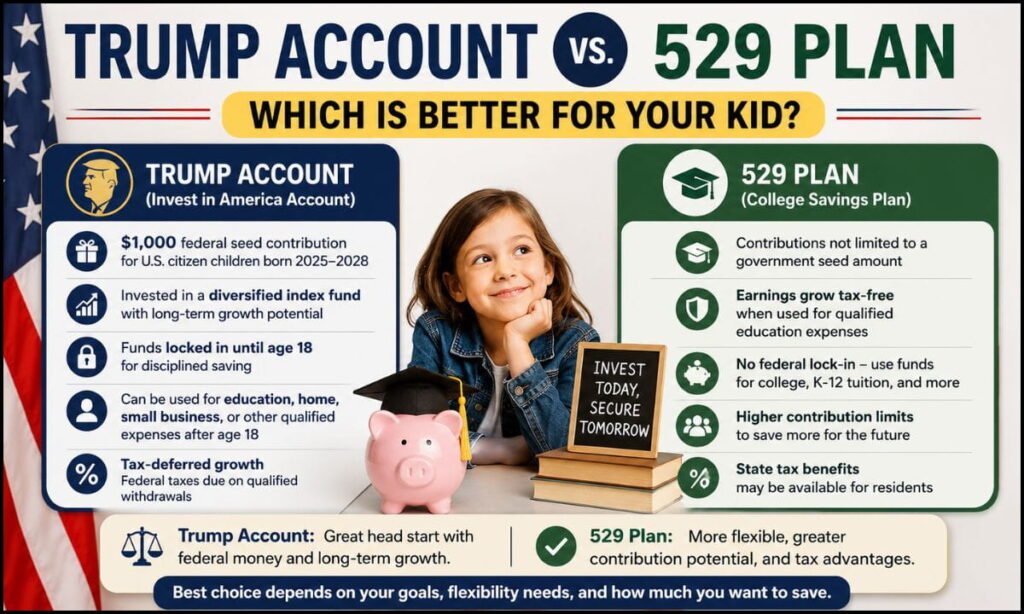
Trump Accounts vs. 529 Plans: Which Is Better?
529 plans remain the stronger choice for education-specific savings, thanks to state tax deductions and 100% tax-free qualified withdrawals for schooling costs. Trump Accounts, by contrast, are built for long-term, retirement-style growth from birth, with the standout advantage of not requiring any earned income — something no other retirement account offers a minor. Financial advisors generally recommend the two as complementary tools rather than substitutes, especially for families who can afford to contribute to both.
The Ongoing Debate: Should Enrollment Be Automatic?
With only about 39% of eligible children currently enrolled for the $1,000 deposit, pressure is building on Treasury to consider automatic enrollment. As of mid-July 2026, policy researchers — including analysts at the Urban Institute and the Annie E. Casey Foundation — are publicly pushing Treasury to auto-enroll eligible newborns by default, and to coordinate with state welfare agencies to include children in foster care through a dedicated enrollment window after court-appointed placement. Treasury has not yet announced a decision on automatic enrollment, but the SSA’s new hospital-based process (above) is widely seen as a first step in that direction.
Trump Accounts Links
| Official Portal (Registration & Login): | trumpaccounts.gov |
| Web App (No Mobile Device Needed): | trumpaccount.com |
| IRS Form 4547 (Election Form): | irs.gov |
| SSA Newborn Enrollment Info: | ssa.gov |
| Customer Support: | 1-866-USA-4547 |
| Home Page | https://govtschemes.org/ |
FAQs
What is a Trump Account?
A Trump Account is a federally created, IRA-style tax-advantaged savings account for children under 18, funded by an initial $1,000 government deposit for eligible newborns, plus optional family, employer, and charitable contributions.
Who qualifies for the $1,000 Trump Account deposit?
U.S. citizen children born between January 1, 2025, and December 31, 2028, with a valid Social Security number and an opened Trump Account.
Is every child automatically enrolled in a Trump Account?
No. As of July 2026, only about 1.4 million of the more than 6.5 million enrolled children are confirmed eligible for the $1,000 deposit, and enrollment still requires either filing Form 4547 or using the new SSA hospital-based process for newborns.
How do I check my child’s Trump Account status?
Log in at trumpaccounts.gov or through the Trump Accounts mobile/web app to view account activation and deposit status.
Can I contribute extra money to a Trump Account?
Yes — parents, relatives, friends, and employers can contribute up to a combined $5,000 per year per child, with employer contributions capped at $2,500/year within that total.
What happens to a Trump Account when the child turns 18?
It automatically converts into a standard traditional IRA, and regular IRA withdrawal rules and penalties apply from that point forward.
Are Trump Accounts better than a 529 plan?
Not necessarily better — they serve different purposes. 529 plans are optimized for education costs, while Trump Accounts are designed for long-term, retirement-style growth without an earned-income requirement.
What if my child was born before 2025?
They don’t qualify for the $1,000 federal deposit but can still have a Trump Account opened for private contributions, and may qualify for a separate $250 Dell Foundation deposit based on ZIP code income levels.