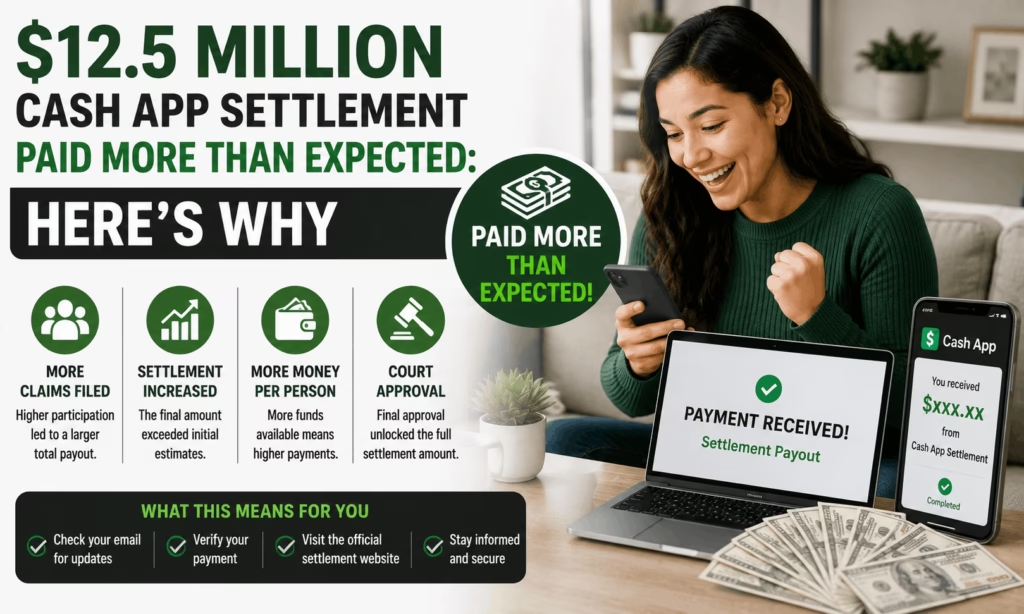
$12.5 Million Cash App Settlement: If you’ve seen a headline promising Cash App users “up to $147” from a class action settlement, that number is already out of date, and in a good way. The people who actually qualified for this settlement ended up getting far more than originally projected: $394.36 each, not $147. Here’s what actually happened, why the payout jumped so much higher than expected, and why this settlement only ever applied to a narrow group of people in one state, not Cash App users everywhere.
The case is Bottoms v. Block Inc., filed in Washington state, and it accused Block, the company behind Cash App, of sending unsolicited “Invite Friends” referral text messages without proper consent, a violation of Washington’s Commercial Electronic Mail Act. Block agreed to pay $12.5 million to resolve the claims without admitting wrongdoing. A judge granted the settlement final approval on December 2, 2025, and the first round of payments, $394.36 per approved claimant, started going out on February 2, 2026. A second round of payments from leftover settlement funds followed in July 2026.
Why the Payout Ended Up Nearly Triple the Original Estimate
When a class action settlement first gets proposed, lawyers usually publish a rough per-person estimate based on how many people they expect to file claims. For this case, that early estimate was somewhere between $88 and $147 per person. That figure is where a lot of the headlines still circulating online got stuck.
But class action payouts work on simple math: a fixed pool of money gets divided by however many valid claims actually get filed. Fewer people filed claims than the settlement administrator expected, so the leftover money got spread across a smaller group, pushing each approved claimant’s payment up to $394.36, well above the original high-end estimate. This is a fairly common pattern in class action settlements, and it’s one reason it’s worth checking a settlement’s final numbers rather than trusting whatever estimate first made headlines months earlier.
Who Actually Qualified, And Why Most People Didn’t
This is the detail that trips up the most people searching for this settlement. It was never open to every Cash App user nationwide. Eligibility was limited to people who lived in Washington state and received an unwanted Cash App referral text message between November 14, 2019, and August 7, 2025, without clearly and knowingly agreeing to receive it.
If you live outside Washington, or you never got one of those referral texts, you were never part of this particular case, regardless of how widely it got shared online. The claim deadline, October 27, 2025, has also been closed for close to a year now. If you didn’t file by then, there’s no active path to file a new claim for this specific settlement.
Missouri SNAP Food Ban Delayed: What’s Banned & Latest Status
Hawaii SNAP Soda Ban Delayed to 2027: What Will Be Banned & Status
Florida SNAP Junk Food Ban 2026: What’s Banned, Court Update, EBT Rules & Latest Status
Nevada SNAP Food Ban: What’s Banned & Start Date Explained
The Bigger Picture: Cash App Has Faced Several Separate Legal Actions
Part of why this settlement causes so much confusion is that it’s not the only Cash App legal matter that’s been in the news lately, and the numbers from different cases keep getting mixed together online. There are actually three distinct situations worth knowing apart from each other.
First, there’s this $12.5 million Washington text message settlement, the one covered above, with its $394.36 payments.
Second, there’s a separate and much larger $15 million nationwide data breach settlement, Salinas v. Block, tied to a 2022 incident involving a former employee accessing customer investment data, and a 2023 incident involving unauthorized access through recycled phone numbers. That case covered people nationwide whose accounts were affected between August 2018 and August 2024, offered up to $2,500 for documented losses, and its claim deadline closed back in November 2024. Payments in that case, averaging around $200 per approved claim, began going out in April 2025 and have continued since.
Third, there’s a federal action entirely separate from either class action. The Consumer Financial Protection Bureau reached a consent order with Block in January 2025 covering fraud-related complaint handling failures, requiring up to $120 million in consumer redress plus a $55 million penalty. Unlike the class actions, this doesn’t require filing a claim form at all, Block is required to identify and pay eligible users directly, and checks connected to that order have been mailing out since early June 2026.
Keeping these three straight matters, because a headline about one can easily get misread as applying to all Cash App users everywhere, when in reality each one has its own narrow group of eligible people.
A Scam Pattern Is Piggybacking on This Story
Here’s something genuinely worth flagging, and it’s a big reason this topic deserves a second look right now. As this settlement has circulated online, a wave of copycat “settlement help” websites and social posts has appeared, many of them urging people to call an unfamiliar phone number to “verify their 2026 payout status” or “check if their claim was approved.” Some of these pages repeat the same phone number dozens of times across otherwise generic, jumbled text that reads like it was written to game search results rather than to actually inform anyone.
This pattern matches a well-documented scam tactic: attaching fake “customer support” numbers to a real, newsworthy settlement so people searching for legitimate information get funneled toward a call where they may be asked for personal or financial details. Cash App and legitimate settlement administrators never require a phone call to a random number to check your status, and they will never ask for your PIN, sign-in code, or full Social Security number over an unsolicited call. If you’re trying to confirm your own claim status, go directly to the official settlement website tied to the specific case, not a phone number from a random blog post or social media ad.
Nebraska SNAP Food Ban Overturned: What’s Banned, Court Update & Latest Status
Ohio SNAP Food Ban starts October 1, 2026: What’s Banned, Court Update & Rules
Oklahoma SNAP Food Ban 2026: Latest Court Ruling, Restricted Items & Status
What To Do If You Think You Missed a Deadline
If you believe you were eligible for the Washington text message settlement but never filed, your options now are limited. You can contact the official settlement administrator directly through the settlement’s court-approved website to ask whether any exception applies, though late claims generally aren’t accepted once a deadline like this has passed.
If instead you’re a Cash App user who experienced actual fraud, unauthorized transactions, or account access issues, it’s worth checking whether the separate CFPB consumer redress process applies to you, since that program doesn’t require filing your own claim form and is meant to identify eligible users automatically.
FAQs
How much did the Cash App settlement actually pay per person?
Approved claimants in the Washington text message settlement received $394.36 each, well above the original $88 to $147 estimate, because fewer valid claims were filed than expected.
Who was eligible for the $12.5 million Cash App settlement?
Only people who lived in Washington state and received an unwanted Cash App “Invite Friends” referral text message between November 14, 2019, and August 7, 2025, without clearly consenting to receive it.
Can I still file a claim for this settlement?
No. The claim deadline was October 27, 2025, and that window has been closed for many months. New claims generally aren’t being accepted.
Is this the same as the $15 million Cash App data breach settlement?
No. That’s a separate, nationwide case covering 2022 and 2023 data security incidents, with its own deadline that closed in November 2024 and payments that began in April 2025.
Do I need to call a phone number to check my Cash App settlement status?
No, and you should be cautious of any website or ad urging you to call an unfamiliar number for this. Legitimate settlement status checks happen through the official, court-approved settlement website tied to the specific case, not through unsolicited phone numbers.
What if I experienced fraud on Cash App but never filed a claim in either lawsuit?
Look into the CFPB’s separate consumer redress process connected to its January 2025 order against Block, which is designed to identify and pay eligible users directly without requiring a new claim form.
Conclusion
The real story behind this settlement is actually good news for the people who qualified: they received nearly triple the amount originally projected. But the settlement was always narrow, limited to Washington residents who received specific unwanted text messages, and its filing window closed nearly a year ago. If you’re seeing this story resurface now, treat any promise of a new “$147 payout” as outdated, and be especially wary of anything asking you to call a number to “verify” your status, since that’s become a real scam pattern riding on this settlement’s popularity.
Official Sources
| Source | Link |
|---|---|
| Bottoms v. Block Inc. settlement (Washington text message case) | Case No. 2:23-cv-01969-MJP, U.S. District Court, Western District of Washington |
| Salinas v. Block Inc. and Cash App Investing settlement (data breach case) | cashappsecuritysettlement.com |
| CFPB consent order against Block, Inc. | consumerfinance.gov |
| Washington State Commercial Electronic Mail Act information | atg.wa.gov |
OAS Payment Increase August 2026: Confirmed Amounts, Payment Date, and the Annual GIS Reset !
Canada Pension Plan Payment August 27th, 2026: Who Will Receive CPP Benefits and How Much?