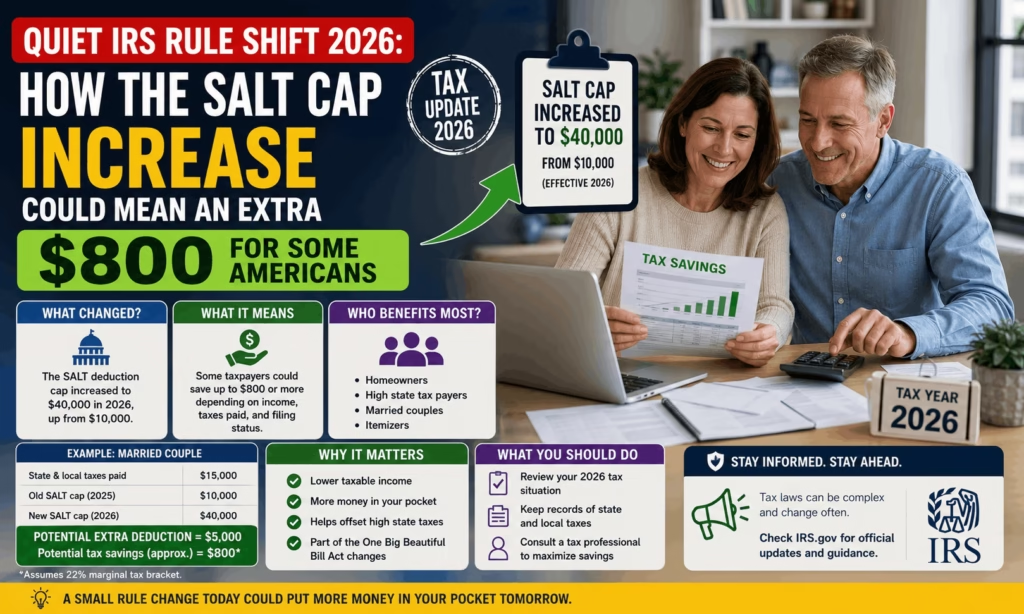
A quiet IRS rule shift for 2026 is putting real money back in the pockets of a specific group of taxpayers, and it barely made headlines when it happened. Buried inside the IRS’s routine annual inflation adjustments, confirmed through Revenue Procedure IR-2025-103, the State and Local Tax (SALT) deduction cap rose from $40,000 to $40,400 for tax year 2026, a small, one percent, automatically indexed increase required under the One Big Beautiful Bill Act (OBBBA). For itemizing homeowners in high-tax states who are near that cap, tax professionals estimate the change could translate into $400 to $800 in real tax savings, depending on their bracket, without a single new law being passed or a single headline being written about it. We’ll be updating this article monthly as the IRS releases further 2026 inflation adjustments and guidance.
This isn’t a payment that arrives automatically like a rebate check, it’s a deduction limit increase that only helps taxpayers who itemize and who live in states with high property or income taxes. This guide breaks down exactly who benefits, how the math works, why this specific change is easy to miss, and what other “quiet” 2026 IRS adjustments are worth knowing about alongside it. Every figure here is sourced directly from the IRS’s own 2026 inflation adjustments and the text of the OBBBA, not secondhand summaries.
Quiet IRS Rule Shift 2026 Key Highlights
| Item | Details |
|---|---|
| The “quiet” change | SALT deduction cap rises from $40,000 (2025) to $40,400 (2026) |
| Legal basis | One Big Beautiful Bill Act (OBBBA), signed July 4, 2025 |
| Type of adjustment | Automatic 1% annual inflation indexing (not a new law) |
| Estimated real savings | $400 to $800, depending on tax bracket, for those near the cap |
| Who benefits most | Itemizing homeowners in high-tax states (CA, NY, NJ, CT, IL) |
| MAGI phase-down threshold (2026) | $505,000 (single/joint); $252,500 (married filing separately) |
| Phase-down rate | Deduction reduced 30 cents per $1 of MAGI above the threshold |
| Floor after phase-down | Cap never drops below $10,000 ($5,000 MFS) |
| SALT cap reverts to $10,000 | Scheduled for 2030, unless Congress extends it |
| Filing deadline this affects | Returns for tax year 2026, filed in early 2027 |
| Also rising in 2026 | Standard deduction, tax bracket thresholds, retirement contribution limits |
What Exactly Changed, and Why Is It Called “Quiet”?
The SALT deduction cap allows itemizing taxpayers to deduct state and local income, sales, and property taxes from their federal taxable income, up to a set dollar limit. Before the OBBBA, that cap had been frozen at $10,000 since the 2017 Tax Cuts and Jobs Act, a limit that hit residents of high-tax states particularly hard. The OBBBA raised the cap dramatically to $40,000 for 2025, then built in a 1% annual inflation adjustment through 2029, pushing it to $40,400 for 2026. That 2026 bump is “quiet” specifically because it wasn’t a new act of Congress or a fresh policy debate, it’s a routine, formulaic inflation adjustment the IRS confirms every year alongside dozens of other number updates, easy to miss unless you’re specifically tracking your own itemized deductions.
2027 Social Security COLA Forecast: Latest Estimate, Medicare Offset & What Retirees Can Expect
How Does the Extra $400 in Cap Space Actually Turn Into $800 in Savings?
This is the part that trips people up: raising the cap by $400 doesn’t hand anyone a flat $400 check, the actual dollar benefit depends on your marginal tax bracket, since a larger deduction only saves you the percentage of tax you’d otherwise owe on that income. For example:
| Tax Bracket | Extra $400 Deduction Saves You |
|---|---|
| 22% bracket | ~$88 |
| 24% bracket | ~$96 |
| 32% bracket | ~$128 |
| 35% bracket | ~$140 |
On its own, the $400 cap increase alone doesn’t reach $800 for most people, the widely cited “$400 to $800” range reflects the combined effect of the higher SALT cap working alongside the broader jump from the old $10,000 cap to $40,000+ that many high-tax-state itemizers are only now fully benefiting from as they adjust withholding and itemization strategy for 2026, plus interaction with other inflation-adjusted 2026 figures. In practice, taxpayers closest to fully utilizing the cap, with $30,000 to $40,000+ in actual state and local tax liability, see the most meaningful year-over-year movement.
Who Actually Qualifies for This Benefit?
Not everyone. This change specifically helps taxpayers who meet all of these conditions:
- You itemize deductions rather than take the standard deduction (most filers now take the standard deduction, so this doesn’t apply to them at all)
- You live in a high-tax state, commonly cited examples include California, New York, New Jersey, Connecticut, and Illinois, where combined state income and property taxes frequently exceed the old $10,000 cap
- Your actual state and local tax burden is close to or above $40,000, since the cap increase only matters if you were previously bumping up against the limit
- Your Modified Adjusted Gross Income (MAGI) is below the phase-down threshold, discussed next, since high earners lose much or all of this benefit
What Is the SALT “Phase-Down,” and Could It Cancel Out Your Benefit?
This is the detail most “quiet rule shift” headlines skip entirely, and it matters. The expanded SALT cap is not available in full to high earners. For 2026, once your Modified Adjusted Gross Income (MAGI) exceeds $505,000 (or $252,500 for married filing separately), your SALT deduction cap is reduced by 30 cents for every dollar of income above that threshold. This phase-down continues until the deduction bottoms out at the original $10,000 floor ($5,000 MFS), meaning very high earners effectively get little to no benefit from the higher cap at all, regardless of how much state and local tax they actually pay. Some tax professionals refer to the sharp effective tax-rate increase that can occur right around this phase-down zone as a “SALT torpedo,” since a relatively small increase in income near the threshold can trigger a disproportionately large loss of deduction value.
Is the SALT Cap Increase Permanent?
No. While the OBBBA made the existence of a SALT deduction cap increase permanent law (as opposed to a temporary provision requiring renewal), the specific elevated amount is scheduled to expire. The cap rises modestly each year through 2029, then reverts back down to the original $10,000 limit ($5,000 MFS) starting in 2030, unless Congress passes new legislation to extend or adjust it before then. Anyone planning around this benefit long-term should treat the current higher cap as a multi-year window, not a permanent fixture of the tax code.
What Other “Quiet” IRS Changes Are Rolling Out Alongside This One?
The SALT cap adjustment isn’t the only under-the-radar 2026 update. Several other inflation-adjusted figures shifted at the same time, without much individual fanfare:
- Standard deduction increase: $16,100 for single filers (up from $15,750), $32,200 for married filing jointly (up from $31,500), and $24,150 for heads of household (up from $23,625)
- Tax bracket threshold increases: for example, the top 37% bracket now starts at $640,600 for single filers, up from the prior year, reducing “bracket creep” for taxpayers whose income rose with inflation
- Retirement contribution limits: the 401(k) elective deferral limit rises to $24,500 (up from $23,500), and the IRA contribution limit rises to $7,500
- Catch-up contributions: workers aged 60 to 63 get a special, temporarily higher catch-up contribution limit of $35,750 for 401(k) plans, though catch-up contributions for high earners must now be made as Roth contributions starting in 2026
- Child Tax Credit: made permanent at $2,200 per qualifying child under OBBBA, indexed for inflation going forward
Centrelink Double Payment Alert – $1678 Centrelink Advanced Pension Payment 2026 Available Now!
When Can I Claim My UK State Pension? UK State Pension Age Changes Explained (2026 Update)
Why Are 2026 Tax Refunds Also Expected to Be Larger?
Separately from the SALT cap specifically, tax analysts, including the Tax Foundation, have projected that average tax refunds in 2026 could run roughly $1,000 higher than in prior years. The reason ties back to IRS withholding tables: because the IRS didn’t fully update paycheck withholding tables to reflect all of the OBBBA’s new deductions, including the SALT cap increase, the new senior deduction, and deductions for qualified tips and overtime pay, many workers effectively overpaid throughout the year and are now positioned for a larger-than-usual refund when they file.
What Should You Do to Actually Capture This Benefit?
- Check whether itemizing now beats the standard deduction for your situation, since the higher SALT cap may tip the math in favor of itemizing for the first time in years for some high-tax-state homeowners
- Calculate your actual MAGI against the $505,000 phase-down threshold before assuming you’ll get the full benefit
- Review your state and local tax total (income or sales tax, plus property tax) to see how close you are to the new $40,400 ceiling
- Adjust your withholding if you expect a significantly different refund or liability due to these combined changes
- Consult a tax professional if you’re near the phase-down zone, since the “SALT torpedo” effect can create unexpected results right around that income level
Official Resources & Status Check Links
| Resource | Purpose | Official Link |
|---|---|---|
| IRS – 2026 Inflation Adjustments | Official source for all 2026 tax figures, including the SALT cap | irs.gov (Revenue Procedure/IR-2025-103) |
| IRS Individual Online Account | Check your tax records, payments, and notices | irs.gov/your-account |
| IRS – Schedule A Instructions | Official guidance on itemizing state and local tax deductions | irs.gov (Form 1040 Schedule A instructions) |
| IRS – Where’s My Refund? | Check your federal tax refund status | irs.gov/wheres-my-refund |
| IRS – Get Ready Campaign | Official 2026 filing season preparation resources | irs.gov/getready |
FAQs
What is the quiet IRS rule shift for 2026?
It refers to the SALT deduction cap rising from $40,000 to $40,400 for 2026, a routine inflation adjustment under the One Big Beautiful Bill Act that received little media attention compared to other tax changes.
Who actually gets an extra $800 from this change?
Primarily itemizing homeowners in high-tax states with state and local tax bills near or above $40,000 and Modified Adjusted Gross Income below the $505,000 phase-down threshold; it does not apply to standard deduction filers.
Is the SALT cap increase the same for everyone?
No, it phases down for high earners once MAGI exceeds $505,000 (2026), reducing the benefit by 30 cents per dollar of excess income until it hits a $10,000 floor.
Will the higher SALT cap last forever?
No, it’s scheduled to revert to the original $10,000 cap starting in 2030 unless Congress passes new legislation before then.
Do I need to apply for this SALT cap benefit?
No, it’s automatically available to anyone who itemizes deductions and claims state and local taxes on Schedule A when filing their federal return.
What is the “SALT torpedo”?
A term describing the sharp, disproportionate loss of deduction value that can occur for taxpayers whose income falls just above the $505,000 phase-down threshold.
Are tax refunds expected to be bigger in 2026 because of this?
This specific change is one contributing factor among several; analysts project average refunds could run about $1,000 higher overall due to a combination of new OBBBA deductions and withholding table timing.
What other IRS numbers changed quietly for 2026?
The standard deduction, income tax bracket thresholds, 401(k) and IRA contribution limits, and the Child Tax Credit amount all received inflation-based increases alongside the SALT cap.
Does this affect my 2025 tax return or my 2026 return?
The $40,400 SALT cap applies to tax year 2026, meaning it affects the return you’ll file in early 2027, not the return due in April 2026 for tax year 2025.
Where can I confirm the exact current SALT cap and phase-down numbers?
Check the IRS’s official 2026 inflation adjustment guidance directly at irs.gov rather than relying on secondhand estimates, since phase-down thresholds are also indexed and will shift again in future years.
Conclusion
The “quiet IRS rule shift” behind the extra $400 to $800 in potential savings for 2026 isn’t a mystery or a rumor, it’s a real, confirmed, if modestly sized, inflation adjustment to the SALT deduction cap, rising to $40,400 under the One Big Beautiful Bill Act. Its real-world impact is genuinely uneven: meaningful for itemizing homeowners in high-tax states sitting below the $505,000 MAGI phase-down threshold, and essentially irrelevant for standard deduction filers or very high earners caught in the “SALT torpedo” zone. Because this cap is scheduled to keep rising slightly each year through 2029 before reverting to $10,000 in 2030, taxpayers who stand to benefit should factor this shrinking window into their broader tax planning, and check the IRS’s own official figures directly rather than relying on a single viral estimate of “$800.”
Also Read
$2969 Social Security Benefit 2026 Eligibility, How to Apply & Fact Checked
$1508 CPP Payment 2026: Next Deposit July 29, Full Schedule & Eligibility Fact-Check