The $1800 BABY Benefit is real, it is already being paid, and it is not a federal or IRS program. New York State’s Office of Temporary and Disability Assistance has been issuing the one-time payment since November 5, 2025, to families who receive ongoing public assistance when a baby is born. The name stands for Birth Allowance for Beginning Year. The amount is $1,800 per child, so twins would bring $3,600, and the money is unrestricted, meaning parents can spend it on diapers, rent, a car seat or anything else the baby needs. There is no separate application and no income form. What matters is whether the family was already on public assistance when the child was born and whether the newborn is added to the case in time. We will be updating this article monthly.
That last condition is where families can lose the payment, and it is why this guide matters now. The state’s own directive says a newborn must be added to an active public assistance case with all paperwork supplied within 90 days of birth, and a family that provides documents on the 91st day is out. Online posts have muddied the picture with claims about IRS deposits, nationwide payments, tax-season rollouts and mid-2026 application windows that the official directive does not support. Here is what the state actually says, who qualifies, how the money arrives, how it affects SNAP and other benefits, and how it compares with other baby-related payments, including New York’s expanded child tax credit and the federal $1,000 Trump Account deposit.
$1800 BABY Benefit Key Highlights
| Item | Detail |
|---|---|
| Program name | Birth Allowance for Beginning Year (BABY) Benefit |
| Who runs it | New York State Office of Temporary and Disability Assistance, through local social services districts |
| Payment amount | One-time $1,800 per child, including each baby in a multiple birth |
| Effective date | November 5, 2025 |
| Eligible births | Children born on or after November 5, 2025 |
| Who qualifies | Families receiving ongoing public assistance in New York when the baby is born |
| Key deadline | Newborn added to the case, with all documents provided, by the baby’s 90th day |
| Separate application | None, the benefit is issued through the existing case |
| How the money is spent | Unrestricted cash |
| Payment method | Check mailed or EBT deposit, depending on district and system |
| Not eligible | Families not on ongoing public assistance at birth, including emergency housing only |
| Legal basis | Social Services Law 131-a and 18 NYCRR 352.7(l), explained in 25-ADM-07 |
What Is the $1,800 BABY Benefit?
New York’s budget for the 2025 to 2026 fiscal year created the benefit, and Governor Kathy Hochul announced the launch on November 24, 2025, calling it a way to help the most vulnerable new parents cover baby essentials. The state’s stated goals are to reduce childhood poverty and improve infant health. It is one piece of a larger family package that the governor’s office valued at $2.2 billion.
The key idea is that this is a cash grant tied to an existing benefit case. A family that already receives public assistance, which in New York means the cash programs run by local social services districts, gets an additional lump sum when a baby is added to that case. Think of it as a birth bonus on top of the regular monthly grant, not a replacement for it.
Social Security COLA 2027 for Seniors Could Get Nearly $200 More Per Month
GOP Convention Fact-Check: What Held Up and What Didn’t From the Dallas Midterm Convention
Who Qualifies for the $1,800 BABY Benefit in New York?
The OTDA directive is specific. To qualify, a family must meet each of these conditions.
- The family lives in New York and is actively receiving ongoing public assistance when the child is born.
- The child was born on or after November 5, 2025.
- The newborn is added to the existing public assistance case.
- All documents needed to add the baby are provided before the baby turns 91 days old, unless the district finds good cause for a delay.
The directive lists documents that districts may require to add a newborn: proof of birth, proof of citizenship, an application for a Social Security number, and cooperation with child support enforcement where appropriate. Families should expect to supply those items quickly.
Several situations are covered in the directive’s examples. A parent who receives Supplemental Security Income and also has an active public assistance case qualifies. A sanctioned parent whose case is still active also qualifies. A noncitizen parent, a grandparent or a relative caretaker who is the payee on an active case can also receive it. In each case, the test is that the family was on ongoing public assistance when the baby was born.
Who Does Not Qualify
The state drew the line firmly, and it catches families who might assume they are covered.
A family that was not receiving ongoing public assistance at the time of birth is not eligible, even if the family would have qualified for assistance at that time and applies right after the baby arrives. Emergency housing help also does not count as ongoing public assistance. A family living in a temporary housing shelter without an ongoing assistance case, for example, would not qualify under the directive’s examples.
The directive also says nothing that would make households qualify based only on SNAP, Medicaid or WIC enrollment. Some websites say otherwise, but the official guidance ties the benefit to public assistance, so anyone relying on another program should confirm with their local social services district before counting on it.
Born Before November 5, 2025? What Happens to Earlier Births
The benefit applies only to children born on or after November 5, 2025. The state’s payment system blocks the payment for any child with an earlier birth date. A baby born in October 2025 does not qualify, even if the family was on assistance the whole time. Online posts that suggest retroactive payments for births earlier in 2025 or for any baby born during the full fiscal year are not backed by the directive.
How to Get the $1,800 BABY Benefit: No Application, But Act Fast
There is no separate form for this benefit. What families need to do is get the baby onto their public assistance case. The practical steps look like this.
- Tell your caseworker or local social services district about the birth as soon as possible.
- Provide proof of the baby’s birth, such as a birth certificate or hospital record.
- Provide proof of citizenship and an application for a Social Security number for the baby.
- Cooperate with child support steps if they apply to your case.
- Submit everything before the baby reaches 91 days old. The state allows documents to be submitted by mobile upload using its document submission tools, so a phone photo can do the job.
- Keep copies and note the date you submitted each item.
The directive also tells district staff that if they learn of a birth on an open case, they must tell the family they can get the benefit and help them finish any missing steps. Even so, families should not wait to be contacted. If you are unsure whether your case counts as ongoing public assistance, call your district office, or in New York City, use the city’s benefits portal and contact center.
Processing Time: How Long Until the Money Arrives?
The directive does not give a fixed number of days. It instructs districts to issue the payment when the baby is added to the case, and it says that if the baby could not be added within 90 days because of district processing delays, the payment must still be made once the baby is added, so long as the family provided everything on time. In other words, the clock that matters to families is the 90-day documentation deadline. How quickly the check or EBT deposit follows depends on how fast the district processes the case.
Some websites claim a payment arrives within 60 days or that payments only started in mid-2026 after an application window opened. The directive does not say either. Treat those timelines as unconfirmed, and ask your district for the date it processed your baby’s addition to the case.
Payment Schedule: One Payment, Not Monthly
The BABY Benefit is a single payment, not a recurring check. It is issued once for each eligible child. If a family has twins or triplets, each baby gets a separate $1,800 payment. The state’s payment code for the benefit, a one-time allowance for the birth of a new child, can only be issued once per child.
| Question | Answer from the State Directive |
|---|---|
| How many payments? | One per eligible child |
| Amount? | $1,800 |
| Is it restricted? | No, it is unrestricted cash |
| How is it delivered? | Mailed check or EBT, depending on the system and district |
| Who can receive it? | The public assistance payee, including SSI parents, relative caretakers and sanctioned parents with an active case |
| What is the age limit? | The system allows payment for a child up to age one, but the 90-day documentation rule still applies |
Will the $1,800 Affect SNAP, Medicaid or Other Benefits?
The directive addresses this directly. For SNAP, one-time lump sum payments are excluded as income, so the $1,800 should not reduce a household’s monthly SNAP allotment. It can count as a resource in the month received, but most New York SNAP households are not subject to a resource test under the state’s broad-based categorical eligibility rules. Households with a sanctioned or disqualified member, or with an older or disabled member and income above 200 percent of the federal poverty level, may still face a resource test, so those families should ask their district.
For the Home Energy Assistance Program, the payment is excluded from income and any remaining balance is not counted as a liquid resource. The directive does not discuss Medicaid, WIC or child care assistance in detail, so families receiving those programs should ask the relevant office rather than assume. Federal and state rules for each program can differ.
$1,800 BABY Benefit vs. Other Baby Payments Families Ask About
The $1,800 is not the only baby-related money in the news. The three programs below are separate and have different rules. Mixing them up is one of the most common sources of confusion.
| Program | Amount | Who Runs It | Who Qualifies | How You Get It |
|---|---|---|---|---|
| BABY Benefit | $1,800 one time per child | New York OTDA | Families on ongoing public assistance with a baby born on or after Nov. 5, 2025 | Add the baby to your case within 90 days |
| Empire State Child Credit | Up to $1,000 per child under 4, up to $330 for ages 4 to 16 in 2026 | New York Tax Department | Eligible New York families filing a return | Claim on your state tax return |
| Trump Account pilot deposit | One-time $1,000 | U.S. Treasury and IRS | U.S. citizen children born from 2025 through 2028 | Elect on IRS Form 4547 |
| Federal Child Tax Credit | Up to $2,200 per child under the 2025 tax law | IRS | Qualifying children with a valid Social Security number | Claim on your federal return |
A family can potentially receive more than one of these at the same time, because they are separate programs. The BABY Benefit is the only one that is tied to public assistance and delivered outside the tax system.
New York’s Expanded Child Tax Credit for Babies and Toddlers
For families in New York who file taxes, the expanded Empire State Child Credit may be worth more than the one-time grant over a child’s early years. Governor Hochul’s office said that starting with 2026 filings, families can claim up to $1,000 per child under age four, and up to $330 per child ages 4 to 16. In 2027, the credit for children ages 4 to 16 rises to $500.
The state says the expansion doubles the average credit from $472 to $943, removes the minimum income requirement so the poorest families can claim the full refundable credit, and will help more than 2.75 million children. As an example from the state, a family of four with a toddler and a school-age child earning up to $110,000 would receive $1,500 a year. Families should claim it on their normal state return, and the New York Tax Department has the current forms.
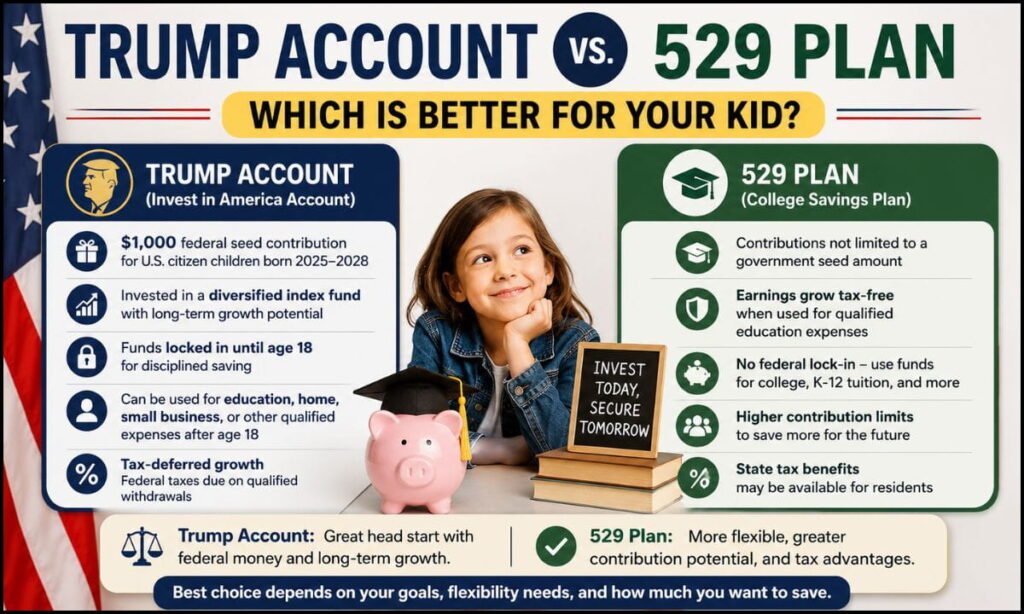
The Federal $1,000 Baby Deposit: Trump Accounts and Form 4547
The federal government has its own baby-related deposit, but it works very differently. Under the 2025 tax law, children born from 2025 through 2028 can receive a one-time $1,000 pilot contribution into a Trump Account, a new tax-deferred savings account for children. It is not automatic. A parent or guardian has to open the account by filing IRS Form 4547 with a tax return or through an online option, and the child needs a valid Social Security number and must be a U.S. citizen.
Contributions to Trump Accounts could not begin before July 4, 2026, which means the $1,000 could not be deposited earlier. There is a $5,000 annual cap on contributions from family members and some employers, and the $1,000 pilot deposit does not count toward that cap. There are no income limits. The money is locked in the account until the child reaches 18, so unlike the BABY Benefit, it is not available for diapers or rent. The IRS has the instructions for Form 4547.
Common Mistakes That Cost Families the $1,800
Social services workers and benefit advocates see the same errors repeatedly. Families wait too long to report the birth and miss the 90-day cutoff. They submit proof of birth but leave out the Social Security number application or proof of citizenship. They assume an emergency housing placement counts as ongoing assistance. They apply for public assistance after the baby arrives and expect a payment for a birth that already happened. And they fall for websites that promise a federal check or ask for fees and personal information to claim the grant. The BABY Benefit is free, and no private company is needed to claim it.
How to Avoid BABY Benefit Scams and Misinformation
Because the benefit has attracted so much attention online, scammers have followed. Be cautious of any message that says you can claim $1,800 from the IRS, that asks for a fee, that requests your bank login, or that tells you to click a link to “unlock” payment. The state handles this benefit through your local social services district and your existing benefit case. If you receive a text or call that does not come through an official channel, do not respond, and contact your district directly. You can report suspected fraud to the New York State Attorney General or the Federal Trade Commission.
FEHB Open Season 2027 Dates: November 9 to December 14, Premiums Up 10.9% and What to Do Now
Federal Pay Freeze 2027: Who Gets No Raise and Who Gets 3.8%
What Might Change Next for the BABY Benefit
The directive describes the benefit as one-time and permanent in the current rules, but it carries no expiration date in the document we reviewed. State budgets can change, and advocates have called for wider eligibility and higher amounts. Any change would need to come through the state budget or a new directive from OTDA. We will update this article if the state announces changes to eligibility, the amount, or the 90-day deadline.
NY BABY Benefit Eligibility Checker
The free eligibility checker that comes with this article lets you enter your baby’s date of birth, the number of babies born, and whether you were receiving ongoing public assistance at the time of birth. It tells you whether the baby is old enough to qualify, how much you could receive, and the last day to submit documents under the 90-day rule. It is a planning aid and not an official decision. Only your local social services district can confirm eligibility.
NY BABY Benefit Eligibility Checker
Estimate whether a baby may qualify for New York’s one-time $1,800 BABY Benefit and find the 90-day documentation deadline.
| Born on or after November 5, 2025? | – |
| On ongoing public assistance at birth? | – |
| Last day to provide documents (90 days) | – |
| Days left to provide documents | – |
| Documents provided in time? | – |
| Possible payment | – |
Official Resources and Links for the BABY Benefit
| Resource | Use It For | Official Link |
|---|---|---|
| NYS Office of Temporary and Disability Assistance | Program information and policy | https://otda.ny.gov |
| 25-ADM-07 directive | The state’s official BABY Benefit rules | https://otda.ny.gov/policy/directives/2025/ADM/25-ADM-07.pdf |
| myBenefits.ny.gov | Apply for and manage benefits online, upload documents | https://mybenefits.ny.gov |
| ACCESS HRA (New York City) | NYC residents manage public assistance cases | https://access.nyc.gov |
| Governor’s announcement | The November 24, 2025 launch release | https://www.governor.ny.gov/news/money-your-pockets-governor-hochul-highlights-new-affordability-initiatives-families-and |
| NYS Department of Taxation and Finance | Empire State Child Credit forms and guidance | https://www.tax.ny.gov |
| IRS Form 4547 | Open a Trump Account and claim the $1,000 deposit | https://www.irs.gov/form4547 |
| Trump Accounts portal | Account setup information | https://trumpaccounts.gov |
| IRS Child Tax Credit | Federal credit rules | https://www.irs.gov/credits-deductions/individuals/child-tax-credit |
| Federal Trade Commission | Report scams | https://reportfraud.ftc.gov |
FAQs About the $1800 BABY Benefit
What is the $1,800 BABY Benefit?
It is a one-time payment of $1,800 per child from New York State for families receiving ongoing public assistance when a baby is born. BABY stands for Birth Allowance for Beginning Year.
Is the $1,800 BABY Benefit a federal or IRS payment?
No. It is a New York State benefit run by the Office of Temporary and Disability Assistance. The IRS does not issue it.
When did the BABY Benefit start?
The rules took effect on November 5, 2025, and apply to children born on or after that date.
Do I have to apply separately?
No. The payment is issued through your existing public assistance case once the baby is added, but you must provide the required documents within 90 days of birth.
Can I get $1,800 if I only receive SNAP or Medicaid?
The state directive ties the benefit to ongoing public assistance and does not list SNAP-only or Medicaid-only households as eligible. Confirm with your local social services district.
Do twins get $1,800 each?
Yes. The directive says each newborn in a multiple birth is entitled to a separate $1,800 payment.
Will the payment reduce my SNAP benefits?
The state says one-time lump sum payments are excluded as income for SNAP, so it should not reduce your monthly allotment.
Can I spend the money on anything?
Yes. The payment is unrestricted cash and parents decide how to use it.
Who is eligible for the $1,800 baby bonus in New York?
Families who live in New York, receive ongoing public assistance when the baby is born, have a baby born on or after November 5, 2025, and add the newborn to the case within 90 days.
How long do I have to report my baby to get the benefit?
You have until the baby reaches 90 days old to provide all required documents. Providing them on the 91st day makes the case ineligible unless the district finds good cause.
Does the $1,800 baby benefit count as income?
For SNAP and the Home Energy Assistance Program, the state excludes it as income. Check with your district for any other program you receive.
Is there a federal baby bonus in 2026?
There is a one-time $1,000 deposit for eligible children born from 2025 through 2028 into a Trump Account, which you claim using IRS Form 4547. It is a savings account deposit, not cash for everyday expenses.
Can I get the baby benefit if I was in a shelter when my baby was born?
Emergency housing assistance by itself is not ongoing public assistance under the directive, so you would likely not qualify unless you also had an active ongoing assistance case.
How much is New York’s child tax credit for babies?
Up to $1,000 per child under 4 for the 2026 filing season, according to the governor’s office. Families claim it on their state tax return.
Where do I report a birth to my public assistance case?
Contact your local social services district, or use myBenefits.ny.gov or the New York City benefits portal if you live in the city.
Conclusion: What New Parents Should Do Right Now
The $1,800 BABY Benefit is a small but meaningful boost for New York families on public assistance, and the rules are simpler than the rumor mill suggests. It is a state payment, it requires no separate application, it applies to births on or after November 5, 2025, and it depends on getting the baby added to an active case with all documents in within 90 days.
If you are expecting or just had a baby, call your caseworker or district office immediately, gather the birth record, citizenship proof and Social Security application, and keep proof of when you submitted them. Then look at the other programs that may apply, including New York’s expanded child credit and the federal Trump Account deposit, since they work separately and can add up. Confirm everything on the official links above, and we will keep updating this guide as the state releases new information.
Social Security COLA by State: Which Retirees Get the Biggest 2027 Raise and Why?
Trump $90 Medicare Check: Who Qualifies, When It Arrives and Why $2 Billion Is Being Redirected?