Canada Investment Summit 2026: Hundreds of the world’s biggest investors descended on Toronto this week for the Canada Investment Summit 2026, a first-of-its-kind, government-hosted gathering built around Prime Minister Mark Carney’s pledge to catalyze $1 trillion in total investment across the country over the next five years. The two-day event, held September 14–15 at a downtown Toronto hotel and co-hosted with two of Canada’s largest pension funds, brought together names like BlackRock CEO Larry Fink, Blackstone President Jonathan Gray, and former Prime Minister Stephen Harper now chair of Alberta’s AIMCo pension fund alongside a roster of Canadian energy, infrastructure, and financial executives.
But the summit’s opening gala at the Art Gallery of Ontario on Monday evening wasn’t the only gathering in Toronto that night. Hundreds of demonstrators including Indigenous leaders, labour unions, and climate and housing advocates marched through downtown Toronto to protest outside the event, arguing the summit hands Canada’s economic future to corporate executives while sidelining the communities most affected by the megaprojects being pitched inside. The clash between a triumphant government pitch and a visible street-level backlash defined the summit’s opening night, and it’s a tension likely to keep shadowing Carney’s nation-building agenda well past this week. We’ll be updating this article monthly as investment commitments, project decisions, and reaction to the summit continue to develop.
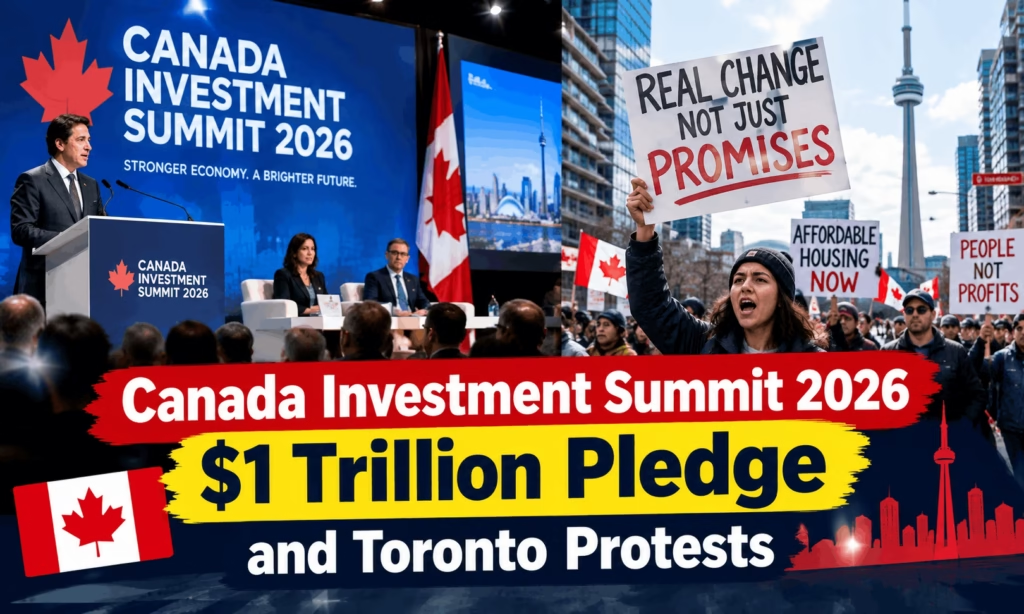
Canada Investment Summit 2026
The Canada Investment Summit is described by the federal government as the first gathering of its kind in Canadian history — a two-day forum explicitly designed to convene global capital rather than simply promote trade in the abstract. It was co-hosted by Prime Minister Carney alongside the Canada Pension Plan Investment Board (CPP Investments) and the Public Sector Pension Investment Board (PSP Investments), two of the country’s largest institutional investors, whose global networks were used to help assemble the guest list.
Canada Investment Summit 2026 Key Highlights
| Detail | Information |
|---|---|
| Dates | September 14–15, 2026 |
| Location | Toronto, Ontario (downtown hotel; opening gala at the Art Gallery of Ontario) |
| Host | Prime Minister Mark Carney, with CPP Investments and PSP Investments |
| Stated investment goal | $1 trillion in total investment over five years (starting September 2025) |
| Government’s direct contribution to the goal | Approximately $280 billion in capital investments and incentives to attract private and institutional capital |
| Investment secured before the summit | Approximately $97 billion in foreign investment commitments and 20+ new economic/defense partnerships since September 2025 |
| Focus sectors | Defence, major infrastructure, Indigenous partnerships, technology, energy, critical minerals, food and agricultural resilience |
| Notable attendees | Larry Fink (BlackRock), Jonathan Gray (Blackstone), C.S. Venkatakrishnan (Barclays), Stephen Harper (AIMCo chair) |
| Trade access cited by organizers | 16 free trade agreements covering 51 countries and roughly 1.5 billion consumers |
| Protest turnout | Hundreds of demonstrators, including Indigenous leaders, labour unions, and climate/housing advocates |
Why Carney Is Betting So Big on This Summit?
The summit didn’t emerge in isolation — it’s the centerpiece of a broader federal push announced back in April 2026, when Carney first unveiled the event as part of a national strategy to strengthen Canada’s economic resilience amid trade tensions with the United States. Organizers framed the trillion-dollar target as achievable specifically because of Canada’s existing advantages: a large base of natural resources and energy production, a skilled workforce, a comparatively stable fiscal position, and preferential trade access through 16 existing free trade agreements.
To help close that gap between ambition and reality, the government has also rolled out new fiscal tools ahead of the summit, including a Productivity Super-Deduction designed to make Canada more tax-competitive for large capital investments, alongside a broader trade-diversification plan intended to reduce the country’s economic reliance on any single trading partner — a policy priority that has taken on new urgency given ongoing trade friction with the United States.
SNAP Benefits Increase: New FY2027 Maximum Amounts & Free Calculator
What Was Actually Pitched at the Summit?
While summit organizers were reportedly reluctant to publicly confirm the full list of projects being pitched to investors ahead of time, reporting on the event’s prospectus and agenda makes clear that energy megaprojects sat near the top of the list. Among the most prominent: the Ksi Lisims LNG terminal and the associated Prince Rupert Gas Transmission (PRGT) pipeline in northern British Columbia, both of which the prime minister added to the federal Major Projects Office’s list of nationally significant projects eligible for fast-tracked approval. Industry analysts have said Ksi Lisims is expected to reach a final investment decision sometime in 2026, with LNG Canada Phase 2 expected to face a similar decision by year’s end.
Beyond LNG and pipelines, the summit’s stated sector focus extended into critical minerals, artificial intelligence and advanced manufacturing, defence procurement, and food and agricultural resilience — a deliberately broad net meant to give the assembled investors multiple entry points into the Canadian economy rather than a single narrow pitch.
Sectors and Projects Featured at the Summit
| Sector | Notable Project or Focus |
|---|---|
| Energy / LNG | Ksi Lisims LNG terminal, Prince Rupert Gas Transmission pipeline, LNG Canada Phase 2 |
| Critical minerals | Domestic mining and processing capacity expansion |
| Defence | New procurement and manufacturing partnerships |
| Technology | Artificial intelligence and advanced manufacturing investment |
| Infrastructure | Major nation-building infrastructure projects |
| Agriculture | Food and agricultural resilience initiatives |
The Protests: Why Indigenous Leaders and Advocacy Groups Pushed Back
The summit’s economic pitch ran directly into organized opposition from the moment its opening gala began. Demonstrators gathered for a downtown rally that grew as it moved toward the Art Gallery of Ontario, chanting and drumming behind signs calling for investment in healthcare, housing, and the environment rather than the corporate and resource-sector deals being negotiated inside. Protest organizers said their objection wasn’t to investment itself, but to a model that puts the country’s economic direction primarily in the hands of CEOs and asset managers.
Wet’suwet’en Hereditary Chief Na’Moks, addressing the crowd, argued that Carney has leveraged the ongoing U.S. trade dispute to build political momentum behind the major projects agenda, and that Indigenous communities whose territories are directly affected by projects like Ksi Lisims and the PRGT pipeline haven’t been meaningfully included as partners in the decisions being made about their land. Separately, a spokesperson for the youth advocacy group Common Horizon said the concern among younger demonstrators wasn’t opposition to investment broadly, but specifically to spending directed toward artificial intelligence, military contracts, and fossil fuel infrastructure over other priorities.
The Government’s Response to Indigenous Concerns
The Carney government’s posture toward Indigenous opposition has shifted noticeably since the sharper backlash it faced roughly a year earlier, when it pushed through legislation to accelerate approval of major projects. Ahead of this week’s summit, the Prime Minister’s Office specifically invited leaders of Canada’s three national Indigenous organizations to a reception the evening before the main summit began, and several Indigenous business leaders attended, including First Nations Bank President and CEO Bill Lomax, First Nations Major Projects Coalition CEO Mark Podlasly, and First Nations Financial Management Board Deputy CEO Scott Munro.
At that Sunday reception, Carney told attendees his government is working in partnership with Indigenous groups to get major projects built rather than proceeding without their involvement — a message that stood in visible tension with the protest that unfolded just one day later outside the summit’s own opening event, underscoring how unresolved the underlying disagreement remains even as outreach efforts have increased.
Trump’s $5000 Dividend: Is It a Bribe If Americans Never Get Paid?
Is Trump Bribing Voters? $500 Obamacare Rebate After $5000 Dividend
Security and Police Response
Toronto Police confirmed it had prepared specifically for demonstrations tied to the summit, with plans in place to manage public safety while minimizing disruption to the broader city. Officials also announced airspace restrictions around the summit site, with drones deployed to monitor the area throughout the two-day event. In a public statement issued the morning of the protest, police reminded demonstrators that the right to protest doesn’t extend to violence, threats, or property damage — a standard advisory ahead of a large public demonstration rather than a response to any specific incident reported at the rally itself.
How the $1 Trillion Goal Is Structured?
Understanding the summit’s headline number requires separating two distinct pieces of the government’s plan. Of the full $1 trillion target, approximately $280 billion is expected to come directly from federal capital investments and incentives — tools like the Productivity Super-Deduction and direct funding commitments — specifically designed to attract the remaining, much larger share from private investors, pension funds, and institutional capital sources like the ones represented at this week’s summit. The roughly $97 billion in foreign investment commitments and more than 20 new economic and defence partnerships secured since September 2025 represent early progress toward that combined total, though it leaves a substantial gap to close over the remaining four years of the five-year window.
Investment Pace Tracker
Because the $1 trillion goal is measured over a full five-year window that began in September 2025, use this calculator to check whether a given level of committed investment is on pace to reach the target, based on the government’s own stated timeline.
Official Resources on the Canada Investment Summit
| Resource | Purpose | Link |
|---|---|---|
| Canada.ca — Canada Investment Summit 2026 | Official government summit page and details | https://www.canada.ca/en/campaign/canada-investment-summit-2026.html |
| Prime Minister of Canada — Newsroom | Official statements and announcements | https://www.pm.gc.ca/en/news |
| CPP Investments | Co-host institutional investor information | https://www.cppinvestments.com |
| PSP Investments | Co-host institutional investor information | https://www.investpsp.com |
| Major Projects Office | Status of nationally significant projects, including Ksi Lisims and PRGT | https://www.canada.ca/en/major-projects-office.html |
EITC Income Limits 2026: New Thresholds and Max Credit Amounts
FAQs About Canada Investment Summit 2026
What is the Canada Investment Summit 2026?
It’s the first-ever national investment summit hosted by the Canadian government, held September 14–15, 2026 in Toronto, aimed at attracting $1 trillion in total investment over five years.
Who hosted the Canada Investment Summit?
Prime Minister Mark Carney co-hosted the event alongside CPP Investments and PSP Investments, two of Canada’s largest institutional pension investors.
What projects were pitched at the summit?
Reporting on the summit’s agenda points to major energy projects, including the Ksi Lisims LNG terminal and Prince Rupert Gas Transmission pipeline, alongside critical minerals, defence, technology, infrastructure, and agricultural investment opportunities.
Why did the summit draw protests?
Indigenous leaders, labour unions, and climate and housing advocates protested outside the summit’s opening gala, arguing the event prioritizes corporate and resource-sector interests over public services and communities affected by the megaprojects being discussed.
How much investment has Canada secured toward its $1 trillion goal?
As of the summit, the government cited approximately $97 billion in foreign investment commitments and more than 20 new economic and defence partnerships secured since September 2025.
Who attended the Canada Investment Summit?
Attendees included BlackRock CEO Larry Fink, Blackstone President Jonathan Gray, Barclays CEO C.S. Venkatakrishnan, former Prime Minister and AIMCo chair Stephen Harper, and numerous Canadian energy and infrastructure executives.
Is the Canada Investment Summit an annual event?
According to reporting on the summit, government officials have indicated an intention to make it a recurring event, though no confirmed date for a future edition has been announced.
Conclusion
The Canada Investment Summit 2026 captured, in a single two-day event, both the scale of Prime Minister Carney’s economic ambitions and the depth of opposition they still face. Assembling what one official described as the largest collection of assets under management ever gathered in one place in Canada was itself a significant achievement for a first-time event, and the roughly $97 billion secured heading into the summit shows real, if partial, progress toward the trillion-dollar target. But the demonstrations outside the summit’s opening gala made clear that the path to that goal paved substantially through LNG terminals, pipelines, and other major resource projects remains contested by the Indigenous communities and advocacy groups whose territories and priorities are most directly affected. How the government balances those two realities is likely to shape not just this summit’s legacy, but whether it becomes the recurring institution organizers hope it will be. We’ll be updating this article monthly as investment commitments, project decisions, and reaction to the summit continue to develop.
25th Anniversary of 9/11 Attacks: How America Is Marking ‘Moments That Divide Time’
US Diesel Prices $6 a Gallon: Iran War Squeezes Fuel Supply to a Record High