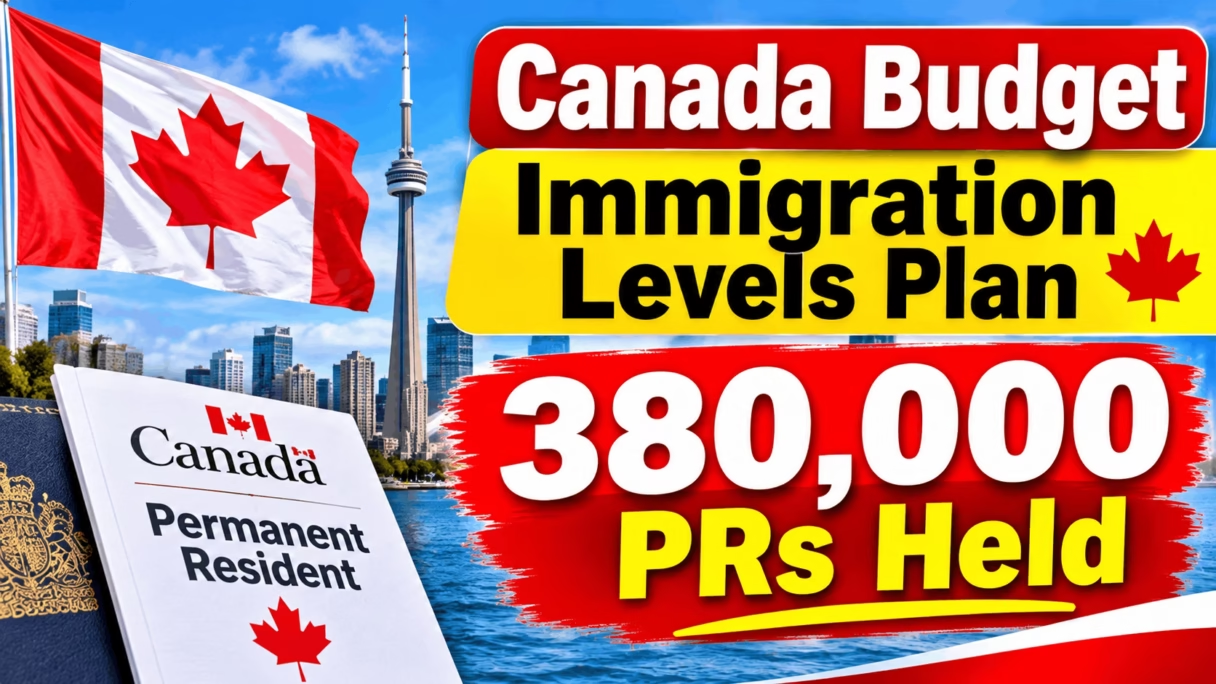
The canada budget immigration levels plan arrived when Finance Minister François-Philippe Champagne tabled Budget 2026 and, for the first time in recent years, folded the multi-year levels plan into the budget itself. The headline is stability: Canada will admit 380,000 permanent residents a year from 2027 to 2029, and new temporary resident arrivals are set at 370,000 a year. The surprise is a one-time bridge. Up to 200,000 people already living in Canada on temporary status could move to permanent residence by the end of 2027, and the government wants temporary residents below 5 percent of the population by then. The federal high skilled stream, which feeds Express Entry, is cut from 111,000 to 100,000. We’ll be updating this article monthly.
The money follows the policy. The budget sets aside $56.9 million over four years for Immigration, Refugees and Citizenship Canada to carry out the plan, $302.3 million to support the 200,000 transition, and $151.5 million over five years to reform the Temporary Foreign Worker Program. It sits inside a much larger package, with about $142 billion in new spending and five year deficits of roughly $289 billion. For a student, worker or family member trying to plan a move, the details matter more than the totals. This guide breaks down the targets by category, compares them with the old plan, shows who may benefit from the transition, and flags what is still unknown, since the targets set limits and do not set draw sizes, cut off scores or application dates.
Canada Budget 2026 Immigration Key Highlights
| Item | What the budget and plan say |
|---|---|
| Budget tabled | Thursday, November 5, 2026, by Finance Minister François-Philippe Champagne |
| Permanent resident target | 380,000 a year for 2027, 2028 and 2029 |
| Planning range | 352,500 to 422,000 a year, with 2028 and 2029 described as notional |
| Three year PR total | About 1.14 million |
| New temporary resident arrivals | 370,000 a year, range 355,000 to 385,000 |
| One time transition | Up to 200,000 temporary residents to permanent status by end of 2027 |
| Temporary resident share goal | Below 5 percent of the population by end of 2027, down from 6.7 percent |
| Federal high skilled (Express Entry) | 100,000 a year, down from 111,000 |
| Provincial Nominee Program | 95,000 a year, up from 92,500 |
| IRCC implementation funding | $56.9 million over four years |
| Transition funding | $302.3 million |
| Temporary Foreign Worker Program reform | $151.5 million over five years |
2027 to 2029 Levels Plan: Permanent Resident Targets by Category
The 380,000 total is unchanged from the current level, but the way it is split tells you where Ottawa wants growth.
| Category | Target for each year, 2027 to 2029 | Share of total |
|---|---|---|
| Economic | 244,700 | About 64.4 percent |
| Family sponsorship | 81,000 | About 21.3 percent |
| Refugees and protected persons | 49,300 | About 13 percent |
| Humanitarian and other | 5,000 | About 1.3 percent |
Inside the economic class, the plan lists several streams. Federal high skilled is 100,000, the Provincial Nominee Program is 95,000, the Atlantic Immigration Program is 6,000, and the Rural Community Immigration Program is 5,500 in 2027, 6,000 in 2028 and 6,500 in 2029. The sources we reviewed did not break down the rest of the 244,700.
Family is split into 66,000 spouses, partners and dependent children and 15,000 parents and grandparents. Refugee targets are 20,000 protected persons in Canada and dependants abroad, 11,750 government assisted refugees and 17,550 privately sponsored refugees.
Express Entry Allocation Cut to 100,000: Old Plan vs New Plan
The sharpest change for skilled workers is the federal high skilled number. It falls by about 9.9 percent, while the provincial nominee stream grows.
| Stream | Previous plan, 2027 | New plan, 2027 | Change |
|---|---|---|---|
| Federal high skilled | 111,000 | 100,000 | Down 11,000 |
| Provincial Nominee Program | 92,500 | 95,000 | Up 2,500 |
| Temporary Foreign Worker new arrivals | 60,000 (2026) | 50,000 | Down 10,000 |
| International students, new arrivals | 150,000 | 150,000 | No change |
That does not mean fewer invitations are guaranteed to be sent every month. It means the yearly ceiling is lower, and the in-Canada transition may route some people through Express Entry or provincial programs. The November 3 scoring changes, which add points for high wage work, are a separate matter and are not part of the budget.
Temporary Resident Targets: Work Permits and Study Permits
The 370,000 new temporary arrivals a year are split between workers and students.
| Group | Target (new arrivals each year) | Share |
|---|---|---|
| International Mobility Program (no LMIA) | 170,000 | Part of 220,000 workers |
| Temporary Foreign Worker Program | 50,000 | Part of 220,000 workers |
| Total workers | 220,000 | About 59.5 percent |
| International students | 150,000 | About 40.5 percent |
These targets do not count visitors, permit extensions, in-Canada study and work permit applications, asylum claimants or Post-Graduation Work Permits. That matters for people already in Canada. A student switching to a work permit, or a worker renewing a permit, is not competing for these new arrival spaces. The target governs people arriving from abroad.
The 200,000 Transition: Who Could Become a Permanent Resident?
This is the part of Budget 2026 most likely to change lives. The government says up to 200,000 temporary residents could receive permanent status by the end of 2027, on top of the regular 380,000. It is time limited and mainly a 2027 measure. Half of the people are expected to be considered for Express Entry or provincial nominee programs, according to Global News.
The plan describes two cohorts.
Workers. Up to 100,000 workers already in Canada, plus accompanying family. Provinces can use extra nominee space, and selected federal programs, such as the Start-up Visa, Self-Employed and Agri-Food Pilot, may be accelerated. No general application process has been announced.
Humanitarian. Up to 100,000 people, including applicants under Hong Kong and Ukraine pathways, certain humanitarian applicants already found eligible, and some in-Canada spouse, partner and dependent child sponsorship applicants. IRCC aims for waits near 12 months for qualifying spouse or partner cases outside Quebec.
Two warnings. There is no application you can file today under the name of the transition, and the details will come from IRCC through program changes, ministerial instructions and provincial announcements. Also, one trade publication reported the total new permanent residents in 2027 could reach up to 622,000 once the transition is counted. That headline combines regular admissions, the transition and other measures, and the sources we reviewed did not show the full arithmetic, so treat it as a ceiling and not a forecast. The transition is separate from Budget 2025 measures, which allowed up to 115,000 protected persons and up to 33,000 work permit holders to transition in 2026 and 2027.
Francophone Immigration Targets Outside Quebec
French speaking admissions outside Quebec keep rising under the plan.
| Year | Share of admissions outside Quebec | Planned admissions |
|---|---|---|
| 2027 | 9.5 percent | 31,825 |
| 2028 | 10.5 percent | 35,175 |
| 2029 | 12 percent | 40,200 |
The percentages apply to admissions outside Quebec, not to the national 380,000, which is why you cannot reproduce the numbers by multiplying the total. For Express Entry candidates, the targets are consistent with the French language category draws that have been bringing in many invitations at lower cut-offs.
How Much Money Did Budget 2026 Set Aside for Immigration?
| Measure | Amount | Period |
|---|---|---|
| IRCC implementation of the levels plan | $56.9 million | Four years, starting next year |
| Support for the 200,000 transition | $302.3 million | Not specified in sources reviewed |
| Temporary Foreign Worker Program reforms, through Employment and Social Development Canada | $151.5 million | Five years, starting this year |
The sources we reviewed state these figures but not a line by line breakdown, so check the budget documents for how the $302.3 million is allocated. The levels plan says its aim is to avoid undue pressure on housing, health care and social services, and the Temporary Foreign Worker Program will be reformed to better respond to regional labour market needs in collaboration with provinces and territories.
Why Ottawa Wants Temporary Residents Under 5 Percent
Temporary residents were about 6.7 percent of the population when the previous plan was set. The government wants that share below 5 percent by the end of 2027. It has two levers: fewer new arrivals, and moving existing residents to permanent status, which removes them from the temporary count. The 200,000 transition does both at once. A person who becomes permanent is counted as a resident for the long term, and the temporary share falls without anyone leaving. Whether it reaches 5 percent depends on how quickly permits expire, how many people leave and how fast IRCC processes the transition.
Free Levels Plan Explorer
Pick a stream and a year to see the planned target, its share of the 380,000 total where that applies, and how it compares with the previous plan. The tool covers only the numbers listed in this article. It does not predict invitations or your chances of selection.
[INSERT CALCULATOR HTML HERE: canada-levels-plan-explorer.html]
What Is Still Unknown After the Budget
Several questions were left open, and it is worth knowing which ones before you make a plan. First, the transition has no intake date, so nobody can say yet who will be asked to apply, which occupations or permit types will be prioritized, or whether people on expiring permits will be treated differently. Second, the plan sets annual ceilings, but IRCC has not announced how many invitations Express Entry will issue in each round, and category rules are normally set early in the year. Third, the Temporary Foreign Worker Program reform has a price tag but no published rule changes, so employers cannot yet tell whether wage thresholds, caps or regional lists will change. Fourth, the sources we reviewed did not describe any study permit changes beyond the unchanged arrival target.
Parliament also still has to pass the legislation that carries the spending. The levels plan itself is an administrative document tabled with the budget, and it can be revised in later years, which is why 2028 and 2029 are described as notional. In practice, that means the safest reading of Budget 2026 is as a direction of travel: stable permanent admissions, fewer new temporary entrants, and a one time effort to move people who are already settled in Canada into permanent status.
What the Budget Means for You
International students. The 150,000 new student arrival target is unchanged, so the cap that has constrained study permits for the past two years stays in place. Check your province’s attestation process and your school’s allocation before applying.
Temporary workers. Fewer new Temporary Foreign Worker Program arrivals, 50,000 against 60,000 last year, and a reform aimed at regional needs. Workers already in Canada may have a better chance than people applying from abroad, as the transition is aimed at them.
Express Entry candidates. A lower federal ceiling but a possible bridge from the 200,000 transition. Keep your profile current and follow the November 3 scoring changes.
Provincial nominees. The 95,000 provincial target is higher, and provinces may use extra space for the transition, so watch your province’s announcements.
Families. The 81,000 family target is unchanged, and some in-Canada spousal cases are part of the humanitarian transition cohort.
Employers. Plan around slower hiring from abroad and clearer regional rules. The reform money suggests new requirements are coming, but the details are not yet public.
Beyond Immigration: Other Budget 2026 Numbers
The immigration plan is one part of a spending heavy budget the finance minister framed around economic growth and what the government calls economic sovereignty.
| Item | Figure |
|---|---|
| New spending | About $142 billion |
| Deficit, 2025 to 2026 | $39.3 billion |
| Deficit, next two years | More than $62 billion each year |
| Five year deficits | About $289 billion |
| Productivity mega deduction | $36.1 billion over five years |
| Grocery benefit | $4.7 billion, including a one time payment of $4.1 billion in early 2027 |
| Child care | $5.4 billion over two years |
| Ending homelessness | $11.2 billion toward a 10 year goal |
| Public debt charges | $53.5 billion this year, rising to $85.5 billion by 2030 to 2031 |
Individuals will notice a lower threshold for the Canada Workers Benefit, which a budget analysis says reaches 1.9 million low income workers, a new exemption that lets foreign buyers purchase new homes, and higher postage rates. The Conservative finance critic said none of the spending is making a difference on the ground, the NDP leader called the mega deductions a gift to billionaires, and an economist described the budget as an attempt to kickstart economic growth.
How to Apply for Permanent Residence Under the New Plan
Nothing about the application process changed in the budget. These are the usual steps.
Step 1. Pick the pathway: Express Entry, a provincial nominee program, family sponsorship, a regional or Atlantic program, or a humanitarian route.
Step 2. Check eligibility in the program guide on the IRCC website.
Step 3. Create or sign in to your IRCC secure account.
Step 4. Complete a language test and, if needed, an Educational Credential Assessment.
Step 5. Submit your profile or application, and wait for an invitation, nomination or sponsorship decision.
Step 6. Submit documents, medicals and police certificates within the deadline in your invitation or letter.
Step 7. Pay the fees and track your file in your account.
Processing Time Under the New Levels Plan
The levels plan sets how many people can be admitted, not how quickly files are processed. IRCC posts current processing times by program in its online tool, and those change often. For families, IRCC aims for waits near 12 months for qualifying in-Canada spouse and partner cases outside Quebec under the humanitarian transition. For Express Entry, a service standard of about six months has long applied for complete applications, but confirm the current time in the IRCC tool before you plan a move.
Fees and Payment Schedule
IRCC raised permanent residence fees on April 30, 2026, and the budget did not announce a new increase in the sources we reviewed. A principal applicant pays $990 in processing fees plus a $600 right of permanent residence fee, a total of $1,590. A spouse pays the same, and a dependent child pays $270. Fees are paid when you submit the application, and the right of permanent residence fee can be paid then or deferred. Language tests, credential assessments, police certificates and medical exams are paid separately to third parties.
Official Resources and Links
FAQs
What is the Canada immigration levels plan for 2027 to 2029?
Canada plans to admit 380,000 permanent residents a year from 2027 to 2029, with 244,700 in the economic class, 81,000 in family sponsorship, 49,300 refugees and protected persons and 5,000 humanitarian and other admissions. New temporary resident arrivals are set at 370,000 a year.
Did Budget 2026 cut immigration?
Not overall. Permanent residence stays at 380,000 and temporary arrivals are held at 370,000. The federal high skilled stream falls from 111,000 to 100,000, and Temporary Foreign Worker new arrivals drop from 60,000 to 50,000.
What is the 200,000 transition in Budget 2026?
It is a time limited plan to move up to 200,000 temporary residents already in Canada to permanent status by the end of 2027, split into workers and humanitarian cohorts. No general application process has been announced.
How much funding did Budget 2026 give IRCC?
$56.9 million over four years to implement the plan and $302.3 million to support the 200,000 transition. A further $151.5 million over five years goes to Temporary Foreign Worker Program reforms.
Will Express Entry draws be smaller?
The yearly ceiling for the federal high skilled stream is 100,000, down from 111,000. The plan does not set draw sizes or cut-off scores.
Are international student numbers changing?
New study permit arrivals stay at 150,000 a year. The sources we reviewed describe no other study permit rule changes.
What happens to the Temporary Foreign Worker Program?
New arrivals fall to 50,000 a year and the program will be reformed to better respond to regional labour market needs, with $151.5 million over five years.
Are Canada’s immigration targets guaranteed?
No. They are planning targets with ranges, and 2028 and 2029 are notional. Actual admissions depend on applications received, processing capacity and later updates.
How many immigrants will Canada accept in 2027?
The plan sets 380,000 permanent residents for 2027. Up to 200,000 additional temporary residents could become permanent by the end of 2027 under the transition, and one report puts the total ceiling at up to 622,000.
Who is eligible for the 200,000 temporary residents to permanent residents plan?
Workers already in Canada, with accompanying family, and humanitarian groups such as certain Hong Kong and Ukraine pathway applicants and some in-Canada spouse and partner applicants. Eligibility rules are still to come.
Why is the Express Entry target lower?
The federal high skilled target is 100,000 against 111,000 before, while the provincial nominee target rises to 95,000. The government has not published a single explanation for the shift beyond its stated goals on housing, health care and services.
Does the budget change the CRS score?
No. The CRS changes took effect on November 3, separately from the budget.
What is the French language immigration target outside Quebec?
9.5 percent of admissions outside Quebec in 2027, 10.5 percent in 2028 and 12 percent in 2029.
Will the temporary resident share fall below 5 percent?
That is the government’s goal for the end of 2027, down from 6.7 percent. It depends on arrivals, permit expiries and the speed of the transition.
When was Canada Budget 2026 tabled?
Thursday, November 5, 2026, by Finance Minister François-Philippe Champagne.
Conclusion
The canada budget immigration levels plan is a story of steady permanent targets and tighter temporary ones, with a large one time bridge for people already here. If you are a worker or student in Canada, watch for the details of the 200,000 transition, keep your documents and status current, and follow IRCC and your province for program announcements. If you are applying from abroad, expect a tighter federal high skilled ceiling and fewer new temporary spaces. Targets are not guarantees, the transition has no application yet, and money for IRCC will take time to show up as faster processing. Check every figure on the official budget and IRCC pages before you act. We’ll keep this guide current as new details are published.