PM Rooftop Solar Scheme 2026 or PM Surya Ghar Muft Bijli Yojana 2026 is an initiative of the central government that was launched on February 15, 2024, to introduce solar power to the Indian homes. The target is 1 crore (10 million) homes to install solar panels on the roofs in 2026 and produce up to 300 units of free power per month to the eligible households. This PM Rooftop Solar Scheme 2026 was announced by Finance Minister Nirmala Sitharaman and was launched by Prime Minister Narendra Modi, a scheme that is regarded as a big push plan on clean energy, cost savings, and lessening dependence on fossil-fuels.
The government also contributes to the installation by subsidizing it to ensure that the installation cost is affordable, particularly to the low and middle income households. Presently registered on PM Rooftop Solar Scheme are more than 1.28 crore and in 2026, there are 14 lakh applications, and this is clearly resonating with Indian families.
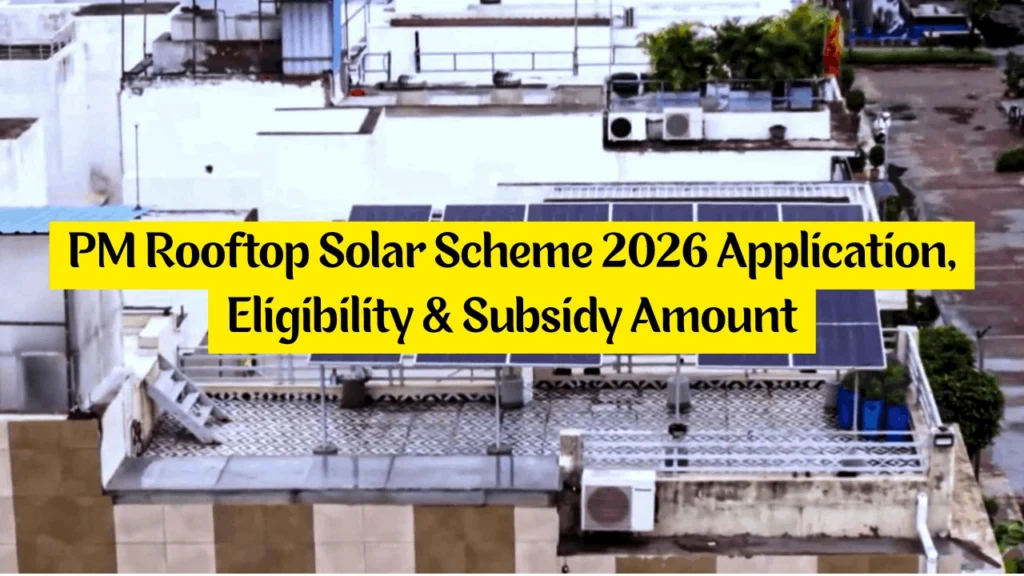
PM Rooftop Solar Scheme 2026 Advantages
The following are the principal advantages:
- Free Electricity: Benefit of a free electricity with up to 300 units of electricity a month according to the capacity of your solar system (usually 1-3 kW in the homes). This will save you 30-50 percent of your electricity bill.
- Subsidies: The government provides subsidies up to 60 per cent of the installation costs, subsidies of up to 78,000 on a 3 kW system.
- Additional earnings: Under net metering, you will be able to sell the excess electricity to your local power supply company (DISCOM) and transform your roof into a little cash-box.
- Eco-Friendly: Solar energy reduces carbon emission, which means that India can achieve its net-zero targets, and the country will not overburden the national grid.
- Long-Term Savings: After 20- 25 years, solar panels can stay in place, and it only produces decades of reduced bills and the payback period (ROI) can be in a few years, i.e., 3-5 years.
- Employment: The PM Rooftop Solar Scheme will generate work in the solar panel production, installation, and repair, improving the local economies.
For example, a 3 KW system could save you ₹15,000 annually on electricity bills, and with subsidies, the upfront cost is much easier to manage. Plus, you’re doing your part for a cleaner environment.
PM Rooftop Solar Yojana Eligibility 2026
PM Rooftop Solar Scheme is not open to all, there are certain eligibility rules that are meant to make certain that it is offered to the right individuals. The following are the requirements to qualify:
- Nationality: You should be an Indian citizen.
- Property Ownership: You should have a house or a business property whose roof allows the installation of solar panels (space and access to sunlight).
- Income: The priority is assigned to the households whose annual income is not more than 1-1.5 lakh, although middle-income families can also apply.
- Electricity Connection: There should be a valid electricity connection of your local DISCOM.
- None of the Benefits: You are not to have taken advantages of subsidies by other solar schemes.
- Age: The applicants should be above 18 years.
Rural, as well as urban homeowners, are able to apply, and apartment complexes can also do so, provided this is possible. It depends on the crucial point that the roof receives enough sunlight and has a stable electricity connection. In the case of renting, you would have to seek the consent of the property owner concerning the installation of panels.
PM Surya Ghar Muft Bijli Yojana 2026 Subsidy, Application Process and Eligibility
RRB Group D Recruitment 2026 Registration Date Extended to 9 March
How to Apply Online for the PM Rooftop Solar Yojana 2026?
The PM Surya Ghar Muft Bijli Yojana is a simple program to apply to since the National Portal on Rooftop Solar is conveniently designed (pmsuryaghar.gov.in). The following are the steps to follow:
- See the official site at pmsuryaghar.gov.in or solarrooftop.gov.in..
- Go to either the Rooftop Solar or Consumer tab and choose the option of Apply Now.
- Register with entering your state, district, name of DISCOM and consumer number (on your electricity bill).
- Enter an OTP to verify your mobile number once you have entered the captcha code.
- Register and complete the application form by entering information about yourself such as the name, Aadhaar number, address, phone number.
- Add necessary paperwork.
- Place the form and remember your application ID to keep track of the application.
- Ask your DISCOM (feasibility) to approve that you have a suitable roof.
- Select a registered vendor among the list of the portal to install your solar panels.
- Once installed all you need to do is to apply using the portal with net metering.
- After inspecting and commissioning of the system by the DISCOM, send your bank account details and canceled cheque.
- The subsidy is to be received in your bank account in 30 working days.
The PM Rooftop Solar Yojana portal is also full of other features such as a solar calculator to determine how big your system will be and stick with a good installer with vendor ratings. In case of difficulties, you may contemplate calling the helpline 15555 which is a toll-free number.
Documents Needed for PM Rooftop Solar Scheme Application
To apply, you’ll need to upload the following documents in the specified format (usually PDF or JPG):
- Latest electricity bill
- Aadhaar card
- PAN card
- Proof of property ownership (e.g., property tax receipt or sale deed)
- Bank details and a canceled cheque
- Photo of the rooftop or area where panels will be installed
Ensure that your documents are readable and current to prevent wastage of time. In case you are seeking an apartment complex application, you might be required to have an extra permission by the resident welfare association.
PM Rooftop Solar Yojana Subsidy 2026
Subsidies and how they find their way to you. PM Surya Ghar Muft Bijli Yojana also has high financial assistance towards installing solar panels to make it affordable. Here’s the breakdown:
Subsidy Amounts
The subsidy depends on the size of the solar system you install:
- 1 kW system: ₹30,000
- 2 kW system: ₹60,000
- 3 kW or above: ₹78,000
In case of group housing societies or resident welfare associations (RWAs), common facilities (such as EV charging) are subsidized at 18000 per kilowatt (3000 per kilowatt house). The subsidy also caters to 60 percent of the cost of installing your system and this will save you a lot of money on the initial cost. On a 3 KW system, which will cost approximately 1.3-1.5 lakh, the subsidy will reduce the price of your system to between 50-70,000 depending on your vendor and location.
RRB Group D 2026 Result at rrbcdg.gov.in
CM Mahila Rojgar Yojana 2026 [₹10,000 to ₹2 Lakh] – How to Apply?
PM Rooftop Solar Yojana Payment Timeline
After the installation and commissioning of your solar system (on DISCOM inspection and net meter installation) you will submit your bank details on the portal. The subsidy is then deposited in your bank account in 30 working days after submission. As an illustration, when your system is commissioned by January 15, 2026, you will have the subsidy by mid-February 2026. In case of delay, then you can monitor your application status on pmsuryaghar.gov.in with the help of your application ID or you can call your DISCOM.
Application Fees
The PM Rooftop Solar Scheme is not charged a separate application fee, the subsidy finance is taken care of. You will however have to pay the vendor the cost of installation (including the subsidy) which can be financed by concessional bank loans provided under the PM Rooftop Solar Scheme. There are state specific subsidies that can be added to some states such as Maharashtra, thus verify with your DISCOM to get extra savings. Here’s a table summarizing the key payment details:
| System Size | Subsidy Amount | Expected Payment Timeline |
| 1 kW | ₹30,000 | Within 30 working days of commissioning |
| 2 kW | ₹60,000 | Within 30 working days of commissioning |
| 3 kW or above | ₹78,000 | Within 30 working days of commissioning |
| Common Facilities (GHS/RWA) | ₹18,000 per kW (up to 500 kW) | Within 30 working days of commissioning |
How Does the PM Rooftop Solar Scheme Work?
This PM Surya Ghar Yojana is aimed at making solar energy available and cost effective. This is the way it works in a simple way:
- Installation: Photovoltaic panels are installed on your roof where they are connected to the power supply of your house. The setup is done by a registered vendor and is in accordance with the grid interconnection and safety standards.
- Net Metering: This is where a net meter measures what you produce and what you use. When you generate more than you consume, you credit your DISCOM grid in which case the excess will be given. This will cover up your bill or make you money.
- Subsidy: Once the system is commissioned the government pays part of the cost of installation in your bank account.
- Savings: You will receive up to 300 units of free electricity every month and cut down your bill. In the case of a 3kW system, this may amount to 15000 in savings each year.
- Maintenance: The system has a maintenance fee of 5 years, which the vendors provide to ensure that the system is running well.
PM Rooftop Solar Scheme is carried out by REC Limited on the national level and by DISCOMs on the state level such as in the case of MSEDCL in Maharashtra. They deal with inspections, approvals, and net metering to make sure that nothing goes wrong.
What Are the Benefits of the PM Rooftop Solar Yojana?
The advantages of PM Rooftop Solar Scheme do not only consist in the reduction of your electricity bill. Here’s a deeper look:
- Cost Savings: 3 kW can help you save 15,000-18,000 a year by guaranteeing you get free electricity and an additional income of the leftover power sales.
- Income Opportunity: OPUN sett within the roof as they sell extra electricity to DISCOMs with net metering and make a small income revenue stream.
- EV Charging: Thanks to excess power, charge the electric cars, and save even greater in terms of the fuel expenses.
- Environmental Impact: The solar power lowers carbon emissions, which coincides with the objective of 40 GW of rooftop solar capacity in the country by 2026 and net-zero emissions.
- Creating job opportunities: The PM Rooftop Solar Scheme will provide the youth with a chance to work in the sphere of solar panels manufacturing, installation, and maintenance.
- Energy Autonomy: To reduce dependence on the grid, produce your own energy and get shielded against the increasing electricity prices.
As an example, a 3 kW system installed in a family in Maharashtra would allow the family with a 2000R monthly electricity bill to reduce their power bill to close to nothing, and earn credits on the additional power sold to MSEDCL. And that is money back in your pocket!
What Happens After You Apply?
After you have applied on pmsuryaghar.gov.in, the following happens:
- Feasibility Check: Your DISCOM comes and checks your roof to see whether it can support the solar panels (have enough sunlight and space).
- Approval: In case of approval, you select a registered vendor on the list of the portal so as to install the system.
- Installation: The vendor installs the panels and this normally takes a few weeks depending on availability.
- Net Metering: Once installed, the DISCOM has been installed with a net meter that monitors your production and consumption of electricity.
- Commissioning: Commissioning is the process in which the DISCOM inspects the system and grants a commissioning certificate.
- Subsidy Disbursement: Add your bank information and canceled cheque using the portal and the subsidy is added in 30 working days. cheque through the portal, and the subsidy is credited within 30 working days.
On the portal you can use your application ID to monitor your application status. In case of any delays or problems, call your DISCOM or the toll-free number 15555.
What If You Don’t Qualify or Miss the Deadline?
In case you do not qualify (e.g. do not possess the property or have an older solar subsidy), you may consider state-specific solar arrangements or individual solar systems. Even after the application window, there is no need to panic, since the PM Rooftop Solar Scheme will be available until 2026-27, and new registration windows should be opened. Continue checking pmsuryaghar.gov.in. You may also discuss your DISCOM or other local solar vendors on how to finance your panels without subsidy using other sources such as low interest loans.