
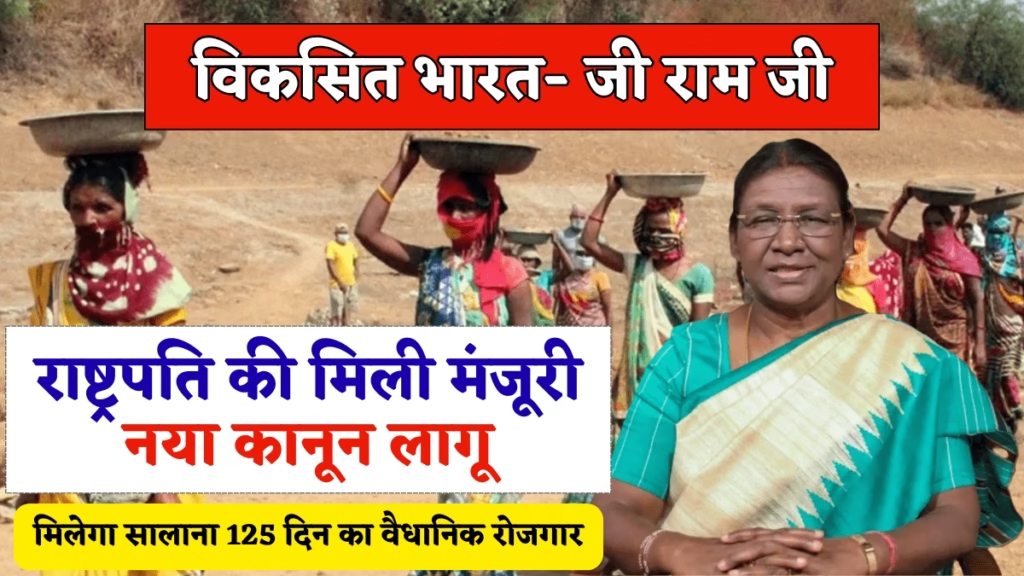
VB-G RAM G Bill: The Viksit Bharat, Guarantee for Rozgar and Ajeevika Mission (Gramin) Bill, 2025, which formally replaced the Mahatma Gandhi National Rural Employment Guarantee Act (MGNREGA), 2005 with a redesigned rural employment framework, was signed into law by President Droupadi Murmu on Sunday.
The new law strengthens income stability and job predictability by increasing the statutory guarantee of wage employment for rural households from 100 to 125 days each fiscal year. The Act seeks to change rural employment from a welfare measure to a development-driven approach and is in line with the Center’s Viksit Bharat @2047 objective.
Vb Gramg Bill 2025 Replace Mgnrega
The nearly two-decade-old MNREGA law has been transformed into a new framework with the passage of the VB-G RAM G Bill 2025, which was approved by President Droupadi Murmu. The employment guarantee for rural households is extended from 100 to 125 days under the new law. A clause allowing for a 60-day work stoppage between the planting and harvesting seasons has been included, along with a 60:40 financial split between the federal and state governments.
The job guarantee given to rural families has been extended from 100 to 125 days under the new law. The VB-G RAM G Bill 2025, also known as the Developed India-Guarantee for Employment and Livelihood Mission (Rural), has been authorized by President Droupadi Murmu. This opens the door for significant modifications to the nation’s premier rural employment program.
Following this approval, a new legal framework that is in line with the government’s Developed India 2047 vision has taken the place of the almost two-decade-old Mahatma Gandhi National Rural Employment Guarantee Act (MGNREGA).
VB-G RAM G News Update
The job guarantee for rural households has been extended from 100 to 125 days every fiscal year, which is the largest modification under the new law. The prior 100-day limit frequently functioned more like a severe maximum limit than a minimum guarantee, according to the administration, which has portrayed this as an increase of benefits.
The funding structure has also undergone significant modifications. The new VB-G RAM G structure creates a shared funding system between the federal and state governments, whereas under MGNREGA, the federal government was responsible for paying all wage costs.
The expenses will be split 60:40 under this arrangement. In the past, the northeastern and Himalayan states followed a 90:10 pattern, while the other states followed a 75:25 pattern. According to the government, this will strengthen cooperative federalism and give the states more authority.
VB-G RAM G Act Weekly Payments Are Required by Law
Additionally, the legislation requires that wages be paid on a weekly basis or within 15 days after the completion of the task, with compensation for any delays. To guarantee the availability of agricultural labor during the busiest sowing and harvesting seasons, states have the authority to announce a cumulative pause time of up to 60 days per year.
VB-G RAM G Key Facts
For the first time, the new rule also stipulates that employment in rural areas may be suspended for up to 60 days during the busiest planting and harvesting seasons. The government claims that this will solve farmers’ worries about labor shortages and guarantee worker availability during critical agricultural times.
Additionally, the scope of the task has been constrained. Four sectors will now be the main focus of employment: climate adaptation, livelihood-related resources, basic rural infrastructure, and water security. According to the government, this would enhance the sustainability and quality of the assets produced.
The opposition has vehemently opposed this law, despite the federal government’s assertion that it is consistent with the objective of a developed India by 2047. The omission of Mahatma Gandhi’s name from the law’s title has drawn criticism from Congress leaders Rahul and Priyanka Gandhi. They claim that the measure restricts workers’ rights, centralizes decision-making, and erodes the rights-based essence of MGNREGA.