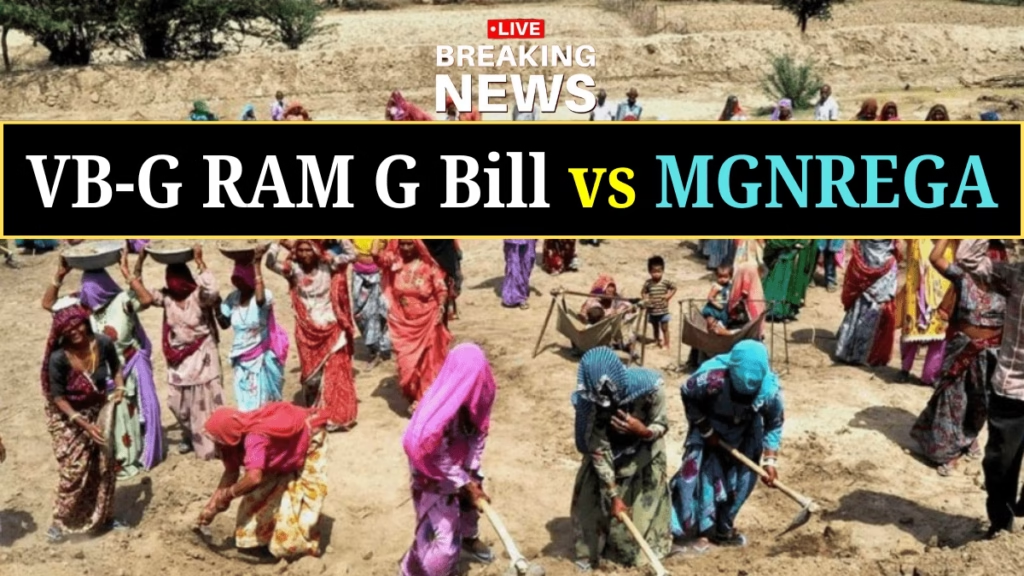
VB-G RAM G Bill vs MGNREGA: The Viksit Bharat Guarantee on Rozgar and Ajeevika Mission (Gramin) Bill commonly referred to as the VB-G RAM G bill was almost unanimously passed in the Lok Sabha after a fierce opposition. The MGNREGA of the UPA regime is substituted with the VB-G RAM G law that gives the rural population 125 days of pay jobs.
The Indian government introduced a Bill in the Lok Sabha, called Viksit Bharat-Guarantee of Rozgar and Ajeevika Mission (Gramin) Bill, 2025 (VB-G RAM G Bill). This bill will supplant and abolish the historic MGNREGA Act of 2005 that will radically transform the Indian rural job market. As the administration claims, the latest step will not only hasten the rural development process but also provide accountability and transparency systems that have better aspects of administration and security.
What Is VB-G RAM G Bill?
Compared to the 100 days under MGNREGA, the Center estimates that the VB-G RAM G Bill will raise the statutory wage employment guarantee of the unskilled workers to 125 days per fiscal year. The new bill will give the gram panchayat and sabha the right to make decisions on what should be done besides bringing about accountability and openness.
It was introduced by Agriculture Minister Shivraj Singh Chouhan who claimed that the bill will lead to comprehensive development of villages and this is meant to assure rich employment to all the poor people, dignity of the people, and also provide extra security to the differently-disabled, elderly, women, Scheduled Castes and Scheduled Tribes.
The measure will focus on water security by building lakes, micro-irrigation canals and basic rural infrastructure, livelihood infrastructure as well as special projects to reduce severe weather. The government reckons the proposed law empowers the rural households as it creates more job opportunities and it is in line with the vision of Viksit Bharat. However, the opposition has also raised concerns regarding the state expenditure, the centralization of decisions and the undermining of the law besides renaming it.
MGNREGA vs VB-G RAM G bill
As the Center indicates, MGNREGA became full of corruption under the UPA government, as the expected funds to be used in buying materials were not spent on set jobs.
However, the new bill not only encompasses material procurement corruption, but other new regulations such as a 60-day suspension, numerous changes to guaranteed days, funding patterns and wage payments are also included.
The new program is a supply-oriented framework having limited allocations as opposed to MGNrega which was a demand-oriented scheme which relied on the availability of workers. Any extra costs will be covered by the state in question. In the project, the Center has put down 95,000 crore.
Under MGNREGA, the Center used to finance 75% of the cost of materials and 100 percent of labor. The new program, however, is an operation of a Centrally Sponsored Program (CSS) where the expenditures are to be borne by the North-Eastern and Himalayan States/UT by 10 percent and by all other states by 40 percent. One area that has received strong attacks by the opposition is the cost-sharing program of the state.
To enable agricultural seasons to acquire farm labor, especially on the busiest sowing and harvesting seasons, there is a new 60 day obligatory prohibition, which is applied in the agricultural seasons.
How to Improve Credit Score Fast in 2026? Credit Score Improve tips
VB-G RAM G Bill has 4 main areas
New program revolves around four core areas as compared to the MGNREGA which revolved around land development, drought resistance, and water supply:
- Water security: groundwater replenishment, irrigation support etc.
- The examples of rural infrastructure are roads, public buildings, educational infrastructure and sanitary systems.
- Livelihood-related infrastructure: cattle, fishing and agriculture.
- Extreme weather: Disaster preparedness, flood control structures, embankments, shelters, and others.
Also, the state governments provide unemployment benefits to candidates who are capable, but fail to secure employment within the specified period.
Why Should MGNREGA Be Replaced?
Rural Realities Are Transforming: MGNREGA was enacted in 2005; government asserts that modernized structure needs to be in place based on the fact that the rural economy has shifted.
Problems with Asset Quality: MGNREGA has been alleged to generate low utility or non-durable assets. The new measure aims at prioritizing the productive assets such as key infrastructure and water security.
Labor Supply in Agriculture: Farmers have lamented that during their most active periods of production that MGNREGA has led to labor shortages. To solve this, the new bill will allow work breaks at harvest and sowing.
Fiscal Discipline: The Center needs to refocus its expenditure by avoiding the open-ended system of funding and moving toward normative allocation.
Benefits of the VB-G RAM G Bill
Improved Employment Security: The annual statutory guarantee would be increased to 125 days per household instead of 100, leading to increased incomes in the rural regions.
Quickened Wage Payments: The weekly salary payments that are drawn by the bill will enhance the liquidity of workers in comparison with 15 days with MGNREGA.
Farming aid: The possibility of suspending the projects of the public works up to 60 days during the peak farming seasons ensures that the farmers get the labor when they are most required.
Attend to Water Security Increasing irrigation and drinking water access in the rural areas is among the objectives of an intensive initiative of water projects.
Technological Integration: To avoid leakage and ensure transparency, the bill needs a digitally comprehensive ecosystem that ensures biometric and AI-powered analytics.
Post Office Investment Schemes | Best Schemes to Invest money in Post Office
Problems and Difficulties
Dilution of Rights: According to critics, the legal claim to work is essentially weakened when it is changed from a “Justiciable Right” to a “Schematic Entitlement” with a budget cap. Work may be refused if funds run out.
Fiscal Burden on States: Poorer states with high labor demand but low revenue capability, such as Bihar or Uttar Pradesh, are severely burdened financially by the change to a 60:40 financing split.
Centralization of Power: States’ ability to make plans based on local need is diminished by the “Normative Allocation” model, which gives the Center the authority to set financial caps.
Effect on Workers Who Are Vulnerable: Landless laborers who depend on the program for survival may suffer from the 60-day seasonal stop, especially during times when private farm employment may not be available or may pay poorly.
Errors in Exclusion: If “Viksit Gram Panchayat Plans” and digital stacks are heavily relied upon, workers who are illiterate or lack access to the internet may be left out.