Canada 2026 Federal Income Tax Brackets: The Canada 2026 federal income tax brackets are officially out, and there’s genuinely good news for most filers this year: the lowest federal tax rate has dropped to 14% for the entire 2026 tax year, down from an effective blended rate of 14.5% in 2025 (when the cut from 15% to 14% only took effect mid-year, on July 1, 2025). Combined with a 2% inflation indexation applied to every bracket threshold and tax credit, most Canadians will pay slightly less federal tax in 2026 than they would have on identical income the year before with the Parliamentary Budget Office estimating average savings of $110–$200 per filer, and more for couples and families with children.
This guide breaks down the complete 2026 Canada federal tax brackets, shows exactly how the Basic Personal Amount reduces your taxable income, walks through real worked examples at different income levels, and critically covers a major provincial update missing from most coverage: Prince Edward Island introduced a brand-new 20% tax bracket on income over $200,000, effective April 14, 2026, which changes the combined tax picture for higher earners in that province. We also compare all 10 provinces so you can see your true combined federal-plus-provincial rate. We’ll be updating this article monthly as new CRA guidance and provincial budget changes are released.
Canada 2026 Federal Income Tax Brackets Key Highlights
| Detail | Information |
|---|---|
| Lowest Federal Rate (2026) | 14% (down from effective 14.5% in 2025) |
| Top Federal Rate | 33% (unchanged) |
| Number of Federal Brackets | 5 |
| Indexation Factor for 2026 | 2.0% (based on Statistics Canada CPI data) |
| Basic Personal Amount (BPA) — Maximum | $16,452 |
| Basic Personal Amount (BPA) — Minimum | $14,829 |
| BPA Phase-Out Range | $181,440 – $258,482 |
| Top Bracket Threshold | Over $258,482 |
| Governing Body | Canada Revenue Agency (CRA) |
| Payroll Guide Update | T4127, effective January 1 and July 1 annually |
| New Provincial Bracket (2026) | PEI: 20% on income over $200,000, effective April 14, 2026 |
| Official Portal | canada.ca/revenue-agency |
| My Account Login | canada.ca/my-cra-account |
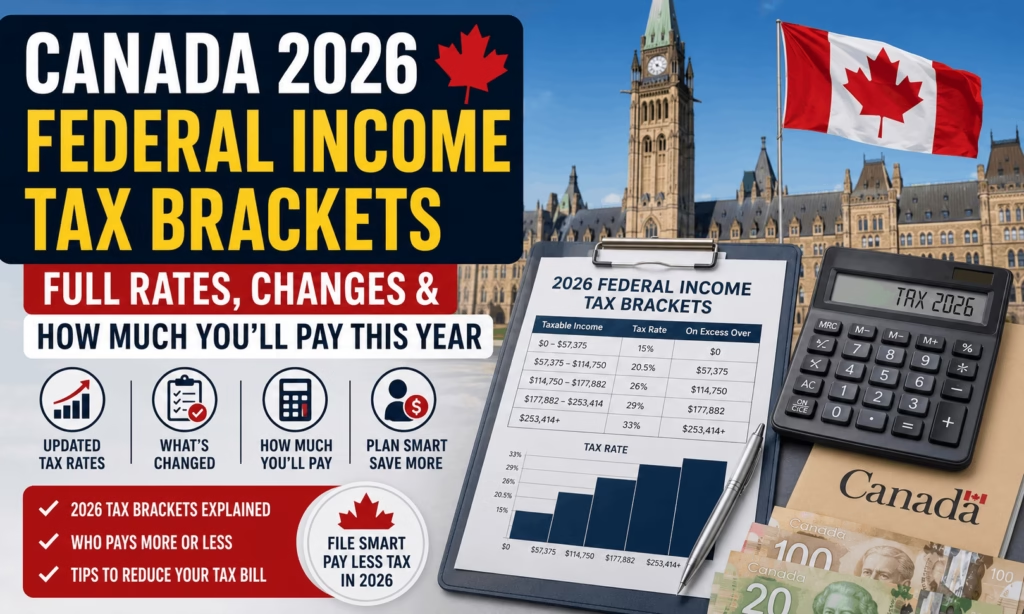
Federal Income Tax Brackets and Rates 2026
| Taxable Income Range | Federal Tax Rate |
|---|---|
| First $58,523 | 14% |
| Over $58,523 up to $117,045 | 20.5% |
| Over $117,045 up to $181,440 | 26% |
| Over $181,440 up to $258,482 | 29% |
| Over $258,482 | 33% |
Canada’s federal tax system is progressive, meaning you never pay the top rate on your entire income — only the portion that falls within each specific bracket is taxed at that bracket’s rate. These 2026 thresholds are identical across all of Canada; only your provincial tax rate changes depending on where you live.
What Changed From 2025 to 2026?
| Bracket | 2025 (Effective) | 2026 |
|---|---|---|
| First | Up to $57,375 at 14.5% | Up to $58,523 at 14% |
| Second | $57,375 – $114,750 at 20.5% | $58,523 – $117,045 at 20.5% |
| Third | $114,750 – $177,882 at 26% | $117,045 – $181,440 at 26% |
| Fourth | $177,882 – $253,414 at 29% | $181,440 – $258,482 at 29% |
| Fifth | Over $253,414 at 33% | Over $258,482 at 33% |
The effective 14.5% rate in 2025 reflected a mid-year change: the lowest bracket was cut from 15% to 14% starting July 1, 2025, so 2025 filers saw a blended rate for the year. For 2026, the 14% rate applies for the full 12 months, delivering a straightforward, complete-year saving to every taxpayer in the lowest bracket. All threshold increases reflect the 2% indexation factor based on Statistics Canada’s Consumer Price Index data.
Basic Personal Amount (BPA) for 2026
The Basic Personal Amount is a non-refundable tax credit that effectively means you pay no federal income tax on the first portion of your income.
- Maximum BPA (2026): $16,452 — available to taxpayers with net income at or below the phase-out threshold
- Minimum BPA (2026): $14,829 — applies once income exceeds $258,482
- Phase-out range: Between $181,440 and $258,482, the BPA gradually declines from its maximum to its minimum
This means if your taxable income is below $16,452, you owe no federal income tax at all once the BPA credit is applied.
Worked Example: $100,000 Taxable Income (2026)
- Subtract the maximum BPA: $100,000 – $16,452 = $83,548 taxable after BPA
- 14% on the first $58,523 = $8,193.22
- 20.5% on the remaining $25,025 ($83,548 – $58,523) = $5,130.13
- Total federal tax payable: approximately $13,323 (before other credits or deductions)
Worked Example: $140,000 Taxable Income (2026)
| Income Portion | Amount | Rate | Tax Owed |
|---|---|---|---|
| First $16,452 (BPA) | $16,452 | 0% | $0 |
| Next $42,071 | $42,071 | 14% | $5,889.94 |
| Next $58,522 | $58,522 | 20.5% | $11,997.01 |
| Remaining $22,955 | $22,955 | 26% | $5,968.30 |
| Total | $140,000 | — | $23,855 |
Major Update: Prince Edward Island’s New Tax Bracket
This is the most significant development missing from most 2026 tax bracket coverage. On April 14, 2026, the Government of Prince Edward Island introduced an entirely new provincial tax bracket: taxable income above $200,000 is now subject to a 20% provincial rate, applying to 2026 and all future years. Because this change was announced partway through the year, employers had already been applying a lower rate for the first half of 2026 — so payroll systems now apply a prorated 21% rate to the qualifying income bracket for the remaining six months of 2026, ensuring the full-year outcome matches the new bracket’s intended annual impact.
This change means Prince Edward Island’s combined federal-plus-provincial top marginal rate rose to approximately 51.75% in 2026, up from prior years — placing it among the higher-tax provinces for top earners, alongside Newfoundland and Labrador, Nova Scotia, Quebec, and Ontario.
How Provincial Tax Adds to Your Total Bill
Federal tax is only part of the picture — every province and territory layers its own tax on top, and the differences are substantial:
| Province | Lowest Rate | Top Provincial Rate | Combined Top Marginal Rate (2026) |
|---|---|---|---|
| Alberta | 8.00% | 15.00% | ~48.00% |
| Saskatchewan | — | — | ~47.50% |
| Ontario | 5.05% | 13.16% | ~53.53% |
| British Columbia | 5.06% (rising to 5.60%) | 20.50% | ~53.50% |
| Quebec | 14.00% | 25.75% | ~53.31%* |
| Prince Edward Island | 9.65% | 20.00% (new bracket) | ~51.75% |
| Nova Scotia | 8.79% | 21.00% | ~54.00% |
| Newfoundland & Labrador | — | 21.80% | ~54.80% |
*Quebec’s combined rate already reflects the 16.5% federal tax abatement unique to Quebec residents, which offsets what would otherwise be an even higher combined figure.
Key takeaway: Alberta and Saskatchewan remain the lowest-tax provinces for most income levels, while Newfoundland and Labrador, Nova Scotia, and Ontario sit at the top. At $100,000 of income, the gap in provincial tax alone between the cheapest province (British Columbia) and the most expensive (Quebec) can exceed $9,800 per year.
Who Benefits Most From the 2026 Changes?
According to the Parliamentary Budget Office, middle-income families see the largest relative benefit, with average savings of $110–$200 per filer — more for couples and households with children. Low-income earners just above the BPA threshold pay minimal or no federal tax at all. Even higher earners see some relief, since the increment in income covered by the wider brackets is proportionally larger in the middle tax bands. Quebec residents receive a slightly smaller relative benefit due to the province’s federal tax abatement, though they still benefit from the indexation overall.
Tips to Lower Your 2026 Tax Bill
- Contribute to an RRSP to reduce your taxable income and potentially stay within a lower bracket.
- Claim eligible medical expenses, tuition, and charitable donations — the BPA combined with these credits meaningfully helps low-to-middle income earners.
- Watch for bracket creep if you’re expecting a raise — a small increase near a bracket threshold means only that portion is taxed higher, not your entire income.
- Track provincial changes annually — indexation factors and new brackets (like PEI’s 2026 change) vary significantly by province and can shift your total bill independent of federal changes.
Official Resources
| CRA Official Website: | canada.ca/revenue-agency |
| CRA My Account (Login/Registration): | canada.ca/my-cra-account |
| T4127 Payroll Deductions Formulas: | canada.ca (search “T4127”) |
| Provincial Tax Rate Comparisons: | taxtips.ca |
| CRA General Enquiries: | 1-800-959-8281 |
| Home Page | https://govtschemes.org/ |
FAQs
What are the federal tax brackets in Canada for 2026?
Five brackets: 14% up to $58,523, 20.5% up to $117,045, 26% up to $181,440, 29% up to $258,482, and 33% above that.
Why is the lowest tax rate 14% instead of 15% in 2026?
The federal government cut the lowest rate from 15% to 14%, effective July 1, 2025. Since 2026 is the first full year at the new rate, taxpayers see the complete annual saving rather than the blended 14.5% rate seen in 2025.
What is the Basic Personal Amount for 2026?
Between $14,829 and $16,452, depending on your income level — meaning you pay no federal tax on income up to this amount.
Did any province introduce a new tax bracket in 2026?
Yes — Prince Edward Island introduced a new 20% bracket on income over $200,000, effective April 14, 2026, raising its combined top marginal rate to roughly 51.75%.
Which province has the lowest combined tax rate in 2026?
Alberta and Saskatchewan have the lowest combined federal-plus-provincial top marginal rates, at approximately 48% and 47.5% respectively.
How much federal tax will I pay on $100,000 in 2026?
After applying the maximum Basic Personal Amount, approximately $13,323 in federal tax alone, before any additional credits or provincial tax.
Is federal tax the same across all of Canada?
Yes. Federal brackets and rates are identical nationwide — only provincial tax rates and brackets differ by where you live.