Canada 2026 Federal Income Tax Brackets: Canada’s 2026 federal tax brackets run from 14% to 33%. See the CRA’s official thresholds, what changed this year, provincial rates, worked examples and answers to common questions. Canada has five federal tax brackets for 2026, ranging from 14% to 33%. The lowest rate is now 14%, down from 15%. The cut took effect July 1, 2025, so 2026 is the first full year at the lower rate. Bracket thresholds rose by 2.0% for inflation. That is lower than the 2.7% increase in 2025.
The federal basic personal amount (BPA) is up to $16,452, from $16,129 in 2025. Provincial or territorial tax is charged on top of federal tax. Your 2026 income is reported on the 2026 tax return, filed in 2027.
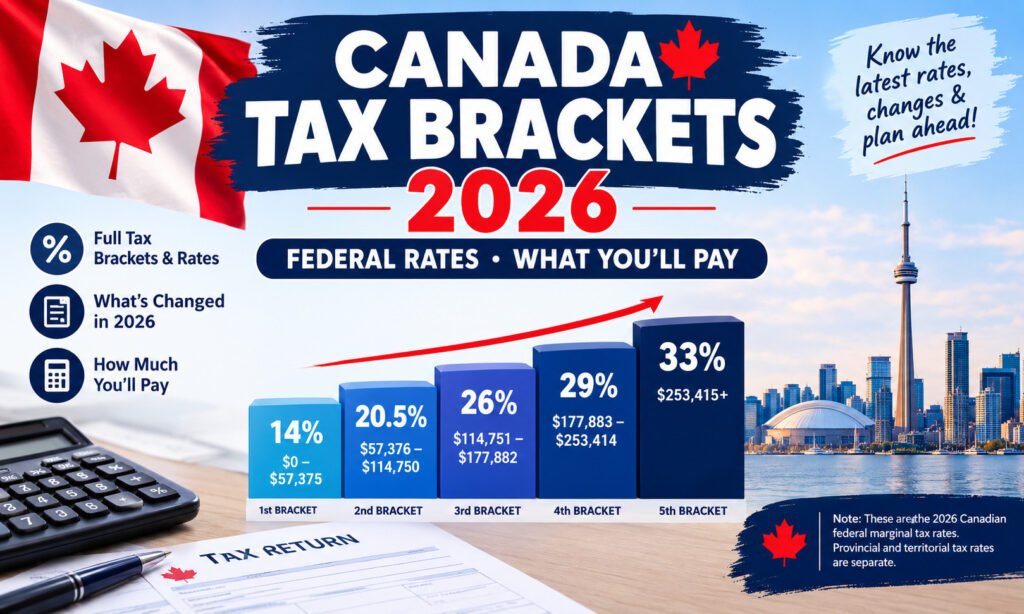
2026 Federal Income Tax Brackets (Official CRA Rates)
| Taxable income | Tax rate |
| Up to $58,523 | 14% |
| $58,523.01 – $117,045 | 20.5% |
| $117,045.01 – $181,440 | 26% |
| $181,440.01 – $258,482 | 29% |
| Over $258,482 | 33% |
These rates apply in every province and territory. The CRA states that each rate applies only to the income inside its own bracket, not to all of your income.
Maximum federal tax at the top of each bracket (before credits):
| Bracket ceiling | Cumulative federal tax |
| $58,523 | $8,193 |
| $117,045 | $20,190 |
| $181,440 | $36,933 |
| $258,482 | $59,275 |
What Changed in 2026?
1. Lowest rate cut from 15% to 14%. The reduction began on July 1, 2025. For 2025, taxpayers effectively paid a blended 14.5%. In 2026 the full 14% applies for the whole year.
2. Inflation indexation of 2.0%. The CRA indexes bracket thresholds every year using Statistics Canada’s CPI. Here is how the indexation has moved over recent years:
| Year | Indexation | 20.5% bracket starts | 33% bracket starts |
| 2023 | 6.3% | $53,359 | $235,675 |
| 2024 | 4.7% | $55,867 | $246,752 |
| 2025 | 2.7% | $57,375 | $253,414 |
| 2026 | 2.0% | $58,523 | $258,482 |
3. Higher credit amounts. Some of the main non-refundable credit amounts for 2026 are:
| Item | 2026 amount |
| Basic personal amount (maximum) | $16,452 |
| Basic personal amount (high earners, above the 33% threshold) | $14,829 |
| Age amount | $9,208 |
| Canada employment amount | $1,501 |
| Disability amount | $10,341 |
The maximum BPA applies if your net income is at or below $181,440, where the 29% bracket begins. It phases down for incomes between that level and $258,482.
4. Bigger benefit payments from July 2026. The CRA says the Canada Groceries and Essentials Benefit (formerly the GST/HST credit) rises by 25% for five years starting July 2026. For July 2026 to June 2027, the adult maximum is $445 per year and the child maximum is $234. A single adult can get up to $679 per year, because a $234 single supplement is added. The Canada Child Benefit and Child Disability Benefit are also indexed from July 1.
How Much Will You Pay? Worked Examples (Federal Tax Only)
These examples use the 2026 brackets and the full $16,452 BPA, which gives a credit of $2,303.28 (14% × $16,452). They exclude provincial tax, CPP/EI and other credits or deductions.
| Taxable income | Federal tax before credit | Federal tax after BPA credit | Effective federal rate |
| $50,000 | $7,000.00 | $4,696.72 | 9.4% |
| $80,000 | $12,596.01 | $10,292.73 | 12.9% |
| $100,000 | $16,696.01 | $14,392.73 | 14.4% |
| $150,000 | $28,758.53 | $26,455.25 | 17.6% |
Step by step for $80,000
- 14% × $58,523 = $8,193.22
- 20.5% × ($80,000 − $58,523 = $21,477) = $4,402.79
- Total before credits: $12,596.01
- Less BPA credit: $2,303.28
- Federal tax ≈ $10,292.73
Moving into a higher bracket does not tax all your income at the higher rate. Only the dollars above the threshold are taxed at that rate.
Provincial and Territorial Tax Rates 2026 (Lowest and Top Brackets)
Your provincial or territorial rate is determined by where you lived on December 31, 2026. Quebec runs its own system through Revenu Québec.
| Province / territory | First bracket | Top bracket |
| Alberta | 8% up to $61,200 | 15% over $370,220 |
| British Columbia | 5.6% up to $50,363 | 20.5% over $265,545 |
| Manitoba | 10.8% up to $47,564 | 17.4% over $101,200 |
| New Brunswick | 9.4% up to $52,333 | 19.5% over $193,861 |
| Newfoundland & Labrador | 8.7% up to $44,678 | 21.8% over $1,141,275 |
| Northwest Territories | 5.9% up to $53,003 | 14.05% over $172,346 |
| Nova Scotia | 8.79% up to $30,995 | 21% over $157,124 |
| Nunavut | 4% up to $55,801 | 11.5% over $181,439 |
| Ontario | 5.05% up to $53,891 | 13.16% over $220,000 |
| Prince Edward Island | 9.5% up to $33,928 | 20% over $200,000 |
| Quebec | See Revenu Québec | See Revenu Québec |
| Saskatchewan | 10.5% up to $54,532 | 14.5% over $155,805 |
| Yukon | 6.4% up to $58,523 | 15% over $500,000 |
Alberta now has an 8% first bracket on income up to $61,200. Ontario (5.05%) and British Columbia (5.6%) still have lower starting rates among the provinces.
Other 2026 Numbers That Affect Your Take-Home Pay
- CPP: Employee and employer CPP contribution rates for 2026 remain at 5.95%, and the maximum contribution is $4,230.45 each. The YMPE is $74,600, and CPP2 adds up to $416 on earnings between $74,600 and $85,000.
- EI (outside Quebec): The employee premium rate is 1.63% on earnings up to $68,900, for a maximum premium of $1,123.07.
- RRSP: The RRSP dollar limit is $33,810 for 2026, up from $32,490 for 2025.
- TFSA: The annual limit stays at $7,000.
- OAS repayment threshold: $95,323.
Ways to Lower Your 2026 Tax Bill
- Contribute to your RRSP. You can check your room in CRA My Account.
- Use your TFSA and FHSA room for tax-free growth.
- Claim every available credit, including medical expenses, the disability amount, the Canada caregiver amount and the age amount.
- Claim eligible deductions, such as child care, moving expenses, union dues and the tradesperson’s tools deduction.
- Consider income splitting options with your spouse where the rules allow it.
- Check your residency on December 31, since it decides which province’s rates apply.
Official Sources (Verified)
News coverage used for cross-checking
| Topic | Outlet | Link |
| 2026 brackets and the 14% cut | CP24 / CTV News | https://www.ctvnews.ca/business/article/canada-tax-brackets-2026-whats-changed-and-how-to-pay-less/ |
| CPP, EI and RRSP 2026 limits | CTV News | https://www.ctvnews.ca/business/article/heres-how-much-you-will-be-taxed-in-2026-canada-revenue-agency/ |
| CPP and RRSP announcement | Investment Executive | https://www.investmentexecutive.com/news/cra-announces-cpp-maximum-pensionable-earnings-for-2026/ |
| RRSP and TFSA limits | Advisor.ca | https://advisor.ca/tax/tax-news/cra-announces-cpp-maximum-pensionable-earnings-for-2026/ |
Frequently Asked Questions (FAQs)
What are the federal tax brackets in Canada for 2026?
They are 14% up to $58,523, 20.5% up to $117,045, 26% up to $181,440, 29% up to $258,482, and 33% above that.
What is the lowest tax rate in Canada in 2026?
The lowest federal rate is 14%, down from 15%. This is the first full year at the lower rate.
What is the highest federal tax rate in Canada?
33%, on taxable income above $258,482.
How much can I earn in 2026 without paying federal income tax?
The basic personal amount is up to $16,452. Income at or below that level generally results in no federal income tax. Provincial tax and other rules may still apply.
How are the 2026 brackets different from 2025?
The thresholds rose by 2.0%, and the first-bracket rate is now a full 14% instead of the 14.5% blended rate for 2025. The 2025 brackets applied to the return filed by April 30, 2026. The 2026 brackets apply to the return you file in 2027
Do I pay 33% on all my income if I earn over $258,482?
No. Canada uses a marginal system, so 33% applies only to the portion above $258,482.
Do I pay provincial tax as well?
Yes. Provincial or territorial tax is charged in addition to federal tax. Quebec residents file a separate provincial return with Revenu Québec.
Which province’s rates apply to me?
The province or territory where you lived on December 31, 2026.
When do I file my 2026 return?
The 2026 return is filed in 2027. The usual deadline is April 30, 2027. Self-employed people usually get a June 15 filing deadline but must still pay any balance by April 30. Check the CRA site for the confirmed dates.
When will the 2027 tax brackets be announced?
The CRA usually announces next year’s indexation in the fall. At the time of writing, the CRA’s indexation page lists amounts only through 2026, so check the CRA site for updates.