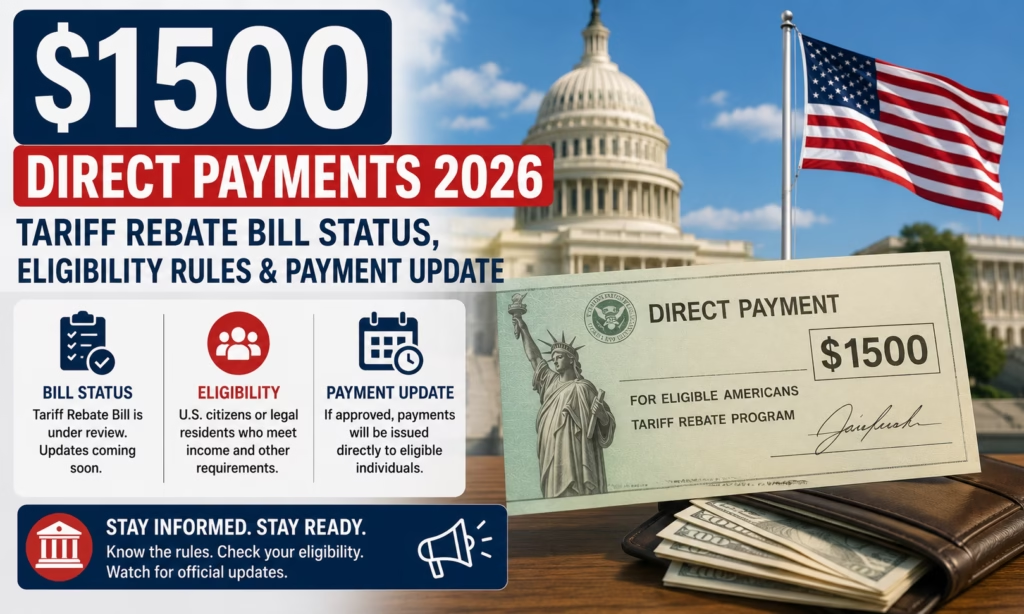
$1500 Direct Payments 2026: Millions of people searching for “$1500 direct payments” this week are landing on the same confusing mix of half-true headlines, and here is the clear version: no $1,500 check has been approved, funded, or scheduled by the IRS or the U.S. Treasury. What does exist is a real bill sitting in a House committee, built around a genuine Supreme Court ruling, that would send average payments close to that number to some households if it ever became law. That gap between “a bill was introduced” and “a check is coming” is exactly where the confusion online is coming from, and it is the core of this update. We’ll be updating this article monthly as the bill, and the competing proposals tied to it, move through Congress.
The number traces back to H.R. 7865, the American Consumer Tariff Rebate Act of 2026, introduced by Representative Henry Cuellar of Texas on March 9, 2026. Cuellar’s own congressional office released illustrative payment estimates using South Texas district tax filing data, putting the average rebate at roughly $1,020 for single filers, $1,530 for heads of household, and $2,040 for married couples filing jointly, plus a $125 bonus per qualifying child. The rounded head-of-household figure is almost certainly where the viral “$1,500” number originated. As of this update, the bill has not picked up a single cosponsor since it was introduced, has not been scheduled for a committee hearing, and has no path to a floor vote that congressional trackers are currently flagging.
What Triggered the Tariff Rebate Debate
This entire conversation started with a real court decision, not an online rumor. On February 20, 2026, the U.S. Supreme Court ruled that the administration’s use of the International Emergency Economic Powers Act to impose sweeping “reciprocal” and “trafficking” tariffs went beyond presidential authority, since the Constitution gives Congress, not the president, the power to set tariffs. Those tariffs had already pulled in more than $133 billion before the court struck them down, and separate estimates from the Court of International Trade litigation put the total figure closer to $175 billion once interest and additional collections are counted.
That ruling created two unresolved questions that lawmakers are still fighting over. First, how should the money already collected be returned, and who decides that, the courts or Congress. Second, who should actually receive any refund, the businesses that paid the tariffs directly at the border, or the consumers who arguably absorbed the higher prices at checkout. Treasury Secretary Scott Bessent has publicly downplayed the idea of automatic consumer refunds, telling reporters shortly after the ruling that ordinary Americans “won’t see” the money and that the refund question was “up to the lower court,” a comment that drew sharp pushback from Senate Democrats. That pushback is part of what is now fueling multiple competing rebate bills on Capitol Hill, of which H.R. 7865 is the most detailed.
$1500 Direct Payments: Key Highlights Table
| Detail | Information |
|---|---|
| Bill name | American Consumer Tariff Rebate Act of 2026 (H.R. 7865) |
| Sponsor | Rep. Henry Cuellar (D-TX-28) |
| Date introduced | March 9, 2026 |
| Current stage | Referred to House Ways and Means Committee, no cosponsors, no hearing scheduled |
| Funding basis | Estimated $231.35 billion in consumer costs tied to invalidated IEEPA tariffs |
| Average payment, single filer | Approximately $1,020 |
| Average payment, head of household | Approximately $1,530 |
| Average payment, married filing jointly | Approximately $2,040 |
| Extra per child | $125 per qualifying child |
| Income limit | Households with AGI above $400,000 excluded |
| Legal basis | February 20, 2026 Supreme Court ruling against IEEPA tariffs |
| Confirmed payment date | None. No date exists because the bill has not passed |
| Related proposal | Trump’s $2,000 tariff dividend, not written into legislation |
| Competing bills | Sen. Josh Hawley’s American Worker Rebate Act; Rep. Jasmine Crockett’s Payback Act |
Where the $1,500 Figure Actually Comes From
It is worth being precise here because several outlets have blurred this together with President Trump’s separate $2,000 “tariff dividend” comments, and the two are not the same thing.
H.R. 7865 does not promise a flat $1,500 to every taxpayer. The payment amount is based on filing status and household size, calculated from a share of the $231.35 billion cost estimate tied to the invalidated tariffs. Using South Texas district data as an illustrative example, Cuellar’s office cited roughly $1,020 for single filers, $1,530 for heads of household, and $2,040 for married joint filers, with an additional $125 for each qualifying child on top of the base amount. A family of four filing jointly could theoretically see a combined figure well above $2,000, while a single filer with no dependents would land closer to $1,000. The widely shared “$1,500” headline is really the head-of-household estimate rounded up, not a guaranteed universal payment.
Is the $1,500 Direct Payment Real or a Scam
The proposal itself is real. It has an official bill number, a named sponsor, published cost estimates, and specific legislative text that anyone can read on Congress.gov. That makes it fundamentally different from the outright hoaxes and phishing texts that occasionally circulate claiming a stimulus check is “already approved.” At the same time, no payment currently exists to claim, no application process has opened, and no federal agency has confirmed a distribution date. Any website, text message, or social media post asking for personal or banking information in order to “register early” for this rebate is not connected to any real government program and should be treated as a scam. State consumer protection offices have already issued warnings about copycat messages using this exact story as bait.
Current Legislative Status of H.R. 7865
According to official congressional tracking records, here is where the bill stands as of this update:
Introduced March 9, 2026, and referred immediately to the House Committee on Ways and Means. As of this update, the bill has zero cosponsors, meaning not a single other member of the House has formally signed on to support it. No committee markup session, hearing, or vote of any kind has been scheduled. Independent bill-tracking analysis from GovTrack notes that legislation referred to committee without further movement within several months of introduction often stalls for the remainder of that congressional session rather than advancing.
In plain terms, this is a formally filed, legitimate piece of legislation rather than an internet rumor, but it remains in the earliest possible stage of the lawmaking process. Passing a bill through the House Ways and Means Committee, a full House vote, a Senate committee, a full Senate vote, and a presidential signature is a long road, and H.R. 7865 has not cleared even the first of those steps.
How the $2,000 Tariff Dividend Fits Into This
President Trump has talked at multiple points over the past year about sending Americans a “tariff dividend,” with figures ranging up to $2,000 per person, funded by tariff revenue collected from importers. In one interview he suggested it could arrive “toward the end of the year,” while in earlier remarks he described a rebate for “middle income people and lower income people” funded by “so much money coming in” from tariffs. White House economic adviser Kevin Hassett has said publicly that any such dividend would require congressional legislation to actually happen, and as of this update, no formal bill matching that specific $2,000 flat-payment idea has been introduced in either chamber. That is the single biggest difference between Trump’s idea and Cuellar’s bill: H.R. 7865 has actual legislative text, a bill number, and cost estimates on file, while the $2,000 dividend remains a verbal proposal without a corresponding piece of legislation.
Independent economists have also questioned whether tariff revenue collected so far could realistically fund a flat $2,000 payment to every eligible adult nationwide, given that even the higher $175 billion refund estimate tied to the invalidated tariffs falls well short of the hundreds of billions such a program would cost at national scale.
Comparing the Competing Rebate Proposals
| Feature | H.R. 7865 (Cuellar) | Trump’s Tariff Dividend | Hawley’s American Worker Rebate Act |
|---|---|---|---|
| Status | Formally introduced, in committee | No bill introduced | Formally introduced |
| Amount | Varies by filing status, roughly $1,020 to $2,040 plus $125 per child | Flat $2,000 per person, as floated verbally | At least $600 per adult and child, or $2,400 for a family of four, higher if revenue exceeds projections |
| Funding source | $231.35 billion tied to invalidated IEEPA tariff costs | General tariff revenue, mechanism unclear | Tariff revenue collected in 2025 and 2026 |
| Income phase-out | Households above $400,000 AGI excluded entirely | Not specified | Reduced 5% above $150,000 joint or $75,000 single AGI |
| Sponsor | Rep. Henry Cuellar (D-TX) | President Trump, via public remarks | Sen. Josh Hawley (R-MO) |
A fourth proposal, Rep. Jasmine Crockett’s Payback Act, was introduced on February 23, 2026, directing the Treasury Secretary to develop a transparent refund formula for tariffs collected unlawfully, following the same Supreme Court ruling. None of these four proposals, Cuellar’s, Trump’s, Hawley’s, or Crockett’s, has passed either chamber of Congress as of this update, which underscores that this is an active, multi-bill policy fight rather than a single program close to launch.
Who Would Qualify If the Bill Eventually Passed
Based on the current text of H.R. 7865, eligibility would extend to taxpayers who filed a federal individual income tax return for the most recent tax year, with automatic enrollment based on that return. Households with adjusted gross income above $400,000 would be excluded entirely, with the resulting savings redirected toward larger per-child payments for qualifying families instead. An additional $125 would be added per qualifying child, on top of the base filing-status amount. A simplified filing option would be created for non-filers who would otherwise qualify but do not currently have a tax return on record, similar to the process the IRS used during the pandemic for people who don’t normally file taxes.
None of this is active policy today. It describes only what would happen if the bill were signed into law, which has not occurred.
How to Apply for the $1,500 Direct Payment
There is currently no application process because there is no approved program. If H.R. 7865 or a similar bill eventually passes, the legislative text points to an automatic payment system rather than a separate application. Treasury would use existing IRS filing data, direct deposit information, and mailing addresses already on file to issue payments without requiring people to submit a new form. The simplified non-filer portal, if created, would mirror the tool the IRS built during the 2020 and 2021 stimulus rounds for people who don’t normally file taxes but would otherwise qualify. Until any version of this bill is signed into law, there is no portal to register on, no waitlist to join, and no legitimate reason for any website to ask for your Social Security number or bank details in connection with this specific proposal.
Processing Time, If the Bill Passes
Congress has not set a processing timeline because no version of this bill has cleared committee. As a point of reference, past federal stimulus payments under the CARES Act, the Consolidated Appropriations Act, and the American Rescue Plan Act typically began direct deposits within two to three weeks of a bill being signed into law, with paper checks and prepaid debit cards following over the subsequent one to two months for people without direct deposit information on file. If H.R. 7865 or a similar rebate bill were eventually enacted, a comparable rollout timeline is the closest realistic estimate available, though the IRS would need to issue its own official schedule once and if that happens.
Payment Schedule: Is There a Confirmed Date
No. This is one of the most searched questions tied to this story, and the honest answer is that no payment date exists because no payment has been authorized. Any website, video, or social post listing specific deposit dates for a “$1,500 direct payment” is either confusing this proposal with an unrelated program, such as ordinary IRS tax refunds or the Earned Income Tax Credit, or publishing unverified speculation designed to generate clicks. If Congress eventually passes legislation along these lines, the IRS has historically announced a distribution timeline publicly within days of a bill being signed, the way it did during the pandemic stimulus rounds.
Real Payments Currently Available in 2026
This part often gets buried under the tariff rebate headlines, but it is genuinely useful. Several states are running their own separate, fully funded rebate or relief programs in 2026, including Pennsylvania, New Jersey, New York, Oregon, Colorado, and California. These programs are confirmed, already funded through state budgets, and completely separate from anything tied to federal tariff policy or Congress. Eligibility rules, payment amounts, and timelines differ by state, so checking your own state’s department of revenue or taxation website directly is the reliable way to find out if you qualify, rather than relying on national headlines about the federal tariff rebate fight.
Official Resources and Status Check Links
| Resource | Purpose | Official Link |
|---|---|---|
| Congress.gov, H.R. 7865 | Official bill status, text and actions | congress.gov/bill/119th-congress/house-bill/7865 |
| GovTrack.us, H.R. 7865 | Independent tracking and passage-likelihood analysis | govtrack.us/congress/bills/119/hr7865 |
| Rep. Henry Cuellar’s official site | Original press release and sponsor updates | cuellar.house.gov |
| Sen. Josh Hawley’s official site | American Worker Rebate Act text and updates | hawley.senate.gov |
| IRS.gov | Tax filing status, AGI details and any future official payment announcements | irs.gov |
| U.S. Supreme Court opinions | Full text of the February 20, 2026 tariff ruling | supremecourt.gov |
| U.S. Treasury Department | Official statements on tariff refund policy | home.treasury.gov |
There is no login portal, registration page, or payment status tracker for this proposal at this time, since no program has been signed into law. The links above are for tracking legislative progress only, not for applying or checking a payment.
People Also Ask
Is the $1500 stimulus check confirmed for 2026? No. The $1,500 figure comes from a real bill, H.R. 7865, but Congress has not passed it, and the IRS has not confirmed any payment.
When will the $1500 direct payment be deposited? There is no deposit date because no law authorizing the payment currently exists. A schedule would only be announced after the bill passes and is signed into law.
Who is eligible for the tariff rebate check? Under the bill as written, taxpayers who filed a recent federal return, with household income at or below $400,000 AGI, would qualify automatically, plus $125 per qualifying child.
Is this the same as Trump’s $2,000 stimulus check? No. They are separate proposals. Cuellar’s H.R. 7865 is a specific bill with published cost estimates. Trump’s $2,000 idea has been discussed publicly but has not been introduced as formal legislation.
Do I need to apply for the $1500 payment? Not currently, since the program does not exist yet. If the bill passes, payments are expected to be issued automatically based on IRS tax return data.
How much tariff money has actually been collected? More than $133 billion had been collected under the tariffs the Supreme Court struck down, with some broader estimates from ongoing litigation placing the total closer to $175 billion.
FAQs
What is H.R. 7865?
H.R. 7865, the American Consumer Tariff Rebate Act of 2026, is a bill introduced by Rep. Henry Cuellar that would send one-time rebate payments to eligible taxpayers, funded by an estimated $231.35 billion tied to tariffs the Supreme Court ruled unconstitutional.
Why is a tariff rebate being discussed right now?
It follows the February 20, 2026 Supreme Court ruling that the administration’s use of emergency powers to impose certain tariffs exceeded presidential authority, since only Congress can set tariffs under the Constitution.
Has any version of a tariff rebate check actually been sent to consumers?
No. As of this update, no individual consumer rebate payments under any of these proposals have gone out. Some businesses have separately pursued refund claims for tariffs they paid directly, through the courts.
What income limit applies to the proposed $1,500 payment?
Households with adjusted gross income above $400,000 would be excluded entirely under H.R. 7865 as currently written.
Are state stimulus or rebate payments in 2026 real?
Yes. States including Pennsylvania, New Jersey, New York, Oregon, Colorado, and California have active, funded rebate programs in 2026 that are entirely separate from the federal tariff rebate debate.
How can I track this bill myself instead of relying on headlines?
Search “H.R. 7865” directly on Congress.gov or GovTrack.us for the most current, official record of any committee action, cosponsors, or scheduled votes.
Conclusion
There is no $1,500 check coming from the IRS this month, this quarter, or on any confirmed date. What exists is a formally introduced bill, H.R. 7865, sitting in a House committee with zero cosponsors since March, built around a genuine Supreme Court ruling that is still working its way through the lower courts on the refund question. It is competing for attention with at least three other proposals, Trump’s $2,000 tariff dividend idea, Senator Hawley’s American Worker Rebate Act, and Representative Crockett’s Payback Act, none of which have passed either chamber of Congress. Until lawmakers actually vote on one of these bills and the IRS issues an official payment announcement, the safest approach is to treat every specific date, dollar figure, or “apply now” link tied to this story as unconfirmed, and to check Congress.gov directly rather than trusting secondhand headlines. This article will be reviewed and updated monthly as the legislative situation develops.
Missouri SNAP Food Ban Delayed: What’s Banned & Latest Status
Hawaii SNAP Soda Ban Delayed to 2027: What Will Be Banned & Status
Florida SNAP Junk Food Ban 2026: What’s Banned, Court Update, EBT Rules & Latest Status
Nevada SNAP Food Ban: What’s Banned & Start Date Explained