Social Security Checklist 2026: In 2026, Social Security recipients are getting a COLA rise of 2.8%. To prevent benefit errors, review your earnings record. To avoid surprises, confirm tax withholding and correct Form W-4V. Verify the direct deposit information to make sure payments are made on schedule. Make sure your mySocialSecurity account is up to date.
Millions of Social Security recipients are getting ready for a 2.8% cost-of-living adjustment (COLA) that will increase monthly benefits in 2026. This annual increase is calculated by the Social Security Administration (SSA) to counteract inflation and preserve the spending power of survivors, retirees, and handicapped workers.

Social Security Checklist 2026
Timely is crucial since more Americans are depending on Social Security for basic income. Payment disruptions may result from inaccurate earnings data, out-of-date bank account information, or unconfirmed direct deposit details, particularly as the SSA fully switches to electronic payments. Beneficiaries can guarantee seamless processing and get their full adjusted benefits in May 2026 by taking a few proactive measures now.
Increased benefits may result in unforeseen tax obligations. Up to 85% of your Social Security benefits may be subject to taxation if your total income surpasses specific criteria. Examine your federal withholding now to avoid a big bill during tax season. You can request that 7%, 10%, 12%, or 22% of your monthly payment be withheld for taxes by submitting IRS Form W-4V to the Social Security Administration. You can stay in compliance with the IRS by updating this before January 1st, which guarantees that your withholdings match the new Social Security amounts.
When payment will be released in May?
For timely payments, the Social Security Payment depends on correct data. Your lifetime benefit amount may be permanently reduced by even a minor inaccuracy in your reported earnings for the prior year. To confirm that your income statistics for this year as they are accurate, log onto your “my Social Security” account. Verify your direct deposit details again as well.
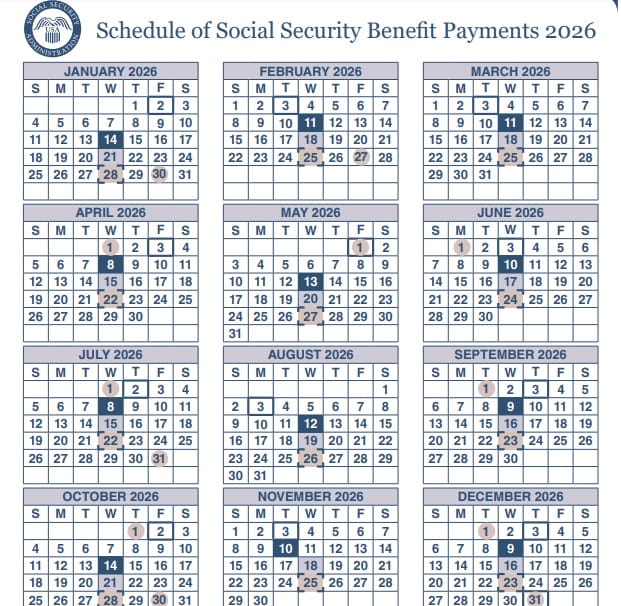
The simplest approach to avoid a missing or delayed check is to make sure your banking information is up to date, as the Social Security Payment 2026 of May month for SSI beneficiaries is scheduled to be released on 1st May (for pre 1997 retires), Wednesdays including (8, 15 & 22) depending on the birth dates.
You must keep an eye on the 2026 earnings test restrictions if you are still employed and under full retirement age. The cap increases to $24,480 for the next year. For every $2 you make beyond this threshold, the SSA will temporarily withhold $1 from your benefits. The immediate impact on your cash flow can be substantial, even though these monies are eventually repaid to you through larger monthly payments after you reach full retirement age. Your monthly budget will remain predictable and overpayment alerts can be avoided by reporting your projected 2026 earnings prior to the start of the new year.
Experts also emphasize that even small errors, like unreported employment activity or missing wage data, can have a big impact on benefit estimates. Before the new year, reviewing data, changing accounts, and verifying tax with holdings will help recipients maximize their 2026 Social Security income without interruption and avoid expensive delays.
Social Security Pay Dates for 2026
How can you optimize benefits by reviewing your earnings history?
A worker’s greatest 35 years of earnings are used to compute Social Security payments. It’s critical to confirm the correctness of your records because missing or inaccurate wages will lower your lifetime benefits. To verify that all earnings are accurately reported, beneficiaries can access their mySocialSecurity account.
Even little inconsistencies, such unreported overtime or years skipped, might have a big long-term financial impact. You may make sure that the SSA uses correct information for determining your 2026 benefits by checking and updating records prior to the receiving month. Corrections can take several weeks to process, and any delay could impact the first payments of the new year, so it’s critical to address these updates as soon as possible.
How can you verify your selections for tax withholding?
Form W-4V can be used by Social Security recipients who pay federal income taxes to seek automatic withholding from their benefits. In order to prevent surprises during the 2026 tax season, it is important to review and update this form to ensure that the correct amount is deducted.
Reporting occupational activity and wages is required for Social Security Disability Insurance (SSDI) recipients. Beneficiaries must provide this information to the SSA either over the phone or online. Failing to notify changes could lead to over payments that the SSA will eventually recoup, which could lower future benefit payments. Making sure tax information is current today avoids needless issues and maintains financial stability.
Why is it so important to update Direct Deposit Information?
The SSA has done away with paper checks as of this year. These days, all Social Security benefits are sent electronically via Direct Deposit or a Direct Express Debit Mastercard. In order to prevent payment delays in May 2026, beneficiaries must verify that their bank account details are up to date.
Payments that are missed or misdirected can be avoided by promptly updating the SSA if a bank account has closed or changed. In order to pay for rent, electricity, prescription drugs, and other necessities, regular payments are crucial, as the average monthly Social Security payout will be approximately $1,800. Making sure that deposit information is correct now protects against needless interruptions at the beginning of the year.
How can you maintain the most recent version of your My Social Security account?
All information pertaining to benefits, such as earnings records, payment schedules, and predicted benefits, is centrally located on the mySocialSecurity portal. In order to guarantee that the SSA has accurate data, you should update your personal information, contact details, and any changes to your living circumstances.
Frequent account monitoring enables you to obtain necessary resources, track impending payments, and identify issues early. When the 2026 COLA increase is implemented, keeping your account up to date reduces the possibility of delays or problems.
FAQ’s about Social Security Checklist 2026
What is the main reason behind the disbursement of Social Security Payment?
Social Security payments provide financial stability by offsetting the loss of income resulting from retirement, disability, or death, thereby ensuring a basic standard of living for individuals and their families.
What are the pay dates for upcoming month?
Social Security Payment 2026 of May month for SSI beneficiaries is scheduled to be released on 1st May (for pre 1997 retires), Wednesdays including (8, 15 & 22) depending on the birth dates.
How to be sure whether your data is correct on portal or not?
In order to guarantee that the SSA has accurate data, you should update your personal information, contact details, and any changes to your living circumstances.
What is the pay date for the beneficiaries in the month of may 2026?
In May 2026, Social Security payments will begin on May 1st with SSI, followed by a special payment on May 2nd (for beneficiaries prior to 1997), and separate payments for others—based on their date of birth—on May 13, 20, and 27.
Also Read :-
$4200 Social Security Back Payment in 2026 [Fact Check]- What Beneficiaries Should Know
$1800 Social Security Payment 2026 – Verified Details, Eligibility & Reality Check!
$1508 CPP Payment 2026 Deposit Date – Check Eligibility, Pay Schedule & Fact Check!
{Fact Check} SSS ₱1000 2nd Tranche Pension Increase: Who Qualifies for April?