In 2026, U.S. states will increase the minimum wage to 20 dollar (expected), increasing the income of millions of workers from Arizona to New Jersey. On January 1, a number of states controlled by Republicans and Democrats will boost their wage floors in accordance with inflation-adjusted increases or as part of planned increases that go into effect at the start of each year.
The left-leaning Economic Policy Institute, or EPI, estimates that 8.3 million workers will benefit from the pay hikes, earning a total of $5 billion by 2026.
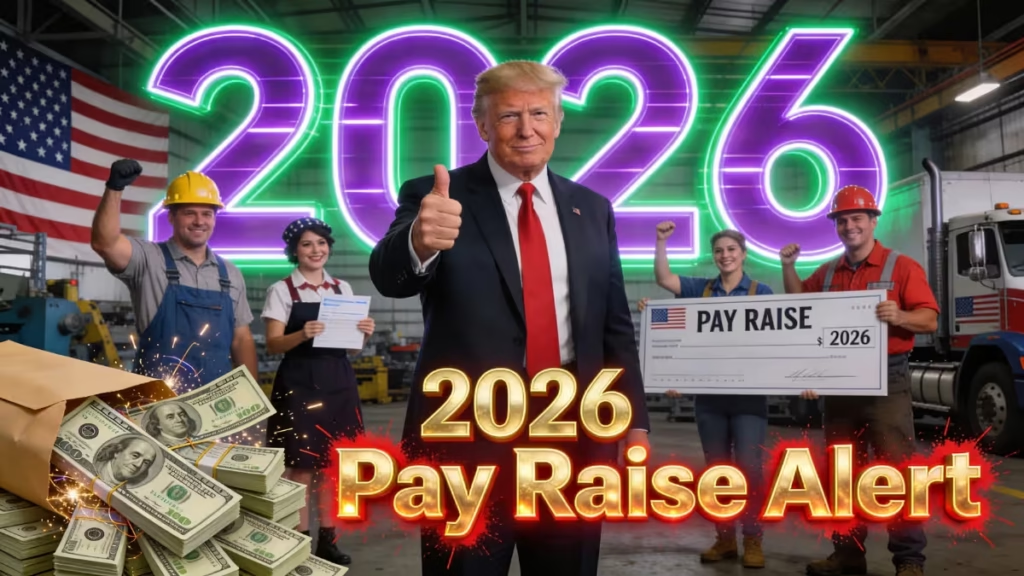
2026 Pay Raise Alert: Minimum Wage Is Rising
According to the EPI, starting next year, there will be more workers in states that guarantee a $15 minimum wage than in those that offer the federal wage floor of $7.25 per hour. Washington will have the highest minimum wage after the wave of wage increases, paying employees $17.13 an hour.
Due to the state’s implementation of a minimum hourly salary of $17 for workers in New York City, Long Island, and Westchester, workers in New York will benefit from the second-highest wage floor. Workers in New York will be paid at least $16 per hour outside of those locations.
Which States Are Giving Raises
Arizona, California, Colorado, Connecticut, Hawaii, Maine, Michigan, Minnesota, Missouri, Montana, Nebraska, New Jersey, New York, Ohio, Rhode Island, South Dakota, Vermont, Virginia, and Washington are among the 19 states that will boost their minimum wages on Thursday.
Some of the roughly 50 cities and other localities that will raise the minimum wage will implement the highest salary ceilings in the country.
Pay increases will be implemented in 29 Californian cities, including West Hollywood, where a $20.25 hourly wage minimum will be implemented. The minimum wage will be raised in eight Washington localities, including Tukwila, which has the highest wage floor in the nation at $21.65 per hour.
However, 20 Southern states with either no minimum wage or a minimum wage that falls short of the federal minimum will not be impacted by the most recent round of pay hikes.
Congress raised the pay floor to its present level in 2009, marking the most recent increase in the federal minimum wage. Since then, inflation has reduced the federal minimum wage by more than 30%.
States set to raise their minimum wage 2026
- Arizona – $15.15
- California – $16.90
- Colorado – $15.16
- Connecticut – $16.94
- Hawaii – $16.00
- Maine – $15.10
- Michigan – $13.73
- Minnesota – $11.41
- Missouri – $15.00
- Montana – $10.85
- Nebraska – $15.00
- New Jersey – $15.92
- New York – $17.00 in New York City, Long Island and Westchester; $16 for the remainder of the state
- Ohio – $11.00
- Rhode Island – $16.00
- South Dakota – $11.85
- Vermont – $14.42
- Virginia – $12.77
- Washington – $17.13
In 2026, which state will have the highest minimum wage?
With a minimum salary of $17.13 per hour in 2026, Washington will have the highest minimum pay of any state.
Since the state establishes a minimum hourly salary of $17 for workers in New York City, Long Island, and Westchester, certain workers in New York will experience the second-highest wage floor. The minimum wage for the remainder of the state will be $16.
The minimum wage in the District of Columbia will continue to be $17.95 per hour even if it is not a state.
Later in 2026, states will raise the minimum wage
Alaska: Starting on July 1, 2026, the hourly wage will increase from $13 to $14.
Florida: On September 30, 2026, it will increase to $15 per hour.
Oregon: The nonurban county rate is currently $14.05 per hour, while the Portland metro rate is currently $16.30 per hour. The standard rate of $15.05 per hour will be adjusted based on CPI inflation data on July 1.
Which states have the lowest minimum wage?
Twenty states either have no minimum wage at all or have one that falls short of the federal minimum of $7.25. The minimum wage in the following states is $7.25 per hour:
- Iowa
- Idaho
- Indiana
- Kansas
- Kentucky
- North Carolina
- Dakota
- New Hampshire
- Oklahoma
- Pennsylvania
- Wisconsin, Texas, and Utah
Six more states either have no minimum wage at all or have one that is less than the federal minimum wage, although these wages only apply to a tiny portion of workers who are not subject to the federal rules dictating employee compensation. There is no set minimum wage in these states:
- Alabama
- Georgia
- Louisiana
- Mississippi
- South Carolina
- Tennessee
- Wyoming
Also Read:
US $4873 April 2026 Direct Deposit Fact Check: Check Eligibility & Full Payment Schedule!
$2000 Stimulus Check in April 2026 – Fact Check [ Confirmed?]
$2000 IRS Direct Deposit April 2026 Confirmed: Know Eligibility, Payout Dates & Fact Check!
$1000 Alaska Stimulus Check April 2026: Verify Eligibility, Deposit Schedule & Fact Check!
$215.40 Centrelink Rent Assistance Increase 2026 – Are You Eligible?