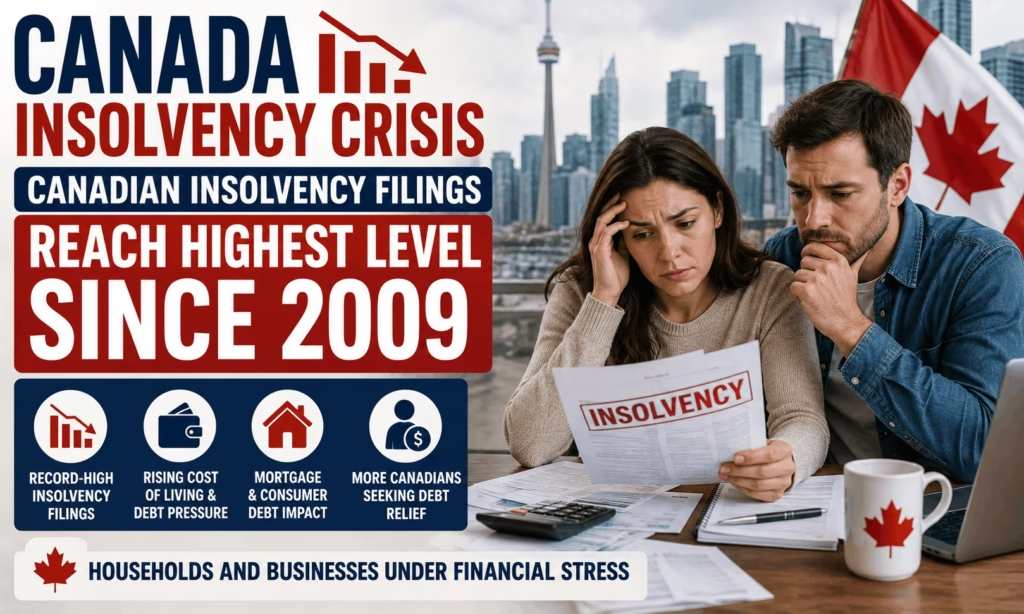
Canada Insolvency Crisis 2026: Insolvency filings across Canada have surged to levels not seen since the aftermath of the 2009 global financial crisis, as thousands of overburdened households reach their absolute financial breaking point. Official statistical reporting released by the Office of the Superintendent of Bankruptcy (OSB) confirms that 37,121 Canadian consumers filed for formal insolvency relief in the first quarter of 2026 alone. According to the Canadian Association of Insolvency and Restructuring Professionals (CAIRP), this represents a steep 8.5 per cent year-over-year increase and equates to an astounding average of roughly 17 Canadians filing for insolvency every single hour. Decades of accumulating household debt, sticky borrowing costs, persistent grocery inflation, and an accelerating wave of mortgage renewals at significantly higher interest rates are combining to create an acute household budget squeeze. We’ll be updating this article monthly.
While macroeconomic indicators show inflation moderating from its multi-decade peaks, everyday living expenditures remain structurally elevated compared to pre-pandemic baseline figures. For millions of working families, the financial margin of safety has completely vanished, leaving no buffer to absorb sudden rent increases, unexpected vehicle repairs, or minor employment disruptions. Financial analysts note that the Canada insolvency crisis 2026 is fundamentally driven by compounded debt servicing costs rather than a single sudden economic shock. As interest rates remain far above the ultra-low levels enjoyed over the past decade, consumers who previously relied on high-interest credit cards and personal lines of credit to bridge monthly income shortfalls can no longer sustain their debt service payments.
Key Highlights of the Canadian Insolvency Surge
| Insolvency Metric | Official Data & CAIRP Key Findings |
| Q1 2026 Consumer Filings | 37,121 filings (Highest quarterly volume since 2009) |
| Hourly Filing Rate | Roughly 17 Canadians filing per hour on average |
| Year-Over-Year Growth | 8.5% increase compared to Q1 2025 |
| Quarter-Over-Quarter Growth | 6.5% increase compared to Q4 2025 |
| 12-Month Trailing Consumer Total | Over 148,000 total filings under the Bankruptcy and Insolvency Act |
| Dominant Relief Mechanism | Consumer Proposals account for over 78% of all consumer filings |
| Most Impacted Age Demographics | Ages 35 to 49 represent the largest single proportion of filings (38.3%) |
| Provinces with Highest Growth | British Columbia (+10.6%), Newfoundland & Labrador (+7.0%), PEI (+6.1%) |
Understanding the Root Causes of the Canada Insolvency Crisis 2026
The current spike in personal restructuring filings is the result of multiple structural economic pressures intersecting simultaneously across Canadian households.
1. The Mortgage Renewal Payment Shock
Hundreds of thousands of Canadian homeowners who secured five-year fixed mortgage rates at historically low levels during the 2020 and 2021 pandemic period are facing mandatory contract renewals. Even with recent policy rate adjustments by the Bank of Canada, prevailing mortgage interest rates remain double or triple the baseline rates of five years ago. This interest rate step-up translates into hundreds or even thousands of dollars in additional monthly mortgage payments for average homeowners, severely eroding discretionary household income and forcing homeowners to default on secondary unsecured debts.
2. Reliance on Unsecured Credit to Offset Inflation
Over the past three years, essential goods such as groceries, home heating, transportation, and auto insurance have experienced significant cumulative price inflation. When real wage growth fails to keep pace with basic cost-of-living increases, families routinely turn to revolving credit instruments. Average credit card interest rates in Canada hover between 19.99 per cent and 24.99 per cent. Carrying balances on these products creates a compounding interest spiral that rapidly consumes household income.
3. Softening Labor Market and Hours Reduction
Although headline national unemployment figures have stayed relatively stable, underlying labor statistics reveal a marked decline in overtime hours, gig economy earnings, and secondary income opportunities. In an environment where many Canadian families rely on two full-time incomes plus side employment to cover living costs, even a slight reduction in total working hours or a temporary layoff can trigger immediate insolvency.
4. Record High Household Debt-to-Income Ratios
Canada continues to maintain one of the highest household debt-to-disposable-income ratios among G7 nations. For every dollar of disposable income earned, Canadian households owe approximately $1.75 to $1.80 in total credit market debt. This high level of leverage makes the financial system exceptionally vulnerable to small changes in interest rates or living expenses.
Fact Check: $791 Extra Payment For 2026 Claim – Real Scheme or Scam?
Consumer Proposals vs. Personal Bankruptcy: How Canadians Are Seeking Relief
Under the federal Bankruptcy and Insolvency Act (BIA), Canadians facing unmanageable debt have two primary legal options administered exclusively by a Licensed Insolvency Trustee (LIT).
The Surge in Consumer Proposals
A consumer proposal is a legally binding offer negotiated between a debtor and their unsecured creditors to settle total debt for a percentage of what is owed, or to extend the time required to pay. According to OSB data, consumer proposals now represent more than 78 per cent of all consumer insolvency proceedings filed in Canada.
- Assets Protection: Unlike personal bankruptcy, a consumer proposal allows individuals to retain their assets, including home equity, motor vehicles, and registered savings plans.
- Interest Freeze: Once a proposal is formally filed, all legal actions, wage garnishments, and collection calls cease immediately, and interest charges are frozen.
- Fixed Monthly Payments: Payments are structured into a predictable, fixed monthly sum over a maximum period of five years.
Personal Bankruptcy as a Last Resort
While personal bankruptcy filings have decreased as a percentage of total insolvencies, it remains the necessary legal path for individuals with minimal income and zero capacity to make ongoing proposal payments. Personal bankruptcy yields a complete discharge of most unsecured debts, usually within 9 to 21 months for first-time bankrupts, but requires the surrender of non-exempt equity assets.
Provincial Breakdown: Where Financial Strain Is Escalating Fastest
Financial strain is not distributed uniformly across the country. Provincial data published by the OSB reveals distinct economic patterns influenced by regional housing markets, local tax structures, and industry sector performance.
British Columbia and Ontario Lead Metropolitan Insolvencies
Both British Columbia and Ontario have recorded consistent increases in insolvency filing volumes. British Columbia experienced a 10.6 per cent year-over-year rise in consumer filings, driven heavily by severe housing unaffordability and high mortgage debt loads in the Greater Vancouver area. Ontario recorded over 1,200 additional consumer insolvency filings year-over-year, reflecting severe budget pressure across the Greater Toronto Area (GTA).
Atlantic Canada and Western Provinces
Newfoundland & Labrador (+7.0%) and Prince Edward Island (+6.1%) recorded notable relative increases in consumer insolvencies, driven by escalating fuel, freight, and utility costs. Conversely, provinces like Saskatchewan (-9.7%) saw declines in insolvency filings, benefiting from relative housing affordability and stability in agricultural and resource sectors.
$2400 Working Families Refund: Eligibility, Income Limits & Status
25 States Sue Trump Administration Over New Tariffs on Trading Partners
Trump Accounts Dell $250 Grant: Check State & ZIP Code Eligibility
Commercial and Business Insolvency Trends
While consumer filings reached historical peaks, business insolvencies under the BIA showed mixed signals.
On an annual trailing basis, corporate bankruptcies and debt restructurings eased compared to prior spike years, but quarterly business insolvencies rose nearly 10 per cent quarter-over-quarter in early 2026. Small and medium-sized enterprises (SMEs) in labor-intensive industries continue to struggle with elevated commercial rent, high borrowing costs, softer retail consumer demand, and ongoing trade or tariff uncertainties.
The business sectors recording the highest volume of restructuring filings include:
- Construction: Highly sensitive to delayed projects, high material prices, and elevated financing costs.
- Accommodation and Food Services: Impacted directly by reduced consumer discretionary spending on dining out and travel.
- Retail Trade: Operating under narrow profit margins amidst shifting consumer buying patterns and rising supply chain expenses.
Official Insolvency Resources and Portal Links
Canadians seeking reliable information regarding insolvency statistics, trustee registries, or debt restructuring regulations should consult official federal and professional association portals.
| Government & Professional Resource | Official Web Portal Link |
| Office of the Superintendent of Bankruptcy (OSB) | Official OSB Canada Portal |
| Directory of Licensed Insolvency Trustees | Find a Licensed Insolvency Trustee |
| CAIRP Professional Insolvency Association | CAIRP Official Website |
| Financial Consumer Agency of Canada (FCAC) | FCAC Debt Management Tools |
| Companies’ Creditors Arrangement Act Registry | CCAA Public Records Registry |
FAQs
Why are Canadian insolvency filings reaching levels not seen since 2009?
Consumer insolvency filings have surged because millions of Canadian households are struggling under the combined weight of high living expenses, elevated interest rates, accumulated credit card debt, and substantial mortgage renewal rate increases.
What is the difference between a consumer proposal and bankruptcy in Canada?
A consumer proposal is an agreement negotiated with your creditors through a Licensed Insolvency Trustee to pay back a portion of your debt over up to five years, allowing you to keep your assets. Personal bankruptcy involves surrendering non-exempt assets in exchange for a full discharge of eligible unsecured debts.
Will filing for insolvency stop collection calls and wage garnishments in Canada?
Yes. As soon as a Licensed Insolvency Trustee files a consumer proposal or bankruptcy with the Office of the Superintendent of Bankruptcy, an automatic stay of proceedings takes effect. This legally freezes all collection calls, lawsuits, interest charges, and wage garnishments.
How does filing for insolvency affect my credit score in Canada?
Filing a consumer proposal results in an R7 credit rating, which remains on your credit report for three years after completion. Personal bankruptcy results in an R9 credit rating, which stays on your report for six years after discharge for a first-time filing.
Who is eligible to file a consumer proposal in Canada?
To qualify for a consumer proposal, you must be an individual residing or owning property in Canada, be insolvent (unable to pay debts as they come due or having liabilities exceeding asset values), and owe less than $250,000 in total debt (excluding the mortgage on your primary residence).
Conclusion
The escalation of the Canada insolvency crisis 2026 highlights the severe financial strain facing households across the nation. As the quarterly volume of consumer filings reaches its highest point since the 2009 financial crisis, thousands of Canadians are taking formal legal action to address unsustainable debt loads. While macro-level challenges like elevated borrowing costs and mortgage renewal pressure continue to weigh on family budgets, early intervention through a Licensed Insolvency Trustee offers a structured, legally protected pathway toward financial recovery. Monitoring official OSB data releases remains essential for understanding how Canadian consumers and businesses are adapting to this evolving economic landscape.
PPTC-153 and US Entry Without a Visa: What It Really Means
Alaska PFD Payment 2026: It’s Actually $1,200, Not Just $1,000 – Here’s the Truth
Social Security Changes August 2026: SSA Announces Major Update for Retirees and Beneficiaries