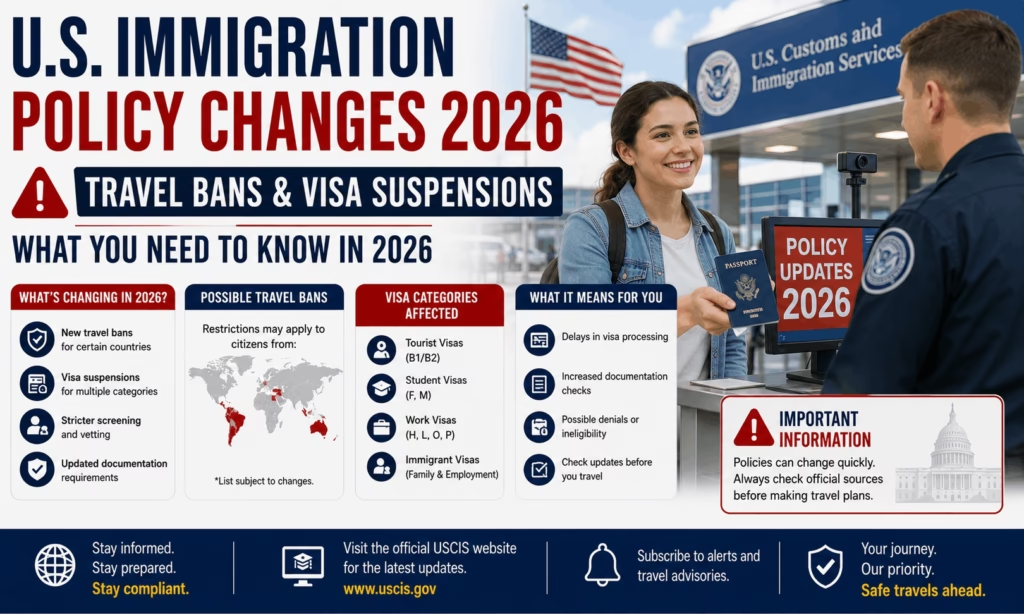
U.S Immigration Policy Changes 2026: The US travel ban 2026 isn’t a future proposal, it’s been active law since January 1, 2026, and understanding it requires untangling three separate government actions that frequently get confused with each other. Presidential Proclamation 10998, signed December 16, 2025, expanded an earlier June 2025 ban to fully or partially restrict entry for nationals of 39 countries plus individuals traveling on Palestinian Authority-issued travel documents. Separately, on January 21, 2026, the State Department paused immigrant visa processing for 75 countries, a broader, distinct action affecting people already in the green card pipeline abroad. And in a major twist, a federal court in Rhode Island ruled on June 5, 2026, that USCIS’s own internal processing holds tied to these proclamations were unlawful, though the government has appealed and the underlying entry ban itself remains in effect. We’ll be updating this article monthly as this litigation, currently the most active front in U.S. immigration policy, continues to develop.
This guide separates these three distinct actions clearly, gives you the complete, verified list of affected countries by restriction tier, and covers exactly what’s still enforceable today versus what a federal court has already struck down. Every detail here is sourced directly from the proclamation text, Congressional Research Service analysis, and official court filings, not secondhand summaries that often conflate these separate policies.
U.S Immigration Policy Changes 2026 Key Highlights
| Item | Details |
|---|---|
| Governing proclamation | Presidential Proclamation 10998 (builds on Proclamation 10949, June 2025) |
| Signed | December 16, 2025 |
| Effective date | 12:01 a.m. ET, January 1, 2026 |
| Full entry suspension | 19 countries (all immigrant + nonimmigrant visas blocked) |
| Partial entry suspension | 19 countries (immigrant + B, F, M, J visas blocked) |
| Special case | Turkmenistan — only immigrant visas suspended |
| Also restricted | Individuals traveling on Palestinian Authority-issued travel documents |
| Separate action: Immigrant visa processing pause | 75 countries, announced January 21, 2026, affects consular-processing green card applicants abroad |
| Existing visa holders | Not affected — valid visas issued before Jan 1, 2026 remain usable |
| Major court ruling | June 5, 2026 — U.S. District Court (Rhode Island) struck down USCIS’s adjudication-hold memos as unlawful |
| Current USCIS status | Complying with court order, resuming applications (including OPT/STEM OPT), pending government appeal |
| Mandatory review cycle | Secretary of State must report every 180 days on whether to continue, modify, lift, or expand restrictions |
What Is Presidential Proclamation 10998, and Is It Still in Effect?
Yes, it is currently in effect. Proclamation 10998, titled “Restricting and Limiting the Entry of Foreign Nationals to Protect the Security of the United States,” took effect at 12:01 a.m. Eastern Time on January 1, 2026, and expands an earlier proclamation (10949) from June 4, 2025. It applies specifically to nationals of the listed countries who were outside the United States on January 1, 2026, and did not already hold a valid U.S. visa as of that date. The administration has framed the policy goal as protecting the U.S. from foreign nationals who pose terrorism, national security, public safety, or hate-crime risks, citing deficient screening, vetting, and information-sharing systems in the affected countries.
Full Suspension: Which 19 Countries Face a Complete Travel Ban?
Nationals of these countries currently face a complete suspension of all immigrant and nonimmigrant visas, meaning no tourist, student, work, or any other visa category is being issued:
Afghanistan, Burkina Faso, Burma (Myanmar), Chad, Republic of the Congo, Equatorial Guinea, Eritrea, Haiti, Iran, Laos, Libya, Mali, Niger, Sierra Leone, Somalia, South Sudan, Sudan, Syria, Yemen
Maximum Social Security Benefit 2026: How to Actually Get $5,181/Month
Partial Suspension: Which 19 Countries Face Limited Restrictions?
Nationals of these countries face a partial suspension, generally blocking immigrant visas plus B-1/B-2 (tourist/business), F and M (student), and J (exchange visitor) nonimmigrant visas, while other categories like H-1B or L-1 may still be issued, though often with shortened validity periods:
Angola, Antigua and Barbuda, Benin, Burundi, Côte d’Ivoire, Cuba, Dominica, Gabon, The Gambia, Malawi, Mauritania, Nigeria, Senegal, Tanzania, Togo, Tonga, Venezuela, Zambia, Zimbabwe
Turkmenistan is a special, standalone case: only immigrant visas are suspended, nonimmigrant visas of any type may still be issued to Turkmen nationals.
What About the Separate 75-Country Immigrant Visa Pause?
This is the action most frequently confused with the travel ban itself, but it’s a distinct, broader policy. On January 21, 2026, the U.S. Department of State announced it would suspend immigrant visa processing for nationals of 75 countries. Unlike the entry ban, this pause applies specifically to intending immigrants applying from outside the United States, people who have already filed, or are beneficiaries of, an approved immigrant petition (such as Form I-130, I-140, or I-360) and are awaiting green card processing through the National Visa Center. This action was framed around concerns over “public benefits usage” risk among applicants from certain nationalities, separate from the security-vetting rationale behind the 39-country entry ban.
Are Existing Visa Holders and Green Card Holders Affected?
No, generally not. Several categories are explicitly exempted or unaffected under the proclamation:
- Lawful permanent residents (green card holders)
- Individuals who already held a valid U.S. visa as of January 1, 2026 — these visas were not revoked and remain usable, including for re-entry, though travelers should expect increased vetting from Customs and Border Protection
- Certain specific visa categories, including some athletes and government officials
- Individuals for whom DHS determines entry serves a U.S. national interest, evaluated case-by-case
However, USCIS has stated that immigration benefits approved on or after January 20, 2021, for nationals of the 39 listed countries are subject to re-review, and pending applications and petitions from affected nationals have, at various points, been placed on hold, a policy now at the center of active litigation (see below).
What Happened in the June 5, 2026 Court Ruling?
This is the most significant recent development, and it’s crucial to understand precisely what it does and doesn’t affect. USCIS had issued two internal policy memoranda implementing processing holds tied to the travel ban countries:
- PM-602-0192 (December 2, 2025) — imposed an adjudication hold tied to the original 19-country list, and placed a nationwide hold on asylum applications
- PM-602-0194 (January 1, 2026) — expanded that hold to cover all 39 travel ban countries
On June 5, 2026, the U.S. District Court for the District of Rhode Island ruled that these USCIS policy memoranda were unlawful, in a case brought by a coalition of immigrant service organizations and labor unions. As of this update, USCIS is complying with the court’s order, setting aside the hold memos and resuming processing of applications, including OPT and STEM OPT, for individuals from the affected countries. However, the U.S. government has appealed this ruling to the Federal Court of Appeals, and USCIS itself has stated that timelines and outcomes may change further as litigation continues. Critically, this ruling does not strike down the underlying entry ban proclamation itself, courts have historically given significant deference to presidential proclamations issued under Section 212(f) of the Immigration and Nationality Act, and separate lawsuits challenging Proclamation 10998 directly remain ongoing.
What Other Legal Challenges Are Currently Active?
Beyond the Rhode Island ruling, several other lawsuits are working through the courts as of this update:
- A Washington, D.C. lawsuit filed by 26 intending immigrants from countries including Afghanistan, Iran, Yemen, Syria, and Zimbabwe argues the State Department’s visa freeze violates the Administrative Procedure Act and exceeds statutory authority
- A separate “75-country pause” lawsuit has been organizing additional plaintiffs, with a June 26, 2026 deadline for joining that specific case
- Following an April 24, 2026 ruling in a related case (RAICES v. Noem), legal teams have begun filing new challenges directly against Proclamation 10998, arguing it exceeds presidential authority by effectively rewriting immigration law rather than supplementing it
Stimulus Check 2026: Fact-Checking Every Viral Payment Claim (Tracker)
Canada 50% Tariff 2026: Full List of Products That Could See Price Hikes
How Does This Compare to the Original June 2025 Travel Ban?
Proclamation 10998 significantly expanded the scope of the original Proclamation 10949 (June 4, 2025):
| Category | June 2025 (Proclamation 10949) | December 2025 (Proclamation 10998) |
|---|---|---|
| Full suspension countries | 12 | 19 |
| Partial suspension countries | 7 | 19 |
| Special-case countries | Turkmenistan (partial) | Turkmenistan (immigrant visas only) |
| Total countries covered | 19 | 39 |
| Additional categories | None | Palestinian Authority travel document holders |
What Should Affected Travelers and Applicants Do Now?
- Confirm your visa status — if you held a valid visa before January 1, 2026, it generally remains usable, though expect additional CBP scrutiny
- Check whether your country falls under full or partial suspension, since the practical impact differs significantly between the two tiers
- If you’re an intending immigrant from one of the 75 paused countries, understand this is a separate action from the 39-country entry ban, and check National Visa Center guidance directly for your case status
- If you have a pending USCIS application affected by the now-struck-down policy memos, watch for updated USCIS guidance, since the agency itself says outcomes may shift depending on the appeal
- Document everything — if refused at a consular interview or issued a denial, ensure you receive written notice citing the specific legal section involved (e.g., Section 212(f) or Section 221(g))
- Consult a qualified immigration attorney for case-specific guidance, since this is one of the most legally fluid areas of U.S. policy right now
Official Resources & Status Check Links
| Resource | Purpose | Official Link |
|---|---|---|
| U.S. Department of State — Travel.gov | Official travel advisories and visa suspension guidance | travel.state.gov |
| USCIS Policy Manual & Alerts | Official USCIS policy memoranda and updates | uscis.gov |
| Federal Register | Full official text of Presidential Proclamation 10998 | federalregister.gov |
| Congressional Research Service | Independent, nonpartisan legal analysis of the proclamations | congress.gov/crs-product |
| National Visa Center | Immigrant visa case status for consular processing applicants | travel.state.gov (National Visa Center) |
FAQs
Is the US travel ban still active in 2026?
Yes, Presidential Proclamation 10998 has been in effect since January 1, 2026, and remains active as of this update.
How many countries are on the US travel ban list?
39 countries total, 19 under full suspension, 19 under partial suspension, plus Turkmenistan as a special case, along with Palestinian Authority travel document holders.
Does the travel ban affect people who already have a valid US visa?
No, visas issued before January 1, 2026, remain valid and usable, though travelers should expect increased vetting at entry.
What is the 75-country immigrant visa pause, and is it the same as the travel ban?
No, it’s a separate State Department action announced January 21, 2026, pausing immigrant visa processing specifically for intending immigrants abroad in consular processing, distinct from the 39-country entry ban.
Did a court strike down the travel ban?
Not the ban itself. A federal court struck down separate USCIS internal processing-hold memos on June 5, 2026, but the underlying entry ban proclamation remains in effect and is being challenged separately.
Is USCIS processing applications for people from travel ban countries right now?
Yes, following the June 2026 court ruling, USCIS resumed processing, including OPT and STEM OPT applications, though this is pending the government’s appeal and could change.
Are green card holders affected by the travel ban?
No, lawful permanent residents are generally exempt from the proclamation’s restrictions.
Which countries face a complete travel ban versus a partial one?
Nineteen countries, including Iran, Syria, Afghanistan, and Yemen, face a complete ban; another 19, including Cuba, Nigeria, and Venezuela, face partial restrictions on immigrant and specific nonimmigrant visa categories.
How often is the travel ban reviewed?
The Secretary of State must submit a report every 180 days evaluating whether restrictions should be continued, modified, lifted, or expanded.
What should I do if I’m affected by these policies?
Confirm your specific visa status, understand which of the three separate actions (entry ban, immigrant visa pause, or USCIS processing hold) applies to your case, and consult a qualified immigration attorney given how actively this area of law is currently being litigated.
Conclusion
U.S. immigration policy in 2026 is best understood as three distinct, overlapping actions rather than one single “travel ban”: the 39-country entry restriction under Proclamation 10998, the separate 75-country immigrant visa processing pause, and the USCIS adjudication holds that a federal court struck down in June 2026, a ruling now under appeal. The entry ban itself remains active law today, while the narrower USCIS processing holds are currently unenforced pending that appeal, a distinction that matters enormously depending on which part of the system actually affects your specific case. Given how fast-moving the litigation around these policies has been throughout 2026, anyone directly affected should verify their current status through official State Department or USCIS channels, and ideally a qualified immigration attorney, rather than relying on any single static summary, including this one, without checking for the latest court developments.