US Visa Waiver Program Eligible Countries: Travelers checking whether their passport still qualifies for visa-free entry to the United States have two pieces of official news to know before booking a trip. First, the Visa Waiver Program eligible countries list officially stands at 42 nations, confirmed directly through U.S. Customs and Border Protection, the Department of Homeland Security, and the Federal Register, with Qatar as the most recent addition in September 2024. Second, and more relevant to anyone applying soon, the ESTA application fee has quietly changed twice in the past year. It nearly doubled from $21 to $40 at the end of September 2025 under the tax and spending law known as H.R. 1, then received a small inflation adjustment on January 1, 2026, bringing the total to $40.27 per applicant.
A bigger shift is still moving through the federal rulemaking process. On December 10, 2025, CBP published a Federal Register notice proposing to require ESTA applicants to disclose five years of social media history, along with expanded phone, email, family, and biometric data. The public comment period closed on February 9, 2026, and as of this update the proposal has not yet taken effect, since it still needs a 30-day notice and Office of Management and Budget approval before CBP can implement it. Travelers should not expect these new questions on the ESTA form immediately, but the direction of travel is clear enough that applicants renewing later this year should watch for an announcement. We’ll be updating this article monthly as CBP, DHS, and the State Department confirm any new country designations, fee changes, or ESTA rule updates.
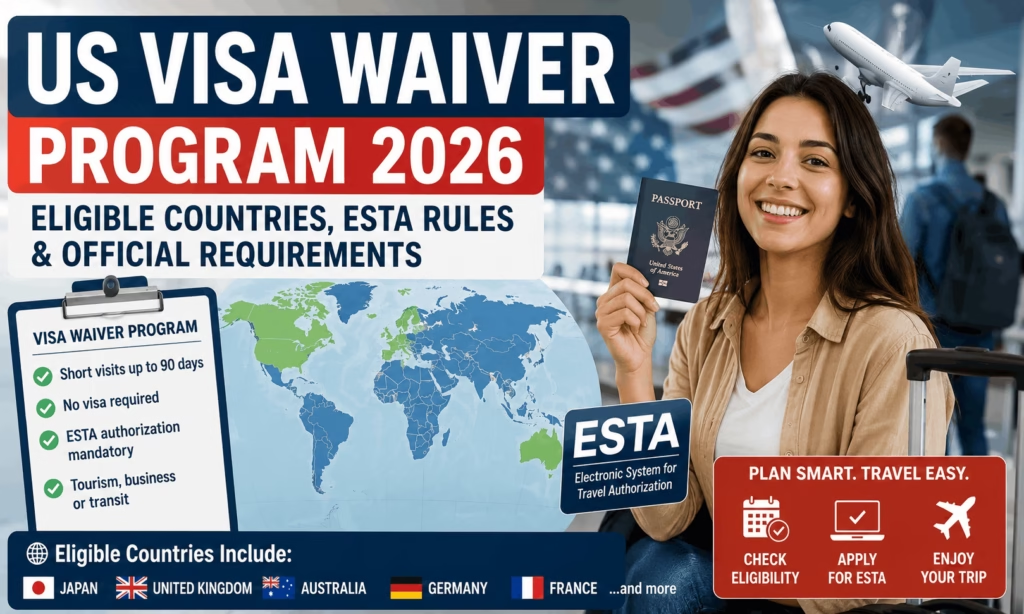
US Visa Waiver Program Eligible Countries Key Highlights
| Detail | Current Status |
|---|---|
| Total eligible countries | 42, per CBP, DHS, and the Federal Register |
| Newest member | Qatar, designated September 24, 2024, ESTA access enabled November 21, 2024 |
| Second newest member | Israel, effective October 19, 2023 |
| Maximum stay under VWP | 90 days for tourism or business, not extendable |
| ESTA application fee | $40.27 total ($10.27 processing plus $30 if approved) |
| ESTA validity | Two years, or until passport expiry, whichever comes first |
| Passport requirement | Valid biometric e-passport with an embedded chip |
| Pending rule change | CBP proposal to require 5-year social media history plus expanded biometric and family data, comment period closed February 9, 2026, not yet finalized |
| Countries under review, not yet approved | Bulgaria, Cyprus, Romania have been publicly discussed but have no confirmed DHS designation as of this update |
What Is The Visa Waiver Program?
The Visa Waiver Program allows citizens and nationals of designated countries to travel to the United States for tourism or business for up to 90 days without first obtaining a traditional visitor visa. It was created under the Immigration Reform and Control Act of 1986 and is jointly administered by the Department of Homeland Security and the Department of State. Instead of a visa, VWP travelers must apply for authorization through the Electronic System for Travel Authorization before departure. ESTA is a pre-screening tool, not a guarantee of admission. A Customs and Border Protection officer still makes the final admissibility decision at the port of entry, even for travelers holding an approved ESTA.
Countries are not added to the program automatically. To be designated, a nation must maintain a nonimmigrant visitor visa refusal rate below roughly 3%, issue machine-readable biometric e-passports that meet international standards, agree to share security and law enforcement data with the United States, and extend reciprocal visa-free privileges to American citizens. Poland joined in 2019, Croatia in 2021, Israel in 2023, and Qatar in 2024, making Qatar the first Gulf nation admitted to the program.
The program serves a dual purpose that is easy to overlook. On one side, it is a tourism and trade facilitation tool, removing friction for millions of travelers from allied nations and generating billions of dollars in visitor spending every year. On the other, it functions as a security partnership. Every participating country agrees to share passenger data, report lost and stolen passports in real time, and meet ongoing counterterrorism cooperation benchmarks. A country’s continued participation is reviewed periodically, not granted permanently, which is part of why Congress and DHS occasionally discuss whether individual countries still meet the criteria that got them admitted in the first place.
Trump Birthright Citizenship Executive Orders: What Changed After Supreme Court Ruling
US Birthright Citizenship 2026: Supreme Court Ruling, New Congressional Bills & What Happens Next
Florida Minimum Wage Reaches $15/Hour: The Final Step of a Six-Year Countdown Arrives September 30
Full List Of Visa Waiver Program Eligible Countries
The following 42 countries are currently designated, based on the Federal Register’s official regulatory text and confirmed by CBP.
| Region | Countries |
|---|---|
| Europe | Andorra, Austria, Belgium, Croatia, Czech Republic, Denmark, Estonia, Finland, France, Germany, Greece, Hungary, Iceland, Ireland, Italy, Latvia, Liechtenstein, Lithuania, Luxembourg, Malta, Monaco, Netherlands, Norway, Poland, Portugal, San Marino, Slovakia, Slovenia, Spain, Sweden, Switzerland, United Kingdom |
| Asia-Pacific | Australia, Brunei, Japan, New Zealand, Singapore, South Korea, Taiwan |
| Middle East | Israel, Qatar |
| Latin America | Chile |
The United Kingdom designation includes British citizens who hold the unrestricted right of permanent abode in England, Scotland, Wales, Northern Ireland, the Channel Islands, and the Isle of Man. Some travel blogs have circulated claims that Romania or Uruguay recently joined the program, or that the total has risen to 43. As of this update, no such designation appears in the Federal Register or on CBP’s official program page, so travelers from those countries should continue applying for a standard visitor visa unless and until an official notice confirms otherwise. Always verify the current list directly at cbp.gov or esta.cbp.dhs.gov before booking, since designations can change with limited advance notice.
Who Qualifies For Visa-Free Entry?
Holding a passport from an eligible country is not enough on its own. To use the VWP, a traveler must meet every one of the following conditions.
- Be a citizen or national, not merely a permanent resident, of one of the 42 designated countries.
- Hold a valid biometric e-passport containing an electronic chip that meets international standards.
- Travel only for an eligible purpose, such as tourism, business meetings, conferences, or short-term training, and never for paid employment or long-term study.
- Plan a stay of 90 days or less, a limit that cannot be extended and is not reset by a short trip to Canada or Mexico during the visit.
- Apply for and receive ESTA approval before boarding, including before boarding a connecting flight through the United States.
- Have no disqualifying travel history, since individuals who have traveled to or held dual nationality with certain restricted countries since March 2011 are generally required to apply for a standard visa instead of using ESTA, regardless of their primary passport.
If any of these conditions are not met, the applicant must instead apply for a B-1 or B-2 visitor visa through a U.S. embassy or consulate, a process that involves an in-person interview and typically takes considerably longer than an ESTA application.
How To Apply For ESTA?
- Go to the official Electronic System for Travel Authorization website at esta.cbp.dhs.gov, or use the CBP mobile application. Never use a third-party site that charges more than the official fee.
- Enter passport information exactly as it appears on the document, along with travel and contact details.
- Answer the eligibility questions, which cover health, criminal history, prior immigration violations, and past travel to certain regions.
- Pay the current fee of $40.27 by debit or credit card.
- Submit the application and wait for a determination.
Most applicants receive a response within minutes, though CBP advises applying at least 72 hours before travel, since some applications take up to 72 hours to process and a small share require additional review. An approved ESTA remains valid for two years or until the traveler’s passport expires, whichever happens first, and covers multiple trips during that window.
Social Security 2100 Act 2027: Bigger COLA Increase, Higher Benefits & Latest Bill Update
2027 HSA Contribution Limits Announced: IRS Confirms $4,500 and $9,000 Caps
ESTA Processing Time
The large majority of ESTA applications are approved almost immediately after submission. CBP’s official guidance still recommends applying well ahead of travel, since a minority of applications are flagged for manual review and can take up to 72 hours to resolve. Applicants who are denied, or whose application is still pending close to their travel date, should not attempt to board without a clear determination, since airlines are required to verify ESTA status before allowing VWP travelers to check in. If your ESTA is denied, the standard visitor visa process becomes the only path to travel, and that process should be started as early as possible given typical embassy appointment wait times.
ESTA Fee Breakdown And Recent Changes
The ESTA fee has changed more in the past eighteen months than in the program’s prior decade combined. From 2022 through September 2025, the total fee sat at $21. Under the reconciliation bill known as H.R. 1, CBP raised the fee to $40 effective September 30, 2025, restructuring it into a $10 processing component and a $30 component charged only if the application is approved. On January 1, 2026, CBP applied its first statutory inflation adjustment under that new structure, nudging the processing portion up by 27 cents and bringing the total to $40.27, where it currently stands. Applicants whose ESTA is denied are only charged the processing portion, currently $10.27, not the full amount.
The Pending ESTA Data Collection Proposal
The most consequential change under discussion right now is not a fee increase but a data collection expansion. Citing Executive Order 14161, CBP’s December 2025 proposal would make social media history from the preceding five years a mandatory ESTA field, and would additionally collect phone numbers used over the past five years, email addresses used over the past decade, names and details of immediate family members, business contact information, IP address metadata, and, where feasible, biometric identifiers. The same notice proposed retiring the ESTA website entirely in favor of a mobile-only application platform.
None of this is in effect yet. The public comment period that ran from December 10, 2025, through February 9, 2026, has closed, and CBP must now review the submitted comments before publishing a follow-up 30-day notice and seeking approval from the Office of Management and Budget. Legal and travel industry analysts following the process have estimated implementation could arrive by mid-2026 if the proposal moves forward largely unchanged, though CBP could also revise or narrow the requirements based on the comments received. Business travel associations and immigration law firms have flagged the proposal as a likely source of longer processing times and higher rejection rates if adopted as written, since similar social media disclosure requirements already apply to several visa categories, including F, M, J, H-1B, and H-4.
Visa Waiver Program Versus A Standard Visitor Visa
Travelers whose country is not on the eligible list, or who do not meet every VWP condition, are not barred from visiting the United States. They simply need a B-1 business visitor visa or B-2 tourist visa instead of ESTA. The core differences are processing time, cost, and flexibility. A B-1/B-2 visa requires an in-person interview at a U.S. embassy or consulate, a nonrefundable application fee that is separate from and higher than the ESTA fee, and typically weeks to months of lead time depending on local wait times. In exchange, a visitor visa is usually valid for a much longer period, often five to ten years for many nationalities, and allows for longer individual stays than the 90-day VWP cap, at the discretion of the CBP officer at entry. Applicants who have ever overstayed a previous US visit, regardless of which program they used, should expect that history to be reviewed closely in either process.
| Factor | Visa Waiver Program (ESTA) | Standard B-1/B-2 Visitor Visa |
|---|---|---|
| Eligible countries | 42 designated countries only | Every country, including all 42 VWP nations if preferred |
| Application method | Fully online, no interview | In-person interview usually required |
| Typical cost | $40.27 | Higher application fee, varies by reciprocity schedule |
| Typical lead time | Minutes to 72 hours | Weeks to several months depending on embassy wait times |
| Maximum single stay | 90 days, no extension | Often up to 180 days, extendable in some cases at CBP discretion |
| Validity period | Two years or until passport expiry | Often 5 to 10 years depending on nationality |
| Employment allowed | Never | Never, same restriction applies to both categories |
Common Reasons ESTA Applications Get Flagged Or Denied
Most travelers who meet the basic eligibility rules receive ESTA approval within minutes, but a meaningful share of applications are flagged for secondary review or denied outright. The most common triggers include a prior visa refusal or denial anywhere in the applicant’s travel history, a criminal record that touches on categories of inadmissibility such as moral turpitude or controlled substance offenses, a prior overstay on a previous US visit under any visa category, and travel to or dual nationality with a small group of countries the United States treats as security-sensitive under the VWP’s own statutory carve-outs. Passport irregularities, such as a passport that is not a genuine biometric e-passport or one nearing expiration, can also trigger a rejection or a request for additional information. None of these factors are new for 2026, but CBP has continued tightening its automated risk-scoring tools, which means applicants with any of these factors in their history should apply well ahead of their trip rather than waiting until the last few days before departure.
10 New Canada Immigration Changes And Updates In September 2026
SSA Ticket to Work Program: How Disability Beneficiaries Can Return to Work Without Losing Benefits
SSA Strategic Plan FY2026-2030: New Goals, Wait Times & Service Targets
Official Visa Waiver Program And ESTA Resources
| Resource | What It’s For | Link |
|---|---|---|
| ESTA Official Application | Apply, check status, or update an ESTA application | esta.cbp.dhs.gov |
| CBP Visa Waiver Program Page | Official program overview and current country list | cbp.gov/travel/international-visitors/visa-waiver-program |
| USAGov VWP and ESTA Guide | Plain-language eligibility overview | usa.gov/visa-waiver-esta |
| CBP Help Center | Fee questions, payment issues, technical support | help.cbp.gov |
| U.S. Department of State Visa Services | Information on standard B-1/B-2 visitor visas | travel.state.gov |
| Federal Register ESTA Notices | Official rulemaking text and comment history | federalregister.gov |
FAQs About US Visa Waiver Program Eligible Countries
Is India on the Visa Waiver Program list?
No. India is not currently designated under the Visa Waiver Program, so Indian citizens need a standard B-1 or B-2 visitor visa to travel to the United States for tourism or business.
Is the United Kingdom part of the Visa Waiver Program?
Yes. The United Kingdom has been part of the program since its earliest years, and the designation also covers British citizens with the unrestricted right of permanent abode in several related territories.
How much does ESTA cost right now?
The current total fee is $40.27 per applicant, made up of a $10.27 processing charge and an additional $30 charged only if the application is approved.
How long is an approved ESTA valid for?
An approved ESTA is valid for two years from the approval date, or until the traveler’s passport expires, whichever comes first, and it covers multiple trips during that period.
Can I extend my 90-day stay under the Visa Waiver Program?
No. The 90-day limit under the VWP is a hard cap that cannot be extended or renewed from inside the United States, unlike some visitor visa categories.
Will the new ESTA social media requirement affect my upcoming trip?
Not yet. The proposal is still under federal review after its public comment period closed in February 2026, and it has not been implemented as of this update.
What happens if my ESTA application is denied?
You will need to apply for a standard B-1 or B-2 visitor visa through a U.S. embassy or consulate instead, which requires an in-person interview.
People Also Ask
How many countries are in the Visa Waiver Program?
Forty-two countries currently participate, according to official designations published by the Department of Homeland Security and the Federal Register.
What is the newest country added to the Visa Waiver Program?
Qatar is the most recently added country, designated in September 2024 and made active for ESTA applications in November 2024.
Do I need a visa if my country is in the Visa Waiver Program?
You do not need a traditional visa, but you must still obtain an approved ESTA before traveling, since ESTA replaces the visa requirement rather than eliminating the need for prior authorization.
Can permanent residents of a VWP country use ESTA?
No. Only citizens or nationals of a designated country can use ESTA. Permanent residents who are not citizens must apply for a standard visa based on their actual nationality.
Conclusion
The Visa Waiver Program eligible countries list remains fixed at 42 nations for now, with no new country formally added since Qatar in 2024 despite ongoing speculation about Romania, Bulgaria, and Cyprus. What has genuinely changed is the cost and, potentially soon, the depth of screening behind every ESTA application. The fee has nearly doubled in the past year to $40.27, and a pending CBP proposal to collect five years of social media history and expanded biometric data is working its way through federal review after its comment period closed in February 2026. Travelers from eligible countries should confirm their passport meets the biometric e-passport requirement, apply for ESTA at least 72 hours before departure through the official CBP website only, and keep an eye on federal notices if their trip falls later this year, since the data collection rule could take effect with limited advance warning once finalized. This article will be updated monthly as CBP, DHS, and the State Department confirm further changes.
H-1B Spouse Work Permit at Risk: How Trump’s Latest Move Could Cut Family Incomes in Half
80% to 100% VA Disability: Why the Final Jump Is the Hardest One Veterans Face
FY2027 Government Shutdown Risk: Congress Races the September 30 Funding Cliff