Government of Canada Jobs Hiring: The Government of Canada, the country’s largest single employer with roughly 367,000 public service workers, currently has active postings open across multiple departments and locations, spanning tax auditing, parliamentary support, and skilled trades roles. Several of the most time-sensitive postings close on August 31, 2026, while others, including a Parks Canada trades role in coastal British Columbia, remain open until the end of the year. With federal departments competing to fill roles before fall budget cycles begin, candidates who understand exactly how the GC Jobs application process works have a meaningful edge over those submitting generic resumes. We’ll be updating this article monthly as new postings open and existing ones close.
Unlike private sector hiring, applying for a Government of Canada job means navigating a distinct system built around merit-based assessment criteria, official language requirements, and, in many cases, security clearance levels tied to the specific role. This article breaks down which postings are currently open across the country, what each pays, who is eligible to apply, and exactly how to submit a competitive application through the official GC Jobs portal, so candidates can move quickly on postings before they close.
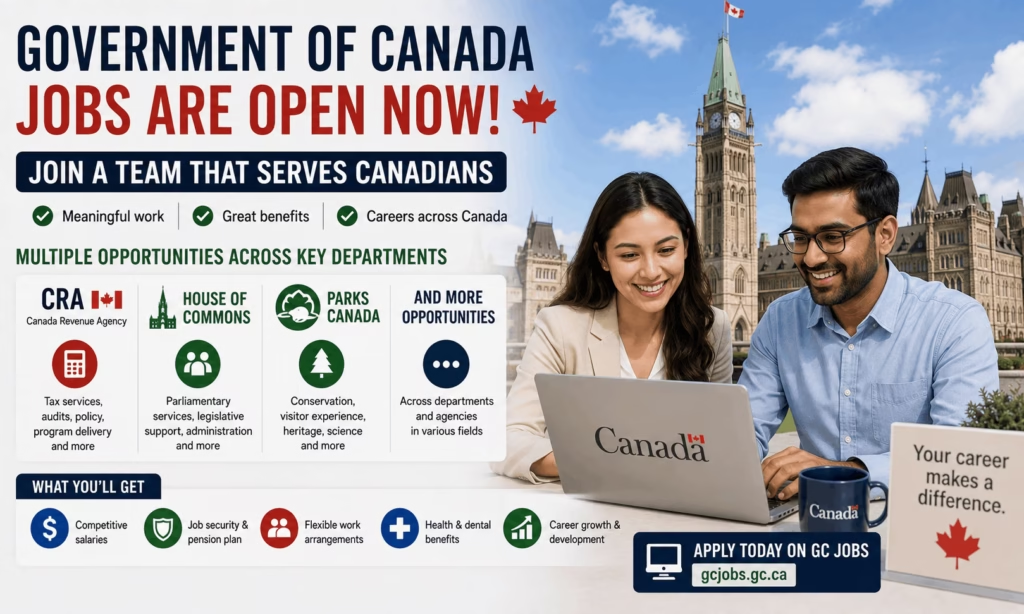
Government of Canada Jobs Hiring 2026
Several federal departments have active recruitment underway as of early August 2026. The Canada Revenue Agency is recruiting for income tax auditor and international tax auditor roles, among the highest-paying postings currently listed, reflecting the agency’s ongoing push to expand compliance and enforcement staffing. Parks Canada is hiring Maintenance Worker III staff for coastal British Columbia locations, a role aimed at tradespeople with backgrounds in plumbing, carpentry, electrical work, or equipment maintenance, and notably open to anyone already legally authorized to work in Canada rather than requiring citizenship. The House of Commons continues accepting ongoing applications for student roles based in Ottawa, covering cybersecurity, engineering, communications, accounting, broadcasting, and information technology.
Application deadlines vary significantly by posting. Several of the most competitive roles close on August 31, 2026, while the Parks Canada trades posting remains open until December 31, 2026, giving candidates more flexibility on timing for that particular role. Most federal vacancies are centralized on the Government of Canada GC Jobs portal, though certain agencies, including the Canada Revenue Agency, maintain their own dedicated careers site separate from the main federal portal.
Government of Canada Jobs Key Highlights
| Position | Department | Location | Salary Range | Closing Date |
|---|---|---|---|---|
| Income tax auditor | Canada Revenue Agency | Multiple locations | Among the highest-paying current postings | Varies by region |
| International tax auditor | Canada Revenue Agency | Multiple locations | Among the highest-paying current postings | Varies by region |
| Maintenance Worker III | Parks Canada | Coastal British Columbia | 29.20 to 31.73 dollars per hour | December 31, 2026 |
| Student positions (cybersecurity, engineering, communications, accounting, broadcasting, IT) | House of Commons | Ottawa, Ontario | 38,751 to 64,902 dollars annually | Ongoing, rolling intake |
| Various inventory-based postings | Multiple federal departments | Across Canada | Varies by classification | Several closing August 31, 2026 |
| Total federal public service workforce | Government of Canada | Nationwide | N/A | N/A, approximately 367,000 employees |
Social Security $200 Monthly Increase 2027: Which Seniors Qualify for the Biggest Raise?
Alberta AAIP Eligibility Assessment Tool: Check Your Immigration Chances Online
Which Roles Require Canadian Citizenship
Eligibility rules differ meaningfully depending on the security level attached to a role. Most federal postings are open to persons residing in Canada, a category that includes permanent residents, not just citizens. However, certain positions require Canadian citizenship specifically because of the security clearance level involved. Roles tied to national security or law enforcement agencies, for example, commonly require an Enhanced Top Secret clearance, which is only available to Canadian citizens. Candidates should check the citizenship and residency requirements listed directly on each individual posting rather than assuming eligibility, since this varies even within the same department depending on the specific role’s classification and clearance level.
The Parks Canada Maintenance Worker III posting is a notable exception to stricter citizenship rules, since it explicitly accepts applications from anyone already legally authorized to work in Canada, making it accessible to a broader pool of candidates including work permit holders who meet that authorization standard.
How Government of Canada Hiring Actually Works
Federal hiring in Canada runs through three distinct systems that candidates often confuse. The Government of Canada, meaning the federal public service, employs roughly 275,000 to 367,000 people across about 90 departments and agencies, with applications processed through the centralized GC Jobs portal at jobs.gc.ca. Provincial and territorial governments run entirely separate careers portals specific to each province, such as the Ontario Public Service or BC Public Service systems. Crown corporations, including entities like Canada Post, the CBC, VIA Rail, and the Bank of Canada, sit at arm’s length from the federal government and hire directly through their own individual careers sites rather than through GC Jobs.
GC Jobs is the single portal specifically for federal public service positions. Candidates create a profile there, which is what is commonly referred to as a GC Jobs login, then search postings, submit applications, and receive invitations for any required assessments or tests through that same account. Each federal posting includes what’s known as a Statement of Merit Criteria, a formal list of essential and asset qualifications that candidates must directly address in writing within their application, not simply imply through a general resume.
How to Apply for a Government of Canada Job Step by Step
The application process begins with creating a GC Jobs profile, which serves as the account used for every subsequent federal application. From there, candidates search active postings by department, location, or job classification, and review each posting’s full Statement of Merit Criteria carefully before applying, since this document outlines exactly what assessors will be scoring against. A resume written for private sector hiring typically underperforms in federal applications, since assessors are specifically looking for direct evidence against each listed criterion rather than a general summary of experience.
After submitting an application, candidates may be invited to complete online tests or written assessments through the GC Jobs system itself, followed by interviews for roles that advance past the initial screening stage. Some postings, particularly ones described as inventory-based processes, review applications on a rolling basis rather than waiting until the closing date, meaning hiring managers may begin pulling qualified candidates from the pool well before a posting officially closes. Waiting until the final days of an open posting to apply can meaningfully reduce a candidate’s chances under this rolling review model.
Understanding Official Language Requirements
Many federal positions, particularly those based in the National Capital Region or requiring public-facing communication, carry bilingual requirements in English and French. Postings will specify whether a role requires being bilingual at the time of hire or whether language training will be provided after appointment, a distinction that significantly affects who should apply immediately versus who might need to build language skills first. Candidates uncertain about their second-language proficiency can find information on the assessment process directly through the GC Jobs portal before applying, allowing them to gauge their readiness against a specific posting’s stated requirements.
Student and Entry-Level Pathways Into the Federal Public Service
Beyond direct hiring for experienced roles, several dedicated programs exist specifically for students and recent graduates looking to enter the federal public service. The Federal Student Work Experience Program remains the primary vehicle through which departments and agencies recruit students for thousands of temporary positions each year. The Post-Secondary Recruitment Program targets university graduates for entry-level positions, while the Post-Secondary Co-operative Education and Internship Program provides students with practical work experience tied to their academic program requirements. The House of Commons student postings currently open fall into this broader category of entry-level federal opportunity, offering meaningful salary ranges for students still completing their studies.
450,000 Borrowers Student Debt Erased: How to Check If You Qualify?
IRS Releases New Details on the Saver’s Match Program: Up to $1,000 for Your Retirement Account
$2000 Stimulus Payment 2026 Fact-Check: Is It Really Coming?
Official Government of Canada Job Resources and Links
| Resource | Purpose | Official Link |
|---|---|---|
| GC Jobs Portal | Search and apply for federal public service positions | jobs.gc.ca |
| GC Jobs Account Login | Create a profile, track applications and assessments | jobs.gc.ca (login required) |
| Canada Revenue Agency Careers | CRA-specific job postings, including auditor roles | canada.ca/en/revenue-agency/corporate/careers-cra.html |
| House of Commons Careers Portal | Parliamentary student and staff positions in Ottawa | ourcommons.ca/en/employment |
| Parks Canada Careers | Trades, science and operational roles across Canada | pc.gc.ca/en/employ |
| Federal Student Work Experience Program | Student job postings across federal departments | canada.ca/en/services/jobs/opportunities/student.html |
FAQs
Do I need to be a Canadian citizen to apply for a Government of Canada job?
Not always. Most postings are open to persons residing in Canada, including permanent residents, though certain roles requiring higher security clearances, such as Enhanced Top Secret, specifically require Canadian citizenship.
How do I apply for a Government of Canada job?
Applications go through the GC Jobs portal at jobs.gc.ca, where candidates create a profile, search postings, and submit applications that directly address each posting’s Statement of Merit Criteria.
What is a Statement of Merit Criteria?
It is a formal list of essential and asset qualifications included in every federal job posting that candidates must specifically address in their application, rather than relying on a general resume summary.
Are Government of Canada jobs the same as provincial government jobs?
No. Federal jobs are posted through GC Jobs, while each province runs its own separate careers portal, and Crown corporations like Canada Post or the CBC hire directly through their own individual sites.
How much do Government of Canada jobs pay?
Pay varies widely by role and classification. Current examples include Parks Canada trades roles paying 29.20 to 31.73 dollars per hour, and House of Commons student positions ranging from 38,751 to 64,902 dollars annually.
What happens if I apply close to a posting’s closing date?
Some postings, especially inventory-based processes, review applications on a rolling basis, meaning hiring managers may already be pulling candidates from the pool before the official closing date, so applying early generally improves a candidate’s chances.
Can permanent residents apply for federal government jobs in Canada?
Yes, most federal postings are open to persons residing in Canada, a category that includes permanent residents, though specific eligibility should always be confirmed on each individual job posting.
People Also Ask
How do I find current Government of Canada job openings? The GC Jobs portal at jobs.gc.ca is the centralized official source for federal public service postings, allowing candidates to search by department, location and classification.
What is the difference between GC Jobs and provincial job portals? GC Jobs covers federal public service hiring only, while each Canadian province and territory operates its own separate careers portal for provincial government positions.
Is it hard to get a job with the Government of Canada? Federal hiring uses a merit-based assessment process that scores applications directly against a posted Statement of Merit Criteria, so candidates who tailor their application to explicitly address each listed qualification generally perform better than those submitting a generic resume.
Do Government of Canada jobs offer good benefits? The federal public service is known for offering strong pension and benefits packages along with long-term job stability, in addition to salary, which is a significant factor drawing candidates to federal roles over comparable private sector positions.
Conclusion
Government of Canada job postings are currently active across multiple departments and locations, from Canada Revenue Agency auditor roles to Parks Canada trades positions and House of Commons student opportunities in Ottawa, with several closing as soon as August 31, 2026. Understanding the federal system’s distinct structure, including how GC Jobs differs from provincial portals and Crown corporation hiring, and how to properly address a posting’s Statement of Merit Criteria, gives candidates a real advantage in a hiring process that rewards precision over generic applications. With rolling review common on inventory-based postings, the most effective step any candidate can take right now is creating a GC Jobs profile and applying to relevant open postings before competitive roles close.
H-1B 60-Day Grace Period Elimination: What US Visa Workers Should Know