IRS Refund Status 2026: Millions of taxpayers checking their IRS refund status 2026 this week are running into the same wall: a “Return Received” screen that refuses to move, or worse, a notice in the mailbox they have never seen before. That notice, labeled CP53E, has already reached more than 830,000 households since the filing season opened, and it is directly tied to a federal policy change that quietly rewired how the IRS pays out refunds this year. Anyone still waiting on money owed to them needs to understand exactly what this notice means, because ignoring it can add six extra weeks to an already long wait.
At the same time, a separate and completely different deadline tied to pandemic-era tax penalties has now closed for good. The window to file a protective claim for COVID-19 disaster relief penalty refunds under the Kwong v. United States ruling ran out on July 10, 2026, and taxpayers who missed it can no longer use that path to recover failure-to-file or failure-to-pay penalties charged between January 2020 and mid-2023. This guide breaks down how to check your IRS refund status 2026, what the CP53E notice actually requires, why the COVID penalty deadline is now closed, and what a September funding deadline in Washington could mean for refund processing speed in the weeks ahead. We’ll be updating this article monthly as new refund data, notice figures, and IRS policy updates are released.
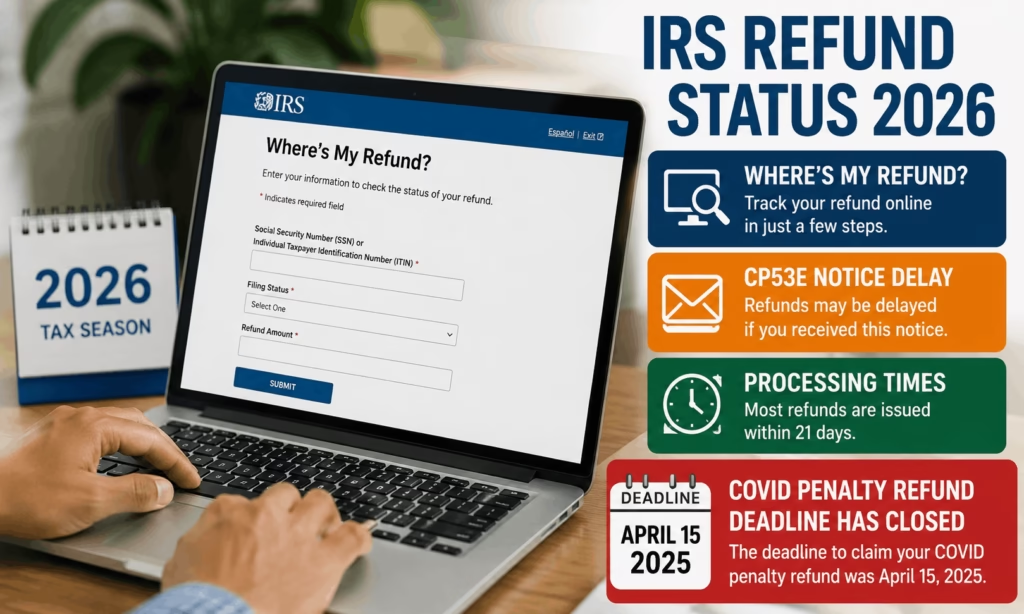
IRS Refund Status 2026 Key Highlights
| Topic | Latest Detail |
|---|---|
| Filing season 2026 result | Nearly 139 million individual returns processed, more than 90 million refunds issued, per the National Taxpayer Advocate’s July 2026 report |
| Average refund amount | $3,804, up roughly 10 percent over last year, according to IRS filing season data |
| CP53E notices issued | Over 830,000 sent in the first weeks of the season, per a Congressional letter to Treasury |
| CP53E response window | 30 days from the notice date to update direct deposit details in your IRS Online Account |
| CP53E missed deadline | IRS mails a paper check roughly six weeks after the notice date if no action is taken |
| COVID penalty refund deadline | July 10, 2026, has passed; new protective claims under the Kwong ruling are no longer accepted |
| Refund delay driver | Executive Order 14247 requiring electronic federal payments, effective for the 2026 filing season |
| Next watch date | September 30, 2026, federal fiscal year end and funding deadline that could affect IRS staffing |
Latest Update on IRS Refund Status 2026
The IRS refund status 2026 picture looks very different depending on when a taxpayer filed. According to the National Taxpayer Advocate’s Fiscal Year 2027 Objectives Report released in mid-2026, the agency processed close to 139 million individual income tax returns this season and issued more than 90 million refunds, a season the report called largely successful despite significant operational strain. More than 14 million returns were suspended during processing at some point, and over one million taxpayers waited well beyond the IRS’s normal turnaround, with an average extra wait of about 5.5 weeks.
Two forces are shaping refund timing heading into September. First, staffing shortages tied to the 43-day government shutdown that ran from October to November 2025 left the IRS working through a backlog even before the 2026 season began, with reporting from Yahoo Finance noting IRS staffing was down roughly 27 percent for the season. Second, the rollout of Executive Order 14247, which pushes nearly all federal disbursements toward electronic payment, has created a wave of CP53E notices for anyone who filed without valid direct deposit information. Both factors are the reason so many taxpayers are refreshing the Where’s My Refund tool with no movement, even months after filing.
How to Track Your IRS Refund Status 2026
The fastest and only official way to check your refund is the IRS’s own Where’s My Refund tool at irs.gov/refunds, or the IRS2Go mobile app. Both pull from the same system and update once every 24 hours, typically overnight.
How to Apply and Check Status
- Wait for the system to recognize your return. E-filed current-year returns usually show up within 24 hours of acceptance; e-filed prior-year returns take about three days; paper returns can take up to four weeks before any status appears.
- Go to irs.gov/refunds and select the Where’s My Refund tool, or open the IRS2Go app.
- Enter your Social Security number or Individual Taxpayer Identification Number, your filing status exactly as shown on your return, and the exact whole-dollar refund amount you claimed.
- Review your stage. The tracker shows three stages: Return Received, meaning the IRS has your return and is processing it; Refund Approved, meaning the amount is confirmed and a date is being prepared; and Refund Sent, meaning the money has left the IRS either by direct deposit or mailed check.
- For an amended return filed on Form 1040-X, use the separate Where’s My Amended Return tool instead, since amended filings do not appear on the standard tracker and can take up to 16 weeks or longer.
- Taxpayers who want a fuller account history can also create or log into an IRS Online Account, which shows notices, payment history, and transcripts in one place.
Processing Time Expectations
Most electronically filed returns with direct deposit are still moving within the IRS’s traditional 21-day window when there are no errors or credit-related holds. Returns claiming the Earned Income Tax Credit or the Additional Child Tax Credit are held by law until mid-February each year, so early filers claiming those credits should expect refunds later in the cycle regardless of how quickly they filed. Paper returns, returns flagged for identity verification, and returns needing manual review because of math errors or mismatched information will run well past three weeks, in some cases into the multi-month range the Taxpayer Advocate described this season.
Payment Schedule and Refund Timing Table
| Filing Method | Typical Status Visibility | Typical Refund Timing |
|---|---|---|
| E-file with direct deposit, no issues | Within 24 hours | Up to 21 days |
| E-file with EITC or ACTC claimed | Within 24 hours, but held by law until mid-February | Held until after mid-February, then normal processing |
| Paper return | Up to 4 weeks | 6 to 8 weeks or longer |
| Return flagged for manual review or ID verification | Delayed status updates | Several weeks to multiple months |
| Amended return, Form 1040-X | Up to 3 weeks to appear | Up to 16 weeks or longer |
| CP53E notice issued, no action taken | Refund held pending banking update | Approximately 6 weeks after notice date for paper check |
If a direct deposit shows as “Refund Sent” but nothing arrives, the IRS recommends waiting five calendar days before contacting a bank, and at least four weeks for a mailed check before requesting a refund trace through the IRS or the Taxpayer Advocate Service.
CP53E Notice Explained
The single biggest driver of confusion around IRS refund status 2026 this year is Notice CP53E, a letter that did not exist in this form in prior seasons. The IRS sends CP53E when it has already approved a refund but cannot deliver it electronically, most commonly because the taxpayer did not include direct deposit information, the bank rejected the deposit due to an incorrect routing or account number, the account name does not match the name on the return, or the account was closed.
In past years, a rejected direct deposit simply triggered a mailed paper check with no extra steps required. That changed under Executive Order 14247, signed in March 2025, which directs the Treasury Department to prioritize electronic payments across nearly all federal disbursements, including tax refunds. As a result, the IRS no longer defaults to a paper check. Instead, it pauses the refund and asks the taxpayer to fix the banking issue first.
What CP53E Requires You to Do
A taxpayer who receives a legitimate CP53E notice has 30 days from the date printed on the notice to log into their IRS Online Account and either correct their direct deposit details or select one of the limited exceptions to the electronic payment requirement. Banking information can only be updated through the secure Online Account portal at irs.gov, never by phone, email, or text. If no action is taken within that 30-day window, the IRS will eventually issue a paper check, but only after roughly six additional weeks have passed from the notice date, meaning the total delay from the original filing date can stretch past ten weeks in many cases.
A House Ways and Means Committee letter sent to then-Acting IRS Commissioner Scott Bessent in March 2026 confirmed that 530,000 CP53E notices had gone out by early March, with another 300,000 scheduled that same week, pushing the total past 830,000 notices in just the opening stretch of the season. Lawmakers flagged that many affected taxpayers, including Americans living abroad without a US bank account, were facing delays of more than two and a half months.
Is the CP53E Notice a Scam?
Because CP53E is unfamiliar to most filers, scammers have tried to exploit the confusion. The genuine notice includes an information-only toll-free line, 866-325-4066, that plays a recorded explanation and cannot take banking details over the phone. The IRS will never request bank account numbers by email, text message, or QR code, and it will never ask for that information verbally through a live representative. The only legitimate place to update direct deposit information is a taxpayer’s own IRS Online Account. Anyone unsure whether a CP53E letter is real should log into their Online Account directly at irs.gov rather than clicking any link or calling any number printed on a suspicious piece of mail, and can always confirm status through the general IRS helpline at 1-800-829-1040.
Why the COVID Penalty Deadline Already Passed
Separate from CP53E, a large number of taxpayers spent the first half of 2026 hearing about a possible refund of penalties and interest charged during the COVID-19 pandemic. That opportunity has now closed, and it is important for anyone reading this in late 2026 to understand why filing a new claim is no longer possible.
The story starts with Internal Revenue Code Section 7508A(d), a provision Congress strengthened in December 2019 that automatically pauses certain tax deadlines during a federally declared disaster. When COVID-19 was declared a nationwide disaster on January 20, 2020, that pause technically applied, and the disaster period ultimately ran until May 11, 2023. Two court rulings, Abdo v. Commissioner in the US Tax Court and Kwong v. United States in the US Court of Federal Claims, later interpreted that provision broadly, concluding many tax deadlines occurring during the pandemic disaster window were automatically postponed all the way to July 10, 2023, even for taxpayers who never specifically requested relief.
Because taxpayers generally have three years from a filing deadline, or two years from a payment date, to claim a refund of penalties or interest, the Kwong reasoning meant the clock for many pandemic-era penalty and interest charges did not truly start running until July 10, 2023. That made July 10, 2026, the final date to submit a refund claim, an amended return, an abatement request, or a protective claim tied to that theory. The IRS itself opened a new electronic filing option through Online Account access for Form 843 interest-and-penalty claims shortly before that date, and the Taxpayer Advocate Service publicly reminded taxpayers of the deadline in early July.
What This Means for Taxpayers Now
Anyone who paid a failure-to-file penalty, a failure-to-pay penalty, an estimated tax penalty, or underpayment interest tied to a deadline between January 20, 2020, and July 10, 2023, and who did not file a claim, amended return, or protective claim on or before July 10, 2026, has generally lost the ability to pursue that specific COVID-era refund path. Because the government has appealed the Kwong decision, the legal question is still not fully settled, but the filing window itself was procedural and did not extend simply because litigation continues. Tax professionals who submitted protective claims before the deadline will have those claims held in suspense until the appeal is resolved, and only those already-filed claims remain eligible for a possible future payout if the courts side with taxpayers. New claims filed after July 10, 2026, are not expected to be accepted under this theory.
Taxpayers who still believe they were charged a penalty in error should not assume every recovery path is closed. Standard penalty abatement requests, including first-time abatement for taxpayers with a clean compliance history, remain available year-round and operate independently of the now-closed COVID disaster relief window.
What September’s Funding Deadline Could Mean for Refunds
The federal government’s current fiscal year funding runs out on September 30, 2026, and Congress must pass new appropriations or another continuing resolution before that date to avoid a fresh lapse in funding. The country has already experienced two disruptive funding lapses in the current cycle, a 43-day shutdown that ran from October to November 2025 and a separate 76-day Department of Homeland Security shutdown that stretched from mid-February to the end of April 2026. Both episodes slowed IRS phone service, paper correspondence, and manual return review, even though core electronic filing systems and legal filing deadlines continued to operate.
If lawmakers do not reach a deal before September 30, taxpayers with returns still stuck in manual review, unresolved CP53E notices, or open Taxpayer Advocate cases could see further slowdowns layered on top of an already reduced IRS workforce. Filing deadlines themselves are not affected by a shutdown, but refund issuance and live phone assistance historically are among the first services to slow down.
Official Resources Table
| Resource | Purpose | Link |
|---|---|---|
| Where’s My Refund | Check current-year refund status | irs.gov/refunds |
| IRS2Go App | Mobile refund tracking | irs.gov/newsroom/irs2goapp |
| IRS Online Account | Update direct deposit, view notices and transcripts | irs.gov/account |
| Understanding Your CP53E Notice | Official CP53E explanation and FAQs | irs.gov/individuals/understanding-your-cp53e-notice |
| Where’s My Amended Return | Track Form 1040-X status | irs.gov/filing/wheres-my-amended-return |
| Form 843, Claim for Refund and Request for Abatement | Penalty and interest abatement requests | irs.gov/forms-pubs/about-form-843 |
| Taxpayer Advocate Service | Help with unresolved refund delays | taxpayeradvocate.irs.gov |
| IRS Refund Trace Request | Report a lost, stolen, or missing refund | irs.gov/refunds/lost-or-stolen-refunds |
FAQs
How can I check my IRS refund status 2026 online?
Use the official Where’s My Refund tool at irs.gov/refunds or the IRS2Go app, and enter your Social Security number or ITIN, filing status, and exact refund amount.
Why has my refund status not updated in weeks?
Common reasons include a return flagged for identity verification, errors or missing information, a credit that requires additional review such as the Earned Income Tax Credit, or a paused refund tied to a CP53E notice.
What should I do if I received a CP53E notice?
Log into your IRS Online Account within 30 days of the notice date and correct or add your direct deposit information, or select an available exception if you qualify for one.
Is the CP53E notice a scam?
It can be legitimate, but scammers have copied its format. The real notice only directs you to update banking details through your secure IRS Online Account, never by phone, email, or text.
Can I still claim a COVID-19 penalty refund in 2026?
No. The deadline to file a new protective claim under the Kwong v. United States reasoning was July 10, 2026, and that window has closed for new filings.
What if I already filed a COVID-era penalty claim before the deadline?
Your claim remains valid and will be held in suspense by the IRS until the government’s appeal of the Kwong decision is resolved.
How long does a paper refund check take after a CP53E notice?
If you do not update your banking details within 30 days, the IRS generally issues a paper check about six weeks after the notice date.
Will a government shutdown in September 2026 delay my refund?
It could slow manual review, phone support, and correspondence if Congress does not fund the government past September 30, 2026, though electronic filing and core refund payments have generally continued during past lapses.
What is the average IRS refund amount in 2026?
The IRS reported an average refund of $3,804 this filing season, up roughly 10 percent from the prior year.
People Also Ask
Why is my tax refund taking longer than 21 days? Refunds most often run past 21 days because of manual review, identity verification holds, math error notices, or a rejected direct deposit that triggered a CP53E notice.
How do I know if my CP53E notice is real? Compare it against the official description on irs.gov/individuals/understanding-your-cp53e-notice, and only ever submit banking updates through your IRS Online Account, never through a phone number or link inside the letter itself.
What happens if I ignore a CP53E notice? Your refund stays on hold for 30 days, after which the IRS automatically switches to mailing a paper check, adding about six extra weeks to your wait.
Can I still get a refund for penalties I paid during COVID? Only if you already filed a claim, amended return, or protective claim on or before July 10, 2026. New claims under this specific relief theory are no longer being accepted.
Does a government shutdown stop tax refunds completely? Not entirely. Filing deadlines and most electronic refund processing have historically continued during shutdowns, but phone assistance, paper correspondence, and manual case review slow down significantly.
Conclusion
The IRS refund status 2026 landscape this fall is defined by two very different stories. For most electronic filers with accurate direct deposit information, refunds are still moving in roughly the usual 21-day window, and the season overall closed with more than 90 million refunds issued. For the growing share of taxpayers caught by a CP53E notice, the fix is simple but time-sensitive: log into the IRS Online Account and correct banking details within 30 days to avoid a six-week paper check delay. And for anyone still hoping to recover pandemic-era penalties, that particular door closed on July 10, 2026, though standard penalty abatement options remain available separately. With a federal funding deadline looming again on September 30, taxpayers with unresolved refund issues should act now rather than wait, since further disruption to IRS staffing could stretch already long delays even further.