New CRA Payment Boost: Millions of Canadians are seeing bigger deposits land in their bank accounts this month, and the increases are coming from several federal programs at once rather than a single announcement. The Canada Revenue Agency and Service Canada have layered a new one-time top-up, a renamed and boosted quarterly credit, and a fresh cost of living adjustment on top of the regular monthly schedule, which means many households will notice the difference without having applied for anything new. We’ll be updating this article monthly as new payment amounts and dates are confirmed.
The most immediate change is the new one-time $150 supplemental payment attached to the Canada Disability Benefit, which began landing in accounts on September 17. That lump sum arrived alongside the regular monthly CDB deposit and can push a recipient’s payment for the month past $350. At the same time, the Canada Child Benefit increased for the 2026-27 benefit year, the Old Age Security pension is carrying a higher quarterly rate, and the program formerly known as the GST/HST credit has been rebuilt into the Canada Groceries and Essentials Benefit with a permanent 25 percent boost. Taken together, these changes represent one of the broader rounds of federal benefit increases Canadians have seen land in the same few weeks.
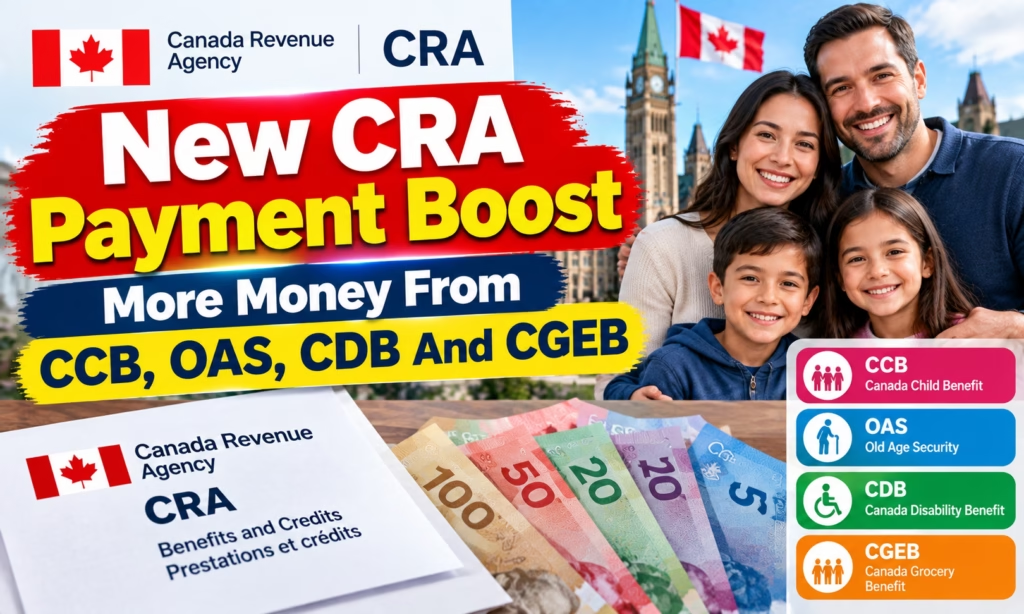
CRA And Service Canada Payment Boost Highlights
| Program | What Changed | Amount |
|---|---|---|
| Canada Disability Benefit (CDB) top-up | New one-time supplemental payment, started September 17, 2026 | $150 lump sum |
| Canada Disability Benefit (CDB) monthly maximum | Benefit year running July 2026 to June 2027 | Up to $204.20 a month |
| Old Age Security (OAS), ages 65 to 74 | Increased for the July to September 2026 quarter | $751.97 a month |
| Old Age Security (OAS), ages 75 and over | Confirmed increase for October to December 2026 | Rising past $838 a month |
| Canada Child Benefit (CCB), child under 6 | 2 percent indexation for the new benefit year | Up to $8,157 a year |
| Canada Child Benefit (CCB), child aged 6 to 17 | 2 percent indexation for the new benefit year | Up to $6,883 a year |
| Canada Groceries and Essentials Benefit (CGEB), single | Replaced the GST/HST credit with a 25 percent boost | Roughly $666 a year |
| Canada Groceries and Essentials Benefit (CGEB), couple | Replaced the GST/HST credit with a 25 percent boost | Roughly $873 a year |
What Is Actually New This Month?
Most Canadians are used to their benefit amounts shifting slightly each year with inflation, but this particular stretch is unusual because four separate adjustments are overlapping in the same few weeks. The Canada Disability Benefit top-up is brand new and never existed before this year. The Canada Groceries and Essentials Benefit is not simply a renamed GST/HST credit, it is a structurally larger payment that is meant to stay in place through 2031. The Old Age Security increase for the fourth quarter is being described by federal officials as the strongest single quarterly adjustment of the calendar year. And the Canada Child Benefit indexation, while smaller in percentage terms than in past years, still adds real dollars to the roughly 8,157 dollar annual maximum for a child under six.
Hungary Poland Immigrant Visa Resumption: What Changed and Who Is Affected?
DHS LPR Rule for Foreign Government Employees’ Children: Eligibility, Fees and How to Apply
HUD-VASH Housing Voucher New 2026 Eligibility Rules Explained
The New $150 Canada Disability Benefit Top-Up
The Canada Disability Benefit, which launched last year for working-age Canadians with disabilities, is getting its first supplemental payment. The federal government confirmed through changes to the Canada Disability Benefit Regulations, published in the Canada Gazette on July 1, 2026, that it would issue a one-time 150 dollar payment to help offset the cost of getting or renewing a Disability Tax Credit certificate, a required step to qualify for the CDB in the first place.
The payment does not require a separate application. Anyone who received a CDB payment between July 2025 and June 2026 automatically qualifies, and the money began landing on September 17, the same day as the regular monthly CDB deposit. Even Canadians who received only a single CDB payment and later became ineligible can still collect the supplemental amount. People who become newly eligible for the CDB later in the current benefit year, including anyone approved for a new Disability Tax Credit certificate after July 2026, will receive their 150 dollar payment in winter 2027 instead.
To qualify for the underlying Canada Disability Benefit, an applicant generally needs to be between 18 and 64 years old, hold an approved Disability Tax Credit, be a Canadian resident or otherwise meet residency requirements, and have filed a 2025 tax return along with any spouse or common-law partner. The maximum monthly CDB amount for the July 2026 to June 2027 benefit year is 204.20 dollars, which means a recipient’s September deposit, once the top-up is included, can be worth more than 350 dollars.
Old Age Security: A Bigger Deposit Landing This Quarter
Old Age Security payments are reviewed four times a year, in January, April, July and October, based on changes in the Consumer Price Index. For the July to September 2026 quarter, OAS increased by 1.2 percent, pushing the maximum monthly payment for seniors aged 65 to 74 to 751.97 dollars, up from 743.05 dollars in the previous quarter. Seniors aged 75 and older receive an automatic 10 percent top-up built into the OAS structure, putting their current maximum higher still.
The bigger news for retirees is what comes next. The federal government has already confirmed a 1.4 percent increase for the October to December 2026 quarter, which officials are calling the strongest quarterly adjustment of the year. That change will push the maximum monthly OAS pension for those aged 65 to 74 past 762 dollars, and past 838 dollars for seniors aged 75 and older, starting with the October 28 deposit.
Canada Pension Plan payments, which are often deposited on the same day as OAS, follow a different schedule and adjust once annually every January rather than quarterly, so CPP amounts are not changing again this quarter. Seniors receiving the Guaranteed Income Supplement, the Allowance, or the Allowance for the Survivor see the same quarterly percentage increase applied automatically alongside their OAS pension.
Canada Child Benefit: Higher Payments For The New Benefit Year
The Canada Child Benefit reset for its 2026-27 benefit year starting with the July payment, and the Canada Revenue Agency applied a 2 percent indexation increase, smaller than the 2.7 percent bump families saw the year before, reflecting cooling inflation. The new maximum annual amounts are 8,157 dollars for each child under age six, an increase of 160 dollars from the prior year, and 6,883 dollars for each child aged six through 17, an increase of 135 dollars. Families with a child who qualifies for the Child Disability Benefit can receive an additional 3,480 dollars on top of the base CCB amount.
Actual payments depend on a family’s adjusted net income from the prior tax year, along with the number and ages of eligible children, so not every family receives the maximum. The CCB continues to be paid monthly, with the September 2026 deposit issued on September 18 and the next payment scheduled for October 20. Many provinces layer their own child benefit programs on top of the federal CCB and typically pay them on the same date, including the Ontario Child Benefit and the Alberta Child and Family Benefit.
VA Disability Cancer Claims: New Conditions & Expedited Processing
FEHB Plans Leaving Open Season: What It Means for Your Premium
Canada Groceries And Essentials Benefit Replaces GST/HST Credit
One of the more significant structural changes this year is the retirement of the familiar GST/HST credit name in favor of the Canada Groceries and Essentials Benefit, or CGEB. The change took effect with the July 3, 2026 payment and came with a permanent 25 percent increase to the baseline amount, a boost the government has said will remain in place through 2031.
Under the new structure, a single eligible recipient can expect roughly 666 dollars a year, while an eligible couple can expect roughly 873 dollars a year, paid out quarterly rather than as a single annual lump sum. The January and April 2026 payments were still issued under the old GST/HST credit name, which means July 3 and October 5, 2026 are the first two payments Canadians are receiving under the new CGEB structure and higher rate. There is no CGEB payment scheduled for September, since the benefit follows a quarterly rather than monthly calendar, with the next deposit landing October 5.
Estimate Your Own CRA Payment Boost
Use the calculator below to get a rough estimate of your combined monthly payment across these programs.
CRA Payment Boost Estimator
Select which benefits apply to you and enter your details to see an estimated combined monthly amount, including the new $150 CDB top-up.
This is a simplified illustration using maximum published rates. It is not an official CRA or Service Canada calculation and does not account for your household income, which reduces most of these benefits above certain thresholds. For your official amounts, check your CRA My Account or My Service Canada Account.
Who Qualifies For Each Program?
Canada Child Benefit. Available to Canadian residents who are primarily responsible for a child under 18, are a Canadian citizen, permanent resident, protected person, or temporary resident who has lived in Canada for the previous 18 months. Payment amounts shrink gradually as adjusted family net income rises above the program’s income thresholds.
Old Age Security. Available to Canadians aged 65 and older who meet residency requirements, generally at least 10 years of Canadian residency after age 18 for a partial pension, or 40 years for the full amount. OAS is not tied to employment history, unlike CPP, though it is subject to a clawback for higher income seniors.
Canada Disability Benefit. Restricted to working-age Canadians between 18 and 64 who hold an approved Disability Tax Credit certificate, meet residency requirements, and have filed a tax return for the relevant year along with any spouse or common-law partner. The benefit is income-tested, with the full amount available below a certain income threshold and a gradual reduction above it.
Canada Groceries and Essentials Benefit. Automatically calculated for anyone who files a tax return and meets the income thresholds, with no separate application needed beyond filing taxes each year.
How This Compares To Last Year?
Retirees, families and CDB recipients are not just seeing routine inflation adjustments this year. The scale of the changes stands out compared to recent history. OAS increases have generally landed in the 0.3 to 1.2 percent range per quarter in past years, so a confirmed 1.4 percent bump for the October to December quarter is on the higher end of what quarterly adjustments have looked like recently. The CCB’s 2 percent indexation this year is actually smaller than the 2.7 percent increase families saw in July 2025, reflecting slower inflation growth, even though the dollar amount families receive is still higher in absolute terms. The CGEB’s 25 percent structural boost, on the other hand, has no recent equivalent, since the GST/HST credit itself had not seen a permanent rate increase of that size in years, making it the most significant single change among the four programs covered in this article.
Common Mistakes To Avoid
A few avoidable mix-ups come up often when Canadians try to track these overlapping payment changes.
Assuming the $150 CDB top-up requires a new application, when in fact it is issued automatically to anyone who already receives the benefit. Confusing the renamed Canada Groceries and Essentials Benefit with a brand new program, when it is built on the same underlying GST/HST credit eligibility rules under a new name and higher rate. Expecting a CGEB payment in September, when the benefit only pays quarterly and the next deposit is not scheduled until October 5. Overlooking that CPP adjusts only once a year in January, while OAS adjusts four times a year, which is why the two payments can appear to move at different speeds even though they often arrive on the same day.
| Benefit | Remaining 2026 Payment Dates |
|---|---|
| Canada Child Benefit (CCB) | October 20, November 20, December 11 |
| Canada Disability Benefit (CDB) | October 15, November 19, December 17 |
| Canada Groceries and Essentials Benefit (CGEB) | October 5 |
| Old Age Security (OAS) and CPP | October 28, November 26, December 22 |
| Advanced Canada Workers Benefit (ACWB) | October 9 |
How To Apply For These Benefits?
- Confirm your CRA My Account is set up and your direct deposit information is current, since most CRA-administered payments including CCB, CGEB and CDB rely on this account for both applications and status checks.
- File your income tax return every year, even with no income, because eligibility and payment amounts for CCB and CGEB are calculated automatically from your return rather than through a separate benefits application.
- Apply for the Disability Tax Credit first if you want to receive the CDB, since DTC approval is a required step before a CDB application can be processed.
- Submit a Canada Disability Benefit application through Service Canada once your DTC is approved, either online, by phone, or in person.
- Register for CPP and OAS through your My Service Canada Account, generally a few months before you want payments to begin, since these programs are administered separately from CRA benefits.
Processing Time For New Applications
CCB applications are typically processed within about eight weeks when submitted online with complete information, and slightly longer for paper applications. CGEB eligibility does not require a separate application beyond filing a tax return, so there is no distinct processing period to track. Canada Disability Benefit applications have taken longer in many cases, given the added step of confirming Disability Tax Credit approval first, and some applicants have reported waiting several months between DTC approval and their first CDB deposit. OAS applications submitted a few months ahead of a senior’s 65th birthday are generally processed in time for payments to begin without a gap, though Service Canada recommends applying early to avoid delays.
$354 Canada Disability Benefit September 2026: Full dates, Eligibility & Calculator
Social Security COLA 2027 Projection: How Much Benefits Rise?
Payment Schedule: When The Money Actually Arrives?
Each program follows its own rhythm. The CCB and CDB pay monthly, generally in the third week of the month. The CGEB pays quarterly, with October 5 marking the next deposit. OAS and CPP are typically deposited together in the final week of each month, landing on October 28, November 26 and December 22 for the remainder of 2026. Direct deposit is faster and more reliable than a mailed cheque, and the government recommends waiting five to ten business days past a scheduled date before contacting the CRA or Service Canada about a missing payment.
FAQs
Do I need to apply separately for the $150 Canada Disability Benefit top-up?
No. The supplemental payment is issued automatically to anyone who already received a CDB payment between July 2025 and June 2026, with no separate application required.
What happened to the GST/HST credit?
It was renamed the Canada Groceries and Essentials Benefit starting with the July 3, 2026 payment, along with a permanent 25 percent increase to the base amount that is set to remain through 2031.
Why did my Old Age Security payment go up this quarter?
OAS is reviewed four times a year based on the Consumer Price Index. The July to September 2026 quarter carried a 1.2 percent increase, and the government has confirmed an even larger 1.4 percent increase for the October to December 2026 quarter.
How much more will the Canada Child Benefit pay this year?
For the 2026-27 benefit year, the CRA applied a 2 percent indexation increase, raising the maximum annual amount to 8,157 dollars for a child under six and 6,883 dollars for a child aged six to 17.
Is the Canada Groceries and Essentials Benefit the same as the old GST/HST credit?
It is built on the same eligibility structure but pays a permanently higher amount, roughly 25 percent more than the old GST/HST credit rate, and uses a new name going forward.
Can I get the Canada Disability Benefit and the Canada Child Benefit at the same time?
Yes. These are separate programs with separate eligibility rules, so a household can qualify for both if individual members meet each program’s requirements.
What if my benefit payment does not arrive on the scheduled date?
Wait five to ten business days past the scheduled date before reaching out, since posted cheques take longer than direct deposit, then contact the CRA for CCB, CGEB, ACWB or CDB questions, or Service Canada for CPP and OAS questions.
Official CRA And Service Canada Resources
| Resource | What It’s For | Official Link |
|---|---|---|
| CRA My Account | Login, registration, check benefit status, update direct deposit | https://www.canada.ca/en/revenue-agency/services/e-services/cra-login-services.html |
| My Service Canada Account | Login, registration, apply for CPP and OAS, check payment status | https://www.canada.ca/en/employment-social-development/services/my-account.html |
| Canada Disability Benefit Program Page | Eligibility rules, application steps, and the $150 supplemental payment | https://www.canada.ca/en/employment-social-development/programs/disability-benefit.html |
| Canada Child Benefit Page | Eligibility, payment amounts, and application steps | https://www.canada.ca/en/revenue-agency/services/child-family-benefits/canada-child-benefit-overview.html |
| GST/HST Credit and CGEB Information | Eligibility and payment schedule for the Canada Groceries and Essentials Benefit | https://www.canada.ca/en/revenue-agency/services/child-family-benefits/goods-services-tax-harmonized-sales-tax-gst-hst-credit.html |
| Old Age Security Payment Amounts | Official current and past OAS payment amounts by quarter | https://www.canada.ca/en/services/benefits/publicpensions/cpp/old-age-security/payments.html |
| All Benefit Payment Dates | Full CRA and Service Canada payment calendar | https://www.canada.ca/en/services/benefits/calendar.html |
Conclusion
This month’s CRA and Service Canada payment boost is not the result of one single announcement but several overlapping adjustments that happen to be landing at nearly the same time. The new $150 Canada Disability Benefit top-up is the most immediately visible change for the people who qualify for it, while the higher Old Age Security rate arriving in late October will be the more widely felt increase given how many seniors receive that payment. The Canada Child Benefit indexation and the restructured Canada Groceries and Essentials Benefit round out a period where households across several different federal programs are seeing more money without having to file anything new. As always, the actual amount each household receives depends on individual income, family size, and eligibility, so checking your CRA My Account or My Service Canada Account remains the most reliable way to confirm your own updated payment amount.
TFSA and RRSP 2027 Contribution Limits: What Canadians Need to Know Now
US Russia Sanctions Bill 2026: 100% Tariff Threat to India Explained
Medicaid Work Requirements 2026: New Rule Rollout, State Start Dates and Who Is Exempt