Atlantic Immigration Program 2026: Skilled workers waiting on a decision through Canada’s Atlantic Immigration Program 2026 just received the clearest sign yet that the backlog is finally clearing. IRCC’s published processing time fell to 26 months as of June 17, 2026, a full 12 months faster than the 38-month wait applicants faced just a month earlier in May. For a program that many newcomers chose specifically because it avoids the competitive points race of Express Entry, that kind of improvement changes the calculation for anyone weighing their options this year.
The processing time is not the only thing that moved. In June 2026, Immigration, Refugees and Citizenship Canada issued a fresh operational bulletin covering what happens when an applicant’s situation changes mid-process, including a change of employer, a shift in family composition, or the loss of a job while a file is still pending. A further clarification followed on July 23, 2026, addressing what happens when a designated employer changes ownership. With 2026 allocations reportedly increased to roughly 6,500 permanent residence spots, up from the prior year, this remains one of the more accessible economic pathways into Canada, provided applicants understand its employer-driven structure. This guide covers current eligibility rules, the updated processing timeline, and the exact steps to apply. We’ll be updating this article monthly as new IRCC data and policy bulletins are released.
What the Atlantic Immigration Program?
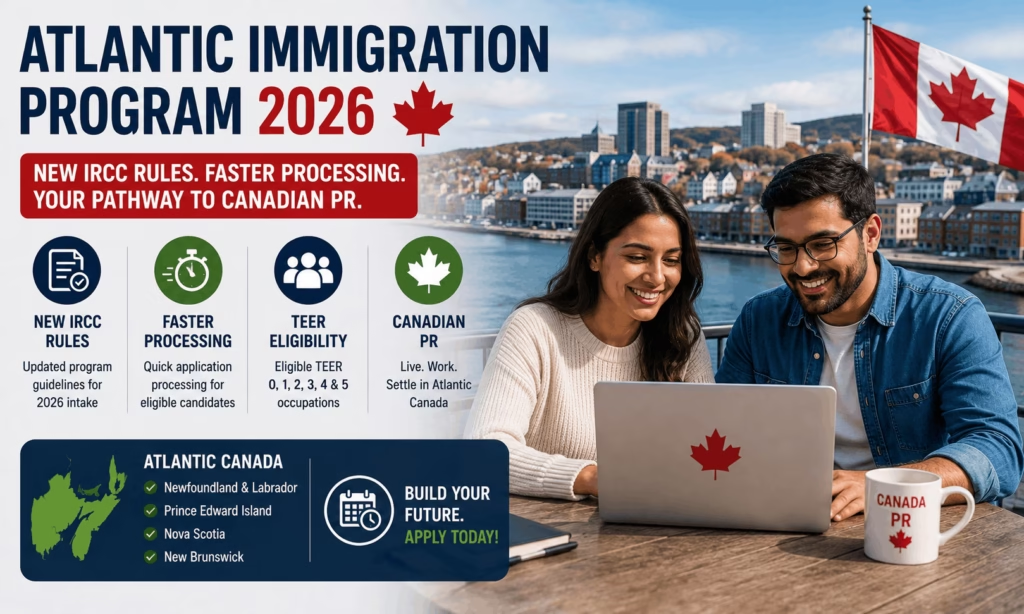
The Atlantic Immigration Program became a permanent federal economic class on March 6, 2022, replacing the earlier Atlantic Immigration Pilot Program that had run since 2017. It connects skilled foreign workers and international graduates with employers in Canada’s four Atlantic provinces, Nova Scotia, New Brunswick, Prince Edward Island, and Newfoundland and Labrador, who are struggling to fill positions locally.
Unlike Express Entry, the AIP does not rank candidates against a Comprehensive Ranking System score. There is no points competition and no draw cutoff to clear. Instead, eligibility runs entirely through a genuine job offer from a provincially designated employer, followed by a provincial endorsement and a federal permanent residence application. This employer-driven structure is the single biggest reason immigration consultants describe the AIP as one of the more predictable routes to Canadian permanent residence, since success depends on meeting fixed criteria rather than out-competing other applicants in a points pool.
Who Qualifies: Skilled Workers vs International Graduates
Eligibility splits into two distinct streams, each with its own entry conditions.
Skilled workers generally need at least 1,560 hours of qualifying work experience, equivalent to roughly one year of full time employment, accumulated within the past five years in an occupation classified under NOC TEER 0, 1, 2, 3, or 4. The work experience must align with the TEER level of the job offer the applicant is actually receiving in Atlantic Canada.
International graduates have a considerably lighter bar. Anyone who completed a credential of at least two years at a recognized post-secondary institution in one of the four Atlantic provinces, within the past two years, and who lived in the Atlantic region for at least 16 months during their studies, is exempt from the work experience requirement entirely. This allows international students to move directly from a study permit into a permanent residence application without first having to prove a year of relevant work history, which remains one of the program’s most attractive features for young talent already settled in the region.
Language, Education, and Work Experience Requirements by TEER Level
The AIP’s language thresholds are notably lower than what most Express Entry candidates need to be competitive, which is part of why the program attracts applicants who are functionally proficient in English or French but might not score well on a high-stakes points test.
| Job Offer TEER Level | Minimum Language Level (CLB) | Minimum Education Requirement | Job Offer Duration Required |
|---|---|---|---|
| TEER 0 or 1 | CLB 5 | One-year post-secondary credential or foreign equivalent | At least 1 year from date of becoming a PR |
| TEER 2 or 3 | CLB 5 | Canadian high school diploma or foreign equivalent | At least 1 year from date of becoming a PR |
| TEER 4 | CLB 4 | Canadian high school diploma or foreign equivalent | Permanent, with no set end date |
An IELTS General Training overall score of roughly 5.0, or a CELPIP score of 5 across all four skill areas, satisfies the CLB 5 requirement. CLB 4 is a lower bar still, roughly equivalent to an IELTS score of 4.5. Accepted tests include IELTS, CELPIP, TEF Canada, and TCF Canada, and all language results must be less than two years old at the time the application is submitted. Applicants whose education was completed outside Canada may also need an educational credential assessment to demonstrate their foreign credential is equivalent to the required Canadian standard.
2027 HSA Contribution Limits Announced: IRS Confirms $4,500 and $9,000 Caps
USCIS Restored Power To Deny Without RFE: Here Is What Policy Alert PA-2026-05 Actually Changes
IEEPA Tariff Refund Process: How Businesses Are Claiming Their Share of $166 Billion
50% US Tariffs on Canadian Goods: Full List and What Changes
The Job Offer and Employer Designation Rules
A genuine, non-seasonal job offer from a provincially designated employer sits at the centre of every AIP application. Each Atlantic province runs its own employer designation process independently, and only businesses that have gone through that provincial vetting can legally hire a candidate under this program. Designation alone does not guarantee a candidate’s success, since the applicant must still separately satisfy every federal eligibility requirement and secure a provincial endorsement on top of the job offer itself.
The job offer cannot come from a company where the applicant, or their spouse or common-law partner, holds a majority ownership stake, a rule designed to prevent applicants from using the program to self-sponsor through a business they effectively control. Employers also carry real financial responsibility under the program. If a candidate with a TEER 4 job offer has their federal permanent residence application refused, the employer becomes solely responsible for covering the cost of returning that applicant to their home country.
New IRCC Rules for Changing Employers and Circumstances Mid-Application
The most significant procedural update this year is IRCC’s June 2026 operational bulletin covering what the department calls other situations, meaning what happens when an applicant’s circumstances shift while their file is still open. The bulletin sets out a formal six-step procedure for handling a change of employer, alongside guidance for changes in family composition, loss of employment during processing, and cases where an applicant has a second permanent residence application pending in another economic class.
On July 23, 2026, IRCC issued a further clarification specifically addressing what happens when a designated employer changes ownership. The updated guidance clarifies the documentary requirements in situations where a province continues to support an applicant even though the employer technically loses its designation because of a change in ownership. In practical terms, this closes a gap that previously left some applicants in limbo when the business backing their application was sold or restructured partway through processing.
A key procedural detail applicants should note: any notification of a change in circumstances must go through the official IRCC web form, not email. Communication sent by email to the AIP processing centre is not the prescribed channel under the current bulletin and will not be reliably recorded in the department’s case management system.
Current AIP Processing Times and Fees
Processing times have moved sharply this year. As recently as May 12, 2026, the expected wait for a decision on a newly submitted AIP application stood at 38 months. By June 8, 2026, that figure had dropped to 26 months, a full year faster, and IRCC’s published timeline as of June 17, 2026 confirms the same 26-month figure.
| Fee Type | Amount |
|---|---|
| Principal applicant (includes $575 Right of Permanent Residence Fee) | $1,525 |
| Spouse or common-law partner | $1,525 |
| Per dependent child | $260 |
| Biometrics (single applicant) | $85 |
| Biometrics (family, maximum) | $170 |
Government fees can be updated periodically, so applicants should confirm the current amounts directly on the official IRCC fee schedule before submitting payment.
Key Atlantic Immigration Program Updates at a Glance
| Update | Detail | Date |
|---|---|---|
| Processing time drops sharply | Wait time falls from 38 months to 26 months | May to June 2026 |
| New operational bulletin | Six-step procedure for change of employer and other mid-application changes | June 2026 |
| Employer ownership change clarified | New documentary guidance for provincial support amid ownership changes | July 23, 2026 |
| 2026 PR allocation | Approximately 6,500 permanent residence spots, up from the prior year | 2026 |
| Retention rate | 72% of AIP newcomers remain in Atlantic Canada after 3 years, up from 58% in 2020 | Ongoing |
Borrower Defense Student Loans: How to Apply for a Full Discharge?
IRS Business Tax Account New Features Give Small Businesses More Ways to Skip the Phone Line
SSA Payroll Information Exchange and New SSI Improvement Office: What the Report Actually Changes
How to Apply for the Atlantic Immigration Program
- Confirm eligibility under either the skilled worker stream or the international graduate stream, based on your work history and education.
- Secure a genuine, full-time job offer from a provincially designated employer in Nova Scotia, New Brunswick, Prince Edward Island, or Newfoundland and Labrador.
- Complete an approved language test, IELTS, CELPIP, TEF Canada, or TCF Canada, and confirm your score meets the CLB requirement for your job offer’s TEER level.
- Work with your employer to begin the provincial endorsement process, since the employer typically initiates this step on the candidate’s behalf.
- Develop a settlement plan documenting your housing and community integration plans in the Atlantic province, a mandatory requirement before endorsement can be issued.
- Gather supporting documents, including employment reference letters, language test results, educational credentials or an ECA, police clearance certificates, and medical examination results.
- Receive your endorsement letter from the province once your employer and settlement plan have been approved.
- Submit your complete permanent residence application to IRCC online, along with the required government and biometric fees.
- Monitor your application through your IRCC online account and respond promptly to any request for additional documents.
- Report any change in employer, family composition, or employment status through the official IRCC web form, not email, to ensure it is properly recorded.
Official Atlantic Immigration Program Resources
| Resource | What It’s For | Official Link |
|---|---|---|
| AIP Program Overview | Full eligibility and application requirements | canada.ca/en/immigration-refugees-citizenship/services/immigrate-canada/atlantic-immigration |
| Check Application Processing Times | Current AIP processing time by application type | canada.ca/en/immigration-refugees-citizenship/services/application/check-processing-times.html |
| IRCC Secure Account Login | Track your application status and submit documents | canada.ca/en/immigration-refugees-citizenship/services/application/account.html |
| Operational Bulletin: AIP Other Situations | Official guidance on change of employer and mid-application changes | canada.ca/en/immigration-refugees-citizenship/corporate/publications-manuals/operational-bulletins-manuals |
| Find a Designated Employer | Provincial employer designation contacts by province | canada.ca/en/immigration-refugees-citizenship/services/immigrate-canada/atlantic-immigration/eligibility/find-employer.html |
FAQs About Atlantic Immigration Program 2026
What is the minimum work experience needed for the Atlantic Immigration Program?
Skilled worker applicants generally need at least 1,560 hours of qualifying work experience, roughly equivalent to one year of full time employment, accumulated within the past five years, in an occupation matching the TEER level of their job offer.
Do international graduates need work experience to qualify?
No. Graduates from a recognized post-secondary institution in Atlantic Canada, with a credential of at least two years completed within the past two years, and at least 16 months of regional residence during their studies, are exempt from the work experience requirement.
How long does the Atlantic Immigration Program take to process in 2026?
As of June 2026, IRCC’s published processing time is 26 months, down sharply from 38 months just a month earlier in May 2026.
Can I change employers while my AIP application is being processed?
Yes, but it must be reported through the official IRCC web form under the department’s June 2026 operational bulletin, which sets out a specific six-step procedure for handling a change of designated employer mid-application.
Is the Atlantic Immigration Program better than Express Entry?
It depends on the candidate. The AIP has lower language requirements, no CRS score competition, and often faster access for candidates with a genuine job offer, but it requires an employer sponsor and settlement intent in a specific region, which Express Entry does not.
What happens if my designated employer is sold or changes ownership?
Following IRCC’s July 23, 2026 clarification, if a province continues to support an applicant despite the employer losing its designation due to an ownership change, specific documentary requirements now apply to keep the application on track.
Conclusion
The Atlantic Immigration Program 2026 is moving faster and, in some respects, becoming more forgiving of the real-world complications applicants face, from employer changes to ownership transfers mid-process. With processing times cut by a full year in just a few weeks and a clearer procedural framework now in place for handling changed circumstances, this remains one of the more accessible economic immigration pathways for skilled workers and international graduates willing to commit to Atlantic Canada. Anyone considering this route should start by confirming eligibility under the correct stream, since a genuine job offer from a provincially designated employer remains the non-negotiable foundation the entire application is built on.
Direct Express Card Transition to Fifth Third Bank: What 3.6 Million Cardholders Need to Know
Federal Fuel Excise Tax Suspension: Ford Pushes Carney to Extend Relief Past Labour Day
FTC Refund 2026: Millions of Americans May Be Owed Money and Most Don’t Know It