CRA Benefit Payments Coming In July 2026: July 2026 marks the start of a new federal benefit year in Canada, and it’s bringing one of the biggest resets of Canada Revenue Agency (CRA) and Service Canada payments in years. Millions of Canadians — families, low-income workers, seniors, and people with disabilities — will see updated amounts landing in their bank accounts this month, driven by a combination of annual inflation indexation and a switch to using 2025 tax return data to calculate entitlements.
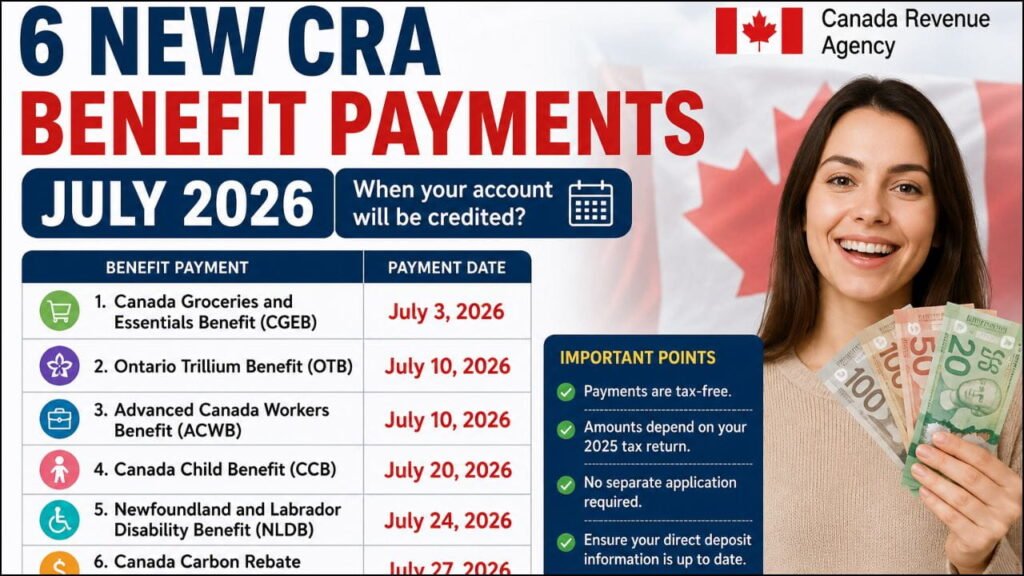
Below is a breakdown of the six major CRA and federal benefit payments arriving in July 2026, based on information from Canada.ca and recent coverage from Canadian news outlets.
1. Canada Groceries and Essentials Benefit (CGEB) — July 3, 2026
The most significant change this month is the debut of the Canada Groceries and Essentials Benefit which officially replaces the long-running GST/HST credit. The rebrand was legislated through Bill C-19, which received Royal Assent in February 2026, and it comes with a 25% increase to quarterly payment amounts, locked in for five years through mid-2031.
The CGEB keeps the same eligibility rules, income-testing formula, and quarterly payment structure as the old GST/HST credit, so no new application is required for existing recipients. To qualify, you generally need to be a Canadian resident for tax purposes, at least 19 years old, and have filed an income tax return. Newcomers who have never received the credit before must file Form RC151 through CRA My Account.
For the July 2026 to June 2027 benefit year, based on 2025 tax return income, a single individual receiving the maximum amount can expect roughly $679 annually (about $169.75 per quarter) — an increase of around $146 compared to the old GST/HST credit maximum. Couples can receive up to roughly $890, plus an additional amount for each eligible child under 19. Payments phase out gradually once adjusted family net income rises above approximately $46,000. This first CGEB payment landed July 3, and it will repeat every three months through the rest of the benefit year.
2. Canada Child Benefit (CCB) — July 20, 2026
The Canada Child Benefit, Canada’s largest tax-free monthly support program for families with children under 18, begins a new benefit year with the July 20 deposit. A confirmed 2% inflation indexation adjustment raises the maximum annual amounts to roughly $8,157 per year (about $679.75 a month) for each child under six, and roughly $6,883 per year (about $573.58 a month) for children aged six to seventeen — up from the previous year’s maximums.
Because CCB entitlement is now calculated using 2025 income tax information instead of 2024 figures, individual payments could go up or down depending on how a household’s income or family composition changed between those two years. The income thresholds used to determine the reduction of benefits have also been adjusted upward for the new benefit year. Families do not need to reapply; the CRA recalculates entitlement automatically based on the most recently filed return, and eligible newcomers can apply as soon as they have a Social Insurance Number rather than waiting to file taxes.
3. Ontario Trillium Benefit (OTB) — July 10, 2026
Ontario residents who receive the Ontario Trillium Benefit — which bundles the Ontario Energy and Property Tax Credit, the Northern Ontario Energy Credit, and the Ontario Sales Tax Credit into a single monthly deposit — will see their first payment of the new benefit year on July 10. Amounts are now based on 2025 tax return information rather than 2024 figures, so recipients whose income or living situation changed may notice a different monthly amount. Ontarians whose total annual entitlement is $360 or less typically receive their full yearly amount as one lump-sum payment in July rather than monthly installments.
4. Advanced Canada Workers Benefit (ACWB) — July 10, 2026
Low-income workers can expect the next Advanced Canada Workers Benefit payment on July 10, 2026. The Canada Workers Benefit is a refundable tax credit for individuals and families earning low working income, and the “advanced” version allows eligible recipients to receive up to 50% of their estimated annual entitlement in installments throughout the year rather than waiting until tax time.
For the 2026–27 benefit year, based on 2025 tax return data, the maximum basic amount is $1,633 for single individuals and $2,813 for families, with an additional disability supplement of up to $843. To qualify, a person generally needs at least $3,000 in employment or self-employment income, Canadian residency for tax purposes, and to be at least 19 years old (or have a spouse, common-law partner, or dependent child). No separate application is required — the CRA automatically calculates and issues advance payments based on the most recent return, with the remaining balance settled when the 2026 tax return is filed in spring 2027.
5. Canada Pension Plan (CPP) and Old Age Security (OAS)/Guaranteed Income Supplement (GIS) — July 29, 2026
For retirees, the end of July brings the CPP and OAS/GIS deposits, scheduled for July 29, 2026. OAS is adjusted quarterly to reflect changes in the cost of living, and this cycle’s increase has been described as the largest quarterly bump for OAS so far in 2026. GIS, which supplements OAS for lower-income seniors, is also adjusted alongside it. CPP retirement, disability, children’s, and survivor benefits are paid on the same date. These payments don’t require a new application each year — the amount is based on individual contribution history (for CPP) and income (for GIS), automatically updated using the latest available tax information.
6. Canada Disability Benefit (CDB)
Rounding out the July changes is the **Canada Disability Benefit**, a monthly payment for eligible Canadians aged 18 to 64 who hold a valid Disability Tax Credit (DTC) certificate. For the July 2026 to June 2027 benefit year, the maximum monthly amount rises from $200 to roughly $204.20 due to annual indexation, working out to about $2,450 a year. The income thresholds for receiving the full benefit have also been adjusted slightly upward. Because the DTC certificate is a prerequisite, Canadians who haven’t yet been approved need to have a medical practitioner complete Form T2201 and submit it to the CRA before they can access this benefit.
What Canadians Should Do?
Because so many of these programs now calculate entitlement using 2025 tax return data instead of 2024 figures, the CRA and Service Canada are urging Canadians to make sure their 2025 return has been filed and assessed, and that their direct deposit and marital or family status information is current in CRA My Account. Anyone who doesn’t receive an expected payment on the scheduled date is generally advised to wait five to ten business days before contacting the CRA, since bank processing and mail delivery (for those on cheques) can add a short delay.
This article summarizes information from Canada.ca (Government of Canada benefits payment calendar) and recent Canadian news coverage. For the most accurate, individualized figures, check your CRA My Account or the official Canada.ca benefits pages, as amounts vary based on income, family situation, and province of residence.
FAQ’s on CRA Benefit Payments July 2026
Which CRA Benefit Payments are being issued in July 2026?
The main CRA Benefit Payments issued by the CRA in July 2026 include:
Canada Groceries and Essentials Benefit (CGEB) – July 3, 2026
Ontario Trillium Benefit (OTB) – July 10, 2026
Advanced Canada Workers Benefit (ACWB) – July 10, 2026
Canada Child Benefit (CCB) – July 20, 2026
Newfoundland and Labrador Disability Benefit (NLDB) – July 24, 2026
What is the Canada Groceries and Essentials Benefit (CGEB)?
The CGEB is a new tax-free quarterly benefit that will replace the GST/HST credit starting in July 2026. It helps low- and modest-income Canadians cover the rising costs of groceries and everyday essentials.
Has the CRA Benefit Payments amount increased?
Yes. Starting in July 2026, the CGEB payment is 25% higher than the previous GST/HST credit, and this increase is planned to remain in effect until 2031.
Do I need to apply for the CGEB?
No. There is no separate application. If you file your tax return, the CRA automatically determines your eligibility.
What happens if I don’t receive my CRA Benefit Payments?
The CRA advises waiting:
5 business days for direct deposit.
10 business days for a mailed cheque.
If the payment still hasn’t arrived, contact the CRA or check your CRA account.