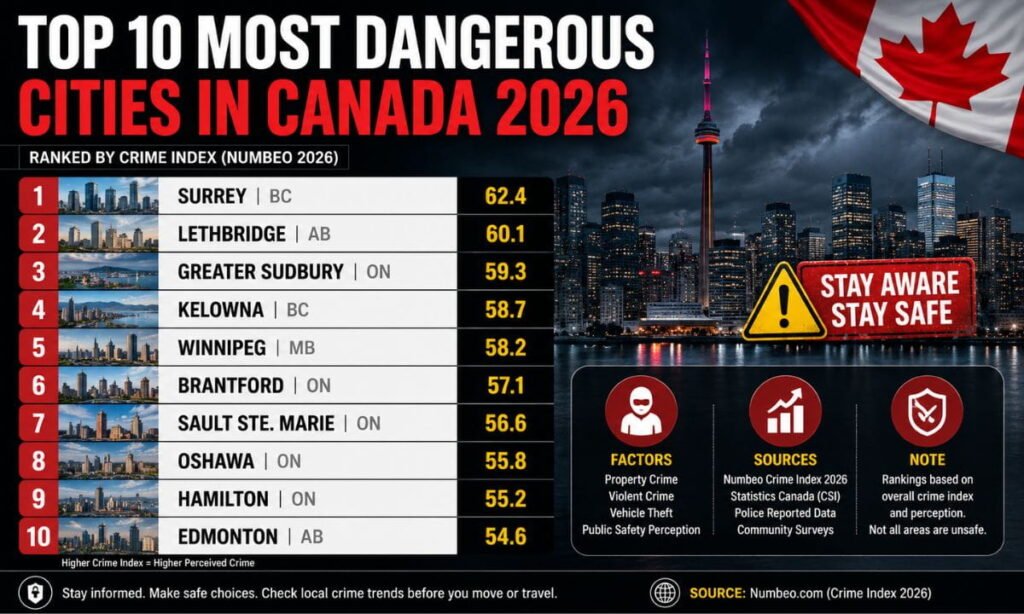
Top 10 Most Dangerous Cities in Canada 2026: Canada is still ranked among the safest countries in the world by most global measures, but that national reputation hides real differences at the city level. A newly updated mid-2026 dataset from Numbeo — the crowd-sourced global cost-of-living and safety index — shows a consistent group of mid-sized cities sitting well above the national average on perceived crime, even as official police statistics tell a more mixed story. Here’s the latest ranking, what’s driving it, and how it compares with Canada’s official crime data.
How This Ranking Is Built?
Numbeo’s Crime Index isn’t based on police records — it’s built from ongoing user-submitted surveys asking residents how safe they feel walking during the day and at night, and how concerned they are about property crime, violent crime, vandalism, and related issues. Responses are converted into a 0–100 score, where scores above 60 are considered “high,” and anything above 80 is “very high.” The Safety Index is simply the inverse: higher means people report feeling safer.
This matters because it’s a different measure than Statistics Canada’s Crime Severity Index (CSI), the country’s official yardstick, which weighs the actual volume and seriousness of police-reported offences. The two often diverge — sometimes sharply — and both are referenced below for a fuller picture.
The Top 10 for Mid-2026
- Surrey, British Columbia— Crime Index: 64.4. Surrey holds the top spot for a third consecutive update, driven largely by an ongoing extortion crisis targeting local businesses and families, with demands reported in the range of $50,000 to $500,000. The situation escalated enough that Ottawa listed the Bishnoi gang as a terrorist entity in September 2025, and the BC government has since funded a dedicated task force and added RCMP officers. Notably, the wider Vancouver metro area’s official CSI actually improved 8% in 2024 — the perception gap hasn’t caught up with that progress yet.
- Lethbridge, Alberta — Crime Index: 63.1. A Fraser Institute study found Lethbridge has the highest property crime rate of any Canadian metro area over 100,000 people — more than double the national average. Organized retail theft rings have been a recurring local issue, though the city’s official CSI improved by 19% year-over-year in 2024.
- Sudbury, Ontario — Crime Index: 62.5. Sudbury’s ranking has been stable for over a year. Its official CSI actually dropped 12% in 2024, but downtown disorder and nightlife-related concerns continue to weigh on how safe residents say they feel.
- Kelowna, British Columbia — Crime Index: 61.6, down slightly from 62.1 earlier in the year. Kelowna RCMP’s own 2025 review found mischief and robbery offences rose noticeably, largely tied to homelessness, addiction, and mental health crises — even as broader property crime has fallen 18% over four years. A local survey found 68% of residents believed property crime was rising even though the official figures showed an 8% decline, a clear example of the perception-versus-data gap.
- Brantford, Ontario — Crime Index: 61.0, up from 60.5, overtaking Winnipeg for the first time in this dataset. Brantford’s official CSI barely moved in 2024 (down just 1%), a flatter trend than many peer Ontario cities.
- Winnipeg, Manitoba — Crime Index: 60.2, an improvement from 60.8. This is the most interesting entry on the list: despite dropping in the Numbeo ranking, Winnipeg’s official 2024 CSI of 124.4 remains the highest of any major Canadian metro area, a legacy of the city’s long-standing struggles with gang activity and drug trafficking. That said, the Winnipeg Police Service’s 2025 annual report shows real progress — homicides down nearly 49%, violent crime severity down over 11%, and youth crime falling for the first time in four years.
- Oshawa, Ontario — Crime Index: 60.2, tied with Winnipeg. Vehicle theft and retail crime dominate resident concerns, and Oshawa’s proximity to the Greater Toronto Area adds to perceptions of spillover crime. Statistics Canada doesn’t publish a CSI for Oshawa separately due to jurisdictional boundary issues, making perception data the main comparison point here.
- Sault Ste. Marie, Ontario — Crime Index: 59.9, just barely dropping below the “high” threshold for the first time in recent updates. Cross-border proximity to Michigan is cited as a factor in ongoing trafficking concerns.
- Hamilton, Ontario — Crime Index: 55.6. Hamilton’s official CSI actually sits below the national average, making this one of the clearest perception-versus-reality gaps on the list — likely driven by visible disorder in specific downtown corridors rather than citywide risk.
- Brampton, Ontario — Crime Index: 55.6, tied with Hamilton. Vehicle theft is the defining issue: thousands of vehicles were stolen across Brampton and Mississauga in 2025 alone, and extortion cases affecting local businesses in the wider Peel Region nearly quadrupled between 2023 and 2025. A federal summit was held in Brampton in early 2026 specifically to address the overlap between auto theft, organized crime, and extortion in the region.
Just outside the top 10: Kamloops, London, Regina, Nanaimo, and Saskatoon round out the next five spots, all in the “moderate” band.
The National Picture Is Actually Improving
It’s worth stressing that Canada’s overall Crime Severity Index fell about 4% in 2024, breaking three straight years of increases, and sits roughly a third below its 1998 peak. The cities on this list represent pockets of elevated concern, not a nationwide reversal. Extortion-related crime — particularly affecting British Columbia and Ontario’s Peel Region — has been the single biggest driver of new anxiety in 2025–2026, prompting a federal Bail and Sentencing Reform package with more than 80 changes, including reverse-onus provisions for violent auto theft and extortion offences, expected to take effect in July 2026.
The Safest Cities, For Contrast
On the other end of the spectrum, Quebec City continues to hold Canada’s lowest Crime Index at roughly 22, followed by Burlington, Ottawa, Montreal, and Guelph — all comfortably in the “low” crime-perception band.
Why the Two Measures Don’t Always Agree?
Perception-based indexes like Numbeo’s tend to be swayed by visible, everydayissues — shoplifting, vandalism, disorder downtown — even when those incidents carry little weight in official severity calculations. Official CSI figures, by contrast, can spike from a single serious incident, like a homicide, without changing how safe most residents feel walking around. Both lenses are useful, but neither tells the whole story alone — which is why city-level rankings should be paired with neighbourhood-specific research for anyone making a relocation or travel decision.
Bottom Line
Surrey, Lethbridge, and Sudbury continue to anchor the top of Canada’s perceived-crime rankings for mid-2026, with an ongoing extortion crisis in BC and Ontario reshaping public anxiety more than any other single factor. But the data also tells a more encouraging story underneath the headlines: several cities on this list, including Winnipeg, Kelowna, and Lethbridge, posted real, measurable improvements in official crime statistics over the past year — improvements that simply haven’t caught up with public perception yet. As always, treat perception-based rankings as one data point among several, not a complete picture of any single city’s safety.
Top 10 Most Dangerous Cities in Canada: Top Searched Questions
Which is considered the most dangerous city in Canada in 2026?
Based on the 2026 Numbeo Crime Index rankings, Surrey, British Columbia, ranks as the city with the highest crime perception score in Canada.
Where can I find official Canadian crime statistics?
Statistics Canada publishes the official Crime Severity Index (CSI), police-reported crime rates, homicide statistics, and other crime data each year.
Does “most dangerous” mean tourists should avoid these cities?
No. These cities remain popular places to live and visit. The rankings reflect crime statistics and residents’ safety perceptions, not that every neighborhood is unsafe. Many areas within these cities are considered very safe.
Which Canadian city has the highest violent crime concerns?
Recent official police-reported data has often placed cities such as Winnipeg among the highest for violent crime rates, although rankings vary depending on the metric used.
Is Toronto on the list?
No. Toronto does not appear in the 2026 top 10 ranking and remains one of Canada’s safer large metropolitan areas by several measures.