Canadian Citizenship Ceremony 2026: Permanent residents across Canada are now waiting roughly 13 months for a decision on their citizenship application, and the queue has swelled past 321,100 files as of the latest IRCC processing update. For the tens of thousands of applicants who clear that wait every month, one final step stands between them and a Canadian passport: the Canadian citizenship ceremony. This is the moment where a permanent resident stands before a citizenship judge, recites the Oath of Citizenship, and legally becomes a Canadian citizen on the spot.
With IRCC continuing to shift more candidates toward virtual video-conference ceremonies while slowly reintroducing larger in-person events at courthouses, community centres, and IRCC offices, many new applicants are unsure which format they will get, what documents to bring, and what actually happens once they log in or walk through the door. This guide breaks down the full Canadian citizenship ceremony process for 2026, including the exact oath wording, the current $653 CAD application fee, dress code expectations, and what happens immediately after you take the oath. We’ll be updating this article monthly as IRCC releases new processing data and ceremony guidance.
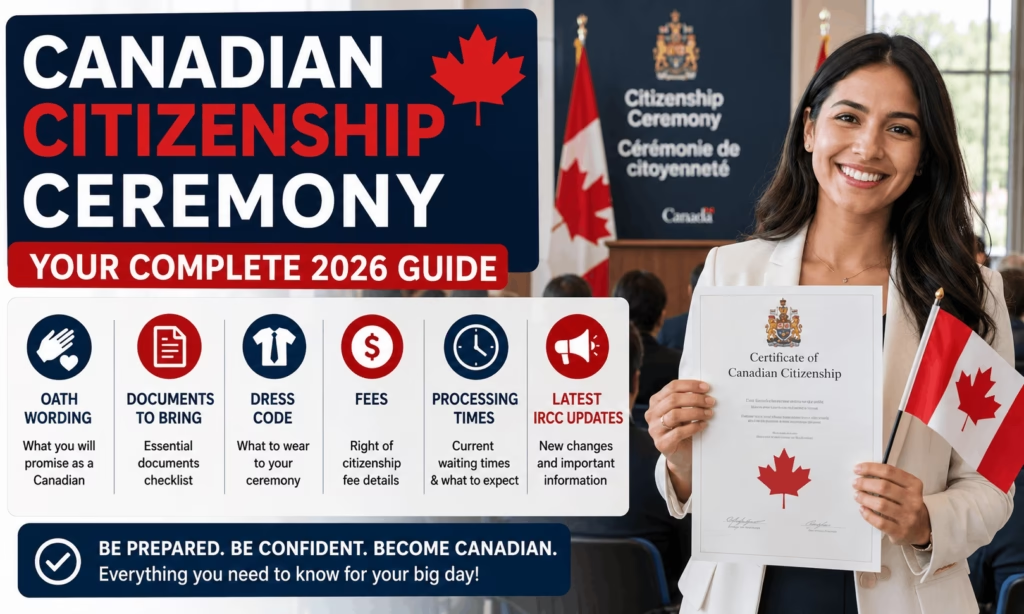
Canadian Citizenship Ceremony Key Highlights
| Detail | Current Information (2026) |
|---|---|
| Ceremony formats | Virtual (video conference) or in-person |
| Ceremony length | Typically 30 minutes to 2 hours |
| Application fee (adult) | $653 CAD ($530 processing + $123 right of citizenship) |
| Application fee (minor) | $100 CAD |
| Citizenship grant processing time | Approximately 13 months (80% of applications) |
| Applications in queue | Around 321,100 as of May 2026 |
| Citizenship test | 20 questions, 75% pass mark, required for ages 18-54 |
| Age exemption | Applicants under 18 or 55+ skip the test and language requirement |
| Documents required | Notice to Appear, PR card or COPR, two pieces of photo ID |
| Oath languages | English or French (bilingual ceremonies available) |
| What you receive | Citizenship certificate (paper or e-certificate) |
What Is a Canadian Citizenship Ceremony?
A Canadian citizenship ceremony is the official, legally required event where an approved permanent resident swears or affirms the Oath of Citizenship and becomes a Canadian citizen. It is presided over by a citizenship judge or another official delegated by IRCC. The ceremony is the final administrative and legal step in the naturalization process, and citizenship takes effect immediately once the oath is signed and confirmed in IRCC’s system, not days later.
Ceremonies are held in two formats. In-person ceremonies take place at IRCC offices, courthouses, community centres, and occasionally larger public venues, and can include anywhere from a handful of candidates to well over 100 people taking the oath together. Virtual ceremonies, conducted mainly over Microsoft Teams or Zoom, were introduced during the COVID-19 pandemic and remain the more common format for most candidates in 2026, though IRCC has been gradually increasing in-person capacity.
Who Needs to Attend
Anyone 14 years of age or older who has been approved for a citizenship grant must personally attend a citizenship ceremony and take the oath. Children under 14 do not need to attend or take the oath themselves; a parent or legal guardian can complete the required steps on their behalf. Applicants aged 55 and over are exempt from the citizenship knowledge test and language requirement but must still attend the ceremony and take the oath like every other adult candidate.
Current Processing Times and Backlog 2026
Timing your expectations correctly starts with understanding how long the full journey to the ceremony actually takes. As of IRCC’s most recent published data, the citizenship grant processing time sits at approximately 13 months for 80% of applicants, up from 12 months just one month earlier. The grant queue has grown to roughly 321,100 people, an increase of nearly 8,000 applicants in a single month.
| Stage | Typical Timeline (2026) |
|---|---|
| Acknowledgement of Receipt (AOR) | 1-4 weeks after submission |
| Citizenship test invitation | 4-7 months after AOR |
| Test and interview | Same appointment, in most routine cases |
| Oath ceremony invitation | 2-4 months after test approval |
| Total (routine file) | 8-11 months |
| Total (flagged for residency, tax, or fingerprint review) | 11-18 months |
Files can move faster or slower depending on residency calculation complexity, tax filing history, security screening, and whether an applicant’s country of origin requires additional checks. A complete, error-free application submitted online remains the single biggest factor in avoiding delay, since paper applications typically run two to three months behind digital ones.
Citizenship Application and Ceremony Fees
IRCC’s official 2026 fee schedule confirms the following current costs, verified directly against the government fee list:
| Fee Type | Amount (CAD) |
|---|---|
| Adult citizenship application (18+) | $653.00 (includes $530 processing + $123 right of citizenship fee) |
| Minor application (under 18) | $100.00 |
| Stateless adult born to a Canadian parent | $123.00 |
| Citizenship certificate (proof of citizenship) | $75.00 |
| Resume citizenship (adult) | $530.00 |
| Renounce citizenship | $100.00 |
There is no separate charge for the ceremony itself. The right of citizenship fee is refundable if an applicant withdraws or is refused, while the $530 processing fee is non-refundable once IRCC begins reviewing the file.
How You Get Invited to Your Canadian Citizenship Ceremony
Once you pass your citizenship test and interview, and IRCC finishes its background and security checks, you will receive a Notice to Appear to Take the Oath of Citizenship (form CIT 0024). This invitation is typically sent to your IRCC secure account, by email, or occasionally by phone call or mail, usually one to eight weeks before your ceremony date. It confirms whether your ceremony is virtual or in-person, the exact date and time, and joining instructions or the venue address. IRCC allows only one request to change the ceremony format, after which you will be assigned a new date and cannot revert to your original one.
What to Bring to Your Citizenship Ceremony
Regardless of format, IRCC requires the following at every Canadian citizenship ceremony:
- Notice to Appear letter (printed copy or clear digital version)
- Permanent Resident (PR) card or Confirmation of Permanent Residence (COPR), even if expired
- Two pieces of government-issued photo ID, at least one bearing your photo and signature
- Any additional documents IRCC has specifically requested in your file
- A pen for signing the Oath or Affirmation of Citizenship form
- For virtual ceremonies: a charged device with a working camera, microphone, and stable internet connection
If you wish to swear the oath on a holy book, you must bring it yourself; IRCC does not provide one. For in-person ceremonies, officials will collect and shred your PR card on-site since your immigration status is changing permanently. Family members are generally welcome to attend as guests, though in-person venues typically allow around two guests per candidate depending on room capacity.
What Happens During the Ceremony
A typical citizenship ceremony follows a consistent structure whether virtual or in-person:
- Registration and identity verification. An officer checks your Notice to Appear, PR card, and photo ID against your file. Virtual candidates are asked to hold documents up to the camera. At larger in-person events, expect to wait up to 30 minutes before registration opens.
- Welcome and remarks. The presiding citizenship judge or official welcomes candidates and guests and often speaks about the meaning of Canadian citizenship, along with the rights and responsibilities it brings.
- The Oath of Citizenship. All candidates stand and recite the oath together, in English, French, or bilingually, either by swearing on a holy book or affirming without one.
- The national anthem. Candidates and guests sing O Canada together.
- Signing the Oath or Affirmation of Citizenship (OAC) form. This legally finalizes your citizenship.
- Receiving your citizenship certificate. In-person candidates typically receive a physical certificate on the spot; virtual candidates receive either a mailed certificate or an e-certificate by email once IRCC confirms the signed OAC form in its system.
For privacy at virtual ceremonies, IRCC asks candidates to change their on-screen display name to the seat number listed on their invitation rather than their real name.
The Oath of Citizenship: Full Text
Every candidate aged 14 or older must swear or affirm the following, using the current wording that reflects the 2021 amendment recognizing Indigenous rights:
“I swear (or affirm) that I will be faithful and bear true allegiance to His Majesty King Charles the Third, King of Canada, His Heirs and Successors, and that I will faithfully observe the laws of Canada, including the Constitution, which recognizes and affirms the Aboriginal and treaty rights of First Nations, Inuit and Metis peoples, and fulfil my duties as a Canadian citizen.”
Candidates may choose to swear (referencing their religious beliefs, often on a holy book) or affirm (a secular declaration with no religious reference). Both carry equal legal weight, and the choice is entirely personal.
Virtual vs In-Person Ceremonies
| Feature | Virtual Ceremony | In-Person Ceremony |
|---|---|---|
| Platform | Microsoft Teams or Zoom | IRCC office, courthouse, community centre |
| Typical size | Individual or small group | 20 to 100+ candidates |
| Documents shown | Held up to webcam | Physically presented and verified |
| Certificate delivery | Mail or e-certificate | Handed out same day |
| PR card handling | Confirmed on file | Physically collected and shredded |
| Guests | Can join the video call | Limited by venue capacity |
Neither format changes your legal status as a citizen once the oath is taken and the form is signed; the difference is purely logistical.
Dress Code and Etiquette
There is no strict uniform requirement, but IRCC expects candidates to dress respectfully and appropriately for a formal legal proceeding. Smart-business attire or traditional cultural dress is both acceptable and commonly seen, reflecting Canada’s diversity. Footwear should be appropriate for a formal indoor setting. Avoid casual items such as flip-flops, gym wear, or clothing with offensive graphics. Face coverings are permitted for religious or cultural reasons, but candidates must show their face when reciting the oath itself, a requirement under the Oath of Citizenship Act.
After the Ceremony: Your Next Steps
Once you sign the Oath or Affirmation of Citizenship form and IRCC confirms it in its system, you are a Canadian citizen immediately, with the same rights as anyone born in Canada. Priority next steps include:
- Apply for a Canadian passport using your citizenship certificate as proof.
- Register to vote through Elections Canada.
- Update your Social Insurance Number record, banking details, and provincial ID or driver’s licence to reflect your new citizenship status where relevant.
- Consider applying for a NEXUS card or other travel programs now open to citizens.
- If applicable, look into dual citizenship rules for your country of origin, since Canada permits dual and multiple citizenship without restriction.
Latest 2026 Updates
- Processing backlog rising: The citizenship grant queue climbed to 321,100 applications with a 13-month wait as of the most recent IRCC release, up from 12 months the previous month, driven by higher application volumes.
- Citizenship certificate delays worsening faster: Proof-of-citizenship (certificate) processing has separately climbed toward 12 to 19 months in different IRCC reporting windows, driven largely by a surge in citizenship-by-descent applications following the Bill C-3 amendments to the Citizenship Act.
- Bill C-3 impact: Since December 15, 2025, expanded citizenship-by-descent rules under Bill C-3 have significantly increased applications for proof of citizenship, with archives across provinces reporting sharp spikes in requests for vital records needed to prove ancestral lines.
- Fee confirmation: IRCC’s official fee list, last modified July 2, 2026, confirms the adult citizenship application fee remains $653.00 CAD, unchanged in structure since the right of citizenship portion was adjusted to $123.00.
- Ceremony format mix: IRCC continues to lean on virtual ceremonies as the default for most candidates in 2026 while gradually restoring more in-person events at courthouses and community venues nationwide.
Official IRCC Resources
| Resource | Purpose | Official Link |
|---|---|---|
| IRCC Secure Account | Login, application tracking, ceremony invitation | canada.ca/en/immigration-refugees-citizenship |
| Check Processing Times | Real-time citizenship processing estimates | ircc.canada.ca (Check processing times tool) |
| Application Status Check | Track your citizenship file status | canada.ca (Check your application status) |
| Citizenship Fee List | Official, current fee schedule | ircc.canada.ca/english/information/fees/fees.asp |
| Prepare for Your Ceremony | Oath text, ceremony guidance | canada.ca (Citizenship ceremony section) |
| Discover Canada Study Guide | Free citizenship test preparation material | canada.ca (Discover Canada) |
| IRCC Web Form | Contact IRCC about ceremony or application queries | canada.ca (IRCC Web form) |
FAQs
How long does a Canadian citizenship ceremony take?
Most ceremonies last between 30 minutes and two hours, depending on the number of candidates and whether it is held virtually or in person.
Can I choose whether my ceremony is virtual or in-person?
Not directly. IRCC assigns the format based on capacity and local scheduling, though you can request one format change after receiving your invitation.
What happens if I miss my citizenship ceremony?
You must contact IRCC as soon as possible to explain the situation and request rescheduling. Missing a ceremony without notice can delay your file further.
Do I keep my permanent resident card after becoming a citizen?
No. For in-person ceremonies, IRCC collects and destroys your PR card since your status has changed. For virtual ceremonies, your PR status is updated electronically.
Can I bring my family to my citizenship ceremony?
Yes, guests are generally welcome, though in-person venues limit attendance based on room capacity, typically around two guests per candidate.
What language can I take the oath in?
You may swear or affirm the oath in English, French, or both, and many ceremonies are conducted bilingually.
How soon can I apply for a Canadian passport after the ceremony?
You can apply immediately after receiving your citizenship certificate, whether physical or electronic.
People Also Ask
What documents do I need for my Canadian citizenship ceremony? Your Notice to Appear letter, your PR card or Confirmation of Permanent Residence, and two pieces of photo ID, one with your photo and signature.
Is the Canadian citizenship ceremony the last step to become a citizen? Yes. Once you sign the Oath or Affirmation of Citizenship form at the ceremony, citizenship takes effect immediately.
What do you say at a Canadian citizenship ceremony? Candidates recite the Oath of Citizenship, which is a pledge of allegiance to the monarch and a commitment to observe Canada’s laws and Constitution.
How much does Canadian citizenship cost in 2026? The adult application fee is $653 CAD, and a minor’s application costs $100 CAD, based on IRCC’s current official fee schedule.
Can seniors skip the citizenship test before the ceremony? Yes. Applicants aged 55 and over are exempt from the knowledge test and language requirement but must still attend the ceremony.
Conclusion
The Canadian citizenship ceremony is a short but legally decisive event that caps a process many applicants spend well over a year completing. With grant processing now running close to 13 months and the national queue past 321,100 files, preparation matters more than ever, from confirming your documents and understanding the current $653 CAD fee to knowing the exact oath wording and dress expectations for the day. Whether your invitation places you in a video call from home or in a courthouse hall with a hundred other candidates, the outcome is the same the moment you sign the Oath or Affirmation of Citizenship form: you become a Canadian citizen with full rights, ready to apply for your passport and register to vote. Because IRCC updates its processing times and ceremony guidance frequently, candidates should always cross-check the latest figures on the official IRCC website before their own ceremony date.