NATO Summit 2026: The 2026 NATO Summit will take place in Ankara, Türkiye, on 7–8 July 2026, marking the 36th NATO Summit 2026 and the second time Türkiye has hosted the gathering following the 2004 summit in Istanbul. The main sessions will be held at the Presidential Complex, formally known as the Beştepe Presidential Complex. The summit’s logo itself features the Beştepe Presidential Complex, underscoring its role as the summit venue.
Hosting the event is itself notable for Türkiye. NATO currently counts 32 members, 17 of which have never hosted a summit, including Canada, Denmark, Greece, Norway and Sweden among others, while 15 have — with Türkiye now becoming one of the few countries to host twice, after Istanbul in 2004.
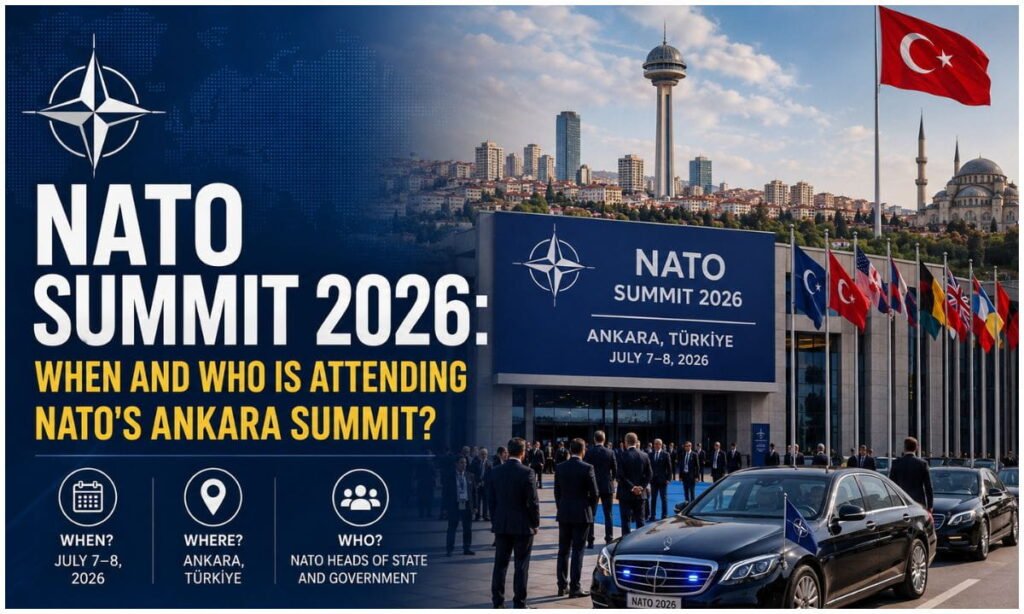
NATO Summit 2026 – When and Where?
Ahead of the leaders’ sessions, the NATO Summit Defence Industry Forum (NSDIF26) — NATO’s premier high-level event on transatlantic defence production, investment and innovation — is being held on 7 July 2026 in Ankara. This forum brings together senior NATO, Allied and partner officials alongside industry leaders and innovation communities to address pressing defence-industrial issues, effectively serving as the industrial and economic curtain-raiser to the political summit.
Who Is Attending NATO Summit 2026?
The NATO Summit 2026 will draw together the alliance’s full membership. Leaders of all 32 NATO member states are expected to meet in Ankara, including U.S. President Donald Trump, in what is being described as one of the alliance’s most consequential summits in recent years. The stakes are heightened by mounting pressure from the Trump administration for Europe to assume greater responsibility for its own defence.
Beyond the 32 principals, a broader circle of partners and guests is expected. Foreign ministers from Bahrain, Kuwait, Qatar and the United Arab Emirates are set to take part in separate discussions, alongside ministers from Australia, Japan, New Zealand and South Korea — reflecting NATO’s long-standing outreach to Gulf partners through the Istanbul Cooperation Initiative and to Indo-Pacific partners more broadly. On the Gulf dimension specifically, Ankara is expected to push for a deepening of the Istanbul Cooperation Initiative, which currently includes Bahrain, Kuwait, Qatar and the UAE as core partners, with Oman and Saudi Arabia participating in selected activities, as Turkey looks to use the summit to strengthen NATO’s southern flank.
Ukraine’s president is also expected in Ankara despite Kyiv not being a member state. Ukrainian President Volodymyr Zelenskyy is expected to participate in summit events alongside NATO leaders, and reporting closer to the summit date indicates an especially active bilateral track: President Trump is expected to meet separately with Zelenskyy while in Turkey, part of a renewed push to advance an end to the war. Turkish reporting has also pointed to a notably packed bilateral schedule for the summit’s host, with meetings involving Erdoğan, Zelensky and Syrian leadership all on the agenda around the summit dates — though details of the full bilateral roster should be treated as still evolving this close to the event.
Not every attendee has had a smooth path to Ankara. One noteworthy wrinkle involves the Czech Republic, where a domestic dispute has complicated the delegation. The Czech government initially refused to accredit the president for the summit, prompting the president to file a competence dispute with the Constitutional Court; the court has not ruled on the underlying question but issued a preliminary injunction ordering the government to accredit him, leaving both the president and prime minister claiming the role of head of delegation as of late June 2026. Domestic reporting also suggested friction extended even to logistics, with the Czech president and prime minister reportedly not flying to the summit on the same plane.
$145.83 BC Family Benefit First Child Payment Confirmed as Income Phase-Out Shifts to $96,562
$1750 Minnesota Child Tax Credit: No Limit on Children, Eligibility & How to Claim It
Why This Summit Matters?
The Ankara gathering is being framed as more than a routine annual meeting. It could shape the future direction of NATO by defining how defence responsibilities are split between the United States and Europe, at a moment when Washington’s long-term military commitment to Europe remains uncertain, Russia’s war in Ukraine continues, tensions persist in the Middle East following the Iran conflict, and the alliance is working to strengthen its military capabilities.
Defence spending sits at the center of the agenda. Last year’s NATO Summit produced a commitment to raise defence spending to 5 percent of GDP by 2035, split between 3.5 percent for core defence and 1.5 percent for resilience, infrastructure and cybersecurity, and this year’s summit is meant to serve as a “delivery” checkpoint on that pledge. That progress check comes against a backdrop of real movement: in 2025, European Allies and Canada increased their core defence investment by USD 139 billion in nominal terms, with some Allies expected to already hit the 5 percent target in 2026, well ahead of schedule.
Ukraine support is the other headline pillar. Allies are expected to affirm a pledge of €70 billion in military equipment, assistance and training for Ukraine in 2026, alongside commitments to sustain similar levels of support in 2027, with additional funding channeled through the EU loan facility and bilateral pledges for 2026-2027, and reported plans for Ukraine to sign major defence deals with at least seven NATO countries by year’s end. That said, unity on this point isn’t guaranteed going into the summit — reporting close to the event suggests some members, reportedly including Italy, have been resisting parts of the Ukraine-related commitments during the drafting of the summit’s final communiqué, meaning the final language could still shift.
Defence-industrial cooperation is a closely linked theme. Strong deterrence requires strong armed forces with the right equipment — weapons, vehicles and new technologies — which is where the parallel Defence Industry Forum comes in.
Turkey’s Own Stakes and Tensions
For the host nation, the NATO Summit 2026 carries its own significance beyond hospitality. A visit by President Trump, despite his well-known skepticism toward the alliance, would represent a major diplomatic and prestige win for Ankara and showcase Turkish convening power. More broadly, the summit is likely to reopen debate about NATO’s strategic orientation, given lingering friction between President Erdoğan and several European counterparts over democratic standards and the centralization of power, even as such criticism has grown more muted since 2022.
Turkey’s own posture toward the war in Ukraine adds another layer: while Ankara has condemned Russia’s 2022 invasion and backed Ukraine’s territorial integrity, and Turkish drones supported Ukraine’s early defense, Turkey has not joined Western sanctions on Russia and has instead positioned itself as a mediator between Moscow and Kyiv, an approach some allies have viewed as equivocation.
The domestic political climate in Türkiye around the summit has also drawn scrutiny from press and rights observers, with reporting pointing to tension between the government’s efforts to project unity on the world stage and separate domestic political disputes playing out in the same window. As with any live, fast-moving diplomatic event, some of the finer details — the exact final communiqué language, the complete bilateral meeting schedule, and last-minute attendance changes — are still being finalized as the summit opens, so it’s worth checking NATO’s official summit page or major wire services for updates once the sessions conclude on 8 July.
Social Security COLA 2026: How Much Extra Will You Receive in Your Aug 2026 Benefit Payment?
Canada Immigration New Rules 2026: Major Visa, Work Permit And Student Rule Changes Explained
FAQ’s on NATO Summit 2026
What is the NATO Summit 2026?
The NATO Summit 2026 is an annual meeting of leaders from NATO member countries. During the summit, heads of state and government discuss collective defense, regional security, military cooperation, and global challenges facing the alliance.
When is the NATO Summit 2026?
The summit is scheduled to take place on July 7–8, 2026.
Where will the NATO Summit 2026 be held?
The summit will be held in Ankara, Turkey, marking a significant diplomatic event for the country.
Why is the 2026 NATO Summit important?
The summit will focus on strengthening collective defense, addressing emerging security threats, supporting NATO’s long-term strategic goals, and enhancing cooperation among allied nations.
Will security be tight during the summit?
Yes. Major security measures—such as road closures across Ankara, restricted zones, and an increased police and military presence—are expected during the event.
Social Security Disability Claim Status Tracker: New Online Tools Launch As SSA Turns 91
Canada FMCSP Study Permit: 2,970 Spots Open August 26, See Eligibility, PR Pathway & How to Apply?
$1,483.50 BC Income and Disability Assistance Payment: Full Monthly Schedule Explained