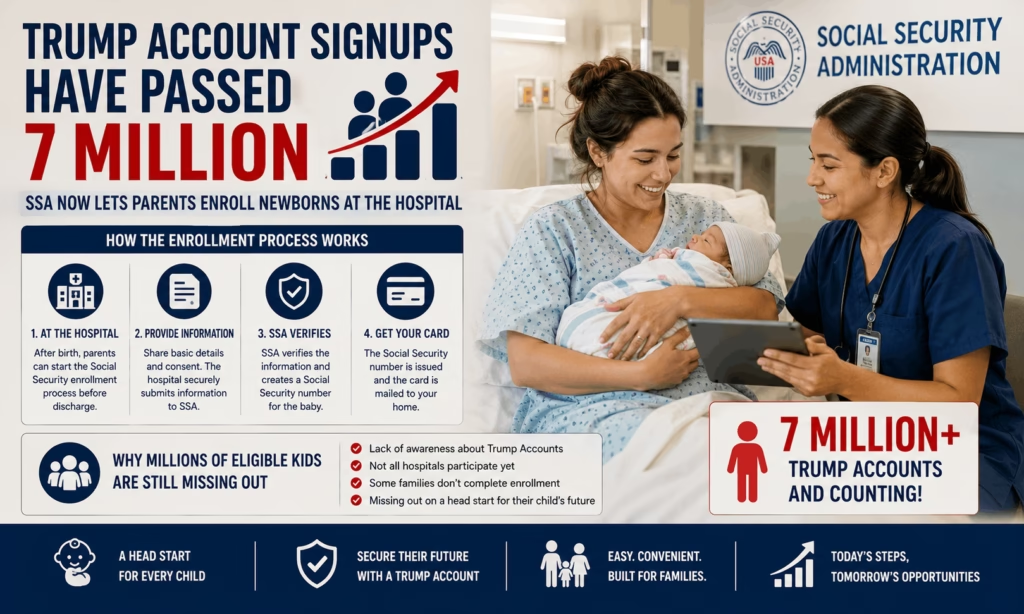
Trump Accounts and SSA Enrollment 2026: Treasury Secretary Scott Bessent announced late last month that signups for Trump Accounts have climbed past 7 million children nationwide, calling the rollout the most successful launch in government history. That is up from 6.5 million just weeks earlier, driven largely by a new enrollment pathway the Social Security Administration built directly into the newborn Social Security number process. Parents can now request a Trump Account for their baby at the same hospital counter where they apply for a Social Security card, using the same Enumeration at Birth paperwork that has issued Social Security numbers to newborns since 1987.
But the headline number hides a more complicated story. Of the more than 7 million children signed up, only about 1.4 million are actually confirmed eligible to receive the government’s one-time $1,000 seed deposit, according to Treasury’s own published figures, roughly 39% of eligible newborns. A new Urban Institute survey found that while roughly 60% of adults say they have heard of Trump Accounts, enrollment among eligible families still lags well behind awareness, and the gap is worst among the very families the program was designed to help most. We’ll be updating this article monthly as SSA, Treasury, and the IRS release new enrollment and deposit figures.
What Is a Trump Account?
A Trump Account is a federally created, IRA-style investment account for children under 18, established under the One Big Beautiful Bill Act that President Trump signed into law on July 4, 2025. Every U.S. citizen child born between January 1, 2025 and December 31, 2028 with a valid Social Security number qualifies for a one-time $1,000 seed deposit from the Treasury Department once an account is opened. Children under 18 born before 2025 can still open an account and receive private contributions, but they do not qualify for the government’s $1,000 pilot deposit.
Because eligibility depends entirely on having a valid Social Security number, SSA has positioned itself as what Commissioner Frank J. Bisignano called the backbone of the program. On July 3, 2026, SSA announced it would begin updating guidance for hospitals nationwide so that the same Enumeration at Birth form parents already fill out to request a newborn’s Social Security number would also let them create a Trump Account in the same step. The agency is working with individual states to modify their existing hospital birth-registration paperwork, and SSA has said future Social Security card mailers sent to new parents will include information about Trump Account enrollment as well.
Trump Accounts, sometimes referred to informally as 530A accounts, are administered day to day by Bank of New York Mellon, with additional account access available through a companion Robinhood app. Once opened, the funds inside a Trump Account must be invested in low-cost, broad-based U.S. stock index funds rather than held as cash, meaning the balance is designed to grow along with the broader market over the course of a child’s childhood. Treasury officials have described the structure as an effort to give American children direct exposure to stock market growth from birth, a benefit that roughly 38% of Americans currently lack entirely, according to Gallup polling cited by Treasury Secretary Bessent.
Trump Accounts SSA Enrollment Key Highlights
| Detail | Information |
|---|---|
| Program created by | One Big Beautiful Bill Act, signed July 4, 2025 |
| Accounts officially launched | July 4, 2026 |
| Total children signed up | About 7 million as of late July 2026 |
| Children confirmed eligible for the $1,000 deposit | About 1.4 million (roughly 39% of eligible newborns) |
| Eligible birth window for the $1,000 deposit | January 1, 2025 to December 31, 2028 |
| SSA hospital enrollment process announced | July 3, 2026 |
| SSA process integrated with | Enumeration at Birth (EAB) program |
| Manual enrollment form | IRS Form 4547, Trump Account Election |
| Annual contribution limit | $5,000 total, including up to $2,500 from an employer |
| Account converts to a standard IRA | At age 18 |
| Public awareness of the program | About 60% of adults, per Urban Institute survey |
OAS Payment Increase September 2026: Confirmed Amounts, Payment Date, and the Annual GIS Reset !
Ohio SNAP Food Ban starts October 1, 2026: What’s Banned, Court Update & Rules
How to Apply for a Trump Account Through SSA’s Hospital Process
There are now two main paths to enroll a child in a Trump Account, and understanding the difference matters for parents trying to move quickly.
The first and newest option is the SSA hospital pathway. When a baby is born at a participating hospital or birthing facility, parents completing the standard Enumeration at Birth paperwork, the same forms already used to request the child’s Social Security number, can now also elect to open a Trump Account in the same step. The facility forwards the request along with the birth registration data to the state’s vital records office, which transmits it to SSA and, through SSA, to the IRS and Treasury systems that actually administer the account. This route is designed to remove a separate application step entirely for families who use it at the time of birth.
The second option, available to any eligible child regardless of birth date or hospital participation, is filing IRS Form 4547, Trump Account Election, directly through TrumpAccounts.gov or the Trump Accounts mobile app. This route requires parents to actively seek out the program, provide the child’s Social Security number, and complete the election themselves. Families whose hospital has not yet updated its forms, or who did not open an account at birth, still have until the child turns 18 to file Form 4547 and claim the $1,000 deposit, provided the birth date falls within the 2025 to 2028 window.
Trump Account $1,000 Deposit Schedule and Contribution Timeline
The federal seed deposit follows a specific schedule tied to enrollment rather than birth date. Contributions of any kind, including the government’s $1,000 pilot deposit, were prohibited from posting to any Trump Account until July 2026. Beginning July 4, 2026, eligible children with an opened and verified account started receiving their initial $1,000 deposit from the Treasury Department, with investment activity in the underlying index fund beginning around July 6, 2026. President Trump noted that more than 500,000 children had received their first deposits within days of the program going live.
For children enrolled after that initial wave, the $1,000 deposit posts once the IRS verifies the child’s Social Security number and citizenship status and the account is fully activated, a process that has generally taken several weeks from the date of election. Beyond the one-time government deposit, families, grandparents, and other individuals can contribute up to $5,000 per year to a Trump Account until the child turns 18, with employers allowed to contribute up to $2,500 of that annual total on an employee’s behalf. Several major employers, including Uber, JPMorgan Chase, and Charles Schwab, have publicly committed to matching employee contributions into their children’s accounts. Contributions are not tax-deductible, but the money grows tax-deferred, and withdrawals are permitted once the child turns 18, at which point the account converts automatically into a standard IRA.
Processing Time: From Hospital Form to Funded Account
Processing time varies depending on which enrollment path a family uses. For the SSA hospital pathway, the timeline generally mirrors how long it already takes to process a standard Enumeration at Birth request, roughly two weeks for SSA to assign the child’s Social Security number, since the Trump Account election cannot be finalized until that number exists. Once the number is issued, the IRS and Treasury typically need additional time to open and verify the account before the $1,000 deposit posts, meaning most hospital-enrolled families should expect the process to take four to eight weeks in total from birth to a funded account.
For families using Form 4547 directly through TrumpAccounts.gov, processing depends on how quickly the IRS can verify the child’s existing Social Security number and citizenship documentation. Treasury has said activation emails with setup instructions go out in phases after a Form 4547 election is received, and account authentication has generally taken a few weeks once the form is submitted. Delays are more common for families who submit incomplete information or whose child’s Social Security record has not yet been fully established.
Why Millions of Eligible Children Are Still Not Enrolled
The single biggest challenge facing the program is not funding, it is participation. Because Trump Accounts are opt-in rather than automatic, a family has to actively know about the program, trust it, and complete an enrollment step before their child receives any money. Researchers at the Urban Institute found that while about 60% of adults report having heard of Trump Accounts, actual enrollment sits closer to 39% of eligible children, and awareness itself varies sharply by race and income. The same research found 66% of white respondents reported awareness of the program compared to 47% of Black respondents and 49% of Hispanic respondents, even though lower-income and historically underserved families often stand to gain the most from a guaranteed $1,000 head start.
Treasury’s own June 2026 data showed that 86% of opened Trump Accounts are linked to families earning less than $200,000 a year, which sounds broad until compared against the roughly 95% of all U.S. households with children that fall under that same income threshold, suggesting higher-income families are still signing up at a disproportionately higher rate. Advocates point to a 2007 Oklahoma pilot program called SEED for Oklahoma Kids as a real-world comparison, that experiment automatically opened accounts and deposited $1,000 for participating newborns and achieved a 99.9% account-opening rate, compared to just 5.5% in a similar opt-in control group.
Researchers studying the current rollout say the gap between awareness and actual enrollment cannot be explained by lack of information alone. Even among adults who say they have heard of Trump Accounts, many eligible families have not completed the steps needed to open one, a pattern consistent with other opt-in savings programs. Administrative complexity, unfamiliarity with investment accounts, limited trust in financial institutions, and competing financial priorities all appear to play a role, and researchers note that even relatively small amounts of friction, such as locating a Social Security number, verifying identity documents, or navigating an unfamiliar website, can meaningfully reduce participation among households already juggling tight budgets and limited free time. One Virginia mother who gave birth to twins in May 2025 said she only learned about the program from a former coworker months after her children were born, and that she found it frustrating to think her family nearly missed out entirely simply because no one told her the accounts existed.
$400 Inflation Refund Checks 2026: New York’s Real Program, Fact-Checked
Stimulus Check 2026: Fact-Checking Every Viral Payment Claim (Tracker)
Social Security SSI Payment Date September 2026 Confirmed by SSA- Check Full Schedule here!
The Push for Automatic Enrollment
Policy researchers, child savings experts, and some lawmakers have been pressing Treasury to move toward automatic enrollment rather than requiring every family to opt in. Advocates argue that even a small amount of administrative friction, filling out a form, navigating a new website, verifying a Social Security number, can meaningfully reduce participation among families with limited English proficiency, no existing bank account, or general distrust of new federal financial programs. Treasury has not announced plans to shift to full automatic enrollment, and current law appears to require an affirmative election under IRS Form 4547 for both the account itself and the $1,000 deposit. SSA’s new hospital-based process is widely viewed as the administration’s most significant step so far toward closing that gap, since it embeds the Trump Account election into a process, applying for a newborn’s Social Security number, that the overwhelming majority of American parents already complete automatically.
Foster Children and the Fostering the Future Initiative
One enrollment gap the administration has moved to address directly involves children in foster care, who often lack a parent able to complete the standard election process on their behalf. Under an initiative led by First Lady Melania Trump called Fostering the Future, state child welfare agencies will be authorized to open Trump Accounts for foster children in their care and to contribute funds the child already receives, such as certain disability benefits, into the account. Advocates have specifically recommended that Treasury create a dedicated 30-day enrollment window that opens after a court-appointed foster placement, giving state agencies a clear trigger point to act on a child’s behalf rather than relying on the general opt-in process.
Trump Accounts Compared to Other Child Savings Programs
Several states already run their own child savings account programs that predate Trump Accounts, and some now overlap with it. California’s CalKIDS program, for example, has established and funded more than 6 million accounts for state residents, though only about 1 million of those accounts have actually been claimed by families, underscoring that the awareness and take-up challenge facing Trump Accounts is not unique to a single federal program. Unlike CalKIDS and similar state programs, which are generally seeded automatically at enrollment in public school or at birth, Trump Accounts remain opt-in at the federal level, which is precisely the design choice researchers say is driving the current enrollment gap.
Official Trump Accounts and SSA Enrollment Resources
| Resource | Link |
|---|---|
| Official Trump Accounts information and enrollment | trumpaccounts.gov |
| SSA July 3, 2026 enrollment announcement | ssa.gov/news/en/press/releases/2026-07-03.html |
| IRS Form 4547, Trump Account Election | irs.gov/forms-pubs/about-form-4547 |
| Enumeration at Birth FAQ | ssa.gov/faqs/en/questions/KA-10041.html |
| Social Security number and card overview | ssa.gov/number-card |
| FDIC guide to Trump Accounts | fdic.gov/consumer-resource-center/understanding-trump-accounts |
| Find a local Social Security office | ssa.gov/locator |
| Report a scam | oig.ssa.gov/report |
FAQs About Trump Accounts SSA Enrollment 2026
What is a Trump Account?
A Trump Account is a federally created, IRA-style investment account for U.S. children under 18, established by the One Big Beautiful Bill Act, offering a one-time $1,000 government deposit to eligible children born between 2025 and 2028.
How do I enroll my newborn in a Trump Account through SSA?
Parents can now request a Trump Account at the hospital using the same Enumeration at Birth paperwork used to apply for a newborn’s Social Security number, or they can file IRS Form 4547 separately through TrumpAccounts.gov at any time before the child turns 18.
Is enrollment in Trump Accounts automatic?
No. Trump Accounts require an affirmative opt-in election, either through the SSA hospital process or by filing IRS Form 4547 directly, which researchers say is the main reason millions of eligible children remain unenrolled.
How long does it take to receive the $1,000 Trump Account deposit?
Most families using the SSA hospital pathway should expect the process to take four to eight weeks from birth to a funded account, since the child’s Social Security number must be issued before the Trump Account election can be finalized.
Do all children get the $1,000 deposit?
No. Only children who are U.S. citizens born between January 1, 2025 and December 31, 2028 with a valid Social Security number and an opened Trump Account qualify for the one-time $1,000 Treasury deposit.
Can foster children get a Trump Account?
Yes. Under the Fostering the Future initiative, state child welfare agencies can open and contribute to Trump Accounts on behalf of foster children in their care.
What happens to a Trump Account when a child turns 18?
The account automatically converts into a standard individual retirement account, and the account holder can begin making withdrawals subject to ordinary IRA rules.
Is there a cost to open a Trump Account?
No. There is no cost to open a Trump Account, whether through the SSA hospital process or by filing IRS Form 4547 directly.
Trump Accounts Dell $250 Grant: Did Deposits Actually Start Monday? Here’s Who’s Actually Been Paid
2027 Social Security COLA Forecast: Latest 3.6% Estimate and How Much Retirees Could Get
$2000 Stimulus Payment September 2026 Fact-Check: Is It Really Coming?
People Also Ask
How many children have signed up for Trump Accounts?
About 7 million children had been signed up for Trump Accounts as of late July 2026, according to Treasury Secretary Scott Bessent, though only about 1.4 million are confirmed eligible for the $1,000 government deposit.
Why are so many eligible children not enrolled in Trump Accounts?
Because enrollment is opt-in rather than automatic, families must actively know about the program, trust it, and complete an application step, a structure researchers say disproportionately leaves out lower-income, non-English-speaking, and historically underserved families.
What is the difference between a Trump Account and a regular IRA?
A Trump Account functions like a traditional IRA but is opened for a child under 18 rather than an adult, can receive a one-time $1,000 government seed deposit, and automatically converts into a standard IRA once the child turns 18.
Who is eligible for the Trump Account $1,000 deposit?
U.S. citizen children born between January 1, 2025 and December 31, 2028 with a valid Social Security number qualify for the one-time $1,000 pilot deposit once their account is opened and verified.
Can grandparents contribute to a Trump Account?
Yes. Grandparents, parents, guardians, employers, and charitable organizations can all contribute to a Trump Account, up to a combined annual limit of $5,000 per child.
Conclusion
SSA’s decision to fold Trump Account enrollment directly into the newborn Social Security number process marks the most significant step so far toward closing the program’s stubborn participation gap, and the jump from 6.5 million to 7 million signups in a matter of weeks suggests it is having an effect. Still, with only about 1.4 million of those millions of enrolled children actually confirmed eligible for the $1,000 deposit, and awareness lagging most sharply among the families researchers say stand to benefit the most, the program’s central challenge remains reaching the households who have not yet heard about it, or who have heard about it but face real barriers to completing the enrollment step. For parents with a baby born in 2025 or later, the fastest and simplest path now runs through the same hospital paperwork already used to request a Social Security number, though families who missed that window at birth still have until their child turns 18 to file Form 4547 and claim the $1,000 seed deposit.
Canada 50% Tariff 2026: 700 US Goods Hit With Tariffs Up to 50% From September 8
Social Security Changes September 2026: SSA Announces Major Update for Retirees and Beneficiaries
Minimum Wage Increase in 5 Canadian Provinces: What Changes October 1, 2026