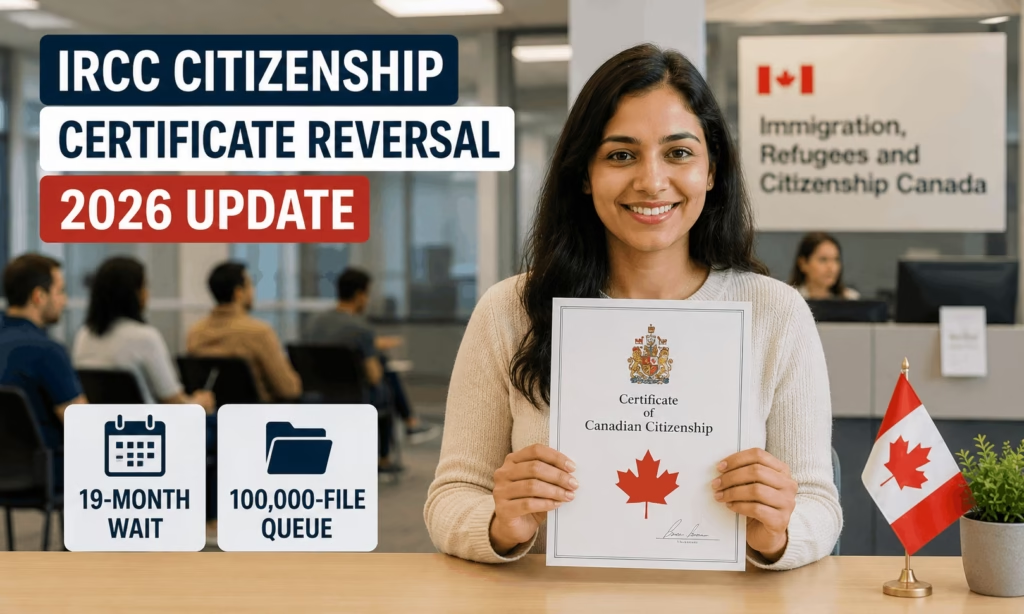
IRCC Citizenship Certificate Reversal 2026: The headline moment came and went fast. In June 2026, Immigration, Refugees and Citizenship Canada sent surrender letters demanding a small group of “Lost Canadians” hand back citizenship certificates issued under Bill C-3, then reversed course within days, confirming the certificates would stay valid after all. That episode is largely closed. What isn’t closed, and what’s actually gotten worse in the months since, is the processing crisis the entire review triggered across IRCC’s citizenship by descent system. As of the most recent published estimate, applicants filing for a proof of citizenship certificate now face a 19-month wait, with the department’s backlog swelling to roughly 100,000 applications.
That number matters more to most affected families than the surrender letters ever did, since the reversal touched only a few dozen people directly, while the resulting wait time affects everyone currently in the queue or considering applying. Understanding how a documentation review aimed at a small number of flagged files ended up slowing processing for tens of thousands of unrelated applicants is the real story behind the IRCC Citizenship Certificate Reversal saga heading into the fall of 2026. We’ll be updating this article monthly as IRCC publishes new processing time and backlog data.
Latest Update: Where the Certificate Reversal Fallout Stands Now
| Detail | Information |
|---|---|
| Surrender letters issued | Weekend of June 13–14, 2026 |
| Signed by | Registrar of Canadian Citizenship Peggy Sun |
| Number of people affected by surrender letters | “A few dozen,” per IRCC |
| Certificates reviewed in the broader audit | Roughly 6,500 |
| Revalidation letters confirming certificates valid | Dated June 19, 2026 |
| Legal basis cited for reversal | Subsection 26(4), Citizenship Regulations |
| IRCC review of all flagged files completed | June 30, 2026 |
| Processing time, pre-Bill C-3 (mid-2024) | Approximately 3 months |
| Processing time, early 2026 | 9 to 12 months |
| Processing time, June 2026 | 15 months |
| Processing time, July 2026 (most recent) | Approximately 19 months |
| Application queue size, July 2026 | Approximately 100,000 |
What Actually Happened With the Certificate Surrender Letters
To understand the fallout, it’s worth recapping what triggered it in the first place, briefly and precisely. In mid-June 2026, IRCC’s Registrar of Canadian Citizenship sent letters to a small number of recently approved Bill C-3 citizenship by descent applicants, asking them to surrender their certificates while the department reviewed the documentation supporting their claims. The core concern centered on applicants who had relied on third-party genealogy platforms, such as Ancestry.ca or FamilySearch, rather than original records from a civil registry or vital statistics office, to establish multi-generational family connections.
The reversal followed quickly. By June 19, 2026, just days after the surrender letters went out, affected applicants began receiving revalidation letters, signed by the same Registrar, confirming their files had been reviewed and their certificates would not be cancelled. IRCC stated the surrender letters had reached only “a few dozen” people out of the roughly 6,500 certificates included in the broader review, and the department completed its full audit of that group by June 30, 2026.
OAS Payment Increase September 2026: Confirmed Amounts, Payment Date, and the Annual GIS Reset !
Ohio SNAP Food Ban starts October 1, 2026: What’s Banned, Court Update & Rules
Why the Reversal Didn’t End the Disruption
Here’s the part that’s easy to miss if you only follow the surrender-letter headlines: even though IRCC resolved the individual cases quickly, the review process itself triggered a pause in finalizing new citizenship by descent applications while the department worked through its documentation concerns. That pause, combined with a simultaneous surge in new applications following Bill C-3’s December 15, 2025 implementation, is what actually drove processing times into their current extended range.
The math behind this is straightforward once you see the trend laid out month by month. Processing times sat around 3 months in mid-2024, before Bill C-3 existed. By early 2026, as the law’s expanded eligibility drew a wave of new applicants, primarily Americans discovering they qualified for citizenship through a Canadian parent or grandparent, that estimate had already climbed to 9 to 12 months. June 2026 pushed the figure to 15 months, and by July 2026, the most recent published estimate puts the wait at approximately 19 months, with the total queue reaching roughly 100,000 applications.
Why Waiting Longer to Apply Doesn’t Help
This is a detail worth stating clearly, since it runs counter to how many applicants instinctively think about a growing backlog. IRCC calculates its processing time estimates based on how many applications are already ahead of a given file in the queue, not a fixed calendar promise. Because new applications continue arriving every week, someone who files today enters the queue behind everyone who’s already filed, meaning the total wait time for a new applicant tends to grow, not shrink, the longer they delay submitting. Waiting for the backlog to “clear” before applying generally means joining an even longer line rather than a shorter one.
Who Is Actually Driving the Application Surge
Understanding who’s filing helps explain why this backlog has grown so quickly. Bill C-3 eliminated the first-generation limit that had restricted citizenship by descent since 2009, meaning Canadians born abroad can now pass citizenship to their own children born outside Canada, something the prior law often blocked beyond a single generation. This retroactively opened citizenship claims for a large population, frequently described in coverage as encompassing potentially millions of Americans with Canadian ancestry who previously had no legal claim to citizenship at all.
Applicants generally fall into two groups with meaningfully different processing experiences. Straightforward, well-documented two-generation claims, where an applicant’s parent’s Canadian birth is easy to verify, tend to process considerably faster than the published average, sometimes within 6 to 9 months. Multi-generational claims, particularly those reaching back to a grandparent or great-grandparent with historical records scattered across older civil registries, or claims relying on documentation from a jurisdiction where records weren’t consistently digitized, routinely stretch to 15 to 18 months or longer, and any request for additional documentation along the way typically adds another 3 to 6 months to that specific file.
What This Means for the Documentation Standard Going Forward
The underlying concern that triggered the June surrender letters, reliance on third-party genealogy websites rather than original source records, hasn’t disappeared just because the specific flagged cases were resolved. IRCC’s updated guidance now specifies that supporting documentation should come from the original issuing authority, meaning a civil registry, vital statistics office, or equivalent government body, rather than a compiled historical database. Applicants currently preparing a citizenship by descent claim should treat this standard as the operative expectation going forward, not as a one-time review limited to the roughly 6,500 files IRCC already audited.
How to Apply for Proof of Canadian Citizenship: Step-by-Step
For applicants navigating the current backlog, a methodical approach to documentation matters more than ever, since incomplete files are what generate the additional-evidence requests adding months to individual cases.
- Confirm your eligibility pathway under Bill C-3, including whether the 1,095-day substantial connection test applies to your specific case if you were born on or after December 15, 2025 to a parent also born outside Canada.
- Gather original-source documentation first, prioritizing records from civil registries or vital statistics offices over genealogy platform printouts, before submitting your application.
- Complete Form CIT 0001, Proof of Citizenship application, along with the CAD $75 government filing fee.
- Submit a complete package the first time, since a missing document or unsigned form can result in your application being returned entirely rather than simply flagged for correction.
- Track your file through your IRCC secure account once you receive your Acknowledgement of Receipt, typically issued within 1 to 4 weeks of submission.
- Respond promptly to any request for additional evidence, since these requests are currently one of the most common reasons individual files exceed the published average wait time.
$400 Inflation Refund Checks 2026: New York’s Real Program, Fact-Checked
Stimulus Check 2026: Fact-Checking Every Viral Payment Claim (Tracker)
Social Security SSI Payment Date September 2026 Confirmed by SSA- Check Full Schedule here!
Processing Time: What to Actually Expect Right Now
Based on the most recent published figures, applicants filing today should realistically plan for a wait in the range of 15 to 19 months, though clean, well-documented two-generation claims frequently process faster than that headline average, while multi-generational or historically complex claims often take longer. IRCC’s own processing time tool reflects a rolling estimate tied to current queue volume, meaning this figure will likely continue shifting as application volume changes, and applicants should check the live tool directly rather than relying on a fixed number from any single point in time.
What This Means for Application Fees and Payment
The government filing fee for a Proof of Citizenship application remains CAD $75 per applicant, unchanged throughout this entire backlog period. This distinguishes citizenship by descent from a grant of citizenship (naturalization) application, which carries a considerably higher CAD $630 fee and involves separate requirements including a language test, citizenship test, and oath ceremony that don’t apply to descent-based claims, since descent applicants are recognizing citizenship they already legally held from birth rather than being granted new status.
Citizenship by Descent vs. Grant Citizenship: Key Differences
Understanding this distinction helps clarify why descent applicants, despite the long wait, still face a fundamentally different and generally less demanding process than someone applying for citizenship as a new immigrant.
| Feature | Citizenship by Descent (CIT 0001) | Grant of Citizenship (CIT 0002) |
|---|---|---|
| Government fee | CAD $75 | CAD $630 |
| Language test required | No | Yes (ages 18–54) |
| Citizenship test required | No | Yes (ages 18–54) |
| Oath ceremony required | No | Yes |
| Residency requirement | None | 1,095 days within the past 5 years |
| Current processing time | Approximately 15–19 months | Approximately 12–27 months |
| What it confirms | Citizenship already held since birth | New citizenship granted to a non-citizen |
How Immigration Lawyers Are Responding to the Backlog
Immigration practitioners who work regularly with Bill C-3 applicants have started adjusting their advice in response to the lengthening queue, and a few consistent recommendations have emerged. Several immigration lawyers now explicitly advise clients to apply as early as possible rather than waiting to accumulate additional supporting documentation over time, arguing that the cost of a slightly less polished application filed now is generally lower than the cost of the additional months added by filing later into a growing queue. This advice has become particularly pointed for applicants who may need a Canadian passport within the next one to two years for work relocation, family reunification, or study plans, since the current 15-to-19-month range means anyone hoping to travel on Canadian documentation soon needs to start the process well in advance of any firm deadline.
Practitioners have also flagged a related pattern worth understanding: applications that come back with a request for additional evidence don’t simply pause and resume where they left off. Each round of correspondence between IRCC and an applicant can add another 3 to 6 months to that specific file, meaning two applicants who filed in the same week can end up with dramatically different total timelines depending purely on how complete their initial submission was. This is part of why immigration consultants increasingly emphasize front-loading documentation, gathering every plausible required record before submission, rather than treating the application as a starting point to be refined through IRCC’s feedback.
Comparing the Backlog to Canada’s Broader Citizenship Processing Picture
It’s worth placing this specific backlog in context against Canada’s other citizenship pathways, since the contrast highlights just how disproportionately Bill C-3 has strained this particular processing stream. Grant citizenship applications, the pathway used by permanent residents applying to naturalize after meeting Canada’s residency requirement, currently show an official processing estimate of around 12 months, though real-world experience varies considerably depending on individual circumstances, sometimes stretching past 24 months for applicants awaiting security or background clearance steps. That grant citizenship pathway hasn’t seen anywhere near the same surge in volume that citizenship by descent applications have experienced since December 2025, since it depends on immigrants completing several years of Canadian residency first, a structural pace limiter that doesn’t apply to Bill C-3’s retroactive descent claims.
This comparison matters for one practical reason: applicants sometimes assume all Canadian citizenship processing is uniformly slow right now, when in fact the extended wait times are concentrated specifically in the proof of citizenship stream that Bill C-3 dramatically expanded. Understanding that distinction helps set more accurate expectations depending on which specific pathway applies to an individual’s situation.
What Happens to Applications Already in Progress
For the tens of thousands of applicants who filed before this backlog reached its current size, a natural question is whether their position in the queue has been affected by the June 2026 review specifically, separate from the general volume-driven slowdown. IRCC’s own communications throughout this period have consistently maintained that the June review targeted a specific, limited set of already-issued certificates rather than pending applications broadly, meaning the pause in finalization activity primarily affected files awaiting a final decision at that exact moment rather than resetting the queue for everyone. Applicants with a file currently in process can check their status directly through their IRCC secure account, and the department has generally continued issuing Acknowledgement of Receipt confirmations within the standard 1-to-4-week window even as the deeper processing stages have slowed considerably industry-wide.
Trump Accounts Dell $250 Grant: Did Deposits Actually Start Monday? Here’s Who’s Actually Been Paid
2027 Social Security COLA Forecast: Latest 3.6% Estimate and How Much Retirees Could Get
$2000 Stimulus Payment September 2026 Fact-Check: Is It Really Coming?
Official Resources for Citizenship by Descent Applicants
Always verify current processing times, forms, and requirements directly through official IRCC channels.
| Resource | Purpose | Official Link |
|---|---|---|
| IRCC Citizenship Act changes overview | Bill C-3 background and eligibility rules | canada.ca (IRCC Citizenship Act Changes) |
| Form CIT 0001 | Proof of Citizenship application | canada.ca (Citizenship application forms) |
| IRCC processing times tool | Live, current wait time estimates | canada.ca (Check processing times) |
| IRCC secure account (login) | Track your submitted application | canada.ca (IRCC secure account) |
| Recall and cancellation of citizenship certificates | Official IRCC policy on certificate review | canada.ca (IRCC operational manuals) |
| IRCC contact form | General inquiries and case-specific questions | canada.ca (Contact IRCC) |
Conclusion
The IRCC Citizenship Certificate Reversal of June 2026 resolved quickly for the small group of applicants directly affected, but the broader disruption it exposed, and accelerated, hasn’t gone anywhere. With processing times now sitting around 19 months and the application queue approaching 100,000 files, the practical reality for anyone pursuing citizenship by descent under Bill C-3 has less to do with the surrender letters themselves and everything to do with patience, thorough original-source documentation, and realistic expectations about timing. For families weighing whether to apply now or wait, the backlog’s own math answers that question: the queue only grows, so filing a complete, well-documented application as soon as you’re ready remains the most reliable way to avoid an even longer wait down the road.
FAQs About IRCC Citizenship Certificate Reversal 2026
Is the IRCC citizenship certificate surrender issue still ongoing?
No, the specific surrender letters sent in June 2026 were resolved by June 30, 2026, when IRCC completed its review and confirmed the certificates would remain valid for the small group affected. The broader documentation standard the review raised, however, remains the operative guidance for new applications.
How long does it take to get a Canadian citizenship by descent certificate in 2026?
As of the most recent published estimate, processing takes approximately 19 months, though straightforward two-generation claims with clean documentation often process faster, while multi-generational or historically complex claims can take longer.
Should I wait to apply until the backlog clears?
No. IRCC calculates processing estimates based on queue position, and the queue continues growing weekly. Waiting to apply generally means entering the queue behind more applicants, resulting in a longer total wait rather than a shorter one.
What triggered the current processing backlog?
Bill C-3’s December 15, 2025 implementation removed the first-generation limit on citizenship by descent, drawing a large surge of new applicants, while IRCC’s June 2026 documentation review temporarily paused finalization of some pending files, both factors combining to push wait times from roughly 9 months in early 2026 to 19 months by July.
What documentation does IRCC now require for a citizenship by descent claim?
IRCC’s updated guidance calls for documentation from original source authorities, such as civil registries or vital statistics offices, rather than compiled genealogy platforms like Ancestry.ca or FamilySearch, which were central to the concerns raised during the June 2026 review.
How much does a Proof of Citizenship application cost?
The government filing fee is CAD $75 per applicant, considerably less than the CAD $630 fee for a grant of citizenship application, since descent applicants are confirming citizenship they already held rather than being granted new status.
Do I need to pass a citizenship test to get proof of citizenship through descent?
No. Citizenship by descent applicants don’t need to pass a language test, citizenship test, or attend an oath ceremony, unlike applicants pursuing a grant of citizenship through naturalization.
Where can I check the current official processing time?
IRCC publishes a live processing times tool reflecting current queue-based estimates, which applicants should check directly rather than relying on a fixed figure from news coverage, since the estimate shifts as application volume changes.
Canada 50% Tariff 2026: 700 US Goods Hit With Tariffs Up to 50% From September 8
Social Security Changes September 2026: SSA Announces Major Update for Retirees and Beneficiaries
Minimum Wage Increase in 5 Canadian Provinces: What Changes October 1, 2026