
Black Friday and Holiday Budgeting 2026: The countdown to the 2026 holiday shopping season is already underway, and if the early data is any indication, this year will look a lot like the last few: a resilient, price-conscious consumer determined to celebrate the season without blowing up their finances. Total US holiday retail sales for 2026 are projected to land somewhere between roughly $998 billion and just over $1 trillion, representing modest but steady growth over the prior year. That is not a story of runaway consumer confidence. It is a story of shoppers who have learned, through several years of inflation and economic uncertainty, how to stretch a dollar further than they used to.
For the average household, this translates into real numbers. Forecasts suggest the typical American will spend somewhere in the neighborhood of $900 this holiday season on gifts, decorations, food, and related purchases. That is a meaningful sum, and for many families it represents one of the single largest discretionary spending events of the entire year. Yet plenty of shoppers still walk into December without a real plan, only to be surprised in January when the credit card statement arrives. This guide is designed to change that. It walks through what is different about the 2026 season, how to build a holiday budget that actually holds up under pressure, how to navigate Black Friday and Cyber Monday strategically, and how to avoid the debt traps that so easily swallow good intentions.
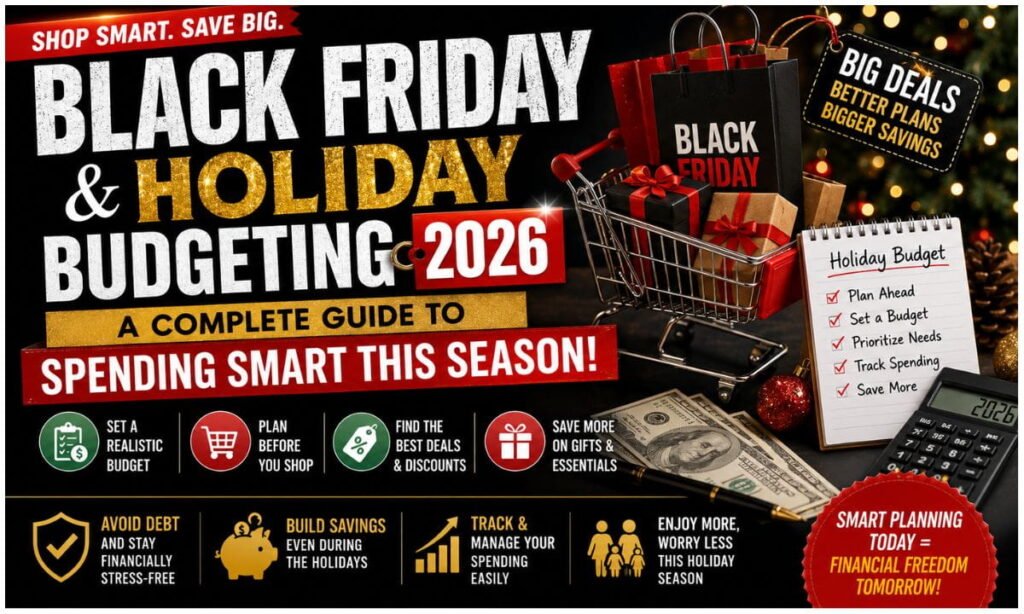
Black Friday and Holiday Budgeting – The State of the 2026 Holiday Shopper
Understanding the mindset of the broader shopping public is useful context before building your own plan, because it shapes pricing, promotional timing, and inventory decisions that will directly affect what deals are available and when.
Survey data collected ahead of the season shows a shopper base that is largely holding steady rather than dramatically expanding or contracting. Roughly half of shoppers say they intend to spend about the same as they did the previous year, while a meaningful minority plan to spend less, citing ongoing economic uncertainty. At the same time, a comparable share plans to spend more, often driven by rising prices rather than a genuine increase in the volume of goods purchased. In other words, the top-line spending growth being reported by analysts is partly an inflation story, not simply a story of consumers buying more stuff.
This matters for your own budgeting because it means the same list of gifts you bought last year will likely cost more this year, even if your habits and preferences haven’t changed at all. Building in a buffer for price increases, rather than assuming static costs from last season, is one of the simplest ways to avoid a budget shortfall in December.
Black Friday and Cyber Monday remain very much alive despite periodic predictions of their decline. Roughly three-quarters of shoppers say they intend to shop on Black Friday itself, and a growing share now believe the day offers genuine value compared to a year earlier. Interest in Cyber Monday has also grown across generations, including among older shoppers who historically favored in-store shopping. Physical retail, in fact, has seen a resurgence, with a growing share of shoppers planning to make in-store purchases this year after a period of ecommerce dominance. The upshot is a genuinely blended shopping environment: online discovery paired with in-store fulfillment, and vice versa, depending on the category and the shopper.
Timing has also shifted. Early-bird shopping, defined as purchases made between January and April of the same year, continues to grow in popularity, with a growing share of shoppers beginning their holiday buying nearly a full year in advance to spread out the cost. October and November remain the two most popular months to begin in earnest, while last-minute December shopping continues to represent a small minority of total activity. If you have historically been a December shopper, this data suggests you may be missing some of the best deals and paying inflated last-minute prices as a result.
Finally, artificial intelligence has become a meaningful part of the shopping journey. AI-referred traffic and AI shopping agents drove billions of dollars in sales during last year’s Black Friday weekend alone, and conversion rates from AI-driven referrals were reported to be dramatically higher than from social media. Retailers are leaning hard into AI-powered product discovery and customer service tools this year, which means shoppers will increasingly encounter AI assistants, chat-based recommendation engines, and automated deal-finding tools as a normal part of the holiday shopping experience. Used well, these tools can help you comparison shop faster and find better prices. Used carelessly, they can also nudge you toward impulse purchases dressed up as personalized recommendations.
Why a Real Budget Matters More Than Ever ?
It is tempting to treat “budgeting” as a formality, a box to check before diving into the fun part of shopping for the people you love. But the data on financial stress during the holidays tells a more sobering story. Recent industry analysis has found that a large majority of holiday shoppers say inflation directly impacted their purchasing decisions, and a strong majority engaged in deliberate deal-seeking behavior as a direct response. Meanwhile, credit delinquency rates have been climbing fastest among younger consumers and in lower-income areas, even as overall holiday spending numbers looked healthy. That combination, rising spending alongside rising financial stress in certain segments, is exactly the pattern a good budget is designed to prevent.
The “say-do gap” is another phenomenon worth understanding. Survey after survey shows shoppers stating an intention to hold back, only for actual spending data to reveal they spent considerably more than planned once the season arrived. One widely cited analysis found that projected gift spending rose by roughly seven percent between a summer survey and an autumn follow-up, even though sentiment throughout that period remained cautious. This is a very human pattern: emotional generosity, social pressure, and the genuine joy of gift-giving routinely override our rational spending plans in the moment. A written budget, set in advance and revisited throughout the season, is one of the few tools proven to counteract this drift.
There is also a generational dimension worth noting. Spending growth over the past year has come disproportionately from higher-income households and younger generations, even as middle- and lower-income consumers pulled back. Gen Z shoppers, in particular, have shown a willingness to spend aggressively during discount windows like the days between Black Friday and Cyber Monday, sometimes described as a five-day frenzy, even while carrying rising levels of financial stress. If you fall into a demographic that is spending more without a corresponding increase in income, that is precisely the profile most likely to benefit from a disciplined, written budget this season.
Step One: Calculate What You Can Actually Afford ?
Before opening a single browser tab or walking into a single store, sit down and determine your total holiday spending capacity based on your actual financial picture, not on what you spent last year or what feels emotionally appropriate.
- Start with your take-home income for the months leading up to and including the holiday season. Subtract your fixed obligations: rent or mortgage, utilities, insurance, minimum debt payments, groceries, and any other non-negotiable expenses. What remains is your discretionary capacity. From that figure, decide what percentage you are willing to allocate to holiday spending versus savings, emergency reserves, or other financial goals.
- A widely used rule of thumb suggests holiday spending should not exceed one to one and a half percent of annual gross income for most households, though this varies considerably based on individual circumstances, family size, and financial priorities. The specific percentage matters less than the discipline of choosing a number in advance, in a calm moment, rather than discovering your limit reactively as bills arrive in January.
- Once you have a total figure, break it down into categories. A reasonable starting framework looks like this:
- Gifts typically represent the largest single category. Within gifts, further divide by recipient: immediate family, extended family, friends, coworkers, teachers, and service providers such as hairdressers or childcare providers who are customarily tipped or gifted during the season.
- Food and entertaining covers holiday meals, hosting costs, and any travel-related food expenses. This category is often underestimated, particularly for households that host multiple gatherings.
- Decorations includes anything from a new set of lights to a full tree replacement. Because decorations are durable goods that can be reused for years, this is often a category where restraint in one season pays dividends across several future seasons.
- Travel covers airfare, gas, lodging, and related costs for anyone visiting family or hosting visitors. Travel costs can swing dramatically based on booking timing, so building flexibility into this line item is valuable.
- Charitable giving is a meaningful category for many households during the holidays and deserves its own line rather than being absorbed informally into gift spending.
- Miscellaneous and buffer should account for the inevitable items you forgot to plan for: a white elephant gift exchange at work, a last-minute babysitter for a holiday party, postage for cards and packages, or a specialty ingredient for a recipe you only make once a year. A buffer of ten to fifteen percent of your total budget is a reasonable cushion.
- Write these numbers down somewhere you will actually see them again: a spreadsheet, a notes app, or a simple piece of paper on the refrigerator. The specific tool matters far less than the act of writing it down and returning to it throughout the season.
Step Two: Build Your Gift List Before You Shop
One of the most effective ways to prevent overspending is to build a complete list of every person you intend to buy for before making a single purchase, rather than shopping opportunistically and adding names as they occur to you. For each person, assign a target dollar amount in advance. This accomplishes two things: it forces you to confront the total scope of your gift-giving obligations honestly, and it gives you a specific number to shop against rather than an open-ended browsing session that can spiral.
Consider, too, whether every name on last year’s list needs to remain on this year’s list. Family circumstances change, friendships evolve, and gift-giving traditions that once felt meaningful can sometimes continue out of habit rather than genuine desire. A brief, honest conversation with extended family about instituting a gift exchange, a spending cap, or a “no adult gifts” policy can meaningfully reduce financial pressure on everyone involved, and is far more common than many people assume once someone is willing to raise the topic.
Understanding Black Friday and Cyber Monday in 2026
Black Friday and Cyber Monday remain the anchor events of the holiday shopping calendar, but the way shoppers engage with them continues to evolve. Roughly forty percent of Black Friday shoppers now plan to shop exclusively online, while a smaller share plans to blend online and in-store shopping, and a modest minority intends to shop in-store only. This matters for strategy: if you are chasing a specific doorbuster item that historically sells out quickly in physical stores, in-person shopping may still be your best option, but for the majority of categories, online deals are now comparably strong and considerably more convenient.
A few practical strategies for navigating the event this year:
Track prices before the sale begins. Retailers frequently mark up items slightly in the weeks before Black Friday so the “discount” appears larger than it actually is. Browser extensions and price-history tools can reveal whether a deal is genuine or manufactured. Building this check into your routine before November prevents you from being fooled by inflated reference prices.
Make a list of specific items and target prices in advance. Retailers design the Black Friday shopping experience to encourage browsing and impulse purchases. Walking in, or logging on, with a specific list and a ceiling price for each item is one of the simplest defenses against overspending.
Recognize that Cyber Monday and Black Friday now blur together. Many of the deals once reserved for Cyber Monday now appear during the preceding weekend, and vice versa. Rather than treating these as two separate shopping days requiring two separate budgets, treat the entire stretch from Thanksgiving through the following Monday as a single shopping window with a single spending cap.
Watch for the growing “five-day frenzy” pattern among younger shoppers. If you find yourself making repeated purchases across several consecutive days because each day brings a new round of deals, that is a signal worth noticing. Set a single spending limit for the entire holiday weekend rather than allowing each day’s sales to reset your mental accounting.
Consider early and late alternatives. With a growing share of shoppers beginning purchases as early as January through April, and a meaningful cohort waiting until December, Black Friday is no longer the only meaningful discount window. If you missed a deal over the Thanksgiving weekend, patience through December, and even into the post-holiday clearance period, often yields comparable or better pricing on many categories.
Category-by-Category Spending Guidance
Different categories of holiday spending call for different strategies.
Gift cards consistently rank as the most requested and most purchased gift category, in part because they eliminate the guesswork of sizing and preference while giving the recipient flexibility. From a budgeting standpoint, gift cards are also easy to track precisely, since the amount spent equals the amount given with no additional markup or uncertainty. If you are unsure what to give someone, a gift card at a reasonable, pre-decided amount is often both a thoughtful and a budget-friendly choice.
Apparel and toys remain consistently popular categories, particularly for gifts given to children and close family members. Because sizing and preferences can change quickly, particularly for children, it is worth confirming current sizes and interests close to the purchase date rather than relying on information from many months earlier.
Food and consumables have seen some of the largest year-over-year spending increases, driven both by elevated grocery prices and by the enduring role of food as an easy, emotionally resonant gift and hosting expense. If your household hosts holiday gatherings, building a realistic per-person or per-meal cost estimate, informed by recent grocery receipts rather than memories of prices from a few years ago, will prevent this category from quietly consuming a larger share of your budget than intended.
Wellness and fitness-related gifts, including wearable fitness trackers and connected fitness memberships, have grown significantly as a holiday gift category in recent years, reflecting a broader cultural shift toward wellness spending among younger consumers in particular. These items can carry meaningful price tags, so if they are on your list, price them early and watch for seasonal promotions rather than assuming the sticker price is fixed.
Experiences, such as travel, concert tickets, or subscription services, tend to lag behind physical goods in overall holiday gift-giving volume, in part because they are more commonly self-purchased than given as gifts. If you are considering an experience-based gift, book or purchase it earlier rather than later, since prices for travel and live events typically climb the closer you get to the date.
Avoiding the Debt Trap: Credit Cards and Buy Now, Pay Later
Perhaps the single most important financial decision you will make this holiday season is not what to buy, but how to pay for it. Financing tools including credit cards and buy now, pay later services remain popular during the holidays, particularly when tied to rewards programs, exclusive discounts, or the ability to spread payments over time. Used carefully, these tools can be a legitimate way to manage cash flow. Used carelessly, they are the single most common path from a reasonable holiday budget to a January financial hangover.
A few guidelines worth following:
Only use buy now, pay later for purchases you could otherwise afford outright. These services are frequently marketed as a way to “afford” purchases that would otherwise be out of reach. If a purchase only fits your budget because it has been split into four installments, that is a signal the purchase itself does not fit your actual budget, regardless of how the payment is structured.
Track every buy now, pay later commitment in one place. Because these services are offered by multiple providers and integrated directly at checkout across many retailers, it is remarkably easy to accumulate several simultaneous payment plans without a clear sense of the combined monthly obligation. Keep a single running list of every active plan, the payment amount, and the due date.
If using credit cards, prioritize cards with rewards relevant to your actual spending, but pay the balance in full. Rewards programs and cash-back offers are genuinely valuable when the balance is paid off each month. They become a net financial loss the moment interest charges begin accruing, since typical credit card interest rates far exceed the value of almost any rewards program.
Set a hard stop for financing new purchases once you have reached your total budget. The temptation to keep financing “just one more thing” because the monthly payment feels small is precisely how holiday spending spirals beyond the original plan. Your written budget should function as a hard ceiling, not a soft suggestion that financing tools make easy to exceed.
Navigating AI Shopping Tools Without Overspending
As AI-powered shopping assistants and recommendation engines become a standard part of the retail experience in 2026, it is worth developing a deliberate approach to using them. These tools are genuinely useful for comparison shopping, tracking price history, and finding deals across multiple retailers faster than manual searching would allow. Retailers are investing heavily in native AI tools this year specifically because they have proven effective at driving conversions, which means the recommendations you receive are, by design, optimized to encourage a purchase, not necessarily optimized to fit your budget.
A simple safeguard is to use AI tools for research and comparison, while keeping the final purchase decision anchored to the specific item and price ceiling you set in your written gift list. If an AI assistant surfaces an appealing alternative or add-on you had not planned for, treat that suggestion the same way you would treat an in-store impulse display: worth a pause and a moment of consideration, not an automatic addition to your cart.
Building in Flexibility for Generational and Family Dynamics
Spending patterns and financial pressures vary considerably across generations, and being honest about where your household falls can help calibrate expectations. Recent data shows that Gen X and Baby Boomer households continue to hold the largest overall shares of holiday spending, while Millennial and Gen Z spending, though smaller in total dollars, has been growing quickly and carries a higher relative share of financial stress and rising delinquency in some segments.
If you are an older shopper with more financial flexibility, it may be tempting to increase spending on children and grandchildren simply because you are more able to. If you are a younger shopper feeling pressure to match the gift-giving habits of parents or grandparents with substantially different financial circumstances, it is worth remembering that a thoughtful, well-chosen gift within your own realistic budget carries no less emotional value than an expensive one purchased under financial strain.
Family conversations about gift budgets, whether that means agreeing on a maximum spending limit for adult gift exchanges, organizing a family name-draw system instead of buying for every relative individually, or simply being transparent that this is a tighter year, tend to reduce stress for everyone involved once they happen. The awkwardness of initiating that conversation is almost always smaller than the financial and emotional cost of quietly overspending to keep pace with an unspoken and unrealistic standard.
Tracking Spending Throughout the Season
A budget set in November is only useful if it is actively tracked through December. Choose one method, whether a simple spreadsheet, a budgeting app, or a dedicated notebook, and update it after every purchase rather than attempting to reconstruct your spending from memory at the end of the season. Because holiday shopping often involves many small transactions spread across multiple retailers and payment methods, it is unusually easy to lose track of the cumulative total even when each individual purchase feels modest.
A useful practice is a weekly check-in throughout November and December: a fifteen-minute review comparing actual spending against your planned category budgets. This allows you to catch overspending in one category early enough to adjust in another, rather than discovering the full picture only after the season has ended.
Planning for January Before December Ends
One of the most overlooked aspects of holiday budgeting is planning for the month that follows. January brings its own financial pressures: credit card statements for holiday purchases come due, gift cards prompt a fresh wave of purchases as they are redeemed, and many households face a natural dip in income or an increase in expenses from holiday travel and hosting. Recent industry data has noted that gift cards top the list of desired holiday gifts, which in practice extends the holiday spending season well into January as recipients redeem them.
Building a small January buffer into your overall holiday budget, rather than treating December 25th as the finish line, prevents the common pattern of finishing the holidays financially even, only to be caught off guard by post-holiday bills and returns processing in the weeks that follow. If you plan to make returns or exchanges, keep receipts organized and be aware of each retailer’s specific return window, since holiday return policies vary considerably and can be shorter than shoppers assume.
A Simple Framework to Take Into the Season
If the details above feel like a lot to absorb at once, the core framework can be distilled into five steps:
- First, calculate your total realistic holiday spending capacity based on your actual finances, not last year’s spending or social pressure.
- Second, build a complete gift list with a target amount assigned to each person before you begin shopping.
- Third, use Black Friday and Cyber Monday strategically, with a specific list and price ceilings in hand, treating the entire weekend as a single spending window rather than several separate opportunities to spend.
- Fourth, be deliberate about how you pay, favoring methods you can pay off in full and treating financing tools as a cash-flow convenience rather than a way to afford purchases that do not otherwise fit your budget.
- Fifth, track spending weekly throughout the season and hold back a small buffer for January, so the new year begins with a clear financial picture rather than an unwelcome surprise.
The broader economic data suggests 2026 will be a season of measured, value-conscious spending rather than dramatic swings in either direction. Shoppers are more informed, more deliberate, and more willing to shop across a wider range of channels and timeframes than in years past.
That environment rewards exactly the kind of planning outlined here: a household that enters November with a clear number, a clear list, and a clear plan for how to pay is far better positioned to enjoy the season than one relying on good intentions alone. The goal, after all, is not simply to spend less, but to spend in a way that reflects your actual values and financial reality, so that the joy of the season is not undercut by the stress that so often follows it.
FAQ’s on Black Friday and Holiday Budgeting
How can I create a realistic budget for Black Friday and holiday shopping in 2026?
Start by reviewing your income, monthly expenses, and savings goals before setting a spending limit for the holidays. Break down your budget into categories such as gifts, travel, decorations, food, and entertainment. Create a shopping list and prioritize essential purchases over impulse buys. Tracking every purchase using a budgeting app or spreadsheet can help you stay within your limits and avoid overspending during the busy holiday season.
What are the best ways to save money during Black Friday and holiday sales in 2026?
To maximize savings, compare prices across multiple retailers before making a purchase. Sign up for store newsletters to access exclusive coupons, cashback offers, and early-access deals. Use price-tracking tools to verify that discounts are genuine, and only purchase expensive items if they fit your budget. Shopping with a list and avoiding emotional spending are among the most effective ways to save money during Black Friday and holiday sales.
How can I avoid going into debt while shopping during the holiday season?
The best way to avoid holiday debt is to spend only what you can comfortably afford. Whenever possible, use cash or a debit card instead of relying heavily on credit cards. If you do use credit, have a repayment plan in place before making a purchase. Avoid “buy now, pay later” services unless you are certain you can meet the payment schedule. Planning ahead, setting spending limits, and avoiding unnecessary purchases can help you enjoy the holidays without financial stress.
Why is it important to create a holiday budget, even with the big discounts available on Black Friday?
Creating a holiday budget is essential because even heavily discounted purchases can quickly become expensive when buying multiple items. Without a clear spending plan, shoppers risk exceeding their financial limits and facing post-holiday credit card debt or depleted savings. A well-planned budget helps you take advantage of genuine deals, prioritize essential purchases, safeguard your long-term financial goals, and enjoy the festive season with greater peace of mind.