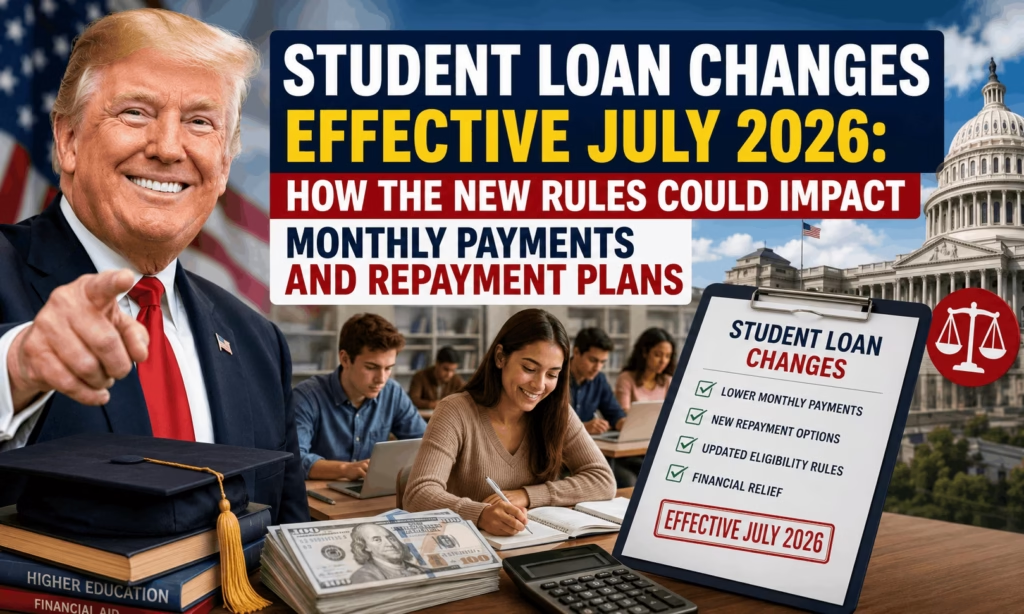
The student loan changes effective July 2026 are no longer upcoming they are now in force, and the impact is already reaching more than 42 million federal borrowers. As of July 1, 2026, the Graduate PLUS Loan program has been eliminated for new borrowers, Parent PLUS Loans now carry hard borrowing caps for the first time, and a brand-new repayment plan called the Repayment Assistance Plan (RAP) has officially launched. These rules stem from the reconciliation law originally called the One Big Beautiful Bill Act (OBBBA) and recently implemented through the Department of Education’s RISE Final Rule (Reimagining and Improving Student Education), which took effect on schedule. Whether you’re a current graduate student, a parent, or managing older undergraduate debt, this guide breaks down exactly what changed, who is protected, and what deadlines still matter. We’ll be updating this article monthly as new departmental guidance and court rulings continue to shape how these rules are applied.
Unlike earlier coverage published before July 1, several details have since been clarified or corrected by official sources: the new law is now also referred to by the Department as the Working Families Tax Cuts Act, the eleven specific “professional degree” fields have been formally listed, and the SAVE Plan was struck down entirely by a federal appeals court on March 10, 2026 rather than merely paused. Parent PLUS borrowers taking out new loans after July 1, 2026 also have no path into RAP or PSLF under the current rules, a detail many earlier reports missed. Below is the complete, corrected breakdown of every major student loan change effective July 2026.
Student Loan Changes Effective July 2026 Key Highlights
| Change | Effective Date | Who Is Affected |
|---|---|---|
| Graduate PLUS Loan eliminated | July 1, 2026 | New graduate/professional borrowers |
| New grad annual limits ($20,500 / $50,000) | July 1, 2026 | New grad/professional students only |
| Parent PLUS cap ($20,000/yr, $65,000 lifetime) | July 1, 2026 | New Parent PLUS borrowers |
| Overall lifetime limit ($257,500) | July 1, 2026 | New borrowers starting programs July 1, 2026+ |
| RAP launched | July 1, 2026 | All borrowers; only IDR option for new loans |
| Tiered Standard Plan launched | July 1, 2026 | All new borrowers |
| SAVE Plan vacated by court | March 10, 2026 | ~7 million enrolled borrowers |
| SAVE exit notices sent | Starting July 1, 2026 | Borrowers must choose a new plan within 90 days |
| PAYE/ICR legacy enrollment deadline | June 30, 2028 | Current SAVE/PAYE/ICR enrollees |
| Parent PLUS borrowers excluded from RAP/PSLF | July 1, 2026 onward | New Parent PLUS loans only |
Change 1: Graduate PLUS Loan Program Eliminated
Effective July 1, 2026, the Federal Direct Graduate PLUS Loan program has been discontinued for new borrowers, ending a program that previously let graduate and professional students borrow up to their full cost of attendance with no annual cap.
New annual and lifetime limits now apply:
| Borrower Type | Annual Limit | Lifetime Limit | Combined Overall Cap |
|---|---|---|---|
| Graduate students (master’s, doctoral) | $20,500 | $100,000 | $257,500 |
| Professional students | $50,000 | $200,000 | $257,500 |
The Department has now clarified the eleven specific fields that qualify for the higher “professional” cap: pharmacy, dentistry, veterinary medicine, chiropractic, law, medicine, optometry, osteopathic medicine, podiatry, theology, and clinical psychology. Programs outside this list including most MBAs and general master’s degrees fall under the lower general graduate cap, even if the program is expensive.
Legacy Provision: Students who had a Direct Loan disbursed before July 1, 2026 and remain enrolled in the same program can continue borrowing under the old rules for up to three additional academic years, or until program completion, whichever comes first some schools have confirmed this extends through June 30, 2029 for students who locked in eligibility during the 2025-26 year. Changing programs, schools, or taking a full withdrawal ends this protection immediately.
Change 2: Parent PLUS Loan Caps Take Effect
For the first time in the program’s history, new Parent PLUS borrowers face hard annual and lifetime limits:
- Annual limit: $20,000 per dependent student
- Lifetime limit: $65,000 per dependent student
Previously, parents could borrow up to the full cost of attendance minus other aid, sometimes tens of thousands of dollars per year at expensive private schools. A newly confirmed detail borrowers should know: Parent PLUS Loans issued on or after July 1, 2026 are not eligible for RAP, the sole income-driven repayment option for new loans, and currently have no confirmed pathway to Public Service Loan Forgiveness either. Parents who already borrowed a Parent PLUS Loan before this date, or whose student borrowed a Direct Loan before July 1, 2026, can continue under the old limits for that same student for up to three more years.
Change 3: The Repayment Assistance Plan (RAP) Has Launched
RAP became available for enrollment on July 1, 2026 and is now the only income-driven repayment plan open to anyone taking out a new federal loan after that date. Existing borrowers may also switch into it voluntarily.
| RAP Feature | Detail |
|---|---|
| Payment calculation | 1–10% of adjusted gross income, based on income bracket |
| Minimum payment | $10/month regardless of income |
| Dependent reduction | Each dependent lowers the monthly payment by $50 |
| Unpaid interest | 100% waived no negative amortization |
| Principal matching | Up to $50/month applied to principal automatically |
| Forgiveness timeline | 360 qualifying payments over at least 30 years |
| PSLF compatible | Yes, for Direct Loan borrowers other than new Parent PLUS loans |
| Married filing separately | Spouse’s AGI can be excluded from the calculation |
RAP’s 30-year forgiveness clock is notably longer than IBR’s 20-year (new borrowers) or 25-year (legacy IBR) timeline, and a month spent on RAP does not count toward IBR’s forgiveness clock if you later switch plans.
Change 4: SAVE, PAYE, and ICR — What Actually Happened
Earlier reporting described SAVE as merely “paused.” That has since changed: a federal appeals court vacated the rule behind the SAVE Plan entirely on March 10, 2026, ending it ahead of the law’s original 2028 phase-out date. As a direct result, loan servicers began mailing 90-day exit notices to the roughly 7 million borrowers still sitting in SAVE administrative forbearance starting July 1, 2026 most affected borrowers will need to select a new plan by September or October 2026 or be automatically defaulted into the Standard or Tiered Standard Plan, typically the most expensive option available.
PAYE and ICR remain open, but only temporarily: current enrollees can stay until June 30, 2028, after which both plans sunset permanently and remaining borrowers are moved to RAP or IBR automatically. New PAYE enrollments specifically close on July 1, 2027, ahead of the full 2028 cutoff. Any qualifying payments already made under SAVE, PAYE, or ICR carry forward toward forgiveness under whichever plan a borrower ultimately lands on.
Change 5: Aggregate Lifetime Borrowing Limit of $257,500
A new $257,500 lifetime cap now applies to all federal student loans combined for undergraduate and graduate/professional borrowing for students starting a new program on or after July 1, 2026 (Parent PLUS loans are excluded from this specific ceiling). Graduate borrowers additionally face their own separate lifetime sub-limit of $100,000 (general graduate) or $200,000 (the eleven listed professional fields), both nested within the broader $257,500 overall cap.
Change 6: FAFSA Rule Changes for the 2026–2027 Cycle
Several targeted FAFSA adjustments are now in effect for the 2026-2027 aid year:
- Family farm, small business, and fishery exclusions reinstated: these asset categories are no longer counted against a family’s Student Aid Index, now expanded to include family-owned commercial fisheries.
- Foreign income now required for Pell eligibility: families with income earned abroad must include it in the AGI used to calculate Pell Grant need, which may reduce awards for some households.
- Full-cost scholarships end Pell eligibility: students whose scholarships or grants already cover their full cost of attendance are no longer eligible for a Pell Grant.
- Short-term Pell Grant expansion: Pell Grants can now help cover eligible short-term career certificate and workforce training programs, a new option for non-degree pathways.
What You Should Do Right Now
| Borrower Type | Action Needed |
|---|---|
| Grad/professional students already borrowing | Confirm legacy provision eligibility with your financial aid office before assuming full COA coverage |
| Parents planning Parent PLUS for Fall 2026 | Model the funding gap above $20,000/year; a Parent PLUS loan now locks you out of RAP |
| Current SAVE enrollees | Watch for your servicer’s 90-day notice and pick a plan before default enrollment |
| PAYE/ICR enrollees pursuing PSLF | You have until June 30, 2028 to transition without losing progress |
| Incoming Fall 2026 undergraduates | File FAFSA early; note the new foreign-income and full-scholarship Pell rules |
People Also Ask
What is the RISE Final Rule? It’s the Department of Education’s implementing regulation, formally called Reimagining and Improving Student Education, that puts the OBBBA’s July 1, 2026 student loan changes into effect.
Why is the law sometimes called the Working Families Tax Cuts Act? The Department has recently used this name to refer to the same reconciliation law previously known as the One Big Beautiful Bill Act (Public Law 119-21).
Which graduate programs count as “professional” for higher loan limits? Pharmacy, dentistry, veterinary medicine, chiropractic, law, medicine, optometry, osteopathic medicine, podiatry, theology, and clinical psychology.
Do old repayment plans still work after July 2026? SAVE no longer exists. PAYE and ICR remain available only for current enrollees who don’t take new loans, through June 30, 2028.
Important Links
| StudentAid.gov account / loan simulator | https://studentaid.gov/loan-simulator/ |
| Apply for RAP, IBR, PAYE, or ICR | https://studentaid.gov/idr/ |
| FAFSA application (2026-27) | https://studentaid.gov/h/apply-for-aid/fafsa |
| Direct Loan limits and terms | https://studentaid.gov/understand-aid/types/loans/subsidized-unsubsidized |
| PSLF Help Tool | https://studentaid.gov/pslf/ |
| Home Page | https://govtschemes.org/ |
FAQs
What are the main student loan changes effective July 2026?
Grad PLUS Loan elimination, new Parent PLUS borrowing caps, the RAP and Tiered Standard Plan launch, the end of SAVE, and a $257,500 aggregate lifetime borrowing limit.
Can I still get a Graduate PLUS Loan in 2026?
Only under the legacy provision, if you had a Direct Loan disbursed before July 1, 2026 and remain in the same program you can continue for up to three more academic years.
Is the SAVE Plan really gone, or just paused?
It’s gone. A federal appeals court vacated the SAVE rule on March 10, 2026, and servicers are now sending 90-day exit notices to affected borrowers.
Do Parent PLUS Loans qualify for RAP?
No new Parent PLUS Loans disbursed on or after July 1, 2026 are not eligible for RAP and currently have no confirmed PSLF pathway.
What is the new lifetime borrowing limit?
$257,500 across all federal student loans combined (excluding Parent PLUS), with separate sub-caps of $100,000 or $200,000 for graduate and professional programs.