
Trump Account vs 529 Plan: If you’re a parent, grandparent, or guardian trying to give a child a financial head start, you now have a genuinely new decision to make. For decades, the 529 college savings plan was the default answer to “how do I save for my kid’s future?” Now there’s a second option on the table: the Trump Account, a brand-new type of savings vehicle created by the One Big Beautiful Bill Act (also called the Working Families Tax Cut), which was signed into law on July 4, 2025, with contributions opening on July 4, 2026.
Both accounts are designed to help a child build wealth over time. Both offer tax advantages. And both come with rules that can trip up families who don’t do their homework first. But they are not interchangeable, and in many cases they’re not even competing for the same job. This Trump Account vs 529 Plan guide walks through how each account actually works, where they overlap, where they diverge sharply, and how to think about using one, the other, or both together.
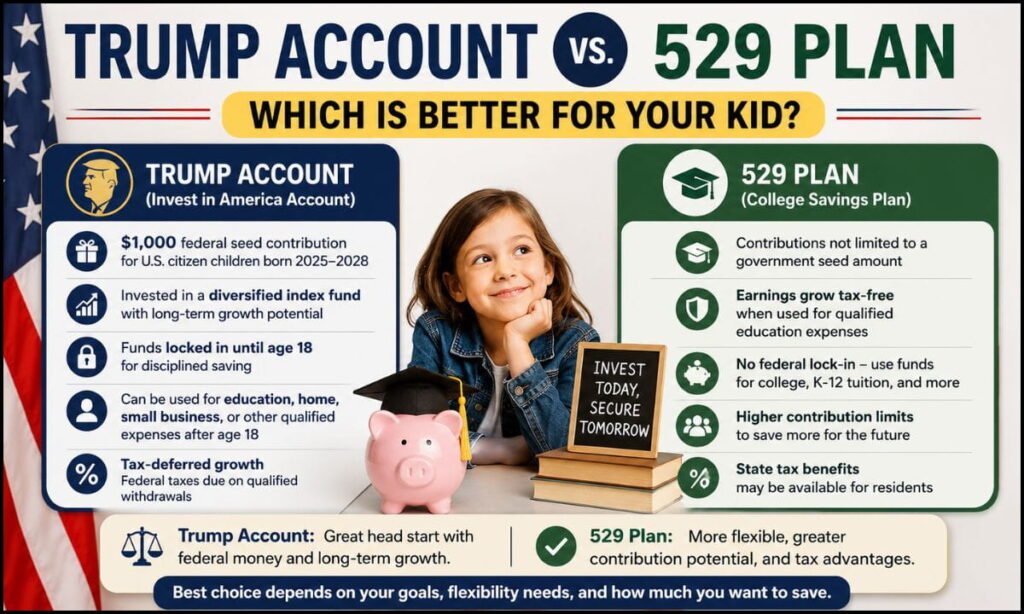
Trump Account vs 529 Plan – The Short Answer
If you’re in a hurry: a 529 plan is almost always the better tool for funding education specifically, because qualified withdrawals are completely tax-free. A Trump Account is a more flexible, general-purpose nest egg that starts your child off with real money — including a possible $1,000 federal contribution — but every dollar that comes out is eventually taxed as ordinary income, and often penalized if withdrawn early for the wrong reason. For most families, the smartest move isn’t choosing one over the other. It’s understanding what each account is actually built to do and using them for different purposes.
What Is a 529 Plan?
A 529 plan is a state-sponsored, tax-advantaged investment account designed specifically to pay for education expenses. It has been around since the late 1990s and is named after Section 529 of the Internal Revenue Code. Nearly every state offers at least one 529 plan, and you’re generally free to use any state’s plan regardless of where you live or where your child eventually attends school (though some states offer tax breaks only for using the in-state plan).
Here’s how a 529 plan typically works?
Contributions. Anyone can contribute to a 529 plan on behalf of a beneficiary — parents, grandparents, aunts, uncles, family friends. Contributions are made with after-tax dollars at the federal level, but many states offer a state income tax deduction or credit for contributions to that state’s plan. There’s no federal contribution limit in the way a retirement account has one; instead, states set aggregate lifetime limits, often in the range of $300,000 to $550,000 per beneficiary. Annual contributions are generally treated as gifts for tax purposes, so they fall under the annual gift tax exclusion (with a special provision allowing you to front-load five years of contributions at once).
Growth and taxes. Money inside a 529 plan grows tax-deferred, and — this is the big one — withdrawals are completely tax-free at the federal level, and usually at the state level too, as long as the money is used for qualified education expenses. That includes tuition, fees, room and board, books, and required supplies at colleges, universities, and eligible trade and vocational schools. Rules have also expanded over the years to include up to $10,000 per year in K-12 tuition, certain apprenticeship program costs, and student loan repayment (up to $10,000 lifetime per borrower).
Investment options. 529 plans typically offer a menu of mutual fund-based portfolios, often including age-based or target-date options that automatically shift from stock-heavy to more conservative allocations as the child approaches college age. You usually have a handful of static portfolios to choose from as well, ranging from aggressive to conservative.
Control. The account owner (usually a parent or grandparent) retains control of the account indefinitely — not the child. This matters a lot: even after the beneficiary turns 18, the owner decides when and how money is withdrawn. If one child doesn’t use all the funds, the account owner can change the beneficiary to a sibling or other qualifying family member without tax consequences.
Penalties for non-qualified withdrawals. If you take money out of a 529 plan for something that isn’t a qualified education expense, the earnings portion (not the original contributions) is subject to ordinary income tax plus a 10% federal penalty. There are some exceptions, such as if the beneficiary receives a scholarship, attends a U.S. military academy, or passes away.
Financial aid impact. A 529 plan owned by a parent is counted as a parental asset on the FAFSA, which has a relatively modest impact on financial aid eligibility (parental assets are assessed at up to 5.64%, compared to a student’s own assets, which are assessed more heavily). Under the newer FAFSA formula, distributions from a grandparent-owned 529 no longer count as student income, which removed a planning headache that used to trip up grandparents trying to help out.
What Is a Trump Account?
A Trump Account is a new type of tax-advantaged savings account for children, created by the same 2025 legislation and officially available starting July 2026. Structurally, it’s a variation on a traditional Individual Retirement Account, opened on behalf of a minor and held during what the law calls a “growth period” — from birth until the end of the year before the child turns 18.
Trump Account vs 529 Plan – Here’s what makes it distinct?
Opening an account. Any child under 18 with a valid Social Security number can have a Trump Account opened for them, using IRS Form 4547 or the online portal at TrumpAccounts.gov. Each child can have only one. Under proposed rules, a legal guardian has first priority to open the account, followed by a parent, an adult sibling, or a grandparent.
The seed money. This is the feature that got the most attention when the accounts launched. Children who are U.S. citizens born between January 1, 2025, and December 31, 2028, are eligible for a one-time $1,000 contribution from the federal government, deposited through a pilot program. This can be claimed anytime from birth through the end of the year the child turns 17. Some private philanthropic efforts have also pledged money into these accounts for eligible children, adding to the initial balance for many families even without any contribution from parents at all.
Ongoing contributions. Beginning July 4, 2026, individuals — parents, grandparents, family friends, even the child if they’re old enough to have income — can contribute up to $5,000 combined per year per child, a figure that will be adjusted for inflation starting in 2027. Employers can also contribute, up to $2,500 annually per employee’s account, which counts toward that same $5,000 combined cap. Contributions from nonprofits and government entities are not subject to this annual limit. Unlike a standard IRA, a Trump Account does not require the child (or the contributor) to have earned income, and there’s no income cap restricting who can contribute.
Tax treatment of contributions. Individual contributions are made with after-tax dollars and are not tax-deductible. Employer contributions, by contrast, are made on a pre-tax basis and aren’t counted as taxable income to the employee.
Investment restrictions. Unlike a 529 plan’s menu of options, Trump Account investments during the growth period are restricted to low-cost, broadly diversified U.S. stock index funds or ETFs, with expense ratios capped at 0.10%. Ahead of the July 2026 launch, the U.S. Treasury designated a specific S&P 500-tracking ETF as the default investment for accounts that don’t specify otherwise. This is a much narrower menu than what 529 plans typically offer, and it means Trump Accounts are essentially 100% invested in U.S. stocks for the entire growth period, with no built-in mechanism to shift toward safer investments as the child nears 18.
What happens at 18. On January 1 of the year the child turns 18, new contributions stop, and the account can convert into a standard traditional IRA now owned and controlled entirely by the (now adult) child. From that point forward, ordinary IRA rules apply. Withdrawals are allowed, but the taxable portion is treated as ordinary income, and a 10% early withdrawal penalty generally applies until age 59½ unless an exception is met.
Penalty exceptions. The 10% early withdrawal penalty can be avoided (though the income tax generally still applies) for a set of specific purposes borrowed from standard IRA rules: qualified higher education expenses, a first-time home purchase (up to $10,000), birth or adoption expenses (up to $5,000 per child), certain medical expenses, disability, and a few other narrow categories such as domestic abuse situations or disaster recovery.
No tax-free education path. This is the detail that surprises a lot of families and is worth stating plainly: even when a Trump Account withdrawal qualifies for the penalty exception for education, the money withdrawn is still taxed as ordinary income. There is no scenario in which Trump Account funds come out completely tax-free for college the way 529 funds can. The account is built more like a retirement account with an early, flexible on-ramp than like a dedicated education fund.
Special one-time rollover option. In the year the beneficiary turns 17, families in certain situations can transfer Trump Account assets into an ABLE account, which is a separate tax-advantaged savings vehicle for people with disabilities.
Head-to-Head Comparison
Who can open one and who controls it?
A 529 plan is opened and owned by an adult — typically a parent or grandparent — who retains control even after the child becomes an adult. The owner decides when money comes out and can redirect the account to another beneficiary entirely.
A Trump Account is opened for a minor, but control transfers to the child automatically once they turn 18. From that point on, it functions like their own personal IRA, and they alone decide what to do with it, subject to normal IRA withdrawal rules. This is a meaningful philosophical difference: 529 plans keep the money under the original saver’s control indefinitely, while Trump Accounts hand the reins to the child at legal adulthood.
Contribution limits
529 plans have no federal annual contribution cap — only high, state-set lifetime limits that most families will never approach. Trump Accounts cap combined annual individual and employer contributions at $5,000 per child (with the employer piece limited to $2,500 of that total), a limit that’s small enough that a determined family could hit it well before their child finishes elementary school.
Tax treatment while the money is growing
Both accounts allow investment growth to happen without annual taxation — that part is similar. The difference shows up at withdrawal. A 529 plan’s earnings come out completely tax-free when used for qualified education expenses. A Trump Account’s earnings are always taxed as ordinary income when eventually withdrawn; the tax is merely deferred, not eliminated. Individual contributions to a Trump Account do come back out tax-free since they were made with after-tax money, but any investment growth on top of that is fully taxable.
Investment choice
529 plans generally offer several portfolios, including age-based options that automatically de-risk as college approaches. Trump Accounts are restricted to low-cost index funds and ETFs tracking U.S. markets, with a government-designated default fund, and there’s no automatic mechanism to shift the allocation as the child ages. That means a Trump Account stays aggressively invested in stocks right up until the child turns 18, which cuts both ways — more growth potential over a long horizon, but more exposure to a market downturn right when the child needs the money.
What the money can be used for?
A 529 plan is purpose-built for education: tuition, fees, room and board, books, K-12 tuition up to certain limits, and some apprenticeship and student loan costs. Step outside those categories and you owe taxes plus a penalty on the earnings.
A Trump Account is far more flexible in theory — the money isn’t earmarked for any single purpose — but that flexibility comes at a tax cost no matter what it’s used for. Whether the withdrawal goes toward college, a first home, or retirement decades later, the earnings portion is taxed as ordinary income. The penalty can be waived for a specific list of purposes, but the tax bill doesn’t disappear.
Timing of access
529 funds can be used at any time for qualified expenses, at any age, without waiting for a milestone birthday. Trump Account funds are essentially locked during the entire growth period; no withdrawals are permitted before the child turns 18, with only a few narrow exceptions like account rollovers or the death of the beneficiary.
Impact on financial aid
Parent-owned 529 plans have a modest, well-understood impact on federal financial aid calculations. Because Trump Accounts are new, there isn’t yet a long track record of how they’ll be treated in aid formulas, though as IRA-style retirement accounts they may end up treated similarly to how retirement assets are generally excluded from FAFAA asset calculations — a potential advantage worth watching as guidance develops, but not yet a settled certainty.
Starting balance
This is where Trump Accounts have a unique edge: many eligible children get a $1,000 head start from the federal government simply for being born in the right window, plus in some cases philanthropic contributions layered on top, with no action required from the family beyond opening the account. A 529 plan starts at zero unless the family funds it themselves (a small number of states do offer modest incentive contributions for opening a 529, but nothing as broad as the Trump Account seed program).
Where Trump Accounts Win?
There are a few scenarios where a Trump Account genuinely shines:
Free money with no strings. If your child was born between 2025 and 2028, the $1,000 government contribution is effectively free money for opening an account, something no 529 plan offers at that scale.
No earned-income requirement. Because Trump Accounts don’t require the child to have their own income, they’re an easier way to start tax-advantaged saving for a newborn than a custodial IRA, which does require earned income.
General-purpose flexibility. If you’re not sure your child will need the money for education — maybe they’ll start a business, buy a home, or just want a financial cushion as a young adult — a Trump Account isn’t restricted to one category of spending the way a 529 plan is.
Long compounding runway. Money that goes in at birth and stays invested in stock index funds for 18 years, then potentially longer inside a traditional IRA, has a very long runway for compounding. Even with eventual taxation, decades of tax-deferred growth is a real advantage over a fully taxable brokerage account.
Where 529 Plans Win?
Tax-free growth used for its intended purpose. For families who are confident their child will pursue some form of post-secondary education, nothing beats the combination of tax-deferred growth and completely tax-free qualified withdrawals. Over 18 years of compounding, the difference between “tax-free” and “taxed as ordinary income” can be worth tens of thousands of dollars.
Much higher contribution ceiling. Families who want to save aggressively — especially those starting later or trying to catch up — aren’t boxed in by a $5,000 annual limit. Grandparents wanting to make a large one-time gift can use the five-year front-loading provision to contribute a substantial lump sum at once.
More investment control. Age-based portfolios that automatically shift toward conservative investments as college nears help protect a family from a bad market year right when the money is needed, something the current Trump Account investment structure doesn’t offer.
No lockup before use. If a need arises — a private K-12 tuition bill, a sudden apprenticeship opportunity — 529 funds can be tapped immediately, not held hostage until age 18.
Flexibility across children. If your oldest child gets a scholarship or decides not to attend college, you can simply change the beneficiary on a 529 plan to a younger sibling, cousin, or even yourself, without any tax consequence. Trump Accounts don’t offer this kind of beneficiary flexibility.
Can You Use Both?
Yes, and for many families that’s the most sensible approach. The two accounts aren’t mutually exclusive, and they’re not really designed to solve the same problem. A reasonable strategy many financial professionals are already discussing looks something like this: open a Trump Account to capture the federal $1,000 contribution (if your child is eligible) and let it grow largely untouched as a long-horizon asset, while directing the bulk of your dedicated college savings into a 529 plan, where the tax-free withdrawal treatment does the most good.
If your child does go to college, the standard advice emerging from early guidance is to draw down 529 funds first, since that money comes out completely tax-free, and treat the Trump Account as a backup or as money that’s better left alone to keep compounding, possibly converting it into a Roth IRA later when your child is in a low tax bracket as a young adult — a strategy that lets future growth become tax-free going forward even though the initial conversion itself is taxed.
A Few Things to Watch
Both of these accounts come with fine print that’s easy to overlook.
With 529 plans, remember that non-qualified withdrawals trigger tax and penalty only on the earnings, not on your original contributions — but the accounting can get complicated if you’re not careful about which dollars you’re withdrawing and why.
With Trump Account, remember that this is a brand-new program. Some administrative details are still being finalized through IRS regulations, state tax treatment of withdrawals varies and in many states hasn’t been fully clarified yet, and the long-term investment performance of a program that only recently required a fixed 100% U.S. stock allocation for its entire duration is obviously untested. Families should treat any online projections showing enormous ending balances with some skepticism, since those projections generally assume steady annual returns that real markets don’t deliver, and they typically don’t reflect the taxes that will eventually come due.
Trump Account vs 529 Plan – Bottom Line
A 529 plan and a Trump Account are solving different problems, even though they get compared constantly because they both aim to give kids a financial head start. If education is the primary goal, a 529 plan’s tax-free withdrawals make it hard to beat. If you want a flexible, long-horizon account that starts your child off with a government contribution and doesn’t box you into one spending category, a Trump Account adds real value, especially as a supplement rather than a replacement.
For most families, the best answer isn’t “Trump Account vs. 529 plan” — it’s “Trump Account and 529 plan,” each doing the job it’s actually built for: one steering your child toward an affordable education, the other quietly compounding in the background as a head start into adulthood.
This article is for general informational purposes and reflects rules as they stood in mid-2026. Trump Accounts are a new program, and some regulatory details are still being finalized. Before opening either type of account, it’s worth speaking with a financial advisor or tax professional who can look at your specific family situation, since contribution limits, tax treatment, and state-level rules can all affect which strategy makes the most sense for you.
FAQ’s on Trump Account vs 529 Plan
Which is better for saving for my child’s future: a Trump Account or 529 Plan?
The better option depends on your financial goals. If your primary objective is saving for college and maximizing tax-free education withdrawals, a 529 plan might be the better choice. If you want an investment account that can be used for various long-term goals beyond education, a Trump account may offer greater flexibility. Some families might even choose to use both accounts as part of a comprehensive savings strategy.
Can I contribute to both a Trump Account and a 529 plan for the same child?
Yes. Generally, if families meet the applicable eligibility and contribution requirements, they can contribute to both types of accounts. Doing so allows parents to benefit from the education-focused tax advantages of a 529 plan while also building long-term savings through a Trump Account. Before contributing, it is important to review current federal and state regulations, as contribution limits and eligibility requirements can change over time.
Are withdrawals from Trump Account and 529 plans taxed differently?
Yes. Qualified withdrawals from a 529 plan used for eligible education expenses are generally tax-free under federal law. A UTMA/UGMA account (often referred to as a custodial account) follows its own tax rules, and withdrawals may be subject to different taxes depending on how the funds are used and whether all eligibility conditions are met. It is important to understand the tax treatment of each type of account before making long-term financial decisions.
Who is eligible to open a custodial account, and who can open a 529 plan?
Eligibility for a custodial account depends on requirements set by law, including rules regarding the child and the establishment of the account. In contrast, almost any U.S. resident can open a 529 plan for a beneficiary, and the account owner does not have to be the child’s parent. Grandparents, relatives, and even family friends can open or contribute to a 529 plan, subject to the plan’s rules.
Should parents choose a custodial account instead of a 529 plan?
There is no single answer that fits everyone. Parents focused primarily on funding higher education often prefer 529 plans because they offer tax benefits for qualified education expenses. Families looking for a long-term investment option might find a custodial account appealing. Before making a decision, consider factors such as your child’s future goals, estimated education costs, tax implications, investment options, and your overall financial plan. Consulting a qualified financial advisor can also help determine which approach best suits your family’s needs.