
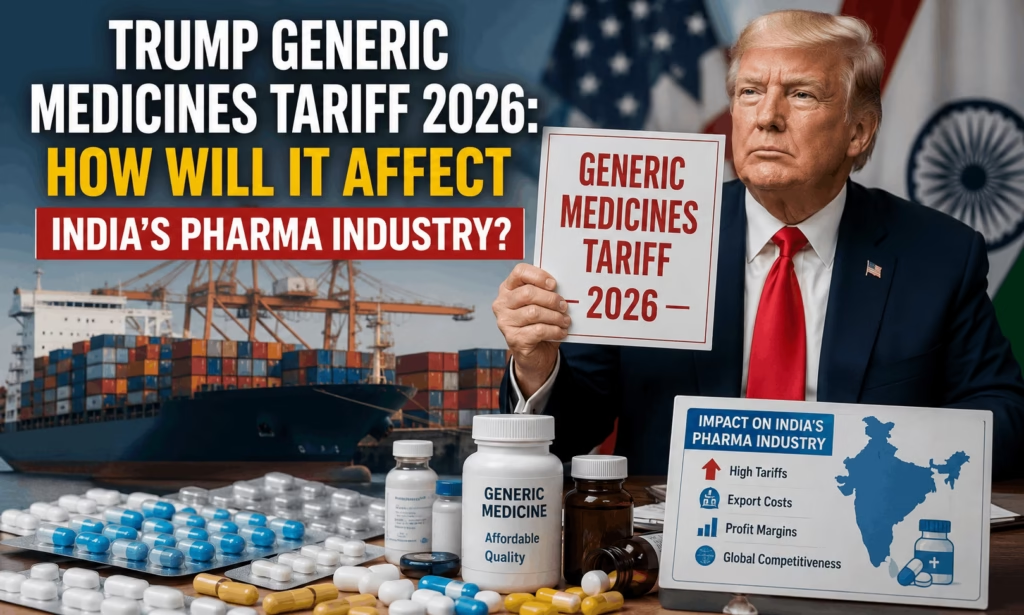
Trump Generic Medicines Tariff 2026: US President Donald Trump made a major announcement on July 22, 2026, unveiling a new generic medicines tariff policy that has sent ripples through the global pharmaceutical industry, especially India’s pharmaceutical sector. Posting on Truth Social, Trump said that starting August 1, 2026, all generic drugs entering the United States will continue to attract a 0% tariff for two years, after which the rate will jump to 100% and eventually 200%. India, the world’s largest exporter of generic drugs to the US, could be directly affected, having shipped roughly $9.7 billion worth of pharmaceuticals to America in 2025.
In this article, we cover everything you need to know about the Trump tariff on Indian pharma, the full timeline, the impact on Indian pharma companies, stock market reaction, and how the government and industry are responding. This information is based on the latest verified sources so you get accurate, up-to-date data. We’ll be updating this article monthly to keep you informed with the newest developments.
What Is the Trump Generic Medicines Tariff 2026?
In his Truth Social post, Trump wrote: “Effective August 1st, 2026, all Generic Drugs being brought into the United States will continue to have a TARIFF of ZERO PERCENT for two years, after which the TARIFF will be raised to 100 per cent for one year, and 200 per cent thereafter.” He said the move is meant to reshore generic pharmaceutical production into the US, penalizing companies that fail to build manufacturing plants domestically within the given timeframe.
It’s important to note that this new announcement is separate from the existing 100% tariff on branded and patented drugs, which has been in effect since October 2025. Trump has clarified that the existing policy on patented medicines remains unchanged.
Generic Medicines Tariff Timeline
| Time Period | Tariff Rate | Details |
|---|---|---|
| Aug 1, 2026 – July 2028 | 0% (Zero Tariff) | Existing arrangement continues, no change |
| From August 2028, for 1 year | 100% Tariff | First penalty phase begins |
| From August 2029 onwards | 200% Tariff | Full penalty rate, permanent |
The purpose of this timeline is to give pharmaceutical companies a two-year window to set up manufacturing plants in the US, allowing them to avoid the steep tariffs that follow.
Potential Impact on India’s Pharma Industry
India is widely known as the “Pharmacy of the World,” and for good reason — it holds the highest number of US FDA-approved manufacturing plants outside the United States, over 3,000 facilities, accounting for roughly 25% of all FDA-compliant plants outside the US. India meets about 47% of America’s generic drug requirements, covering medicines for hypertension, diabetes, cancer, infectious diseases, and mental health conditions.
In 2025, India’s total global pharma exports stood at $25.8 billion, of which exports to the US alone were $9.7 billion (38%). This is why any new US policy on India pharma exports to the US has a direct impact on the earnings of Indian pharmaceutical companies and their stock performance.
Indian Pharma Companies Most Likely to Be Affected
- Sun Pharma – Earned 30.26% of its FY26 revenue from the US; it is the world’s fourth-largest specialty generic pharma company.
- Aurobindo Pharma – Operates three manufacturing sites in the US, with a focus on dermatology and respiratory products.
- Lupin – Derived 41.04% of its revenue from North America.
- Zydus Lifesciences – US business accounts for 43.85% of revenue.
- Dr Reddy’s Laboratories and Cipla – Both are major exporters of generic drugs to the US market.
Stock Market Reaction: How Investors Responded
Following Trump’s announcement on July 22, 2026, shares of Sun Pharma, Aurobindo Pharma, Dr Reddy’s, Lupin, and Zydus Life were in sharp focus. Since this new policy includes a two-year zero-tariff window, the market’s reaction was comparatively calmer than earlier tariff scares. However, analysts believe this “relief” is temporary, and companies will eventually need to scale up their US manufacturing capacity.
For context, back in September 2025, when Trump first announced a 100% tariff on branded/patented drugs, the Nifty Pharma Index fell nearly 2–2.6%, with stocks like Sun Pharma, Laurus Labs, and Biocon dropping between 3% and 6%.
Response From the Indian Pharmaceutical Alliance (IPA) and Industry
Indian Pharmaceutical Alliance (IPA) Secretary General Sudarshan Jain has previously said that tariffs on patented and branded drugs do not directly impact generic medicines. According to Pharmexcil Chairman Namit Joshi, major Indian pharma companies already operate manufacturing or repackaging units in the US, which could limit the near-term impact.
That said, opinions on this new 200% tariff announcement are divided among market experts. Harshal Dasani of INVAsset PMS notes that the two-year zero-tariff period should be viewed not as relief, but as a compliance deadline companies must race against.
Why This Policy Also Matters for US Consumers
Indian generic medicines saved the US healthcare system $219 billion in 2022 alone, and a total of $1.3 trillion between 2013 and 2022. If tariffs eventually raise the cost of generic drugs, American patients and insurance companies could feel the pinch directly through higher medicine prices.
Uncertainty Remains Over Complex Generics and Biosimilars
Pharma experts note that simple generic drugs face no immediate risk for the next two years. However, uncertainty persists around complex generics (such as inhalers, injectables, and ophthalmic solutions) and biosimilars, since these products often border on the branded/patented category. ICICI Securities analyst Pankaj Pandey has pointed out that these categories could still face tariff risk down the line.
Official and Reliable Source Links
You can track further updates on this topic through the following official and trusted sources:
| US Trade Representative (USTR) Official Website: | https://ustr.gov |
| Truth Social (Trump’s official statements): | https://truthsocial.com |
| Department of Pharmaceuticals, Government of India: | https://pharmaceuticals.gov.in |
| Pharmexcil (Pharmaceuticals Export Promotion Council of India): | https://pharmexcil.com |
| Indian Pharmaceutical Alliance (IPA): | https://ipa-india.org |
| Home Page | https://govtschemes.org/ |
Conclusion
The Trump generic medicines tariff announcement marks a significant turning point for India’s pharmaceutical industry. While a two-year relief period has been granted, Indian companies will need to reassess their long-term US strategy. It remains to be seen how the Indian government, industry bodies, and individual companies respond in the coming months. We will keep updating this article every month with the latest developments, so be sure to bookmark this page.
FAQs
Will all Indian generic medicines face a 200% tariff immediately?
No. From August 1, 2026, the tariff will remain at 0% for the next two years (until July 2028). The 100% tariff kicks in from August 2028, and the full 200% tariff applies from August 2029 onwards.
Which Indian pharma companies will be most affected?
Companies with large US revenue exposure — Sun Pharma, Aurobindo Pharma, Lupin, Zydus Lifesciences, Dr Reddy’s, and Cipla — are likely to feel the biggest impact.
Does this tariff also apply to branded and patented drugs?
No, Trump has clarified that the existing 100% tariff policy on patented and branded drugs remains unchanged. This is a separate policy specifically for generic medicines.
How much pharma does India export to the US?
In 2025, India exported approximately $9.7 billion worth of pharmaceuticals to the US, accounting for 38% of India’s total global pharma exports of $25.8 billion.
What is the purpose of this tariff?
The Trump administration says the goal is to reshore generic pharmaceutical manufacturing back to the US, reducing dependence on foreign suppliers.
Can Indian pharma companies avoid the impact of this tariff?
Yes, if major companies set up manufacturing plants in the US within the two-year window or expand their existing US operations, they could avoid the steep tariffs altogether.