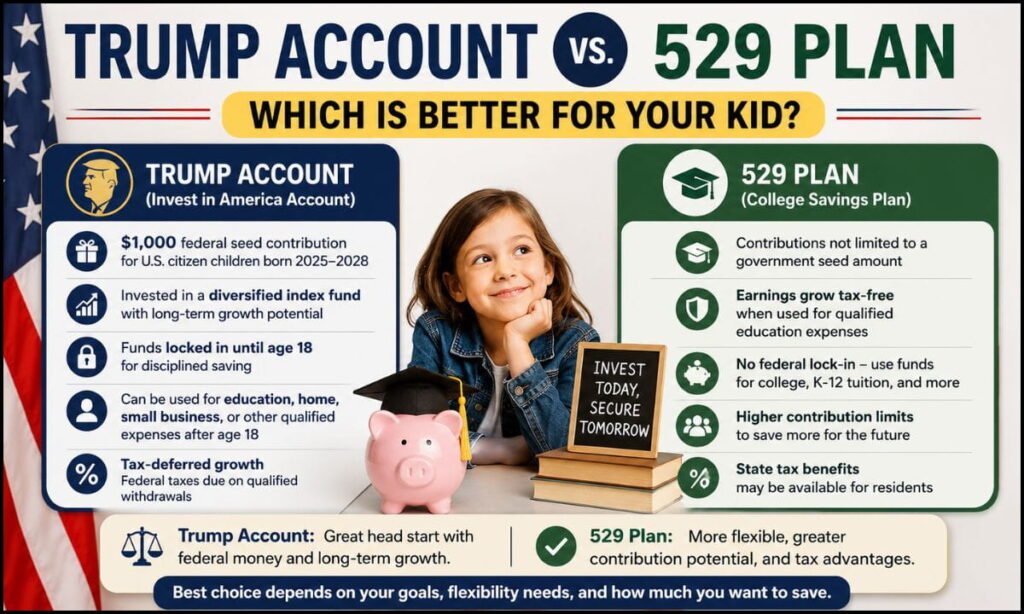
The $1000 Trump Accounts Program took a major turn on October 1, 2026, when the Treasury Department said more than 60 million American children under 18 had been automatically enrolled in the new accounts. That sounds like free money for every child in the country. It is not. The $1,000 federal seed deposit is limited to children born from 2025 through 2028, and a parent or guardian still has to claim it. Before the auto-enrollment, only about 7 million of roughly 73 million eligible children had been signed up, according to Treasury figures reported in early September. The accounts launched July 4, 2026, and they can now collect gifts from family, employers and charities. A separate $250 grant from Michael and Susan Dell is also moving into some accounts without an application. We’ll be updating this article monthly.
The difference between having an account and having the $1,000 is where most families will get tripped up. Auto-enrollment creates the account. It does not automatically prove your child qualifies for the pilot program, and it does not substitute for the election form tied to the federal deposit. This guide explains who actually gets the $1,000, how to claim it, what the Dell money is and who qualifies, how much you can contribute, how withdrawals and taxes work, and which official sites to use. It also includes a calculator that shows how a Trump Account could grow by age 18 under different assumptions, with clear caveats that returns are never guaranteed.

$1,000 Trump Accounts Key Dates and Numbers
| Item | Latest detail |
|---|---|
| Official launch | July 4, 2026 |
| Federal pilot deposit | $1,000, one time |
| Who qualifies for the $1,000 | Children born January 1, 2025 through December 31, 2028, with a valid Social Security number |
| Auto-enrollment announced | October 1, 2026, more than 60 million children |
| Signed up before auto-enrollment | About 7 million of roughly 73 million eligible children |
| Annual contribution limit | $5,000 from family, friends and employers combined |
| Employer contribution | Up to $2,500 per employee per year, counted inside the $5,000 limit |
| Dell grant | $250 for children born 2016 through 2024 in eligible ZIP codes |
| Official site | TrumpAccounts.gov |
| Election form | IRS Form 4547 |
Who Gets the $1,000 in a Trump Account?
Only one group is eligible for the federal seed money: children born between January 1, 2025 and December 31, 2028. The child must have a valid Social Security number, and a parent or authorized adult must make the election to enroll in the pilot program. A child born in 2024 or earlier can have an account, but does not receive the Treasury deposit.
That cutoff matters because many families assume every child gets $1,000. Treasury has been consistent on this point since the program was announced. The program was created by the One Big Beautiful Bill, signed on July 4, 2025, and the $1,000 was designed as a seed for the youngest group first. Older children may benefit from other sources, such as employer gifts, family contributions or the Dell grant, but the Treasury deposit is tied to birth year.
Social Security COLA Increase 2027: How Much Your Check Could Rise and the Catch for Retirees
How to Claim the $1,000 Trump Account Deposit?
There are three main routes for making the election, and all of them lead back to IRS Form 4547, the Trump Account Election form.
- File Form 4547 with your federal tax return.
- Submit it through your IRS online account.
- Use the official Trump Accounts app.
Once the election is made, Treasury sends activation instructions to the person who made it. You then verify your identity, confirm account details and finish setup. Families who signed up early began receiving activation emails in phases before the July 4 launch. If you were auto-enrolled, check TrumpAccounts.gov or the app to see what is in the account and what still needs action.
Keep your child’s Social Security number handy, since the program requires a valid one. If your child does not have a number yet, request one through the Social Security Administration first.
Did Auto-Enrollment Change Anything? What 60 Million Accounts Really Mean
Yes and no. Under the new approach, Treasury created accounts for millions of children who had not been signed up, so that eligible contributions from governments and charities can reach them. That includes the Dell money for eligible older children, which is deposited without an application.
What auto-enrollment does not do is replace the pilot program election for the $1,000. Reporting from early October noted that sign-ups had stalled at under 8% before the shift and that parents still need to act for the federal deposit. In other words, the account may exist, but the $1,000 may not arrive until the family completes the election and activation steps. That is why the first thing every parent should do is log in and look.
Trump Accounts Growth Calculator: What Could $1,000 Become by Age 18?
The calculator below lets you test different starting deposits, yearly contributions and return assumptions. It is an illustration, not a forecast. Real markets go up and down, and a bad stretch can leave a balance lower than the amount put in.
Trump Account Growth Calculator
Illustration only, not a forecast. Investment returns vary and can be negative. Contributions are assumed to be made at the end of each year. Official rules: trumpaccounts.gov.
To give you a sense of scale, here are some simple scenarios over 18 years. Contributions are assumed to be made at the end of each year, and returns are constant, which real investments never are.
| Scenario | 5% yearly return | 7% yearly return | 10% yearly return |
|---|---|---|---|
| $1,000 deposit only | About $2,400 | About $3,400 | About $5,600 |
| $1,000 plus $1,200 each year | About $36,200 | About $44,200 | About $60,300 |
| $1,000 plus $5,000 each year | About $143,100 | About $173,400 | About $233,600 |
Some promotional projections, including figures cited at launch, show far larger numbers, such as $271,000 by age 18 with maximum contributions. Those rely on high return assumptions. Treat any single projection with caution.
Social Security COLA Announcement Date, Estimate & Payment Schedule
The Dell $250 Grant: Who Qualifies and When It Arrives
Michael and Susan Dell pledged $6.25 billion to put $250 into the accounts of up to 25 million children. The target group is children born from 2016 through 2024 who live in ZIP codes where median household income is below $150,000. The grant is designed to reach kids who do not qualify for the $1,000, because they were born before 2025.
Deposits began around August 31, 2026, with early coverage pointing to Texas first. Following auto-enrollment, the Dell Foundation and Invest America say the $250 is being deposited directly into eligible children’s accounts and invested, with no application required. The money moves from the donor to Treasury and is then distributed to eligible accounts, reportedly on a quarterly basis. That means timing can vary, so do not panic if your neighbor’s child saw it before yours did. You can check eligibility through the Invest America page and see the deposit in the Trump Accounts app.
How Much Can You Contribute to a Trump Account?
The yearly limit is $5,000 from family, friends and employers combined. The cap is expected to be adjusted for inflation after 2027. The $1,000 federal pilot deposit and certain group gifts from governments or charities, including the Dell money, do not count toward the limit.
| Contributor | Rule |
|---|---|
| Parents, relatives and friends | Part of the $5,000 yearly limit |
| Employers | Up to $2,500 per employee per year, inside the $5,000 limit |
| Federal pilot program | $1,000 one time, outside the limit |
| Governments and charities | Allowed, general contributions outside the limit |
| Child’s own earnings | Special rules may apply, check official guidance |
Employers can also set up pre-tax payroll contributions for an employee’s dependent child through a cafeteria plan. Ask your benefits team whether your company participates. Several large companies and philanthropists have announced matching gifts, so it is worth asking at work.
How Are the Funds Invested?
Trump Accounts are designed to hold low cost investments tied to broad U.S. stock market indexes. The federal $1,000 is invested in that way once it is deposited. Families who contribute can generally choose among approved options, subject to program rules.
Because the money is invested in the stock market, the balance can fall as well as rise. A child who is 15 when a market drop happens has less time to recover than a newborn. If you are thinking about a lump sum, remember that investing is a long term decision, and past results do not predict future ones.
Withdrawals, Taxes and What Happens at Age 18
The accounts are a type of individual retirement account for children, often called 530A accounts. Contributions generally cannot be withdrawn before the year the child turns 18. After that, the account is treated like a traditional IRA, with normal income tax on pre-tax amounts and growth.
Early withdrawals before age 59 and a half may be subject to regular income tax plus a 10% penalty, unless an exception applies. Reported exceptions include higher education costs and a first home purchase, up to $10,000. These rules can change as regulations are finalized, so confirm with the IRS or a tax professional before taking money out.
Payment Schedule: When Will the $1,000 and Other Deposits Appear?
Timing depends on when your child’s account was activated and what kind of money is involved.
| Deposit | Timing |
|---|---|
| $1,000 federal pilot contribution | Began on or after July 4, 2026 for eligible, activated accounts |
| Family and employer contributions | Accepted starting July 4, 2026 |
| Dell $250 grant | Rollout began August 31, 2026, with distributions reportedly quarterly |
| Auto-enrolled accounts | Created the week of October 1, 2026 |
| Investment tracking | Available in the app after activation |
Because activation is a step the family must complete, a child who is eligible for the $1,000 may not see money until that is done. Check the app regularly and watch for emails from official Treasury addresses.
Timeline: How the Program Reached This Point
| Date | Event |
|---|---|
| July 4, 2025 | One Big Beautiful Bill signed, creating Trump Accounts |
| December 2025 | IRS Form 4547 released and Dell pledge announced |
| March 6, 2026 | Treasury and IRS issued proposed regulations |
| March 31, 2026 | IRS reported more than 4 million children signed up |
| July 4, 2026 | Official launch, contributions open |
| August 31, 2026 | Dell $250 deposits begin |
| Early September 2026 | About 7 million children signed up |
| October 1, 2026 | Treasury announces more than 60 million auto-enrolled |
How to Apply for a Trump Account and Check Your Status
If you have not opened an account, you can still do so at any time. Parents, guardians and other authorized adults can submit IRS Form 4547.
- Confirm your child has a valid Social Security number.
- Download the official Trump Accounts app or visit TrumpAccounts.gov.
- Submit Form 4547 through the app, your IRS online account or your tax return.
- Check your email for activation instructions and complete identity verification.
- Review the account, add contributions if you wish, and keep your confirmation.
To check status, sign in to the app or the official site. If you opted in years ago and never heard back, review your IRS online account and your email spam folder. Scammers are active in this area, so only use official addresses.
SSI Payment Gap Alert: October 2 Deposits, November 0, December 2 (Full Calendar)
Who Gets 3 Deposits in October 2026? SSI and Social Security Recipients Explained
Processing Time: How Long Does Activation Take?
Treasury has said activation emails were sent in phases, so timing varied. Families who signed up in the spring received instructions before the July launch, while those who sign up later may wait longer. After activation, the $1,000 deposit is typically visible once the election is confirmed and the account is active.
There is no guaranteed number of days, because processing depends on identity checks and the volume of new accounts. If you do not see an update after several weeks, check the app and contact the official support channel listed on TrumpAccounts.gov.
Official Websites: Login, Registration, Status Check and Form Links
| Resource | Best used for | Link |
|---|---|---|
| Trump Accounts | Login, app download, account status | https://trumpaccounts.gov |
| IRS Form 4547 | Election to open an account and join the pilot program | https://www.irs.gov/forms-pubs/about-form-4547 |
| IRS online account | Submit forms and check tax records | https://www.irs.gov/payments/your-online-account |
| Treasury announcement | Launch details and next steps | https://home.treasury.gov/news/press-releases/sb0508 |
| Invest America, Dell grant | Dell $250 eligibility and updates | https://investamerica.org/dell/ |
| Social Security number | Request a number for a child | https://www.ssa.gov/ssnumber/ |
Use only these official sites. Anyone asking you to pay a fee to receive the $1,000, or asking for your full bank login, is not part of the program.
Scam Warning: How to Avoid Trump Account Fraud
Any big new government program attracts scammers. Watch out for texts that say you must pay a processing fee, calls that claim your child’s money is about to expire, and websites that mimic TrumpAccounts.gov. The federal deposit is free, and there is no charge to open an account.
Never share your Social Security number or your child’s number with someone who contacted you first. Type the address yourself, use the official app from the App Store or Google Play, and report suspicious messages to the Federal Trade Commission.
Should You Contribute? A Practical Way to Think About It
For families with spare cash and a long time horizon, the accounts offer tax deferral and a way to invest for a child. But the money is locked up for a long time, and it is subject to retirement style rules. If you do not yet have an emergency fund or are carrying high interest debt, paying those down may be a better first step.
If your employer offers a contribution, that is almost always worth taking. Free money is free money. Families who can afford to contribute should also compare the accounts with alternatives, such as 529 college savings plans, which have different tax rules and flexibility. A fee only financial planner can help weigh the choices.
What Critics and Supporters Are Saying
Supporters call the accounts a way to put every American child on the path to owning investments, and they point to large private gifts as proof of momentum. Critics say the benefits flow most to families with money to contribute, and they worry about administrative complexity and the low sign up rate before auto-enrollment.
The auto-enrollment move was seen as an attempt to close the gap, but it also raised questions about how many families will actually claim the $1,000 and how accounts are protected from fraud. Those debates are likely to continue as final regulations are written and more data comes in.
What to Do This Week
Open the app or visit the official site and see whether your child has an account. If your child was born between 2025 and 2028, make sure the pilot election is complete. If your child was born between 2016 and 2024, check the Dell eligibility page. Ask your employer about contributions, and keep your Social Security information current.
Finally, set a calendar reminder to check the account monthly for new deposits and to review any emails from Treasury. Official updates have been arriving in waves, and it is easy to miss something.
Conclusion
The $1,000 Trump Accounts program is now live, and the news this fall is the October 1 auto-enrollment of more than 60 million children. The federal $1,000 is still limited to children born from 2025 through 2028 and still requires a parent or guardian to claim it, while the Dell $250 grant is being deposited without an application for eligible older children. Contributions are capped at $5,000 a year, withdrawals are restricted until adulthood, and returns are never guaranteed. Use the calculator to set expectations, verify your child’s account on the official site and check back as we update this guide.
SSI Payment Dates October 2026 to January 2027: Every Early Deposit Explained
FAQs About $1000 Trump Accounts
Who gets the $1,000 Trump Account deposit?
Children born from January 1, 2025 through December 31, 2028 with a valid Social Security number, once a parent or guardian completes the election.
Do I have to sign up to get the $1,000?
Yes. Auto-enrollment creates an account, but families still need to claim the pilot program contribution.
How do I claim the $1,000?
Submit IRS Form 4547 through your tax return, your IRS online account or the Trump Accounts app.
What is the Dell $250 grant?
It is a $250 gift for children born 2016 through 2024 who live in ZIP codes with median household income below $150,000.
How much can I contribute each year?
Up to $5,000 combined from family, friends and employers.
Can my child withdraw the money early?
Generally not before the year they turn 18, and early withdrawals later can trigger taxes and penalties.
Where do I check my child’s account?
TrumpAccounts.gov or the official Trump Accounts app.
What are Trump Accounts?
They are tax-advantaged investment accounts for children under 18, also called 530A accounts, created by the One Big Beautiful Bill.
Is the $1,000 Trump Account real?
Yes. The program launched July 4, 2026, and eligible children are receiving the one time Treasury deposit after activation.
When will I get the $1,000 for my baby?
After you complete the election and activation steps. There is no single date for everyone.
Are Trump Accounts only for babies?
No. Any child under 18 with a Social Security number can have an account, but only those born 2025 through 2028 get the $1,000.
Can employers contribute to Trump Accounts?
Yes, up to $2,500 per employee per year, inside the $5,000 limit.
Are Trump Accounts taxable?
Growth is tax deferred, and withdrawals after the account converts to IRA treatment are taxed under standard rules.
Is there a fee to open a Trump Account?
There is no fee to claim the federal deposit, and you should avoid anyone asking you to pay one.
What happens if my child is auto-enrolled but I do nothing?
The account exists and can receive certain gifts, but you may miss the $1,000 if your child qualifies and you do not claim it.
VA Disability Pay Increase: New Rates, Payment Dates and What You Will Get