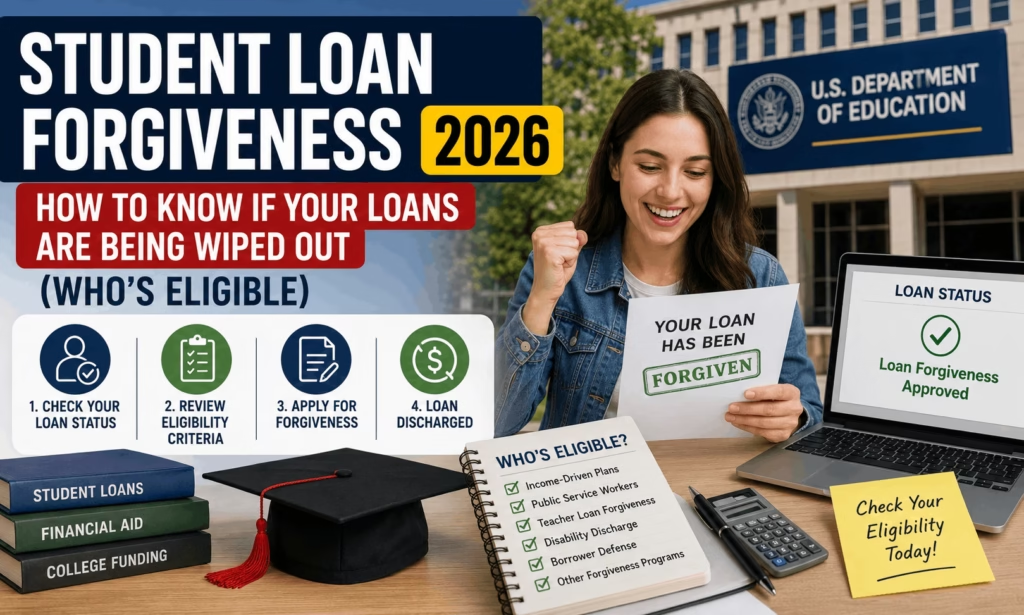
Student loan forgiveness 2026 is real, but it looks nothing like the broad, headline-grabbing relief many borrowers were promised a few years ago. The SAVE Plan is officially dead — a federal court vacated it on March 10, 2026, and the Department of Education began notifying all 7.5 million enrolled borrowers on March 27, 2026 — but several genuine forgiveness pathways remain fully open: Public Service Loan Forgiveness (PSLF), income-driven repayment (IDR) forgiveness, Teacher Loan Forgiveness, closed school discharge, borrower defense to repayment, and total and permanent disability discharge. The question isn’t whether forgiveness exists in 2026 — it does — the question is whether you qualify, and that depends entirely on your loan type, your repayment history, your employer, and critically, your timing, since several major deadlines land in the second half of 2026.
This guide walks through exactly how to check if your student loans are being discharged, who’s actually eligible for each remaining program, and the tax rules that changed dramatically on January 1, 2026 — details many borrowers still don’t know. We’ll cover the new Repayment Assistance Plan (RAP) that launched July 1, 2026, the PSLF employer eligibility changes, and a little-known IDR settlement that’s already discharging loans for thousands of long-term borrowers. We’ll be updating this article monthly as new Department of Education guidance is released.
Student Loan Forgiveness 2026 Key Highlights
| Program | Status in 2026 | Time to Forgiveness |
|---|---|---|
| Public Service Loan Forgiveness (PSLF) | Active — employer eligibility rules changed July 1, 2026 | 10 years (120 qualifying payments) |
| IDR Forgiveness (IBR, ICR, PAYE) | Active — now taxable federally starting 2026 | 20–25 years |
| SAVE Plan | Terminated — vacated by court March 10, 2026 | N/A |
| Repayment Assistance Plan (RAP) | New — launched July 1, 2026 | Up to 30 years |
| Teacher Loan Forgiveness | Active | 5 years |
| Closed School Discharge | Active | Immediate upon approval |
| Borrower Defense to Repayment | Active | Case-by-case |
| Total & Permanent Disability Discharge | Active, tax-free permanently under OBBBA | Immediate upon approval |
| Parent PLUS Consolidation Deadline | June 30, 2026 (passed) — preserved IDR/PSLF access | — |
| PAYE, ICR, SAVE Elimination | July 1, 2028 | Only IBR and RAP will remain |
| Official Portal | studentaid.gov | — |
SAVE Plan Is Officially Gone — What Happens to Enrolled Borrowers
The Saving on a Valuable Education (SAVE) plan, once the most popular income-driven repayment option, was struck down following the Eighth Circuit Court of Appeals’ March 9, 2026 ruling, with a federal court formally vacating the SAVE Final Rule the next day. The Department of Education confirmed the plan is finished and began notifying all 7.5 million enrolled borrowers on March 27, 2026. Interest on SAVE balances had already resumed accruing back on August 1, 2025, and starting July 1, 2026, servicers began sending borrowers 90-day notices requiring them to choose a new repayment plan.
If you were on SAVE, you must select a new plan — most borrowers are being directed toward Income-Based Repayment (IBR), described by loan attorneys as the most stable remaining path to IDR forgiveness, or the newly launched RAP.
The Repayment Assistance Plan (RAP): What’s New for 2026
Created under the One Big Beautiful Bill Act, signed July 4, 2025, the Repayment Assistance Plan (RAP) launched July 1, 2026 as the new default income-driven plan for new federal student loans. RAP counts as a qualifying repayment plan for PSLF, meaning payments made under it still count toward your 120-payment forgiveness total. Its forgiveness timeline runs considerably longer than legacy IDR plans — up to 30 years — reflecting the broader shift toward extended repayment structures under the new law.
Important structural change on the horizon: by July 1, 2028, the PAYE and ICR plans, along with what remains of SAVE, will be fully eliminated. Only IBR and RAP will remain as income-driven options going forward.
Public Service Loan Forgiveness (PSLF): Still Available, But Employer Rules Changed
PSLF remains a statutory program under Section 455(m) of the Higher Education Act — only Congress can eliminate it, and Congress did not touch it in the One Big Beautiful Bill Act. Your existing qualifying payment count is fully protected; you do not lose credit already earned because of the 2026 changes.
What actually changed on July 1, 2026:
- The Department of Education gained new authority to disqualify employers it determines were “organized for a substantial illegal purpose” from counting toward PSLF eligibility going forward.
- Public school districts, state/public universities, and 501(c)(3) private nonprofit organizations remain qualifying employers as before.
- Employer eligibility is verified through submitted and approved Employment Certification Forms (ECFs).
Who qualifies for PSLF:
- Work full-time for a qualifying government or 501(c)(3) nonprofit employer.
- Make 120 qualifying monthly payments (10 years) under an eligible repayment plan, including the new RAP.
- Have Direct Loans, or consolidate other federal loan types into a Direct Consolidation Loan first.
How to check your status: Use the PSLF Help Tool at studentaid.gov/pslf to verify your employer’s eligibility and track your qualifying payment count directly.
Income-Driven Repayment (IDR) Forgiveness: The Tax Rule That Changed
IDR forgiveness — available after 20 or 25 years of qualifying payments, depending on your specific plan and when you first borrowed — remains a real, active pathway. But the tax treatment shifted dramatically on January 1, 2026.
The American Rescue Plan Act of 2021 made all student loan forgiveness tax-free at the federal level through December 31, 2025. Congress did not extend that exemption. As a result:
- IDR forgiveness received in 2026 or later is now taxable federal income, unless you qualify for the IRS insolvency exclusion.
- PSLF forgiveness remains permanently tax-free — this exemption was not affected.
- Teacher Loan Forgiveness and Perkins Loan cancellation also remain tax-free.
- Death and disability discharges remain permanently tax-free under OBBBA.
A critical exception worth knowing: federal guidance suggests that if you satisfied all forgiveness requirements in 2025 but the government simply hadn’t finalized your discharge paperwork until 2026, your relief may still be treated as having occurred in 2025 for federal tax purposes — meaning it could still be tax-free. If your discharge is pending, this timing distinction is worth raising directly with your servicer.
The IDR Account Adjustment: A Little-Known Path Already Discharging Loans
A separate legal settlement is quietly resulting in real discharges for long-term IDR borrowers. Under the terms, your effective discharge date is the date you actually hit 240 or 300 qualifying payments — not the date the Department of Education processes the paperwork. If that milestone date falls in 2025 or earlier, your forgiveness remains tax-free even if processed in 2026.
A January 2026 court filing identified 10,873 IBR borrowers, 10,729 original ICR borrowers, and 820 PAYE borrowers as eligible for discharge under this settlement. If you reached your 20- or 25-year threshold and kept making payments past that point, the Department of Education is required to refund those overpayments once your discharge processes.
Faster Discharge Options: You Don’t Need Decades of Payments
Two options exist for borrowers who don’t have a long repayment history but were genuinely harmed:
Closed School Discharge: If your school closed while you were enrolled (or shortly after you withdrew), you may qualify for a full discharge of the loans taken out for that program — no minimum repayment history required.
Borrower Defense to Repayment: If your school made false claims about job placement rates, accreditation status, or program costs, you may be eligible for discharge based on institutional misconduct. Processing deadlines are specific and enforced: for Exhibit C schools, the Department of Education must issue a decision by January 28, 2026, or the application is automatically approved; all other post-class applications must receive a decision by April 15, 2026.
Total and Permanent Disability Discharge
If you’re determined to be totally and permanently disabled by the Department of Veterans Affairs, the Social Security Administration, or through physician certification, you qualify for a full discharge of your federal student loans. As of 2026, this discharged amount remains permanently non-taxable — a 2021 protection that has held firm through all subsequent tax law changes. Apply through the Department of Education’s disability discharge servicer.
Teacher Loan Forgiveness: A Faster Option for Educators
Teachers working full-time for five consecutive academic years at a qualifying low-income school or educational service agency can receive up to $17,500 in forgiveness, depending on subject area taught. Important: you cannot count the same five-year period toward both Teacher Loan Forgiveness and PSLF simultaneously. As a rule of thumb, PSLF over 10 years typically wins for higher loan balances, while Teacher Loan Forgiveness at year five usually wins for smaller balances and faster relief.
Parent PLUS Loans: A Deadline That Already Passed
Parent PLUS loans faced a major structural change effective July 1, 2026: Parent PLUS loans first disbursed on or after that date have no route into ICR or PSLF under current rules. Borrowers who wanted to preserve IDR and PSLF eligibility for existing Parent PLUS debt needed to complete a Direct Consolidation Loan by June 30, 2026 — a deadline that has now passed. If you missed it and hold newly disbursed Parent PLUS loans, your forgiveness options are now considerably more limited than for Direct Loan borrowers.
How to Check If Your Loans Qualify
- Log in to StudentAid.gov and review your loan type, servicer, and current repayment plan.
- Check your payment count — approaching 20+ years, IDR forgiveness may be closer than you think; under 10 years, focus on PSLF eligibility (if your employer qualifies) or enrolling in IBR.
- Use the PSLF Help Tool to verify employer eligibility and confirm your qualifying payment total.
- Review your payment history annually on both your servicer’s site and StudentAid.gov — keep your own independent records and promptly dispute any qualifying months that appear missing or miscounted.
- If your school misled you or closed, check your closed school discharge or borrower defense status directly at Student Aid.
- If you were on SAVE, respond promptly to your servicer’s 90-day notice and select a new qualifying plan before the deadline.
Official Resources
| Federal Student Aid Official Portal | studentaid.gov |
| PSLF Help Tool | studentaid.gov/pslf |
| New Repayment Plans (RAP) Information | studentaid.gov/bigupdates |
| Repayment Calculator | studentaid.gov/repayment-calculator |
| Borrower Defense Application | studentaid.gov/borrower-defense |
| Home Page | https://govtschemes.org/ |
FAQs
Is student loan forgiveness still available in 2026?
Yes. PSLF, IDR forgiveness, Teacher Loan Forgiveness, closed school discharge, borrower defense, and disability discharge all remain active — though the SAVE Plan has been terminated.
How do I know if my student loans are being forgiven?
Log in to StudentAid.gov to check your qualifying payment count, use the PSLF Help Tool if applicable, and review your servicer account annually to confirm your payments are being counted correctly.
Is student loan forgiveness taxable in 2026?
IDR forgiveness received in 2026 or later is now federally taxable, since the American Rescue Plan Act’s tax exemption expired December 31, 2025. PSLF, Teacher Loan Forgiveness, Perkins cancellation, and disability discharge remain permanently tax-free.
What happened to the SAVE Plan?
A federal court vacated the SAVE Final Rule on March 10, 2026, following an Eighth Circuit ruling. All 7.5 million enrolled borrowers were notified and must select a new repayment plan.
What is the Repayment Assistance Plan (RAP)?
A new income-driven repayment plan created under OBBBA, launched July 1, 2026, offering forgiveness after up to 30 years and counting toward PSLF qualifying payments.
Does PSLF still exist in 2026?
Yes. PSLF is protected by federal statute and remains fully active, though employer eligibility rules changed July 1, 2026, giving the Department of Education authority to disqualify certain organizations.
Can I get forgiveness if my school closed or defrauded me?
Yes — closed school discharge and borrower defense to repayment don’t require a long repayment history and can result in faster discharge than IDR or PSLF.
Q2.
Q3.
Q4.
Q5.
Q6
Q7.