USDA SNAP Waiver States 2026: USDA SNAP waiver approvals have reshaped how SNAP/EBT benefits work across the United States in 2026. As of this update, USDA’s Food and Nutrition Administration (FNA) has approved food-restriction waivers for 22 states — an original group of 18, plus four more added in March 2026 — letting each state remove items like soda, candy, and energy drinks from what SNAP benefits can buy. But a June 2026 federal court ruling blocked implementation in five of those states, which means the answer to “is my state on the approved list, and is the restriction actually active?” now depends on two separate things: USDA approval status and current court status. We’ll be updating this article monthly as USDA issues new approvals and as litigation develops.
This guide answers the questions SNAP recipients are asking most right now: Is my state on the USDA SNAP waiver states list? Has the waiver just been approved, or has implementation actually started? Which foods will be restricted? Which states did the court block? And what does any of this mean for my EBT benefits? Below, you’ll find a full approved-states table, a detailed state-by-state breakdown, a state SNAP agency directory, a court-case timeline, and FAQs — all built around real SNAP food restrictions data as it stands today.
What Is the USDA SNAP Waiver?
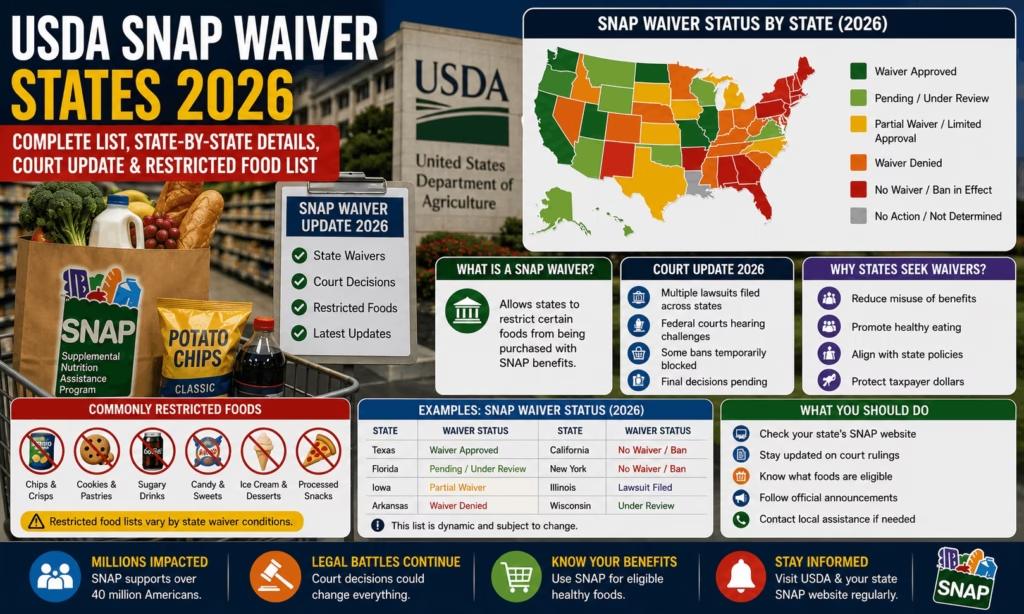
A USDA SNAP waiver, in this context, is federal approval that allows a state to redefine which foods count as “SNAP-eligible” within its own program. Under standard nationwide SNAP rules, almost any food product sold at a grocery retailer — including soda and candy — has historically qualified for SNAP/EBT purchase. These new waivers change that at the state level.
Why does a state need a waiver? Because SNAP eligibility rules are set federally under the Food and Nutrition Act. A state cannot unilaterally restrict what SNAP dollars buy; it must first request and receive USDA’s sign-off through a formal demonstration-project waiver.
Federal SNAP rules vs. state waivers: The federal baseline is identical everywhere in the country. A waiver only changes the rules for recipients inside that specific state, which is why the same item — say, a candy bar — may be SNAP-eligible in one state and restricted in the neighboring one.
How the USDA approval process works:
- A governor issues an executive order or directive requesting a food-restriction waiver
- The state’s Department of Human/Social Services (or equivalent agency) prepares and submits a formal waiver application to USDA
- USDA’s Food and Nutrition Administration reviews the proposal, including the state’s retailer communication and evaluation plans
- If approved, a roughly two-year demonstration period begins, usually with renewal options
- The state sets an effective/implementation date, which is often months after approval to allow retailer systems to update
After approval, states must notify SNAP retailers and update point-of-sale (POS) systems so restricted items are automatically excluded from EBT-eligible purchases at checkout.
Why Did These States Request SNAP Waivers?
The push behind this wave of USDA-approved SNAP states ties back to the federal “Make America Healthy Again” (MAHA) initiative, championed by Health Secretary Robert F. Kennedy Jr. and supported by USDA Secretary Brooke Rollins. States cited several recurring justifications in their waiver applications:
- Healthy food policy — aligning SNAP purchases with public-health nutrition guidance
- Reducing sugary-drink purchases — soda and sweetened beverages are consistently cited as the top SNAP purchase category
- Limiting candy purchases — targeting low-nutrient confectionery items specifically
- Public health goals — addressing rising rates of obesity and diet-related chronic disease among low-income populations
- State nutrition reform — giving governors a policy lever to shape SNAP spending patterns within their state
- Federal encouragement — USDA actively invited governors to apply, accelerating the number of applications submitted in late 2025 and early 2026
USDA SNAP Waiver States 2026 Complete List
| State | USDA Waiver Approved | Current Status | Court Status | Implementation Timeline |
|---|---|---|---|---|
| Arkansas | 2025 (1st wave) | Active | Not challenged | July 1, 2026 |
| Colorado | 2025 (1st wave) | Blocked | Vacated June 22, 2026 | Was April 30, 2026 |
| Florida | 2025 (1st wave) | Active | Not challenged | 2026 |
| Hawaii | Dec 10, 2025 | 🟡 Pending | Not challenged | 2026 |
| Idaho | 2025 (1st wave) | Active | Not challenged | 2026 |
| Indiana | 2025 (1st wave) | Active | Not challenged | Jan 1, 2026 |
| Iowa | 2025 (1st wave) | ⚖️ Blocked | Vacated June 22, 2026 | Was Jan 1, 2026 |
| Louisiana | 2025 (1st wave) | Active | Not challenged | 2026 |
| Missouri | Dec 10, 2025 | Pending | Not challenged | 2026 |
| Nebraska | 2025 (1st wave) | Blocked | Vacated June 22, 2026 | Was Jan 1, 2026 |
| North Dakota | Dec 10, 2025 | 🟡 Pending | Not challenged | 2026 |
| Oklahoma | 2025 (1st wave) | Active | Not challenged | 2026 |
| South Carolina | Dec 10, 2025 | 🔄 Phased rollout | Not challenged | Aug 31, 2026 |
| Tennessee | Dec 10, 2025 | Blocked | Vacated June 22, 2026 | Was July 31, 2026 |
| Texas | 2025 (1st wave) | Active | Not challenged | 2026 |
| Utah | 2025 (1st wave) | Active | Not challenged | Jan 1, 2026 |
| Virginia | Dec 10, 2025 | Phased rollout | Not challenged | April 2026 |
| West Virginia | 2025 (1st wave) | Blocked | Vacated June 22, 2026 | Was Jan 1, 2026 |
| Kansas | March 4, 2026 | Phased rollout | Not challenged | Feb 15, 2027 |
| Nevada | March 4, 2026 | Phased rollout | Not challenged | Feb 1, 2028 |
| Ohio | March 4, 2026 | Phased rollout | Not challenged | Oct 1, 2026 |
| Wyoming | March 4, 2026 | Phased rollout | Not challenged | Feb 1, 2027 |
State-Wise USDA SNAP Waiver Details
Arkansas SNAP Waiver
Arkansas was part of the first wave of USDA-approved SNAP states, with its waiver objective centered on removing soda and candy from EBT-eligible purchases. Implementation officially began July 1, 2026, targeting sugar-sweetened beverages and confectionery items. Arkansas was not named in the Aragon v. Rollins lawsuit, so its waiver is currently unaffected by the June 2026 court ruling and remains fully active. Recipients should expect restricted items to be automatically excluded at EBT checkout at participating retailers. Important updates and retailer guidance are issued through the Arkansas Department of Human Services, which administers the state’s SNAP program. EBT users in Arkansas should confirm current eligible-item lists directly with their retailer or the state agency, since enforcement details can be refined after the initial rollout date. As one of the earlier-approved states, Arkansas’s experience is often used by USDA and other states as a reference case for retailer compliance timelines. No further court challenges have been filed against Arkansas’s waiver as of this update, and the state has given no indication of reversing course, making it one of the more stable, fully active waivers currently in effect nationwide.
Colorado SNAP Waiver
Colorado’s waiver was approved in the initial 2025 wave, with a planned implementation date of April 30, 2026, aimed at restricting soft drinks purchased with SNAP benefits. However, Colorado was one of five states named as a plaintiff jurisdiction in Aragon v. Rollins, the federal lawsuit challenging USDA’s legal authority to approve these waivers. On June 22, 2026, a U.S. District Court judge ruled that USDA exceeded its statutory authority and skipped required rulemaking procedures, and vacated Colorado’s waiver along with four others. As a result, Colorado’s restriction is not currently active — SNAP recipients in the state can purchase soda and other previously restricted items again. USDA retains the option to appeal this ruling, which could eventually reinstate the waiver if a higher court sides with the agency. Until then, recipients should treat Colorado as reverted to standard federal SNAP eligibility rules. The Colorado Department of Human Services is the administering agency and the best source for any future updates if the case is appealed or the waiver is resubmitted through a corrected regulatory process.
Florida SNAP Waiver
Florida’s SNAP waiver, approved in the first 2025 wave, restricts soda and candy purchases and has moved into active enforcement during 2026. Florida has not faced a court challenge, so its restrictions remain fully in effect. The waiver’s stated objective follows the broader MAHA-aligned public-health goal of reducing sugar-sweetened beverage and confectionery purchases among SNAP recipients. Retailers across the state have updated their point-of-sale systems to automatically flag restricted items at checkout. SNAP recipients in Florida should direct questions about specific product eligibility to the Florida Department of Children and Families, which administers the state’s SNAP program alongside EBT card services. No changes to overall benefit amounts have occurred — only the categories of eligible purchases have shifted. Florida is frequently cited alongside Texas and Indiana as one of the states furthest along in real-world rollout, giving it a useful reference point for how enforcement plays out at the retail level once a waiver moves from “approved” to “active.”
Hawaii SNAP Waiver
Hawaii received USDA approval on December 10, 2025, as part of the second wave of approved states, targeting sugary drinks and candy. As of this update, Hawaii’s waiver remains in the pending implementation stage, meaning USDA approval is confirmed but the state has not yet finalized its retailer rollout and enforcement start date. No court challenge has been filed against Hawaii’s waiver. SNAP recipients in the state should watch for formal announcements from the Hawaii Department of Human Services, which will communicate the exact effective date and specific restricted-item list once implementation begins. Given Hawaii’s unique retail supply chain and higher reliance on imported packaged foods, the state’s rollout plan is expected to include additional retailer coordination compared to mainland states. Recipients currently retain full access to previously eligible items, including sugary drinks and candy, until an official implementation date is announced and enforced at checkout systems statewide.
Idaho SNAP Waiver
Idaho’s waiver, approved in the initial 2025 wave, restricts soda and candy purchases and is currently in active enforcement. The state’s approach mirrors several of its regional neighbors, focusing narrowly on sugar-sweetened beverages and confectionery rather than a broader food-category restriction. No court challenge has been filed against Idaho’s waiver, so the restriction remains fully in effect for SNAP recipients statewide. The Idaho Department of Health and Welfare administers the program and is the primary resource for retailer guidance and recipient questions. EBT users should expect restricted items to be automatically excluded from SNAP-eligible totals at checkout, with no impact on their overall monthly benefit amount. Idaho has not announced any plans to expand its restricted-food list beyond the current categories, though like other early-adopter states, it may serve as a template if USDA or the state legislature considers additional restrictions in future demonstration-period renewals.
Indiana SNAP Waiver
Indiana was among the earliest states to move from approval to full implementation, restricting soft drinks and candy effective January 1, 2026. The waiver reflects the state’s broader public-health goal of reducing sugar-sweetened purchases among SNAP recipients. No legal challenge has been filed against Indiana, and the restriction remains active statewide. The Indiana Family and Social Services Administration (FSSA) oversees SNAP administration and EBT services in the state. Because Indiana’s implementation date was earlier than most other approved states, its rollout has been closely watched as an early indicator of retailer compliance challenges — including how smaller convenience stores and rural retailers adapted their point-of-sale systems to flag restricted items. Recipients report no disruption to overall benefit amounts, only a narrower list of SNAP-eligible purchases at checkout. Indiana’s experience has also been referenced by USDA in guidance materials for states implementing waivers later in 2026 and 2027.
Iowa SNAP Waiver
Iowa’s waiver stands out because its restricted-food definition is unusually broad — rather than listing specific categories like soda or candy, Iowa’s waiver ties SNAP eligibility to the state’s own sales-tax code, effectively excluding any food item subject to state sales tax. This waiver was approved in the first 2025 wave with a planned effective date of January 1, 2026. However, Iowa was one of the five plaintiff states in Aragon v. Rollins, and its waiver was vacated by federal court order on June 22, 2026. As a result, Iowa’s SNAP restrictions are not currently active, and recipients have full access to standard federal SNAP-eligible items again. Legal analysts have noted Iowa’s case may be particularly vulnerable to future challenges even if USDA appeals, given how broad its restricted-item definition was compared to other states. The Iowa Department of Health and Human Services remains the point of contact for any future updates on this waiver’s status.
Louisiana SNAP Waiver
Louisiana’s waiver, approved in the first 2025 wave, restricts soda and candy and has moved into active enforcement during 2026. No court challenge has been filed against the state. Louisiana’s approach follows the standard pattern seen in most active-status states: sugar-sweetened beverages and confectionery items are excluded from SNAP-eligible purchases, while all other standard grocery categories remain unaffected. The Louisiana Department of Children and Family Services administers the program and handles EBT-related recipient inquiries. SNAP households in Louisiana should not expect any change to their monthly benefit amount — only the categories of items they can purchase with those benefits. As with other early-implementing states, retailers statewide have updated checkout systems to flag restricted items automatically, and recipients attempting to purchase excluded products with SNAP funds will need to pay for those items separately using another payment method.
Missouri SNAP Waiver
Missouri received USDA approval on December 10, 2025, with a notably detailed restricted-item list covering candy, prepared desserts, soda, and drink mixes or concentrates containing less than 50% natural juice. As of this update, Missouri’s waiver is in the pending rollout stage for 2026, with formal implementation details still being finalized by the state. No court challenge has been filed against Missouri. The Missouri Department of Social Services is the administering agency and will issue official guidance on the exact effective date and retailer requirements once implementation begins. Missouri’s waiver is considered one of the more comprehensive among the approved states because it explicitly addresses “prepared desserts” as a category, going beyond the soda-and-candy scope seen in many other states’ waivers. SNAP recipients in Missouri should monitor state announcements closely, since the broader restricted-item list may require more significant adjustments to typical grocery shopping habits once the waiver takes effect.
Nebraska SNAP Waiver
Nebraska’s waiver, approved in the first 2025 wave, targeted soda and energy drinks with a planned implementation date of January 1, 2026. Nebraska was one of the five states named in Aragon v. Rollins, and its waiver was vacated by the federal court on June 22, 2026. Nebraska’s situation carries an added wrinkle: the state reportedly submitted an additional waiver request while litigation was still ongoing, which could complicate how the court’s ruling applies going forward. For now, Nebraska’s SNAP restrictions are not active, and recipients can purchase previously restricted items again. The Nebraska Department of Health and Human Services remains the administering agency and the best source for updates if USDA appeals the ruling or if Nebraska pursues a revised waiver application that addresses the court’s procedural objections.
North Dakota SNAP Waiver
North Dakota’s waiver was approved on December 10, 2025, targeting sugary drinks and candy. The state’s implementation remains in the pending rollout phase as of this update, with no finalized effective date yet announced. No court challenge has been filed against North Dakota. The North Dakota Department of Health and Human Services administers SNAP in the state and will communicate specific retailer and recipient guidance once a formal rollout date is set. North Dakota’s relatively rural retail landscape means the state may need additional lead time to ensure smaller grocery stores and convenience retailers can update their point-of-sale systems to flag restricted items correctly. SNAP recipients in North Dakota currently retain full access to sugary drinks and candy under standard federal eligibility rules until the state’s waiver moves from “approved” to “active” status.
Oklahoma SNAP Waiver
Oklahoma’s waiver, approved in the first 2025 wave, restricts soda and candy and is currently in active enforcement. No legal challenge has been filed against the state’s waiver. Oklahoma’s implementation has proceeded without major reported disruptions, following the standard model used by most early-adopter states. The Oklahoma Department of Human Services (OKDHS) oversees SNAP administration and EBT services statewide. Recipients should expect restricted sugar-sweetened beverages and candy items to be automatically excluded from SNAP-eligible totals at checkout. As with other active-status states, Oklahoma’s overall SNAP benefit amounts are unaffected — only the list of items eligible for purchase with those benefits has changed. Oklahoma has not announced plans to expand or narrow its restricted-food categories since implementation began, and the state’s waiver has not been challenged in court as of this update.
South Carolina SNAP Waiver
South Carolina’s waiver, approved December 10, 2025, is one of the more detailed among approved states, covering candy, energy drinks, soft drinks, and any beverage with 5 grams or more of added sugar per serving — while explicitly exempting items like protein bars, granola bars, and baking ingredients from the candy definition. South Carolina is following a phased rollout, with implementation effective August 31, 2026, under a two-year demonstration period with renewal options for up to three additional years. No court challenge has been filed against South Carolina’s waiver. The South Carolina Department of Social Services administers the program and is coordinating with retailers ahead of the effective date. Recipients should watch for retailer notices in the months leading up to August 2026, as point-of-sale systems statewide will need to be updated to reflect the detailed added-sugar threshold used in this particular waiver’s restricted-item definition.
Tennessee SNAP Waiver
Tennessee’s waiver was approved on December 10, 2025, targeting soda, energy drinks, and candy, with implementation originally scheduled for July 31, 2026. Tennessee was one of the five plaintiff states in Aragon v. Rollins, and its waiver was vacated by the federal court on June 22, 2026 — before its scheduled effective date ever arrived. As a result, Tennessee’s restrictions will not go into effect as planned unless USDA successfully appeals the ruling or the state resubmits a corrected waiver application. SNAP recipients in Tennessee currently remain under standard federal eligibility rules with no purchase restrictions. The Tennessee Department of Human Services is the administering agency and will be the source of any future announcements if the legal situation changes.
Texas SNAP Waiver
Texas’s waiver, approved in the first 2025 wave, restricts soda and candy and is currently in active enforcement statewide. No court challenge has been filed against Texas. As one of the largest SNAP caseloads in the country, Texas’s rollout has been closely watched as a test case for how large-scale retail systems — including major grocery chains and big-box stores — adapt checkout systems to flag restricted items across thousands of locations. The Texas Health and Human Services Commission (HHSC) administers SNAP and EBT services in the state. Recipients should not expect any change to their overall monthly benefit amount, only to which items qualify for SNAP purchase. Texas has not announced plans to expand its restricted-item categories since implementation, and there have been no reported large-scale enforcement issues since the waiver became active.
Utah SNAP Waiver
Utah’s waiver, approved in the first 2025 wave, restricts soft drinks and took effect January 1, 2026. Utah’s waiver is narrower in scope than several other states, focusing specifically on soft drinks rather than a broader candy-and-beverage combination. No court challenge has been filed against Utah. The Utah Department of Workforce Services administers SNAP benefits in the state. Because Utah’s restriction is limited primarily to soft drinks, the practical impact on typical grocery purchases has been smaller than in states with broader restricted-item lists, such as Missouri or Iowa. SNAP recipients in Utah should confirm current eligible-item lists with their retailer if uncertain about a specific product, though enforcement has been reported as straightforward given the narrower scope of the restriction.
Virginia SNAP Waiver
Virginia’s waiver, approved December 10, 2025, restricts sweetened carbonated beverages specifically — a narrower category than most other approved states, which often include candy as well. Virginia is following a phased rollout, with implementation beginning April 2026, after the state completed required submissions covering a retailer communication plan, an evaluation plan, and a program budget. No court challenge has been filed against Virginia’s waiver. The Virginia Department of Social Services administers the program statewide. Because Virginia’s restriction excludes candy and focuses only on sweetened carbonated soft drinks, recipients face a more limited adjustment to shopping habits compared to broader-scope states. Retailers across Virginia have been coordinating with the state ahead of the April 2026 effective date to ensure checkout systems correctly flag restricted beverage items.
West Virginia SNAP Waiver
West Virginia’s waiver, approved in the first 2025 wave, targeted soda with a planned effective date of January 1, 2026. West Virginia was one of the five plaintiff states in Aragon v. Rollins, and its waiver was vacated by the federal court on June 22, 2026. As a result, West Virginia’s SNAP restrictions are not currently active, and recipients have resumed standard federal SNAP eligibility, including the ability to purchase soda with benefits. The state’s SNAP program is administered by the West Virginia Department of Human Services (following the state’s broader health-agency restructuring). Recipients should watch for updates if USDA appeals the court’s ruling or if West Virginia pursues a revised waiver submission addressing the procedural issues identified by the court.
4 More States Approved Since the Original Group
In March 2026, USDA approved a third wave of waivers, expanding the total beyond the original 18 states. These four states are on a longer runway before their restrictions take effect:
- Kansas — approved March 4, 2026; will restrict candy and soft drinks starting February 15, 2027
- Nevada — approved March 4, 2026; will restrict candy and sugar-sweetened beverages starting February 1, 2028, the longest lead time of any approved state
- Ohio — approved March 4, 2026; will restrict sugar-sweetened beverages starting October 1, 2026
- Wyoming — approved March 4, 2026; will restrict sweetened carbonated beverages starting February 1, 2027
None of these four states has faced a court challenge so far.
States Where Federal Court Blocked SNAP Waiver Implementation
Five states had their SNAP waivers vacated in a single federal ruling: Colorado, Iowa, Nebraska, Tennessee, and West Virginia. The case, Aragon v. Rollins (Case No. 1:26-cv-00861, U.S. District Court for the District of Columbia), was brought by five SNAP recipients — one from each affected state — arguing USDA misapplied 7 U.S.C. § 2026(b), a statute intended for “program efficiency” pilot projects, not food-purchase restrictions, and that USDA skipped the notice-and-comment rulemaking required for a change of this scale.
On June 22, 2026, the court agreed, ruling that USDA exceeded its statutory authority and vacating the waivers in all five states. Current legal status:
- Restrictions are not active in any of these five states
- SNAP recipients there can currently purchase soda, candy, and other previously restricted items
- USDA has the option to appeal the ruling to a higher court
- Because most other approved states relied on the same USDA legal authority and process, legal observers say this ruling could set a precedent that invites similar challenges against the remaining 17 active or pending waivers
- Nebraska’s case includes an added complication, since the state reportedly filed an additional waiver request during litigation
States Where SNAP Restrictions Are Rolling Out in Phases
Not every approved state launched restrictions on day one. Several are following staged rollouts, often because USDA required additional planning documents (retailer communication plans, evaluation plans, budgets) before granting a live effective date:
- South Carolina — effective August 31, 2026
- Virginia — effective April 2026
- Ohio — effective October 1, 2026
- Kansas — effective February 15, 2027
- Wyoming — effective February 1, 2027
- Nevada — effective February 1, 2028
- Missouri, Hawaii, North Dakota — approved but still finalizing rollout details for 2026
States like Arkansas, Florida, Indiana, Louisiana, Oklahoma, Texas, and Utah completed their rollout earlier and are already in active enforcement, rather than a phased schedule.
What Foods Could Be Restricted?
| Food Category | Status |
|---|---|
| Soda | Restricted in most active-status states |
| Sugary Beverages | Restricted in most states; definitions vary (e.g., 5g+ added sugar in South Carolina) |
| Candy | Restricted in most states, except narrower waivers like Virginia’s and Utah’s |
| Energy Drinks | Restricted in several states (e.g., Nebraska, Tennessee, South Carolina) |
| Sweet Snacks | Restricted in select states with broader waiver definitions |
| Certain Desserts | Restricted specifically in Missouri’s waiver |
The exact restricted-food list is not uniform — it depends entirely on each state’s individual USDA-approved waiver document, so always confirm specifics with your state agency rather than assuming another state’s rules apply to you.
What Foods Can SNAP Recipients Still Buy?
Regardless of which waiver applies in your state, these categories remain SNAP-eligible nationwide:
- Fruits
- Vegetables
- Eggs
- Milk and dairy
- Bread and cereals
- Rice, pasta, and beans
- Meat, poultry, and fish
- Baby formula and baby food
- Natural fruit/vegetable juice (typically 50%+ juice content)
- Other standard grocery staples not named in a state’s restricted-item list
Will My EBT Card Still Work?
Yes. Your EBT card remains fully active regardless of whether your state has an active, pending, or blocked waiver. Your total SNAP benefit amount does not change because of these waivers — only the categories of items eligible for purchase may change, and only in states where a restriction is currently enforced. If you try to buy a restricted item with SNAP funds in an active-waiver state, the point-of-sale system will typically exclude that item automatically, and you’ll need another payment method to complete that portion of the purchase.
How to Check If Your State Has Implemented the USDA Waiver
- Visit your state SNAP agency’s official website (see directory below) for the latest implementation notices
- Watch for EBT mailers or account notices from your state agency ahead of an effective date
- Check USDA’s Food and Nutrition Administration announcements at fna.usda.gov for the master approved-states list
- Contact your local SNAP office directly if you’re unsure whether a specific product is currently restricted
- Ask your retailer/grocery store — most participating stores are notified before enforcement begins and can confirm what SNAP currently covers at checkout
Will More States Receive USDA Approval?
Very likely. USDA has already approved waivers in three separate waves since 2025, and additional states have either submitted requests or signaled interest in doing so. At the federal level, a proposed Healthy SNAP Act would restrict soda, candy, ice cream, cookies, and desserts from SNAP purchases nationwide, but it remains pending in Congress with no recent movement. Until such federal legislation passes (if it does), expect the state-by-state waiver approach to continue, meaning more states could join this list in future USDA review cycles.
State-Wise SNAP Agency Directory
| State | SNAP Agency | Official Website |
|---|---|---|
| Arkansas | Department of Human Services | humanservices.arkansas.gov |
| Colorado | Department of Human Services | cdhs.colorado.gov |
| Florida | Department of Children and Families | myflfamilies.com |
| Hawaii | Department of Human Services | humanservices.hawaii.gov |
| Idaho | Department of Health and Welfare | healthandwelfare.idaho.gov |
| Indiana | Family and Social Services Administration | fssa.in.gov |
| Iowa | Health and Human Services | hhs.iowa.gov |
| Louisiana | Department of Children and Family Services | dcfs.louisiana.gov |
| Missouri | Department of Social Services | dss.mo.gov |
| Nebraska | Department of Health and Human Services | dhhs.ne.gov |
| North Dakota | Department of Health and Human Services | hhs.nd.gov |
| Oklahoma | Department of Human Services | oklahoma.gov/okdhs |
| South Carolina | Department of Social Services | dss.sc.gov |
| Tennessee | Department of Human Services | tn.gov/humanservices |
| Texas | Health and Human Services Commission | hhs.texas.gov |
| Utah | Department of Workforce Services | jobs.utah.gov |
| Virginia | Department of Social Services | dss.virginia.gov |
| West Virginia | Department of Human Services | dhs.wv.gov |
Agency names and site structures occasionally change — always confirm through a direct search of “[your state] SNAP office” if a link above doesn’t resolve.
Timeline of USDA SNAP Waiver Changes
- State submits waiver — Governor’s office directs the state SNAP agency to prepare a formal waiver application
- USDA review — Food and Nutrition Administration evaluates the retailer plan, evaluation plan, and program budget
- Approval — USDA grants a roughly two-year demonstration-project waiver
- Implementation planning — State sets an effective date and notifies retailers to update POS systems
- Court review (if applicable) — Some states faced legal challenges arguing USDA lacked authority for these waivers
- Implementation — Restricted items become ineligible for SNAP purchase at checkout on the effective date
- Future updates — Renewal decisions, possible appeals, and additional state approvals continue to shape this list
Key dates so far: first 12 states approved in 2025; 6 more approved December 10, 2025 (bringing the total to 18); 4 more approved March 4, 2026 (bringing the total to 22); 5 states’ waivers vacated by federal court June 22, 2026.
FAQs
Which states received USDA SNAP waivers?
22 states have USDA approval as of this update: Arkansas, Colorado, Florida, Hawaii, Idaho, Indiana, Iowa, Kansas, Louisiana, Missouri, Nebraska, Nevada, North Dakota, Ohio, Oklahoma, South Carolina, Tennessee, Texas, Utah, Virginia, West Virginia, and Wyoming.
Is my state on the approved list?
Check the master table above. If your state isn’t listed, it has not received a SNAP food-restriction waiver as of this update.
Can I still buy soda with SNAP?
Depends on your state. It’s currently restricted in active-waiver states, allowed again in the five court-blocked states, and still allowed until the effective date in phased-rollout states.
Is candy banned under SNAP?
Also state-dependent — most active waivers restrict candy, but a few states (like Virginia and Utah) only restrict beverages, not candy.
Which states were blocked by the federal court?
Colorado, Iowa, Nebraska, Tennessee, and West Virginia — all five had their waivers vacated on June 22, 2026, in Aragon v. Rollins.
When will my state implement the waiver?
Effective dates range from January 2026 through February 2028 depending on the state — see the implementation timeline column in the master table.
Will my SNAP benefits decrease?
No. These waivers only change which food categories are eligible for purchase — they do not reduce your total monthly SNAP benefit amount.
Can states add more restricted foods?
Yes, in theory, through waiver renewal or amendment requests to USDA, though any changes would still require USDA approval and are subject to the same legal scrutiny seen in current court challenges.
How do I check my state’s SNAP rules?
Visit your state’s official SNAP agency website (see the directory above) or USDA’s Food and Nutrition Administration site for the latest confirmed list.
Will more states receive USDA approval?
Likely yes — USDA has approved waivers in three waves already and continues reviewing new state requests.
Key Takeaways
- 22 states currently have USDA-approved SNAP food-restriction waivers (18 original + 4 added March 2026)
- 5 states — Colorado, Iowa, Nebraska, Tennessee, West Virginia — are blocked by a federal court order and are not currently enforcing restrictions
- 9 states — Arkansas, Florida, Idaho, Indiana, Louisiana, Oklahoma, Texas, Utah — are already in active enforcement
- The remaining states are in pending or phased rollout stages, with effective dates through 2028
- Restricted categories mainly cover soda, candy, energy drinks, sugary beverages, and select desserts
- EBT cards remain fully active everywhere — only eligible purchase categories change, and only where a waiver is currently enforced
- SNAP recipients should check their state SNAP agency’s official website for the most current, state-specific guidance