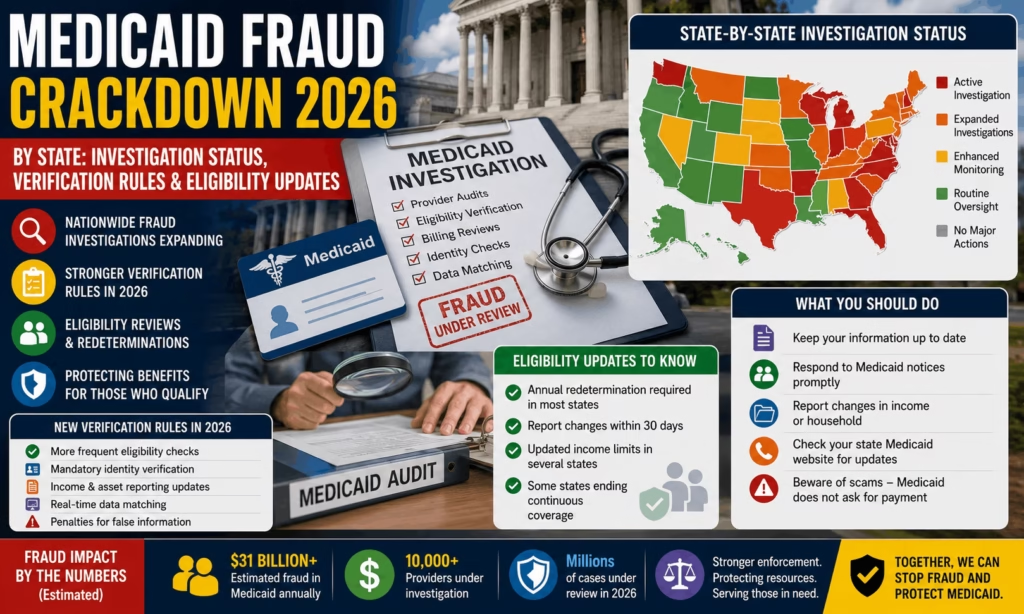
Medicaid Fraud Crackdown 2026 is a real and rapidly escalating story, but it’s important to separate what’s actually been confirmed from what’s still an open investigation. Every state, plus DC, Puerto Rico, and the U.S. Virgin Islands, has a federally required Medicaid Fraud Control Unit (MFCU) 53 in total and in 2026 those units are under unprecedented federal review. In May 2026, the HHS Office of Inspector General (HHS-OIG) notified every single MFCU it would face a “robust review” before its next recertification, and in June 2026 HHS denied recertification for Hawaii’s MFCU, cutting off its federal funding — the first confirmed action of its kind this year. Separately, in 2026 the administration’s CRUSH initiative (Comprehensive Regulations to Uncover Suspicious Healthcare) and a House Energy and Commerce Committee inquiry have put California, Minnesota, New York, Maine, and Florida under direct federal scrutiny, and as of late July 2026, CMS is deferring more than $1 billion in federal Medicaid payments to California and Minnesota pending review of specific claims categories. This does not mean fraud has been proven in those states California’s Medicaid director has publicly said CMS has not yet provided specific instances of fraud, waste, or abuse to justify the deferral, and CMS itself has acknowledged a factual error in figures it used to help justify a separate probe into New York.
This guide walks through what Medicaid fraud enforcement actually covers, what’s confirmed versus still under investigation in specific states, how eligibility verification is changing for ordinary beneficiaries, and how to report suspected fraud. We’ll be updating this article monthly as HHS-OIG completes its MFCU reviews and as the disputes in California, Minnesota, and New York develop.
What Is the Medicaid Fraud Crackdown 2026?
Medicaid fraud refers to intentionally deceiving the program for financial gain — this can come from providers (billing for services not rendered, upcoding, kickbacks) or, less commonly, from beneficiaries (misrepresenting income or identity to gain ineligible coverage). Multiple layers of government share responsibility:
- CMS (Centers for Medicare & Medicaid Services): Oversees state Medicaid programs, approves state plans, and can defer or withhold federal matching funds when it suspects fraud.
- HHS-OIG (HHS Office of Inspector General): Audits programs, excludes bad actors from federal healthcare programs, and oversees state MFCUs.
- DOJ (Department of Justice): Prosecutes criminal healthcare fraud, including through the annual National Health Care Fraud Takedown and a newly created Fraud Enforcement Division (NFED).
- State Medicaid Fraud Control Units (MFCUs): State-level law enforcement units, usually housed in the state Attorney General’s office, that investigate and prosecute Medicaid provider fraud and patient abuse or neglect using combined state and federal funding.
Why Are States Increasing Medicaid Fraud Investigations?
Several forces are driving the 2026 surge in enforcement:
- Improper payments: A congressional watchdog reported roughly $37 billion in Medicaid improper payments for fiscal year 2025 (a figure that includes errors and unsupported claims, not only proven fraud).
- New federal oversight initiatives: CMS launched the CRUSH initiative in 2026 specifically targeting suspicious healthcare billing, and CMS Administrator Dr. Mehmet Oz directed all 50 states to submit fraud-prevention plans.
- MFCU performance pressure: In May 2026, Vice President JD Vance publicly warned MFCUs the federal government would cut their funding if they didn’t pursue fraud aggressively; HHS-OIG followed with its formal review of all 53 units.
- High-risk billing categories: Federal officials have specifically flagged personal care/in-home services, billing for deceased patients, and claims tied to immigration-status questions as areas of concern in ongoing reviews.
- Political scrutiny: The House Energy and Commerce Committee sent information-request letters to ten states in March 2026, and the issue has been raised at the presidential level, including in a State of the Union address.
What Types of Medicaid Fraud Are Being Targeted?
Fake Medical Billing
Billing for services, equipment, or visits that never happened.
Duplicate Claims
Submitting the same claim multiple times, sometimes across different providers or billing codes.
Identity Theft
Using a beneficiary’s or provider’s identity without authorization to submit claims.
Prescription Fraud
Includes opioid diversion and other controlled-substance schemes — a recurring theme in the 2026 DOJ National Health Care Fraud Takedown.
Home Healthcare Fraud
Billing for in-home visits or personal care services not actually delivered — one of the highest-risk categories federal reviewers have identified in both California and Minnesota.
Personal Care Attendant Fraud
Billing for caregiver hours that were not worked, or using unlicensed/unauthorized attendants.
Transportation Fraud
Billing for non-emergency medical transportation that wasn’t provided or wasn’t medically necessary.
Provider Kickbacks
Illegal payments between providers or suppliers in exchange for referrals.
Managed Care Fraud
Fraud within Medicaid managed-care organizations, including misrepresenting enrollee risk or service utilization.
State Medicaid Fraud Control Units: The National Baseline
Before looking at individual states, it’s worth being clear about what’s actually uniform nationwide: every state, DC, Puerto Rico, and the U.S. Virgin Islands operates an MFCU under federal law — 53 total — funded jointly by state and federal dollars and required to operate independently from the state Medicaid agency (usually housed instead within the state Attorney General’s office). All 53 MFCUs participated in the 2026 National Health Care Fraud Takedown. In FY2025, MFCUs nationwide recovered $4.64 for every $1 spent and secured 1,185 convictions, a 3% increase over FY2024. Provider enrollment screening, claims auditing, and fraud-hotline reporting are standard practice in every state — what currently differs state to state is whether a state has received a specific federal information request, payment deferral, or MFCU compliance action in 2026. The table below reflects only what’s been publicly confirmed for each state; it does not imply that states without a noted federal action are free of fraud risk, nor does it imply that states with a federal action have had fraud proven against them.
| State/Territory | MFCU Status | 2026 Federal Action (confirmed) | Beneficiary Impact |
|---|---|---|---|
| All 50 states + DC, Puerto Rico, U.S. Virgin Islands | Active MFCU (53 total); under HHS-OIG “robust review” ahead of recertification, per May 2026 letter to every state AG | Varies — see below | Generally none directly; reviews target providers/state programs, not individual beneficiaries |
| Hawaii | MFCU recertification denied in June 2026; federal funding for the unit discontinued | Confirmed federal funding action against the MFCU itself | No reported direct impact on beneficiary eligibility |
| California | Active MFCU | Named in CRUSH initiative (March 2026); CMS deferred ~$1.3 billion in Medicaid payments (announced May 2026), with ~$867.5 million specifically confirmed deferred as of July 21, 2026, pending review of high-risk claims (in-home supportive services, immigration-status-related claims, billing tied to deceased patients) | State disputes CMS has provided specific fraud evidence; no reported beneficiary eligibility changes tied to this action |
| Minnesota | Active MFCU | CMS froze ~$260 million in Medicaid funding beginning February 2026; an additional ~$199 million deferred as of July 21, 2026; DOJ investigation reportedly examining losses that could exceed $9 billion statewide; May 2026 Minnesota Health Care Fraud Takedown | State says it is executing a corrective action plan and has cooperated with federal reviewers |
| New York | Active MFCU | Named in CRUSH initiative and received a CMS information request; CMS separately acknowledged an error in figures it used to help justify part of the New York probe (reported April 2026) | No confirmed payment deferral action reported as of this writing |
| Maine | Active MFCU | Named in CRUSH initiative; received CMS information request | No confirmed payment deferral action reported |
| Florida | Active MFCU | Fifth state added to CRUSH scrutiny (March 2026); required to submit information on its fraud detection/prevention practices | No confirmed payment deferral action reported |
| Colorado, Massachusetts, Nebraska, Oregon, Pennsylvania, Vermont, Washington | Active MFCUs | Received House Energy & Commerce Committee information-request letters (March 3, 2026) alongside CA, ME, and NY, as part of a 10-state inquiry into Medicaid fraud, waste, and abuse | No confirmed payment deferral action reported |
| All other states not listed above | Active MFCU | No specific federal payment-deferral or recertification action publicly confirmed as of this writing | Standard provider screening and claims auditing continue as before |
This table reflects only publicly confirmed federal actions as of late July 2026. Being named in an information request or a CRUSH review is not the same as a fraud finding — several of the states above have publicly disputed that adequate evidence has been provided to justify federal action against them.
States Under Increased Federal Scrutiny: What’s Actually Confirmed
California: Named under the CRUSH initiative in early 2026; CMS has cited concerns about a rapid increase in in-home supportive services spending (reported at roughly twice the national average growth rate), claims tied to immigration status, and billing for deceased patients. CMS announced a Medicaid payment deferral in May 2026 that California’s Medicaid director testified, before Congress, had not yet been accompanied by specific documented instances of fraud. As of July 21, 2026, HHS confirmed it is deferring approximately $867.5 million in federal payments pending California’s submission of additional documentation. Current status: payment deferral, disputed by the state, review ongoing.
Minnesota: CMS froze approximately $260 million in Minnesota Medicaid funding beginning in February 2026, and a DOJ investigation has reportedly examined potential losses that could exceed $9 billion in the state’s Medicaid program over time — a figure from an ongoing investigation, not a final finding. Minnesota participated in a May 2026 Health Care Fraud Takedown targeting the state specifically. As of July 21, 2026, HHS confirmed an additional roughly $199 million in payments deferred. State officials say they have been executing a corrective action plan and cooperating with federal reviewers. Current status: active investigation and payment deferral, state says it’s cooperating.
New York: New York was named alongside California and Maine as part of the CRUSH initiative and received a CMS information request regarding program integrity and fraud prevention. Notably, CMS acknowledged to the Associated Press in April 2026 that it had made a significant error in the figures it used to help justify part of the New York fraud probe. Current status: information request active; no confirmed payment deferral; part of the original justification has been publicly corrected by CMS itself.
Hawaii: Distinct from the payment-deferral actions above, Hawaii’s case involves its Medicaid Fraud Control Unit specifically — HHS-OIG denied the unit’s annual recertification in June 2026, discontinuing federal funding for the unit itself, reportedly tied to compliance/performance concerns under the new “robust review” standard applied to all MFCUs. Current status: confirmed, funding for the MFCU has been cut off.
Note on tone: Being named in an investigation, information request, or payment-deferral action is not the same as a proven fraud finding. Several named states have publicly and specifically disputed that adequate evidence has been provided to justify the federal action taken against them.
How Medicaid Eligibility Verification Is Changing
- Income verification: States are being pushed toward more frequent electronic income data matching rather than relying solely on self-reported figures.
- Identity verification: Cross-checking Social Security and other federal databases to confirm applicants are who they say they are.
- Residency verification: Confirming an applicant actually lives in the state administering their benefits.
- Asset checks: Applied where relevant, particularly for long-term care Medicaid eligibility categories.
- More frequent renewals: Some states are moving toward more frequent eligibility redeterminations rather than annual-only reviews.
- Document verification: Increased requests for supporting documents (pay stubs, ID, proof of address) before or during renewal.
How Providers Are Being Audited
- Claim reviews: Automated and manual review of billing patterns for anomalies.
- Site inspections: In-person visits to confirm a billing provider’s business actually exists and operates as claimed.
- Electronic billing audits: Data-analytics review of claims submitted electronically, increasingly assisted by AI tools within CMS’s Integrated Data Repository.
- Prior authorization reviews: Checking whether services billed actually had required pre-approval.
- Enrollment screening: Verifying a provider’s credentials, licensure, and ownership before allowing Medicaid billing.
- License verification: Cross-checking state licensing boards to confirm a provider is currently licensed and in good standing.
As part of the 2026 National Health Care Fraud Takedown, CMS suspended 1,079 providers and revoked billing privileges for 1,403 providers, while HHS-OIG pursued more than 1,400 exclusion and Civil Monetary Penalty actions seeking over $10 billion.
Does This Affect Medicaid Recipients?
This is the most important point in this entire guide: these investigations overwhelmingly target providers, billing practices, and state program administration — not individual eligible beneficiaries. If you are an eligible Medicaid recipient:
- You generally keep your coverage as long as you remain eligible and respond to any verification requests.
- A provider being investigated does not automatically affect your coverage, though you may need to find a new provider if a facility loses its billing privileges.
- Update your personal information promptly (income, address, household changes) to avoid your own case being flagged for a verification hold.
- None of the confirmed 2026 federal actions described above have been reported to include beneficiary eligibility terminations as a direct result.
How to Report Medicaid Fraud in Your State
- State fraud hotline: Every state Medicaid agency and MFCU maintains a dedicated fraud-reporting line — check your state Medicaid agency’s website for the specific number.
- Online complaint portal: Most states and HHS-OIG accept online fraud tip submissions.
- HHS-OIG national hotline: 1-800-HHS-TIPS (1-800-447-8477), or online at oig.hhs.gov/fraud/report-fraud.
- State Medicaid agency: Can also field reports of suspected beneficiary or provider fraud directly.
- Anonymous reporting: Both HHS-OIG and most state hotlines allow anonymous tips.
Common Reasons Medicaid Claims Are Flagged
- Missing or incomplete documentation
- Duplicate billing for the same service
- Incorrect procedure or diagnosis coding
- Identity mismatches between billing records and enrollment data
- Suspicious provider billing patterns (unusually high volume, outlier growth rates)
- Incomplete medical records supporting the billed service
What Documents Beneficiaries Should Keep
- Medicaid approval/eligibility letter
- Proof of income (pay stubs, tax returns, benefit award letters)
- Government-issued ID
- Proof of residency (lease, utility bill)
- Relevant medical records
- Any renewal or redetermination notices received from your state agency
What Happens If Fraud Is Confirmed?
For providers, if fraud is proven:
- Civil monetary penalties
- Criminal charges and potential prosecution
- Exclusion from federal healthcare programs (Medicaid, Medicare)
- Repayment of improperly billed amounts
For beneficiaries, if fraud is proven (this is rare compared with provider fraud):
- Loss of eligibility
- Recovery of overpaid benefits
- Right to appeal the finding through a fair hearing process
How States Are Using Technology
- AI-assisted claim reviews: CMS and DOJ are jointly deploying AI and cloud-based analytics within CMS’s Integrated Data Repository.
- Data analytics: A multi-agency Data Fusion Center combines DOJ data analytics, HHS-OIG, and FBI resources.
- Electronic Visit Verification (EVV): Required nationally for home health and personal care services to confirm visits actually occurred, using time/location data.
- Identity matching: Cross-referencing enrollment data against Social Security and other federal identity databases.
- Cross-agency verification: A Financial Intelligence Review Team combines Medicaid claims data with financial transaction analysis.
Key Takeaways
- All 53 MFCUs (50 states + DC + Puerto Rico + U.S. Virgin Islands) are undergoing a federal “robust review” ahead of recertification in 2026.
- Hawaii’s MFCU had its recertification denied in June 2026 — the only confirmed MFCU defunding so far.
- California and Minnesota are currently facing a combined $1 billion+ in deferred federal Medicaid payments pending review of specific high-risk claims categories; both states dispute that sufficient fraud evidence has been provided.
- New York, Maine, and Florida are under CRUSH-initiative scrutiny with information requests, but no confirmed payment deferral as of this writing; CMS has acknowledged an error in part of its New York justification.
- Ten states total received a House Energy & Commerce Committee information request in March 2026: California, Colorado, Massachusetts, Maine, Nebraska, New York, Oregon, Pennsylvania, Vermont, and Washington.
- The 2026 National Health Care Fraud Takedown charged 455 defendants in schemes involving over $6.5 billion in alleged false claims, and led to 1,079 provider suspensions and 1,403 billing-privilege revocations.
- Eligible beneficiaries are not the target of these investigations and generally keep coverage by remaining eligible and responding to verification requests.
Official Resources
| HHS-OIG Fraud Reporting | https://oig.hhs.gov/fraud/report-fraud/ |
| HHS-OIG National Hotline | 1-800-HHS-TIPS (1-800-447-8477) |
| KFF Tracker on Federal Medicaid Program Integrity Actions | https://www.kff.org/medicaid/what-to-know-about-recent-federal-actions-involving-state-medicaid-program-integrity/ |
| CMS Medicaid Program Integrity | https://www.medicaid.gov |
| Home Page | https://govtschemes.org/ |
FAQs
Is my state investigating Medicaid fraud?
Every state has an active MFCU that investigates fraud continuously. As of mid-2026, California, Minnesota, New York, Maine, and Florida are under additional, specific federal scrutiny; ten states received congressional information requests in March 2026.
Which states have Medicaid fraud crackdowns?
California and Minnesota currently have confirmed federal payment deferrals. New York, Maine, and Florida are under information-request scrutiny. Hawaii’s MFCU had its federal recertification denied.
Can I lose Medicaid because of an investigation?
Generally no — these investigations target providers and state program administration, not individual eligible beneficiaries. You could lose coverage only if you personally fail to meet eligibility requirements or don’t respond to verification requests.
How do I report Medicaid fraud?
Contact your state’s Medicaid fraud hotline or the national HHS-OIG hotline at 1-800-HHS-TIPS, or file online at oig.hhs.gov.
What is a Medicaid Fraud Control Unit?
A state-based law enforcement unit, usually within the state Attorney General’s office, that investigates and prosecutes Medicaid provider fraud and patient abuse or neglect, funded jointly by state and federal dollars.
Will Medicaid eligibility checks increase?
Yes — states are moving toward more frequent electronic income, identity, and residency verification, and more frequent redeterminations in some states.
Are providers being audited?
Yes, extensively — through claims reviews, site inspections, electronic billing audits, and enrollment screening, backed by new AI-assisted data analytics tools.
What documents do I need as a beneficiary?
Your approval letter, proof of income, ID, proof of residency, medical records, and any renewal notices.
Can I appeal a Medicaid decision?
Yes, through your state’s fair hearing process if you believe your eligibility or benefits were wrongly affected.
Does every state have an MFCU?
Yes — all 50 states, DC, Puerto Rico, and the U.S. Virgin Islands operate one, for 53 total.
People Also Ask
Why did CMS freeze Medicaid payments to California and Minnesota?
CMS says reviews identified high-risk claims categories — including in-home supportive services, claims tied to immigration status, and billing for deceased patients — that required additional documentation before funds could be released. Both states dispute that specific fraud evidence has been provided.
Has fraud been proven in California or Minnesota’s Medicaid program?
Not as a finalized finding as of this writing. Payments have been deferred pending review, and both states have publicly pushed back on the justification provided.
What is the CRUSH initiative?
“Comprehensive Regulations to Uncover Suspicious Healthcare” — a 2026 CMS initiative targeting suspicious healthcare billing, currently focused on California, Minnesota, Maine, New York, and Florida.
Did any state lose its Medicaid Fraud Control Unit funding?
Yes — Hawaii’s MFCU had its federal recertification denied in June 2026, discontinuing its federal funding.