For millions of Americans who buy health insurance through the Affordable Care Act Marketplace, 2026 brought an important change that can have a major effect on what they pay each month. The ACA subsidy cliff is back.
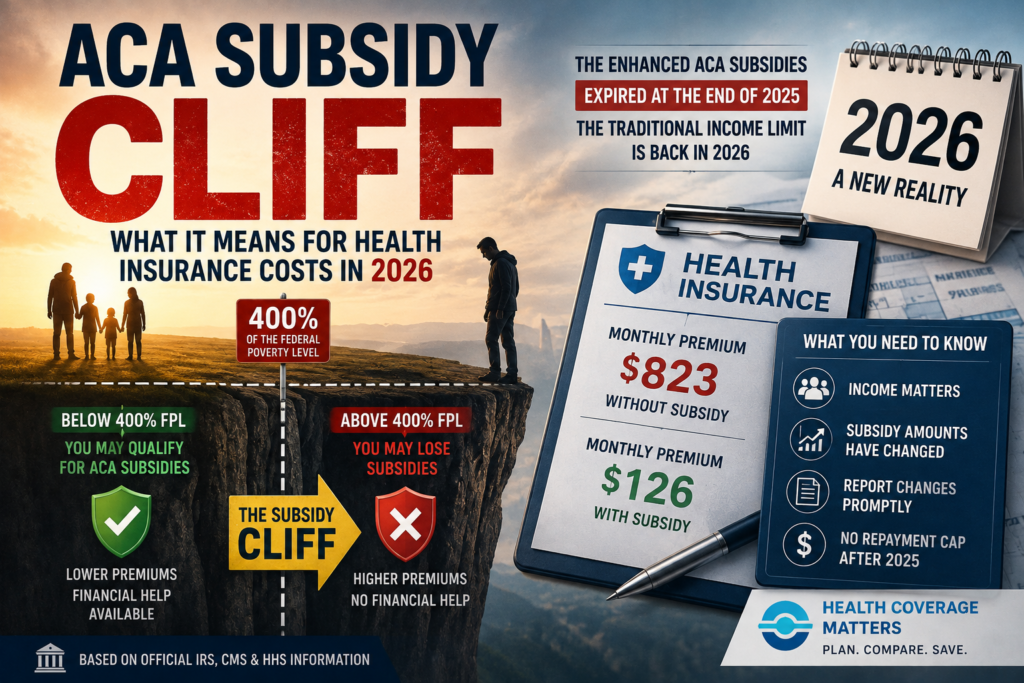
The term “subsidy cliff” refers to the sharp change in eligibility for the federal Premium Tax Credit when household income crosses the applicable income limit. For 2026, the temporary expansion that had removed the 400% federal poverty guideline ceiling is no longer in effect. As a result, households with income above 400% of the applicable federal poverty guideline generally cannot receive the federal Premium Tax Credit.
This does not mean that ACA financial assistance disappeared altogether. The Premium Tax Credit itself continues. What changed is the generosity and eligibility structure compared with the enhanced rules that applied from 2021 through 2025. CMS says financial help remains available to most Marketplace enrollees in 2026, but some higher-income consumers no longer qualify and many consumers are paying more after tax credits than they did previously. That distinction is critical to understanding the ACA subsidy cliff in 2026.
What Is the ACA Subsidy Cliff?
The ACA Premium Tax Credit is a refundable federal tax credit designed to make Marketplace health insurance more affordable for eligible individuals and families. The amount of the credit is generally based on household income, family size and other eligibility factors. Consumers can have the credit paid in advance to their insurance company, reducing the monthly premium they pay themselves.
Under the enhanced rules introduced during the COVID-19 period, the traditional upper income limit was temporarily removed. That meant households above 400% of the federal poverty level could still qualify for a Premium Tax Credit if they otherwise met the requirements. That temporary expansion lasted through tax year 2025.
For 2026, the standard ACA structure returned. Under the current rules, household income generally must be at least 100% and no more than 400% of the applicable federal poverty guideline for the household size, subject to specific eligibility rules and exceptions. This creates the “cliff.”
A household just below the applicable income bracket may qualify for a tax credit, while a household just above it can lose eligibility for the federal credit altogether. The financial difference can therefore be much larger than the relatively small change in income might suggest.
Why Did the ACA Subsidy Cliff Return in 2026?
The current situation goes back to two temporary laws. The American Rescue Plan Act of 2021 temporarily expanded the Premium Tax Credit for 2021 and 2022. Among other changes, it eliminated the rule that prevented households above 400% of the federal poverty line from receiving the credit.
The Inflation Reduction Act of 2022 extended those enhanced Premium Tax Credit provisions through 2025. The temporary expansion was therefore scheduled to expire at the end of 2025. The Congressional Research Service explains that the enhanced Premium Tax Credit provisions increased both eligibility and subsidy amounts compared with the original ACA rules. The sunset date for the enhanced provisions was January 1, 2026.
CMS also prepared for the expiration in its 2026 Marketplace rules and consumer guidance. The agency states that the enhanced subsidies expired at the end of 2025 and that 2026 Marketplace coverage would return to the pre-2021 calculation rules.
2027 Social Security COLA Forecast: Latest Estimate, Medicare Offset & What Retirees Can Expect
Social Security Payment August 2026: How Much Will You Receive This Week?
What Happens to ACA Subsidies in 2026?
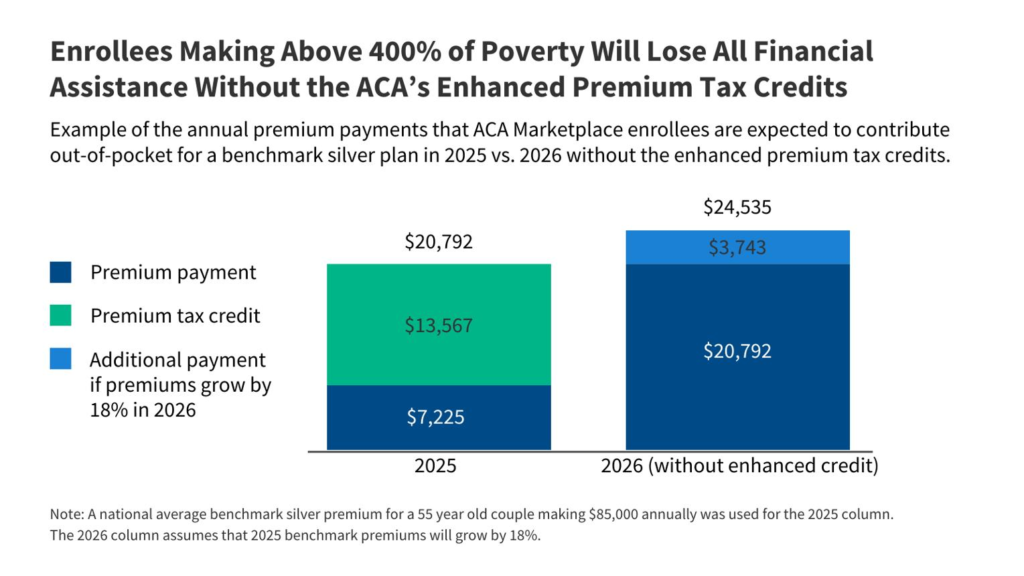
The most important point is that ACA subsidies did not disappear in 2026. The regular Premium Tax Credit remains available to eligible Marketplace consumers. However, the enhanced version that provided larger credits and extended eligibility to some higher-income households is no longer available under the expired provisions.
CMS says that for 2026, most Marketplace enrollees can still receive financial assistance, but some higher-income consumers will no longer qualify. The agency also warns that some people who previously had $0 premiums will have to pay a premium in 2026 because the tax credits no longer fully cover their plans.
This is why describing 2026 as the end of ACA subsidies would be inaccurate. The more precise description is that the enhanced ACA subsidies expired, restoring the traditional income ceiling and changing how much assistance some households receive.
Who Is Most Affected by the ACA Subsidy Cliff?
The households most directly exposed to the cliff are those whose income is around or above 400% of the applicable federal poverty guideline. For 2026 Marketplace eligibility, the IRS says the applicable federal poverty guidelines are based on the most recently published guidelines on the first day of the annual Open Enrollment Period. Because 2026 Open Enrollment began on November 1, 2025, the relevant guidelines for determining 2026 Premium Tax Credit eligibility are the guidelines applicable at that time.
The 2025 HHS poverty guidelines for the 48 contiguous states and the District of Columbia were:
| Household size | 2025 poverty guideline | 400% of guideline |
|---|---|---|
| 1 | $15,650 | $62,600 |
| 2 | $21,150 | $84,600 |
| 3 | $26,650 | $106,600 |
| 4 | $32,150 | $128,600 |
| 5 | $37,650 | $150,600 |
| 6 | $43,150 | $172,600 |
| 7 | $48,650 | $194,600 |
| 8 | $54,150 | $216,600 |
These calculations use the 2025 HHS poverty guidelines and the 400% threshold relevant to the 2026 Marketplace coverage year. Alaska and Hawaii have separate federal poverty guidelines. The important point is that these are not universal subsidy amounts. Crossing 400% of the guideline does not mean everyone below that level receives the same credit. The Premium Tax Credit is calculated based on household circumstances and the applicable Marketplace plan.
Why the “Cliff” Can Be So Significant
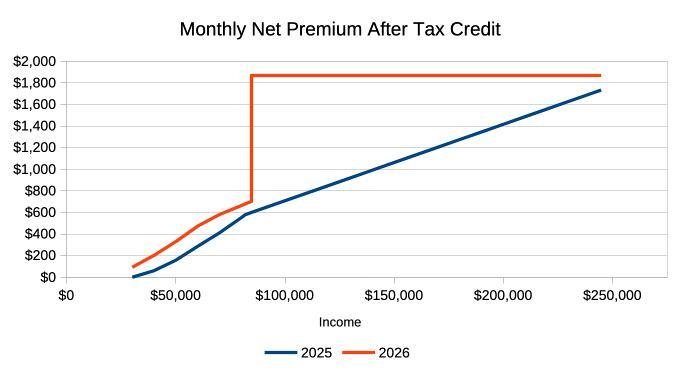
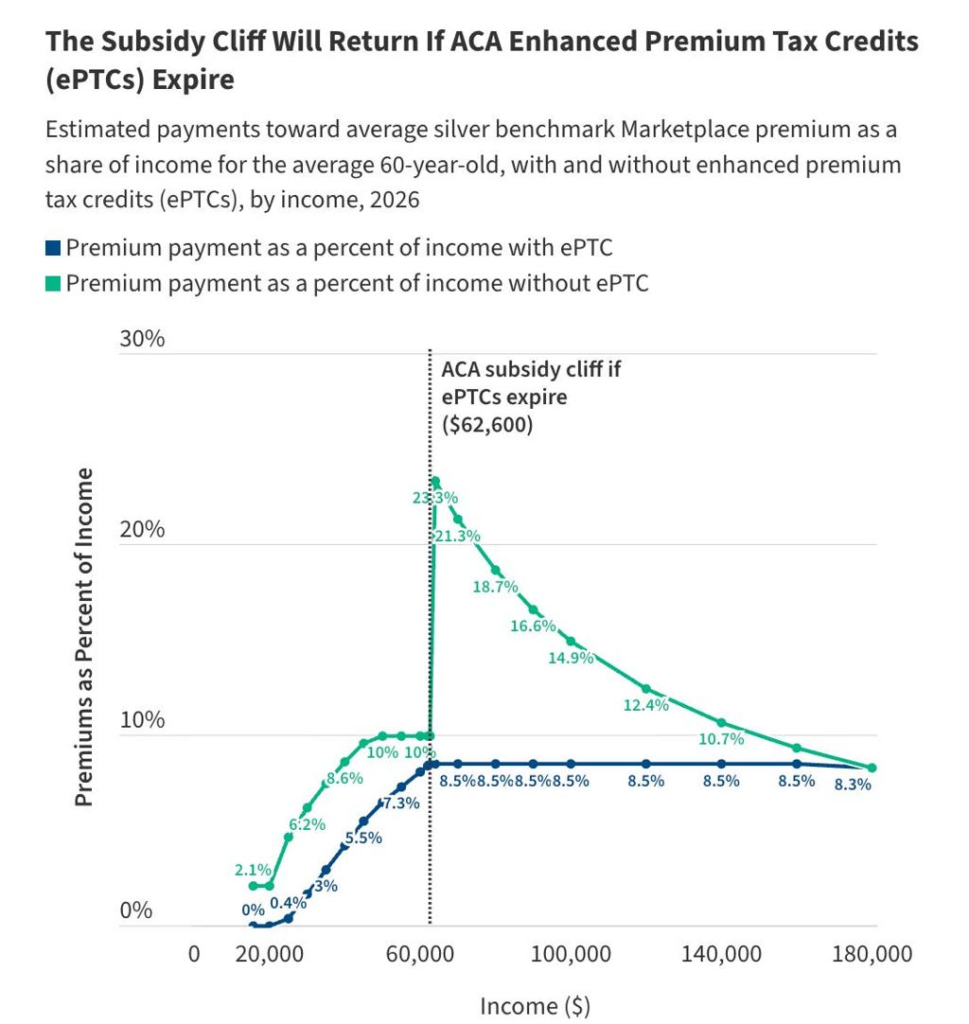
The word “cliff” describes the structure of the eligibility rule. Suppose two households are otherwise similar, but one has household income below the applicable 400% threshold while the other has income above it. Under the enhanced rules that applied through 2025, the higher-income household could still potentially qualify for the Premium Tax Credit.
In 2026, that is generally no longer the case. The IRS states that taxpayers with household income above 400% of the federal poverty line generally are not allowed the Premium Tax Credit under the standard rules. That means a relatively modest increase in annual household income can potentially produce a much larger increase in the amount a family must pay toward Marketplace coverage. This is the central reason people use the term ACA subsidy cliff.
How the Subsidy Cliff Raises Marketplace Premium Costs
The effect of the subsidy cliff is not limited to the advertised premium of an insurance plan. Marketplace consumers need to consider the relationship between the premium, the tax credit and the plan they select. The Premium Tax Credit reduces the amount an eligible household pays for Marketplace coverage. When the credit becomes smaller or disappears, the household’s net premium can rise even if the underlying insurance plan has not changed dramatically.
CMS projected that the average premium after tax credits for the lowest-cost HealthCare.gov plan would be $50 per month in 2026 for eligible enrollees, $13 more than in 2025. CMS also projected that tax credits would cover 91% of the lowest-cost plan premium on average for eligible HealthCare.gov consumers. Those averages do not describe every household. Someone affected by the subsidy cliff can face a very different premium because the household may no longer qualify for the federal tax credit at all.
The Difference Between Losing the Enhanced Subsidy and Losing All Financial Help
This is another area where headlines can cause confusion. There are two different situations:
First: A household remains eligible for the regular Premium Tax Credit but receives a smaller subsidy than it would have received under the enhanced rules.
Second: A household’s income is above the traditional 4 herefore generally does not qualify for the federal Premium Tax Credit.
The first situation can mean higher monthly premiums. The second can mean the household must pay the full Marketplace premium without the federal Premium Tax Credit. CMS specifically states that financial help remains available for most Marketplace enrollees in 2026, while some higher-income consumers will no longer qualify.
$2000 Stimulus Payment 2026 Fact-Check: Is It Really Coming?
Why Income Planning Matters More in 2026
The return of the 400% ceiling makes projected household income especially important for some Marketplace consumers. The Marketplace calculates advance Premium Tax Credit payments using information such as household composition and projected household income. The final credit is ultimately reconciled with the taxpayer’s actual circumstances when the tax return is filed.
Income can change during a year. A household may receive a bonus, realize capital gains, receive certain taxable distributions, get married, divorce, have a child or experience another change that affects its tax family. The IRS specifically advises taxpayers receiving advance Premium Tax Credit payments to report changes that can affect the amount of their credit. For households close to the 400% threshold, those changes can be particularly important.
Repaying Excess Advance Premium Tax Credits in 2026
There is another important change in 2026 that Marketplace consumers should understand. Before 2026, repayment of excess advance Premium Tax Credit payments could be subject to repayment caps for taxpayers below 400% of the federal poverty line. The IRS says that there is no repayment cap for tax years after 2025. If a taxpayer receives more advance Premium Tax Credit than they are ultimately entitled to, the full excess generally must be repaid for tax years after 2025.
This makes accurate income estimates even more important. For example, if a consumer’s Marketplace application is based on an income estimate that turns out to be significantly different from actual annual income, the final Premium Tax Credit may be different from the amount paid in advance. The IRS recommends reporting changes in circumstances promptly so that advance payments can be adjusted.
Does the ACA Subsidy Cliff Affect Everyone?
No. The impact varies considerably. People with lower household incomes who remain within the regular Premium Tax Credit eligibility rules can continue to receive assistance. Some households may qualify for Medicaid or CHIP instead, depending on their circumstances and state rules. Others may have access to affordable employer-sponsored coverage, which can affect Premium Tax Credit eligibility.
The IRS lists several conditions that must be satisfied before a taxpayer can claim the Premium Tax Credit, including Marketplace enrollment and not being eligible for certain affordable employer or government coverage. Therefore, income alone does not determine eligibility.
What Does the ACA Subsidy Cliff Mean for 2026 Marketplace Enrollment?
The expiration of enhanced subsidies was expected to affect Marketplace enrollment. CMS explicitly considered the potential effect of enhanced subsidy expiration when setting its 2026 Marketplace assumptions and fees. The agency noted that the enhanced subsidies had increased Marketplace enrollment by millions and that their expiration could affect projected enrollment.
The Congressional Research Service similarly reported that expiration of the enhanced Premium Tax Credit would reduce subsidized exchange enrollment and increase the uninsured rate relative to a scenario in which the enhanced credits were extended. This is one reason the subsidy cliff is more than a tax-policy issue. It can influence whether people decide to keep Marketplace coverage, switch plans or go without coverage.
Why Some Families May Still Find Affordable ACA Plans
The return of the traditional subsidy structure does not mean every Marketplace plan is unaffordable. CMS reported that eligible HealthCare.gov consumers continue to have access to low-premium plans after tax credits in 2026. The agency projected that the average lowest-cost plan premium after tax credits would be $50 per month for eligible enrollees.
However, consumers should not use the national average as a prediction of their own cost. Premiums vary by location, age, household circumstances, plan selection and other factors. The impact of the subsidy cliff is particularly significant for people who are above the 400% threshold because they may not receive the federal Premium Tax Credit at all.
Before purchasing Marketplace insurance Consumer should pay attention to several Factors:
1. Household income
The projected annual income used on a Marketplace application matters because the Premium Tax Credit is based partly on household income.
2. Family size
The applicable poverty guideline changes with household size, so the 400% threshold is different for a single person and a larger family.
3. Changes during the year
Marriage, divorce, a new child, income changes and changes in eligibility for employer or government coverage can affect the credit.
4. Advance payments
Consumers receiving advance Premium Tax Credit payments should understand that the amount is an estimate that is reconciled against the final credit on the tax return.
5. Tax filing
Consumers receiving advance payments must reconcile those payments with the actual Premium Tax Credit using the required tax forms.
Why the ACA Subsidy Cliff Matters in 2026
The return of the subsidy cliff creates a very different environment from the one consumers experienced between 2021 and 2025. The enhanced credits were designed as temporary measures. They increased the size of subsidies and removed the traditional 400% income ceiling. Those provisions expired at the end of 2025.
In 2026, the standard ACA Premium Tax Credit remains, but households above 400% of the applicable federal poverty guideline generally no longer qualify for the federal credit. That creates a sharp dividing line for some middle- and higher-income households. It also means that a family whose income changes during the year may need to pay closer attention to its Marketplace information and tax situation.
The ACA subsidy cliff in 2026 is the result of the expiration of the temporary enhanced Premium Tax Credit provisions that were introduced during the pandemic and extended through 2025. The ACA did not eliminate its Premium Tax Credit in 2026. Instead, the federal government returned to the traditional income framework under which households generally must have income between 100% and 400% of the applicable federal poverty guideline to qualify.
For people below the 400% threshold, financial assistance can still be available, although the subsidy may be smaller than it was under the enhanced rules. For households above the threshold, the change can be much more dramatic because the federal Premium Tax Credit is generally unavailable. At the same time, the IRS has removed the repayment cap on excess advance Premium Tax Credit payments for tax years after 2025, making accurate income estimates and timely reporting of changes more important.
FAQ’s About the ACA Subsidy Cliff 2026
What is the ACA subsidy cliff?
The ACA subsidy cliff is the sharp change in Premium Tax Credit eligibility that can occur when household income crosses the 400% federal poverty guideline threshold. For 2026, the temporary removal of this income ceiling has expired.
Did ACA subsidies end in 2026?
No. The regular Premium Tax Credit continues in 2026 for eligible Marketplace consumers. What expired was the temporary enhanced subsidy structure that had expanded eligibility and increased subsidy amounts.
What is the 400% FPL limit for a family of four?
For 2026 Marketplace coverage, using the applicable 2025 poverty guideline, 400% for a family of four is $128,600 in the 48 contiguous states and Washington, D.C.
What happens if my income goes above 400% of the poverty guideline?
Under the standard 2026 rules, a household with income above 400% of the applicable federal poverty guideline generally cannot receive the federal Premium Tax Credit.
Can I still get an ACA subsidy if my income is below 400% FPL?
Potentially, yes. Meeting the income requirement is only one part of eligibility. Other requirements also apply, including Marketplace enrollment and rules concerning employer-sponsored and government coverage.
What happens if my income changes after I enroll?
A change in income can change the amount of Premium Tax Credit you are ultimately eligible to receive. The IRS recommends reporting changes to the Marketplace so advance payments can be adjusted.
Is there a repayment cap on excess ACA subsidies in 2026?
No. The IRS says there is no repayment cap for tax years after 2025. If advance Premium Tax Credit payments exceed the credit a taxpayer is ultimately allowed, the excess generally must be repaid.
Why is the ACA subsidy cliff important in 2026?
It is important because households near the 400% income threshold can experience a substantial change in their federal Premium Tax Credit when their income crosses the applicable limit. It can therefore have a significant effect on their net Marketplace premium.
Official Sources
- IRS — Premium Tax Credit Questions and Answers
- IRS — Premium Tax Credit Overview
- IRS — Reconciling Advance Premium Tax Credit Payments
- HHS/ASPE — 2025 Poverty Guidelines
- CMS — 2026 Marketplace Plans and Prices
- CMS — 2026 Enhanced Premium Tax Credit Guidance
- Congressional Research Service — Enhanced Premium Tax Credit and 2026