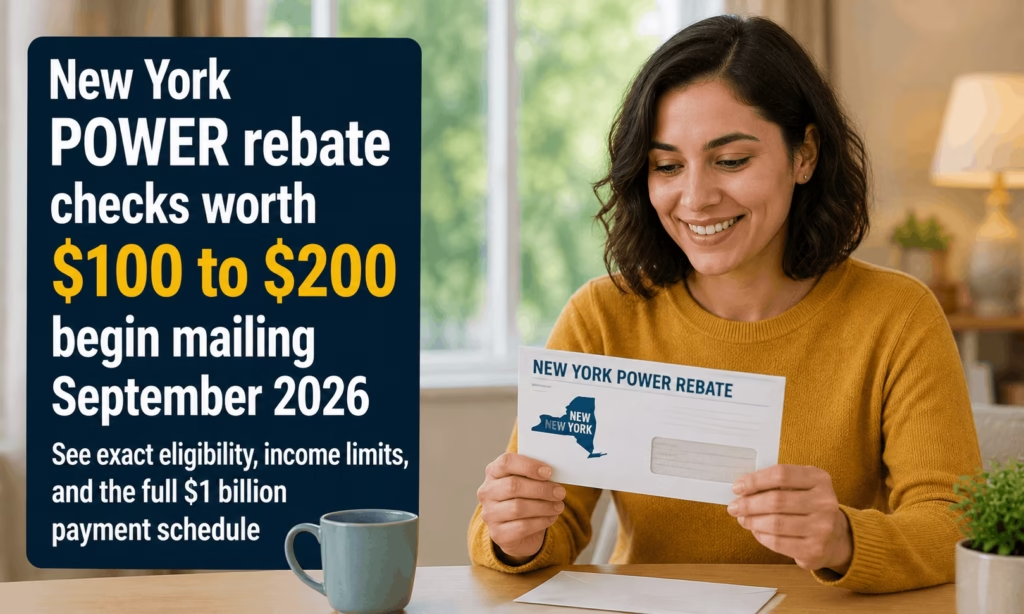
New York POWER Rebate Checks: Mailboxes across New York State are about to get a lot more interesting. Starting this month and continuing through December 2026, more than 8 million New Yorkers will receive a one-time POWER rebate check, part of a $1 billion state relief program officially named the Protecting Our Wallets Energy Rebate. Governor Kathy Hochul confirmed the rollout is now underway, with payments ranging from $100 to $200 depending on income and filing status, issued automatically based on each resident’s 2024 state tax return, no application required.
The timing hasn’t gone unnoticed politically. These checks start arriving in September and continue through October, landing squarely before Election Day, a pattern State Senator Dean Murray, a Suffolk County Republican, pointed to directly, arguing that rebate programs timed for election season are rarely a coincidence. Hochul’s office has pushed back on that framing, describing the POWER program as a direct response to utility rates the administration says have climbed due to federal energy policy. Whatever the political motivation, the money itself is real, budgeted, and already moving. We’ll be updating this article monthly as New York State confirms further POWER rebate mailing waves.

Latest Update: New York POWER Rebate Checks for September 2026
| Detail | Information |
|---|---|
| Official program name | Protecting Our Wallets Energy Rebate (POWER) |
| Total program funding | $1 billion |
| Estimated New Yorkers benefiting | Over 8 million (some reports cite 8.2 to 8.5 million) |
| Mailing window | September 2026 through December 2026 |
| Established under | 2026-27 New York State Budget, signed late May 2026 |
| Legislative bill reference | S9009C/A10009C (“big ugly” revenue bill) |
| Application required | No; payments issued automatically |
| Basis for eligibility | 2024 New York State Resident Income Tax Return |
| Tax treatment of the rebate | Exempt from state and local income tax |
| Administering agency | New York State Department of Taxation and Finance |
$200 Extra Social Security Payment: When Is It Being Approved, and Who Can Get It?
VA Benefits Lawyer: For Which Claims Do You Need One, and How Much Can They Cost?
Tax Extension Deadline October 15: What Filing Late Actually Costs You
New Canada Prescription Drug Rules October 2026: What Every Patient and Pharmacy Needs to Know
How Much Will Your POWER Rebate Check Actually Be?
The exact dollar amount depends entirely on your 2024 filing status and income, with three distinct payment tiers built into the program.
| Filing Status | 2024 Income Range | Rebate Amount |
|---|---|---|
| Joint filers / surviving spouses | Under $150,000 | $200 |
| Joint filers / surviving spouses | $150,000 to $300,000 | $150 |
| Single filers / heads of household | $150,000 or less | $100 |
Households at the lower end of each income bracket receive the larger payment, a design intentionally structured so the relief is weighted toward moderate-income families rather than distributed as a flat, universal amount regardless of earnings.
Who Actually Qualifies for a POWER Rebate Check?
Eligibility is determined entirely by your 2024 New York State Resident Income Tax Return, and the criteria are straightforward:
- You filed a timely New York State Resident Income Tax Return for the 2024 tax year.
- You were a full-year resident of New York State during 2024.
- Your reported income falls within the qualifying thresholds for your filing status.
- You were not claimed as a dependent on another taxpayer’s return for that tax year.
There’s no separate application, no online form, and no portal to register for this payment. The New York State Department of Taxation and Finance determines eligibility automatically using the tax return data already on file, then mails a physical check directly to the address associated with that return.
Why New York Created the POWER Program
Understanding the reasoning behind this specific rebate helps explain both its design and its timing. Governor Hochul’s office has framed the POWER program as a direct response to rising utility costs, with a spokesperson stating the rebate checks are meant to provide relief for “overburdened ratepayers who are dealing with higher prices across the board” tied to federal energy policy decisions. Assembly Speaker Carl Heastie echoed that framing during budget negotiations, describing the program as part of the Assembly Majority’s commitment to putting money back into the pockets of working New Yorkers amid a broader cost-of-living squeeze.
The program emerged from negotiations between the Legislature and the Governor’s office as part of the 2026-27 state budget, a $277 billion spending package signed into law in late May 2026. It was specifically written into the budget’s revenue bill, sometimes referred to informally in Albany as the “big ugly,” a nickname for the large, consolidated legislation that finalizes major fiscal policy changes alongside the core budget appropriations.
OAS Payment Increase September 2026: Confirmed Amounts, Payment Date, and the Annual GIS Reset !
Ohio SNAP Food Ban starts October 1, 2026: What’s Banned, Court Update & Rules
The Political Debate Behind the Rebate’s Timing
Not every New York lawmaker views this program the same way, and it’s worth presenting both sides of that debate fairly. Critics, including Republican State Senator Pam Helming, have argued the POWER rebate treats a symptom rather than the underlying cause, contending the payments don’t address structural problems within New York’s energy sector that are driving rates higher in the first place. Senator Dean Murray raised a related concern about timing specifically, noting that rebate programs distributed during election season tend to arrive suspiciously close to voting day, a pattern he described as a near-certainty whenever this kind of payment coincides with a fall election cycle.
Supporters of the program counter that regardless of timing, the underlying relief is genuine and needed, pointing to the same underlying pressure that’s driven several other 2026 state relief efforts, including New York’s separate $400 Inflation Refund Checks program and adjustments to the STAR property tax credit. Whether the timing reflects political strategy or simply the normal pace of state budget implementation, the $1 billion in funding is real and already being distributed as scheduled.
How the POWER Rebate Differs From New York’s Other 2026 Relief Programs
New York residents may find themselves eligible for more than one relief payment this year, and keeping these programs straight matters since they have entirely different eligibility rules, funding sources, and purposes.
| Program | Purpose | Payment Range | Basis |
|---|---|---|---|
| POWER Rebate | Offset rising utility/energy costs | $100–$200 | 2024 state income tax return |
| $400 Inflation Refund Checks | General inflation relief | $150–$400 | 2023 state income tax return |
| STAR Credit | Property tax relief for homeowners | Varies by district and income | School tax due dates by district |
| HEAP | Home energy assistance for lower-income households | Varies by household size and income | Seasonal application-based program |
A key distinction: POWER and the Inflation Refund Checks are both automatic, no-application rebates tied to different tax years, while STAR and HEAP each have their own separate eligibility structures, and HEAP specifically requires an application during its seasonal enrollment window rather than being issued automatically.
How to Apply for a POWER Rebate Check
Since the program requires no application, the practical steps for residents look different than a typical benefit program.
- Confirm you filed a timely 2024 New York State Resident Income Tax Return. If you haven’t filed, you generally won’t be included in this automatic distribution.
- Verify your address on file with the Department of Taxation and Finance is current, since checks are mailed physically to the address associated with your 2024 return.
- Check your income against the qualifying thresholds for your filing status to estimate whether you’ll receive $100, $150, or $200.
- Watch your mail between September and December 2026, since the state is distributing checks in waves rather than all at once.
- Contact the Department of Taxation and Finance directly if you believe you qualify but haven’t received a check by the end of the distribution window, rather than assuming you’ve been excluded.
Processing Time: When Will Your Specific Check Arrive?
New York hasn’t published a strict, address-by-address delivery schedule, and checks are being mailed in waves across the four-month window from September through December 2026 rather than all at once. Based on how the state has structured similar automatic rebate programs in the past, including the $400 Inflation Refund Checks, distribution generally follows a rolling batch pattern rather than a fixed, predictable date tied to any specific factor like ZIP code or last name. Residents shouldn’t be concerned if a check arrives later in the window, since the full distribution period runs a full four months by design.
What This Means for Your Taxes
One detail worth highlighting clearly: the POWER rebate is exempt from both state and local income tax, according to the language written directly into the budget legislation. This means the $100, $150, or $200 you receive is not taxable income on your New York State return, and you won’t need to report it as additional income when filing your next state tax return. This mirrors how New York structured its earlier Inflation Refund Checks program as well.
Payment Schedule: What “September Through December” Actually Means
Because this is a one-time rebate rather than a recurring monthly benefit, there’s no ongoing “payment schedule” to track beyond the initial four-month distribution window. Once your check arrives, that’s the full extent of the POWER program benefit for your household, there’s no follow-up payment or second installment planned under the current program structure. This distinguishes POWER from ongoing benefit programs like STAR, which recipients continue receiving in future years as long as they remain eligible.
$400 Inflation Refund Checks 2026: New York’s Real Program, Fact-Checked
Stimulus Check 2026: Fact-Checking Every Viral Payment Claim (Tracker)
Social Security SSI Payment Date September 2026 Confirmed by SSA- Check Full Schedule here!
A History of New York Utility Relief: This Isn’t the State’s First Attempt
The POWER program didn’t emerge out of nowhere. New York has a documented track record of stepping in with one-time utility relief when energy costs spike, and looking at that history helps explain why this approach felt like a natural next step for Albany. Back in February 2024, Governor Hochul announced a $200 million energy bill credit adopted by the New York State Public Service Commission, providing a one-time discount to more than 8 million directly metered electric and gas customers, part of a broader $1.4 billion in total utility assistance made available that year. The Public Utility Law Project, a consumer advocacy organization, praised that earlier effort at the time as an important step toward addressing energy affordability, while also noting the need for continued, longer-term solutions beyond one-time credits.
The POWER program essentially scales up that same basic approach considerably, five times the funding of the 2024 credit, moving from a bill-credit mechanism administered through utility companies to a direct-mail rebate check issued straight from the state tax department. This shift in mechanism matters practically: rather than seeing a smaller credit applied automatically to a utility bill, POWER recipients get a physical check they can use however they choose, whether that’s actually paying down an energy bill or covering any other household expense.
Regional Impact: Where the $1 Billion Is Going
Local news coverage across New York has emphasized that this rebate reaches every corner of the state, not just New York City or a handful of large metro areas. Reporting from Rochester-area outlets specifically noted that a substantial share of local taxpayers are expected to qualify, with roughly 8.2 million New Yorkers statewide falling within the program’s income thresholds. Because eligibility is based purely on 2024 income and filing status rather than geography, the distribution naturally spreads across upstate communities, Long Island, the Hudson Valley, and all five boroughs of New York City in roughly the same proportion as the state’s overall income distribution, rather than concentrating relief in any single region.
This broad geographic reach is part of why the program carries such a large total price tag relative to some of New York’s more narrowly targeted relief efforts. Programs like HEAP specifically target lower-income households already struggling to heat their homes, while POWER’s income thresholds, reaching up to $300,000 for joint filers, extend the benefit considerably further up the income scale, capturing a meaningfully broader slice of New York’s tax-filing population than most of the state’s other targeted relief programs.
Protecting Yourself From POWER Rebate Scams
Whenever New York rolls out a large, automatic payment program like this, scammers reliably follow close behind, and it’s worth understanding the warning signs specific to this rebate. The genuine POWER program requires no application, no phone call, and no online form, meaning any text message, email, or phone call asking you to “confirm your information” or “verify your bank details” to receive your POWER check should be treated as a scam attempt. The New York State Department of Taxation and Finance has previously issued public warnings about fraudulent activity tied to its Inflation Refund Checks program, and the same scam patterns are likely to resurface around POWER given the similarities between the two rebates.
A few practical safeguards apply here: the state will never ask for payment to “release” a rebate check, will never request your Social Security number over an unsolicited call or text, and will only ever mail the actual check to the address on file with your 2024 tax return rather than depositing it electronically without your prior banking information already on record. If you receive any communication asking you to click a link or provide personal information to claim your POWER rebate, do not respond, and consider reporting it directly to the Department of Taxation and Finance’s fraud reporting channel.
Official Resources for the POWER Rebate Program
Always verify your specific eligibility and payment status directly through these official New York State channels.
| Resource | Purpose | Official Link |
|---|---|---|
| New York State Department of Taxation and Finance | Official POWER program information and updates | tax.ny.gov |
| Check your refund/rebate status | Track your POWER rebate or other state payments | tax.ny.gov (refund status tool) |
| New York State Budget documents | Full text of the 2026-27 budget and POWER provisions | budget.ny.gov |
| Governor’s Press Office | Official POWER program announcements | governor.ny.gov/news |
| File or amend a New York State tax return | Confirm your 2024 return is filed and accurate | tax.ny.gov (e-file services) |
| Report scams related to state rebates | Protect yourself from POWER-related fraud | tax.ny.gov (report fraud) |
Conclusion
The New York POWER rebate checks landing in mailboxes this fall represent a genuinely real, fully funded piece of state relief, $1 billion spread across more than 8 million residents, tied directly to 2024 tax return data and requiring no application whatsoever. Whether you view the September-to-December timing as a coincidence of budget scheduling or a calculated election-season move, the practical reality for eligible New Yorkers is the same: if you filed a timely 2024 state return, met the income thresholds, and weren’t claimed as a dependent, a check worth $100 to $200 is either already on its way or will be within the coming months. Keep your mailing address current with the Department of Taxation and Finance, watch your mailbox through December, and remember that whatever amount arrives, it’s yours tax-free.
FAQs
What is the New York POWER rebate check?
POWER stands for Protecting Our Wallets Energy Rebate, a one-time $1 billion New York State program providing $100 to $200 checks to eligible residents to help offset rising utility and energy costs, funded through the 2026-27 state budget.
Do I need to apply for the POWER rebate check?
No. Payments are issued automatically by the New York State Department of Taxation and Finance based on your 2024 New York State Resident Income Tax Return. There is no separate application or portal to register.
How much will my POWER rebate check be?
Joint filers earning under $150,000 receive $200; joint filers earning between $150,000 and $300,000 receive $150; single filers and heads of household earning $150,000 or less receive $100.
When will POWER rebate checks arrive?
Checks are being mailed in waves between September 2026 and December 2026. New York has not published an exact date for individual households, so residents should watch their mail throughout the full four-month window.
Is the POWER rebate check taxable?
No. The rebate is explicitly exempt from both New York State and local income tax under the budget legislation that created the program.
Is the POWER rebate the same as New York’s $400 Inflation Refund Check?
No. These are two separate programs. POWER is based on your 2024 tax return and funds utility cost relief, while the Inflation Refund Checks were based on your 2023 tax return and addressed general inflation relief, with different payment amounts and different mailing timelines.
Can I receive a POWER rebate check if I was claimed as a dependent in 2024?
No. Being claimed as a dependent on another taxpayer’s 2024 return disqualifies you from receiving a POWER rebate check under the program’s eligibility rules.
Why is New York sending these checks right before Election Day?
Governor Hochul’s office attributes the timing to when the funding became available for distribution following the May 2026 budget signing. Critics, including some Republican state senators, have suggested the September-October timing is politically motivated given the proximity to the fall election.
Trump Accounts Dell $250 Grant: Did Deposits Actually Start Monday? Here’s Who’s Actually Been Paid
2027 Social Security COLA Forecast: Latest 3.6% Estimate and How Much Retirees Could Get
$2000 Stimulus Payment September 2026 Fact-Check: Is It Really Coming?