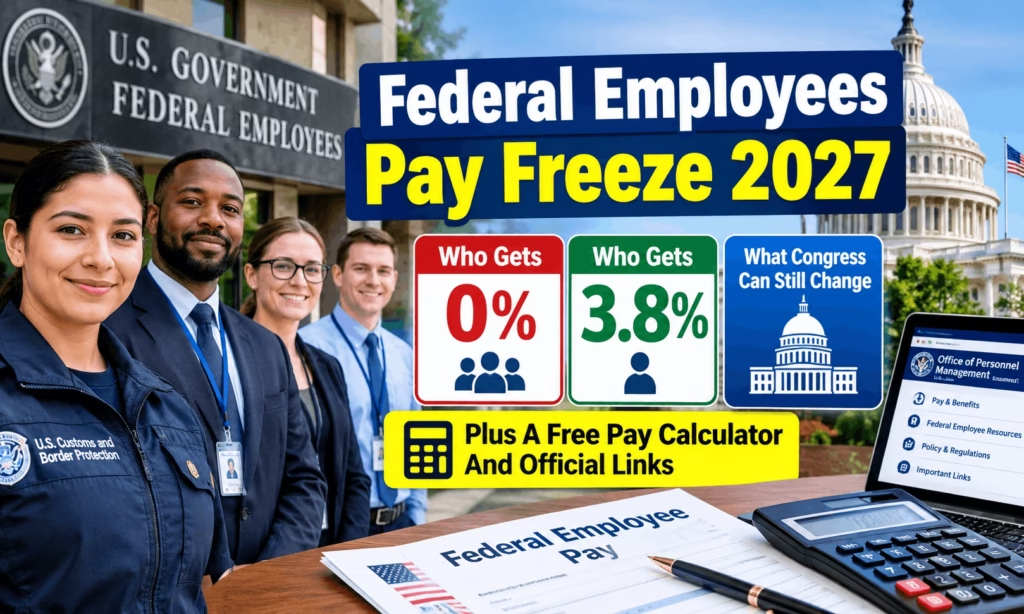
Federal Employees Pay Freeze 2027: Most civilian federal workers will open their first January 2027 paycheck and find no raise. On August 26, 2026, President Trump sent Congress an alternative pay plan that holds both base pay and locality pay at 2026 levels for most civilian employees. In the letter he wrote that base and locality pay “will not change from the 2026 rates.” The federal employees pay freeze 2027 covers roughly two million people on the General Schedule and related pay systems. It follows a 1% raise in 2026, and it comes while living costs are still climbing. Federal law enforcement officers are the main exception, with a planned 3.8% increase, and military members get larger raises. This article walks through the dates, the money, the politics and a calculator you can use. We’ll be updating this article monthly.
The freeze is a proposal, not yet a signed order. Presidents normally lock in the alternative plan by executive order in December, and Congress can still change the number. Last week, members of the Federal Workforce Caucus and union leaders said at a press conference that they want a 4.1% raise under the FAIR Act. They told reporters that after the midterm elections Congress will have only a few weeks to act before January. So far, the Republican-led appropriations committees have shown no sign of moving off the freeze. If you work for the government, the next 90 days matter. Here is where the 2027 federal pay freeze stands today, what could still change it, and what it means for your paycheck, your pension and your plans.
Federal Employees Pay Freeze 2027 Key Highlights
| Item | Latest detail |
|---|---|
| Proposal | 0% base pay and 0% locality pay for most civilian employees |
| Letter date | August 26, 2026 |
| Planned effective date | First pay period of January 2027 |
| Law enforcement raise | 3.8% for eligible positions, as determined by OPM |
| Other uniformed services | 3.6% planned |
| Active military | 5% to 7% depending on experience |
| Democratic counter-proposal | FAIR Act, 4.1% average raise |
| Formula raise if no plan was sent | About 3.1% across the board plus locality increases averaging 20.6% |
| Final decision | Usually a presidential executive order in December |
| 2026 raise for comparison | 1% for most civilian employees |
Latest Update: What Happened to the 2027 Federal Pay Raise
The timeline has moved quickly this year. In the spring, the White House budget request left out any civilian raise while recommending large increases for service members. Months earlier, the House Appropriations Committee approved a general government spending bill with no mention of a raise, and its Republican majority voted down a Democratic amendment for 3.1%. When Congress writes no number, the president’s recommendation takes effect by default, which is why that vote drew so much attention.
Then came the formal step. The alternative pay plan letter arrived on Wednesday, August 26, ahead of the statutory deadline of August 31 under the Federal Employees Pay Comparability Act, usually shortened to FEPCA. Reports at the time described it as a quiet transmission, but its effect is large. It replaces the automatic formula that would otherwise have raised pay in January.
The newest development is political. Democrats on the Federal Workforce Caucus asked congressional leaders to reject the freeze. Some of them also wrote to the president asking for an across-the-board raise. Even if the FAIR Act stalls, they said they want at least 3.8% for civilians, matching what law enforcement is set to receive. Their argument is simple. If recruitment and retention justify a raise for one group, the same worry applies elsewhere in government.
Is the 2027 Federal Pay Freeze Final?
Not yet, but it is the likeliest outcome. Three things have to line up for a different result.
First, Congress would need to pass legislation that sets a specific pay adjustment. The usual vehicle is the spending bill covering general government. Second, the president would have to sign it. Third, the timing has to work out. With elections on the calendar and a short post-election session, floor time is limited.
Federal pay history gives both sides something to point to. In most years the alternative pay plan becomes the final raise. There is also a precedent for Congress overriding a freeze. Federal News Network has noted a past case in which a legislated raise overrode a freeze the president had announced only months earlier, and the increase was paid retroactively to the first full pay period of January. So the freeze is not guaranteed, but it needs a legislative push that has not yet appeared.
Why Was a Federal Pay Freeze Proposed for 2027?
The legal background explains the headline. FEPCA sets a formula for General Schedule pay. Each year, base pay rises by a statutory amount tied to private sector wage growth, and locality pay is meant to close the gap between federal pay and local market pay. If the president does nothing, that formula applies automatically. If the president sends an alternative plan before September 1, the plan replaces the formula.
According to the letter, the formula would have produced a 3.1% across-the-board increase and locality pay increases averaging 20.6%. The administration said that setting the adjustment to zero will “maintain fiscal responsibility without harming the government’s ability to recruit and retain well qualified employees.” Employee groups disagree. They point out that a flat paycheck loses ground every month that prices rise, and that frozen pay makes government jobs less competitive against private employers.
Who Gets a Raise in 2027 and Who Does Not?
The plan is not a blanket freeze for every federal paycheck. It splits the workforce into groups.
| Group | Planned 2027 adjustment |
|---|---|
| General Schedule employees (most) | 0% base, 0% locality |
| Other civilian pay systems covered by the plan | 0% |
| Eligible federal law enforcement | 3.8% |
| Active military members | 5% to 7% by experience |
| Other uniformed service members | 3.6% |
| Federal retirees | Separate COLA, see below |
The Office of Personnel Management will decide which law enforcement positions qualify for the 3.8% increase. If you work in a job that is near the line, such as a criminal investigator or a security role, watch OPM guidance closely. Agencies may also issue internal notices once the list is final.
Social Security COLA 2027 Medicare and Payment Changes in October
Social Security 2027 COLA Notices: When They Arrive and What They’ll Show
Federal Employees Pay Freeze 2027 Calculator
Use the calculator below to see what the freeze means for your own situation. Enter your current annual salary, choose a scenario, and add an inflation rate and your expected FERS service years. It shows the difference in annual pay, the cost per biweekly paycheck, the purchasing power you lose to inflation, and a rough effect on a FERS pension. Remember that the calculator is an estimate. Your agency payroll system, your locality area, your step increases and any special rates can change the exact numbers.
Federal Employees Pay Freeze 2027 Calculator
Estimate only. Actual pay depends on your agency, locality area, step and special rates. Check OPM for official tables.
How the Federal Pay Freeze Is Applied: No Application Needed
Many people search for how to apply when they read about a pay change. Here there is nothing to apply for. The adjustment, or lack of one, is applied by your agency’s payroll provider based on the official pay tables. You do not register, log in or file anything to receive a raise or to be placed under a freeze.
What you can do is check your own record. Look at your Standard Form 50, the personnel action that shows your grade, step, basic pay and locality, once the new year begins. Compare it with your last pay stub from December. If you are in a law enforcement role and expect the 3.8% increase, confirm with your human resources office that your position code is on the list OPM approves.
Processing Time for the 2027 Pay Table
Processing follows a predictable order. After the president signs an executive order, usually in December, OPM publishes the official pay tables. Agencies then load the rates and issue personnel actions. For most employees, the pay change takes effect in the first pay period of January. A freeze simply means the 2026 table stays in place.
If Congress changes the number late, expect some delay. Back pay has been used in the past, with new rates reaching paychecks a few pay periods after enactment and a lump sum covering the difference. If that happens, your payroll office will announce its own schedule. Employees paid through a shared service provider should watch for notices from that provider.
Payment Schedule for Federal Employees in 2027
Most federal employees are paid every two weeks, which gives 26 pay periods in a typical year. A raise would first show up in the paycheck for the first pay period of January 2027, which is normally paid in late January. Because of the lag between the end of a pay period and payday, a change that begins in the second week of January often appears in a deposit about two weeks later.
Under a freeze, your gross biweekly pay in January 2027 should match what you see now, except for step increases, promotions, changes in health premiums and tax withholding. Check the official OPM pay calendar and your agency’s payroll calendar for exact payday dates.
2026 vs 2027 Federal Pay: What Changes
| Category | 2026 | 2027 (proposed) |
|---|---|---|
| Most civilian employees | 1% | 0% |
| Locality pay | Unchanged from schedule | Frozen at 2026 rates |
| Law enforcement | Higher raise for eligible roles | 3.8% |
| Active military | Raise approved | 5% to 7% |
| Retiree COLA | Announced in October 2025 | Announced in October 2026 |
How the Pay Freeze Affects FERS and CSRS Pensions?
Pay and pensions are linked. Both FERS and CSRS annuities are calculated from your high-3 average salary, which is the highest average basic pay over any three consecutive years. A pay freeze can slow the growth of that average.
Here is a simple example. Say you plan to retire at the end of 2027 with 30 years of FERS service, and a base salary of $100,000. At 1% per year of service, your pension would be $30,000 a year. A 3.8% raise in the final year would lift your three-year average by about 1.27%, which adds roughly $380 a year to the pension. Under the freeze, you do not get that boost. The amount is modest for one year, but a series of freezes can add up over a long career.
The effect matters most for employees within a few years of retirement. Younger workers feel it as lost earning power rather than a pension change, since later raises can partly close the gap. TSP contributions are another channel. If your agency matches a percentage of salary, a flat salary means flat matching dollars.
Pay Freeze vs COLA
The freeze applies to active employees. Retirees receive a cost-of-living adjustment that is calculated automatically from consumer price data and does not depend on the president or Congress. The Social Security and federal retirement COLAs for 2027 are expected to be announced in October, after third-quarter inflation data are released. Early estimates in industry reporting point to a range of about 3.5% to 3.7%, but treat that as an estimate until the official figure arrives.
For households with both an active worker and a retiree, the gap can feel stark. One person’s income stays flat while the other’s rises. Plan around the official announcement, not around forecasts. FERS retirees also have special COLA rules that can make their adjustment smaller than the Social Security figure, so read the OPM notice when it is published.
Social Security’s Trump Bump-Fueled 2027 COLA Is Set to Make History 2 Different Ways
Social Security’s 2027 COLA Could Outpace This Year’s Raise — Here’s How Helpful It Really Is
What a Flat Paycheck Really Costs?
A freeze is called a zero percent change, but the real impact is negative. If prices rise by 3% over the year, a worker with a $90,000 salary loses about $2,700 of buying power compared with last year. Over several years, the effect compounds. Add health insurance premium changes and higher costs for housing, groceries and childcare, and the squeeze is clear.
That is why the calculator asks for an inflation rate. Try one scenario at 0% and another at 3.8% or 4.1%. The difference per paycheck may look small, but over 26 pay periods it adds up to a number that can influence decisions about savings, debt payments and job moves.
What Federal Employees Can Do Now?
There are practical steps that do not depend on Congress.
Review your budget for January and assume flat pay. If a raise arrives, treat it as a bonus to savings. Look at your within-grade increase eligibility, because step increases are separate from the annual adjustment and continue under a freeze. Check promotion timelines and career ladder positions. Review your TSP contribution rate, and if you can, keep contributing enough to capture the full agency match. Consider the open season for health benefits in the fall, since premium changes can offset or magnify the effect of a flat paycheck.
You can also contact your representatives. The Federal Workforce Caucus has said it is looking for action before January, and constituent messages from federal workers are one of the ways members gauge support. Union and employee association websites often publish ready-to-use templates.
Official Resources and Links
| Resource | What it offers | Link |
|---|---|---|
| OPM Salaries and Wages | Official pay tables and locality information | https://www.opm.gov/policy-data-oversight/pay-leave/salaries-wages/ |
| OPM Retirement Center | FERS and CSRS rules, annuity information | https://www.opm.gov/retirement-center/ |
| Congress.gov | Track the FAIR Act and spending bills | https://www.congress.gov/ |
| White House | Presidential letters and executive orders | https://www.whitehouse.gov/ |
| Social Security COLA | Official cost-of-living announcement | https://www.ssa.gov/cola/ |
| BLS Consumer Price Index | Inflation data behind COLA | https://www.bls.gov/cpi/ |
| Employee Express | Federal employee self-service for many agencies | https://www.employeeexpress.gov/ |
| MyPay (DFAS) | Pay statements for DoD civilians and military | https://mypay.dfas.mil/ |
| USAJOBS | Federal job listings and pay ranges | https://www.usajobs.gov/ |
Login pages vary by agency, so use the payroll portal named on your own pay stub. A pay freeze has no registration or status check, but Congress.gov lets you follow any bill that could change the outcome.
Federal Employees Pay Freeze 2027 FAQs
Will federal employees get a raise in 2027?
Most civilian federal employees are on track for no raise. The alternative pay plan sets base and locality pay at 2026 levels. Eligible law enforcement personnel are slated for 3.8%, and military pay rises more. Congress can still change the outcome.
Is the 2027 federal pay freeze official?
It is formally proposed and expected to take effect, but it is not final until the president issues the December executive order. Lawmakers could pass a different number first.
What is the FAIR Act and does it still matter?
The FAIR Act would provide an average 4.1% raise for civilian federal employees in 2027. It was reintroduced by congressional Democrats in February 2026. It has not passed, and Republican committee leaders have not signaled support.
Does the pay freeze include locality pay?
Yes. The plan keeps both base pay and locality pay at 2026 rates for most civilian employees, so your locality percentage will not rise in January.
Can Congress override the pay freeze?
Yes. Congress can set a different adjustment in legislation, usually through a spending bill. The president would need to sign it, or Congress would need enough votes to overcome a veto.
When will I know my final 2027 pay?
Look for the executive order in December and the OPM pay tables that follow. New rates, or the freeze, apply from the first pay period of January 2027.
Will I still get step increases during a freeze?
Yes. Within-grade increases and promotions are separate from the annual adjustment and continue on their normal schedules.
Do federal retirees get a raise in 2027?
Retirees receive a COLA, not a pay raise. The official number is expected in October, with early estimates around 3.5% to 3.7%.
How does a pay freeze affect my federal pension?
It can slow growth in your high-3 average salary. The effect is largest for people retiring soon, and it is usually a few hundred dollars a year for one missed raise.
Which law enforcement jobs get 3.8%?
OPM will decide which positions qualify. Ask your human resources office and watch for OPM guidance.
What is the last time federal pay was frozen?
Federal civilian pay was frozen in the early 2010s, and analysts say 2027 would be the first comparable freeze since then.
Conclusion
The federal employees pay freeze 2027 is not final, but it is the baseline. The president has set a zero percent adjustment for most civilians, kept a 3.8% raise for law enforcement, and given service members bigger increases. Lawmakers who want 4.1% under the FAIR Act, or at least 3.8%, have only a short window after the midterms. Until something changes, plan for flat pay in January, keep an eye on your pension math, and use the official links above for confirmation. We will update this page monthly as the executive order, the spending bills and the retiree COLA come into focus.
SSI Payment Schedule October 2026: Two Deposits Are Coming, and Here Is When Your Benefits Land
Social Security Payment Dates for November 2026: SSI, SSDI and Retirement Schedule