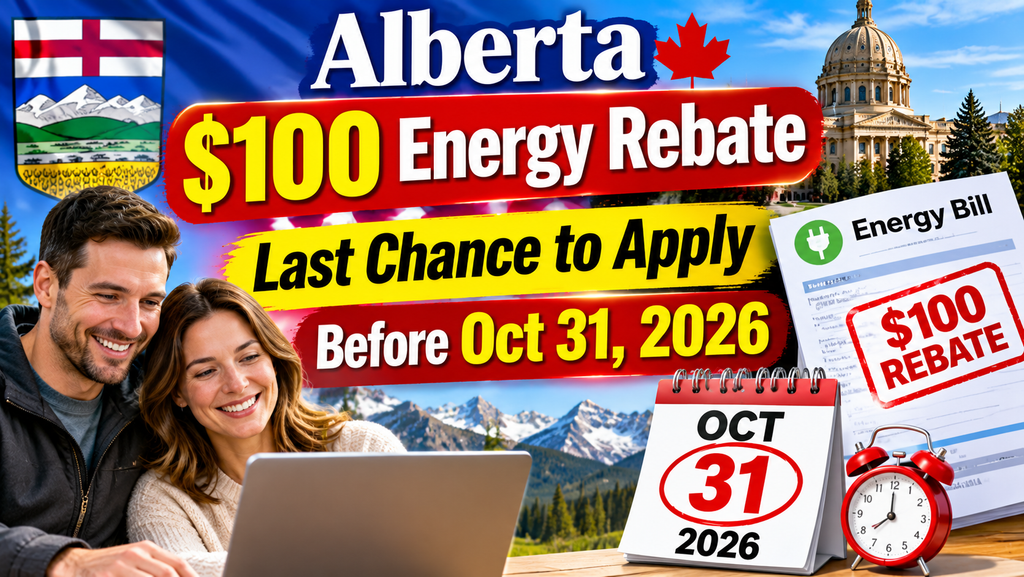
Alberta $100 Energy Rebate 2026: If you live in Alberta, or you’re an American with a life north of the border, there’s a deadline coming up. Alberta’s one-time Energy Rebate closes for applications on Saturday, October 31, 2026. The province already pushed that date back once, from September 30, and nothing I found suggests it will happen again.
The payment is $100 per eligible adult, which is a little over US$70 at recent exchange rates (check the current rate before you budget it). It isn’t life-changing money. It also takes about fifteen minutes to claim, and a lot of people haven’t done it yet. Here’s what the official sources say, what the rebate is meant to do, and how to avoid the mistakes that slow people down.
Highlight of Alberta $100 Energy Rebate
- Deadline: October 31, 2026. That’s a Saturday, so the phone lines will be closed. Realistically, aim to finish by Friday, October 30 at the latest, and preferably this week.
- Amount: $100 per eligible adult. A married or common-law couple can each qualify, so $200 for two.
- Who qualifies: Alberta residents who were 18 or older on July 1, 2026, filed a 2025 tax return, and have household income of $225,000 or less.
- Where to apply: The official portal, linked from alberta.ca/alberta-energy-rebate.
- Tax treatment: Alberta says the rebate is non-taxable and doesn’t need to be reported to the Canada Revenue Agency.
- Payout time: Up to 14 days after you submit.
Why Alberta $100 Energy Rebate 2026 required
As per some official sources, especially if you’re reading this from the US and wondering why a provincial government is mailing out checks Alberta is Canada’s oil country. When crude prices rise, the province’s treasury benefits, and so do pump prices. In its June 17, 2026 announcement, the government said West Texas Intermediate, the same benchmark American drivers hear about, averaged about $92.74 a barrel over a 20-day review window from mid-May to mid-June. Premier Danielle Smith framed the rebate as a way to send some of that windfall back to residents.
The rebate also grew out of a policy argument. Alberta normally runs a fuel tax relief program that cuts the provincial tax on gasoline and diesel when oil prices climb. The government said it was skeptical that those cuts always reach drivers, noting that when the federal government suspended its 10-cent fuel excise tax earlier this year, the savings were gone from pump prices within days. So for July through September, it swapped the fuel tax cut for direct payments.
The province also pointed out that a fuel tax cut only helps people who buy fuel. The average Albertan uses about 2,000 litres a year, which the government says works out to roughly $65 in savings per person for a single quarter. A flat $100 reaches seniors, transit riders, remote workers, and anyone else who doesn’t drive much. Americans will recognize the logic. It’s the same trade-off behind the “send everybody a check or cut the gas tax” debates that come up here whenever prices spike.
IRS 2027 Tax Brackets, Standard Deduction and 401(k) Limits: What’s Official and What’s Coming
Alberta $100 Energy Rebate Deadline Extension
On September 30, the government announced it was extending the application window by 31 days. Finance Minister Jason Nixon said more than 1.45 million Albertans had already applied for and received the rebate, and that over 97 percent of those applicants had been paid. The Canadian Press reported that nearly 3.4 million adults are eligible, and that about 1.5 million had applied by the end of September.
Do the math and you’ll see the issue. Even counting the people who were enrolled automatically, a large share of eligible Albertans hadn’t claimed their money when the original deadline arrived. That’s the reason for the extension.
CTV News also reported that the program drew criticism after launch, with some residents raising concerns about the application process and privacy. Smith acknowledged last week that Albertans weren’t happy with the rebate approach and said the government would go back to cutting the 13-cent-per-litre fuel tax through the end of the year. I’ll cover the fuel tax piece below, because it affects what the rebate means in practice.
The province also added a third way to verify your identity and bank details in the portal, which I’ll explain in the how-to section. That change came in response to people getting stuck partway through.
Who’s eligible for Alberta $100 Energy Rebate 2026
Alberta.ca lists four requirements:
- You were 18 or older as of July 1, 2026.
- You’re an Alberta resident.
- You filed your 2025 tax return.
- Your household’s total income is $225,000 or less.
The tax return requirement trips people up, so it’s worth a second look. The government uses your 2025 filing to confirm your income and your household. If you didn’t file for 2025, the rebate isn’t available through the standard route.
How “household” works
Alberta’s definition is narrower than you might expect. A household is either one person or two people who are married or common-law. That’s it. So if you have a 22-year-old living in your basement, or three roommates, or your parents are living with you, each adult is treated as a separate household and has to apply separately. That’s why the government says a two-adult household can receive $200, and why additional adult family members can each claim $100 of their own. It’s also why one person applying doesn’t cover the others in the house.
How income is calculated
The income test isn’t simply “what’s on your paycheck.” The province starts with line 15000 (total income) on the Canadian tax return, for you and your spouse or common-law partner if you have one, then subtracts a few items:
- Split pension amounts (line 21000)
- Tuition expenses (line 32000)
- Medical expenses for yourself, your spouse, or dependent children under 18 (line 33099)
- Medical expenses for other dependents (line 33199)
If you’re anywhere near the $225,000 line, run those numbers before you apply. For most households this won’t matter, since $225,000 is a high threshold.
Who didn’t need to apply for Alberta $100 Energy Rebate 2026
About 315,422 people were enrolled automatically, according to the province. Those are people receiving the Alberta Seniors Benefit, or enrolled in AISH (Assured Income for the Severely Handicapped), the Alberta Disability Assistance Program, or Income Support. If that’s you, you shouldn’t need to do anything.
One catch: people who joined those programs after July 1 aren’t automatically included. They have to apply through the portal like everyone else.
What Americans should know
A fair number of US readers have a connection to Alberta, whether you’re a US citizen working in Calgary’s energy sector, a dual citizen, a student, a retiree, or someone whose family lives there. A few practical points.
Residency is what counts, not citizenship. The rules are about living in Alberta, being 18 or older, and having filed a 2025 return. They don’t mention citizenship. If you’re a US citizen who lives in Alberta and filed a Canadian return for 2025, you meet the same criteria as anyone else. If you live in the US full-time, you don’t.
Snowbirds. If your home base is Alberta but you spend winters in Arizona or Florida, the question is whether you’re still an Alberta resident for tax purposes. I couldn’t find a government statement addressing winter visitors specifically. If your situation is borderline, call the program line (details below) before you rely on it.
Banking. The payout runs through Interac, Canada’s interbank payment system, either as a direct deposit or an e-Transfer. That points toward needing a Canadian bank account. The official page doesn’t spell that out, so treat it as my inference and confirm if you bank only in the US.
US taxes. Alberta says the rebate is non-taxable and doesn’t have to be reported to the CRA. What the IRS wants to know about it is a different question, and the official page doesn’t address it. If you’re a US citizen filing in both countries, ask a cross-border tax professional. I won’t guess at it.
How to apply for Alberta $100 Energy Rebate 2026
The Alberta.ca instructions come down to five steps.
1. Get a verified Alberta.ca Account.
If you don’t have one, create one. If you do, make sure it’s verified, which is a separate step from simply having a login. This is the most common reason people stall, so do it first.
2. Check that your address matches.
The mailing address on your Alberta driver’s licence or ID card needs to match the information in your Alberta.ca account. A mismatch can hold things up.
3. Open the portal.
Apply through alberta.ca/alberta-energy-rebate, which links to the official application site. You’ll need your Social Insurance Number. If you have a spouse or common-law partner, you’ll also need their SIN, date of birth, and legal name exactly as they appear on your 2025 tax return.
4. Choose how you’ll be paid and verified.
There are now three options:
- Direct deposit through Interac Verified. If your bank or credit union participates, you sign in through your online banking to confirm your account. The government says it doesn’t receive your banking login details. The payment arrives by direct deposit.
- Email e-Transfer with photo ID verification. This is for people whose bank isn’t on the Interac Verified list, or who’d rather not use online banking for verification. You’ll need a phone or tablet with a camera. The e-Transfer goes to the verified email on your Alberta.ca account, and your security answer is the application code you get by email after you submit.
- Email e-Transfer with your 2025 Notice of Assessment. This is the newest option. It’s for people whose bank isn’t listed and who can’t complete the photo ID check. You verify using information from your 2025 CRA Notice of Assessment. Same e-Transfer mechanics and application code as the second option.
5. Review, save, submit.
Your progress saves automatically, so you can stop and come back. But once you submit, you can’t change anything, so check your numbers first. Then allow up to 14 days for processing.
If your computer access is limited or you need hands-on help setting up a verified account, the province says you can visit an Alberta Supports centre for computer access and on-site assistance.
Canada Pension Payment 2026 Full Schedule: CPP, OAS & GIS Full Schedule – Oct 28, Nov 26 & Dec 22
$200 Extra Social Security Payment: When Is It Being Approved, and Who Can Get It?
New York POWER Rebate Checks: $100 to $200 Payments Begin Landing in Mailboxes This Fall
Get your documents ready first
Most of the frustration people report comes from starting the application and then having to dig for something. Before you sit down, have these ready:
- Your SIN
- Your spouse or partner’s SIN, birth date, and legal name as filed on the 2025 return
- Your 2025 Notice of Assessment, in case you need the third verification route
- Your phone or tablet, if you’ll use photo ID verification
- Access to the email address tied to your Alberta.ca account, since your application code will go there
With all of that on the table, it’s a quick process. Without it, you’ll be hunting for documents on October 30.
Watch for scams
Alberta flagged this specifically, and it’s worth repeating. Scam texts about the Energy Rebate are circulating. The government’s guidance is blunt: don’t click links in text messages to apply, because the official portal is the only legitimate way. It also says the government won’t send money to you by text message.
One detail to keep straight: if you choose e-Transfer, your security answer is your application code, which comes by email after you submit. A real e-Transfer won’t ask you to tell a stranger that code over the phone or by text. Rebate deadlines are exactly the kind of moment fraudsters use, with their messages designed to make you feel rushed. Type the address in yourself.
After you apply for Alberta $100 Energy Rebate 2026
Expect your payment within 14 days. It arrives either by direct deposit or as an Interac e-Transfer to your verified email. The rebate is non-taxable and, per the province, won’t affect other government benefits. The June announcement was specific on that point, saying receiving it won’t change eligibility or benefit amounts for AISH, ADAP, Income Support, the Alberta Seniors Benefit, or federal seniors’ programs. Remember the cutoff, though. You have to apply by October 31. If you submit on the last day, the 14-day processing window runs after that.
The Fuel Tax Relief Program
The rebate replaced the Fuel Tax Relief Program for July 1 through September 30. Since October 1, that program is back, and Alberta has suspended its full provincial fuel tax. The government says that saves 13 cents per litre on gasoline and diesel, through the end of the year.
Why does this matter if you’re deciding whether to bother with the rebate? Because the two aren’t the same kind of help. The fuel tax suspension only helps if you buy fuel. The rebate is a flat payment that doesn’t depend on whether you drive. Doing one doesn’t affect the other, so claim the money you’re owed either way.
FAQ’s about Alberta $100 Energy Rebate 2026
Do I need to apply if I’m on the Alberta Seniors Benefit or AISH?
No, you’re enrolled automatically, unless you joined the program after July 1.
My spouse and I file together. Do we both need to apply?
The province’s framing is that two-adult households can receive $200, so plan on each adult completing their own application. Confirm the details through the portal or the program line.
I have an adult child living at home.
They count as a separate household and apply separately.
I made a mistake after submitting.
The portal says changes aren’t possible once you submit. Call the program line and ask what your options are.
Is the rebate taxable?
Alberta says no, and that you don’t need to report it to the CRA.
What if I miss October 31?
The province has extended once, but there’s no announcement of another extension. Don’t plan around one.
Contact information
The official contact details for the Alberta Energy Rebate:
- Rebate questions: 1-844-401-4014 (toll-free) or 780-401-4014. Open Monday to Friday, 8:15 a.m. to 4:30 p.m. Mountain Time.
- Alberta.ca Account problems: 1-844-643-2789, same hours.
Calling from the US, you may need to dial the 1 first, as with any toll-free number, and Alberta runs on Mountain Time. And since October 31 is a Saturday, the call centres won’t be open that day.
I’ll end with a plain opinion, which is mine and not the government’s. The rebate is modest, and the rollout clearly frustrated some people. The premier herself has said so. But $100 is $100, and the program is one of the more direct ways a government can return oil revenue to residents. If you qualify and haven’t applied, the hardest part is probably setting up a verified account, and you can do that today.
Don’t wait for the last weekend. The call centres are closed Saturday, the portal will be busiest right before the cutoff, and a missing document can turn a fifteen-minute task into a missed deadline. Set aside a quiet half hour this week, gather your paperwork, and get it done.