Millions of divorced Americans are sitting on a Social Security benefit they have never claimed, and many do not even know it exists. Under a rule the agency has enforced for decades, anyone whose marriage lasted at least 10 years before ending in divorce can potentially collect a monthly payment based on their former spouse’s earnings record, even if the divorce happened 20 or 30 years ago. It does not matter whether the ex-spouse has remarried, whether the two people are on speaking terms, or whether the higher earner has even filed for their own benefits yet. Social Security divorced spouse benefits remain one of the most overlooked parts of the retirement system heading into 2026.
Two things make this a timely topic right now. The 2026 Social Security earnings test limit rose to $24,480 for anyone still working and claiming before full retirement age, changing how much a divorced spouse can earn before benefits are temporarily withheld. And the repeal of the Windfall Elimination Provision and Government Pension Offset, effective for benefits payable from January 2025 onward, means divorced spouses of teachers, firefighters, and other public-sector workers whose benefits were once reduced or wiped out entirely can now receive the full amount they are owed. We’ll be updating this article monthly as new Social Security figures and rule changes take effect.
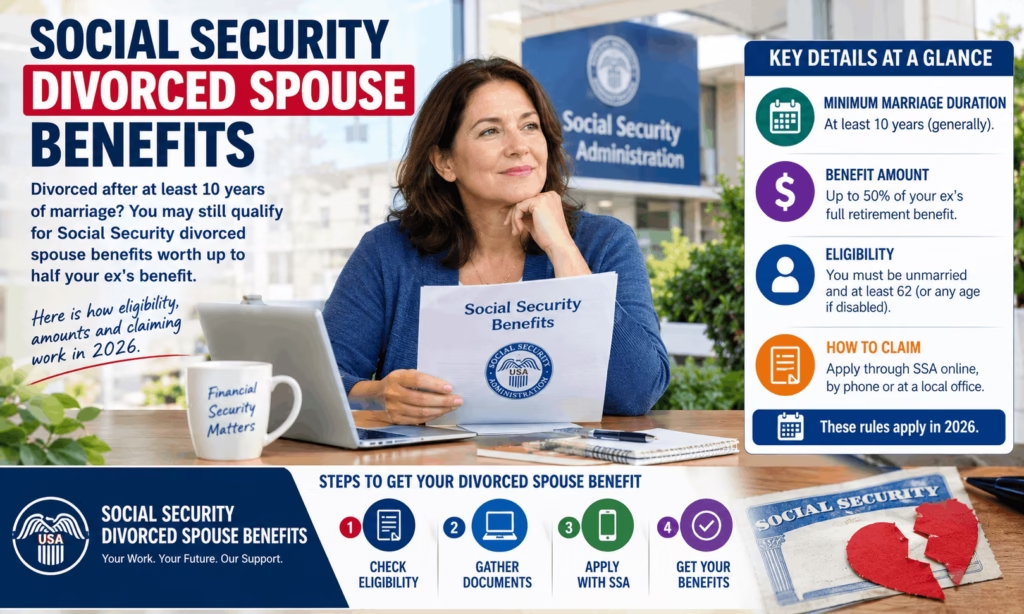
What Is the Social Security 10-Year Marriage Rule?
The 10-year marriage rule is the foundational eligibility test for divorced spouse benefits. Social Security counts the marriage from the legal wedding date to the date the final divorce decree was entered, not the date of separation and not the date divorce paperwork was filed. A marriage that lasted nine years and eleven months does not qualify, regardless of how long the couple had been together before the wedding or how amicable the split was. There is no grace period and no rounding up.
This threshold matters because it is binary. Someone married nine years and eleven months gets nothing from this provision, while someone married ten years and one day is fully eligible. For couples approaching their tenth anniversary while contemplating divorce, the timing of a final decree can be worth hundreds of thousands of dollars in lifetime benefits, particularly when one spouse earned substantially more than the other over their working years.
Divorced Spouse Benefits Key Highlights
| Detail | Information |
|---|---|
| Minimum marriage length | 10 consecutive years before the divorce became final |
| Minimum age to claim | 62 (no age minimum if caring for the worker’s qualifying child) |
| Maximum benefit at full retirement age | Up to 50% of the ex-spouse’s Primary Insurance Amount |
| Full retirement age (born 1960 or later) | 67 |
| Current marital status required | Unmarried, unless a later remarriage has ended |
| 2026 earnings test limit (under FRA) | $24,480 per year, $1 withheld per $2 earned above |
| 2026 earnings test limit (year reaching FRA) | $65,160, $1 withheld per $3 earned above |
| Effect on ex-spouse’s own benefit | None, claiming does not reduce the ex’s payment |
| Survivor benefit if ex has died | Up to 100% of the deceased ex-spouse’s benefit |
| WEP and GPO repeal effective date | Benefits payable from January 2025 onward |
| 2026 average retired worker benefit | About $2,071 per month |
OAS Payment Increase September 2026: Confirmed Amounts, Payment Date, and the Annual GIS Reset !
Ohio SNAP Food Ban starts October 1, 2026: What’s Banned, Court Update & Rules
Who Qualifies for Social Security Divorced Spouse Benefits
To claim benefits on a former spouse’s earnings record, a divorced individual generally must meet all of the following conditions at the time of claiming. The marriage must have lasted at least 10 consecutive years immediately before the divorce became final. The applicant must currently be unmarried, since an active remarriage generally disqualifies someone from claiming on a prior spouse’s record, though if that later marriage ends by death, divorce, or annulment, eligibility on the original ex-spouse’s record can become available again. The applicant must be at least 62 years old, unless they are caring for the former spouse’s child who is under 16 or disabled and also receiving benefits, in which case the age-62 floor still applies but the benefit is not reduced for early claiming. Finally, the divorced spouse’s own retirement benefit, if any, must be lower than the divorced spouse benefit they would receive, since Social Security automatically pays whichever amount is higher rather than both.
One detail surprises many applicants. The former spouse does not need to consent to the claim, does not need to be notified, and in most cases will never even know the claim was filed, since Social Security does not routinely inform a worker when an ex-spouse begins collecting divorced spouse benefits on their record. Someone who was married and divorced multiple times, with more than one marriage meeting the 10-year threshold, can also choose among qualifying ex-spouses, and Social Security will calculate whichever record produces the highest benefit.
How Much a Divorced Spouse Can Receive
Divorced spouse benefits are calculated as a percentage of the ex-spouse’s Primary Insurance Amount, the monthly benefit the ex-spouse would receive by claiming at their own full retirement age, currently 67 for anyone born in 1960 or later. At full retirement age, a divorced spouse can receive up to 50% of that Primary Insurance Amount. Claiming earlier than full retirement age permanently reduces the benefit. For example, someone who claims at age 62 instead of 67 generally receives roughly 30% to 32.5% of the ex-spouse’s Primary Insurance Amount rather than the full 50%, and that reduction is locked in for life.
Unlike a worker’s own retirement benefit, which grows by roughly 8% for each year of delayed claiming up to age 70, there is no advantage to waiting past full retirement age for a divorced spouse benefit. The 50% figure is the ceiling regardless of how long a divorced spouse waits beyond their own full retirement age. Using the 2026 average retired-worker benefit of about $2,071 a month as an example, a divorced spouse who waits until their own full retirement age could receive roughly $1,035 a month, while claiming at 62 would produce a permanently reduced amount closer to $650 to $700 a month, depending on exact birth month and the applicable early-claiming reduction schedule.
Independently Entitled Divorced Spouse Benefits
One of the least understood parts of this rule is that a divorced spouse does not always need to wait for the ex to actually file for their own benefits. Under what Social Security calls the independently entitled divorced spouse provision, someone who has been divorced for at least two continuous years can claim divorced spouse benefits once they reach age 62, as long as the former spouse is at least 62 and has enough work credits to qualify for retirement benefits, even if that former spouse has not yet applied. This provision exists specifically because an ex-spouse has no ongoing relationship or leverage over a former partner’s filing decisions, and Social Security built in a way for eligible divorced spouses to claim independently rather than waiting indefinitely on someone else’s timeline.
This distinction does not apply to current, still-married spouses, who generally cannot claim a spousal benefit until the working spouse has filed for their own retirement benefit. Divorced spouses who meet the two-year divorce threshold are exempt from that requirement entirely.
$400 Inflation Refund Checks 2026: New York’s Real Program, Fact-Checked
Stimulus Check 2026: Fact-Checking Every Viral Payment Claim (Tracker)
Social Security SSI Payment Date September 2026 Confirmed by SSA- Check Full Schedule here!
Survivor Benefits for Divorced Spouses
The rules change again, and become considerably more generous, if the former spouse has died. A surviving divorced spouse who was married to the deceased worker for at least 10 years can receive a survivor benefit worth up to 100% of what the deceased ex-spouse was receiving or was entitled to receive, rather than the 50% cap that applies to divorced spouse benefits while the ex is still alive. Survivor benefits for a divorced spouse can generally begin as early as age 60, or age 50 if the surviving divorced spouse is disabled, with permanently reduced amounts for claiming before the survivor’s own full retirement age.
Remarriage rules are also more forgiving for survivor benefits than for standard divorced spouse benefits. A surviving divorced spouse who remarries after age 60, or after age 50 if disabled, does not lose eligibility for survivor benefits based on the deceased ex-spouse’s record. This is a meaningful distinction, since remarrying before age 60 generally does disqualify someone from claiming survivor benefits on a former spouse’s record, at least while that later marriage remains in effect.
How the 2026 Earnings Test Affects Divorced Spouse Claims
Divorced spouses who continue working while collecting benefits before their own full retirement age are subject to the same Social Security earnings test that applies to workers and current spouses. In 2026, Social Security withholds $1 in benefits for every $2 earned above $24,480 for someone who will not reach full retirement age at any point during the year. In the calendar year someone reaches full retirement age, a higher threshold of $65,160 applies to earnings in the months before that birthday, with only $1 withheld for every $3 earned above the limit. Once full retirement age is reached, the earnings test disappears entirely, and any amount of work income can be earned without affecting the benefit.
Importantly, money withheld under the earnings test is not lost permanently. Social Security recalculates the benefit at full retirement age to credit back the months in which payments were reduced or withheld, which generally results in a higher ongoing monthly benefit afterward, though full recovery of every withheld dollar is not guaranteed and depends on how long the person lives after reaching full retirement age.
How WEP and GPO Repeal Changed Divorced Spouse Benefits
For divorced spouses of teachers, police officers, firefighters, and other public-sector workers who spent part of their career in jobs not covered by Social Security, two provisions used to significantly cut or eliminate spousal and divorced spouse benefits, the Windfall Elimination Provision and the Government Pension Offset. The Social Security Fairness Act, signed into law in January 2025, repealed both provisions retroactively for benefits payable from January 2025 forward. For divorced spouses specifically, this means someone who was previously told their divorced spouse benefit would be reduced or eliminated because their ex-spouse received a government pension from non-covered employment may now be eligible for a substantially higher payment, or may qualify for a divorced spouse benefit for the first time. Anyone in this situation who was denied or received a reduced divorced spouse benefit before the repeal should contact Social Security directly to confirm whether their record has been recalculated.
How to Apply for Divorced Spouse Benefits
Divorced spouse benefits are never paid automatically. An eligible individual must actively file a claim, and Social Security recommends applying up to four months before the date benefits should begin. The most direct path is applying online through a my Social Security account at ssa.gov, where the application walks through marital history, work history, and identifying information for both the applicant and the former spouse. Applicants who prefer not to apply online can call Social Security’s national customer service line to schedule a phone or in-person appointment at a local field office.
Documentation matters. Applicants should have their marriage certificate and final divorce decree on hand, along with their own Social Security number, birth certificate, and, if available, their former spouse’s Social Security number, though Social Security can often locate the ex-spouse’s record using their name and date of birth if the number is not readily available. Providing accurate marriage and divorce dates upfront helps avoid processing delays, since the 10-year threshold is verified against the exact dates on those documents.
Processing Time for Divorced Spouse Benefit Claims
Processing time for a divorced spouse benefit claim generally runs similarly to a standard retirement benefit application, typically a few weeks from a complete application to an initial decision, though cases requiring manual verification of an old marriage or divorce record, particularly from decades ago or from a state with less digitized recordkeeping, can take longer. Claims filed under the independently entitled divorced spouse provision, where the former spouse has not yet filed for their own benefits, sometimes take additional time since Social Security must confirm the ex-spouse’s earnings record and eligibility independently. Applicants who do not receive a decision within roughly 30 to 60 days of submitting a complete application are generally advised to follow up with their local Social Security office.
Divorced Spouse Benefit Payment Schedule
Once approved, divorced spouse benefits are paid on the same monthly schedule Social Security uses for all retirement and spousal benefits, based on the recipient’s date of birth. Beneficiaries born on the 1st through the 10th of the month are generally paid on the second Wednesday of each month, those born on the 11th through the 20th are paid on the third Wednesday, and those born on the 21st through the 31st are paid on the fourth Wednesday. Recipients who also receive Supplemental Security Income, or who began receiving Social Security benefits before May 1997, typically follow a different, earlier payment date. Payments are deposited directly into a bank account or, in limited cases, loaded onto a Direct Express debit card, since Social Security has been phasing out paper checks in favor of electronic payment methods.
Common Mistakes Divorced Spouses Make
Several recurring mistakes cost divorced individuals money over the life of their benefit. Some assume that because they have not spoken to their ex-spouse in years, or do not know whether the ex is still living, they cannot file a claim, when in fact Social Security can generally locate the necessary record independently. Others wrongly assume that filing for a divorced spouse benefit will reduce their ex’s payment or notify the ex directly, which discourages many eligible people from ever applying, even though claiming has no effect whatsoever on the former spouse’s own benefit amount. Some divorced individuals also assume they must choose between their own retirement benefit and a divorced spouse benefit permanently, when Social Security automatically pays the higher of the two, recalculating as needed if circumstances change. Finally, many people wrongly believe waiting past full retirement age increases a divorced spouse benefit the way it increases a worker’s own retirement benefit, leading some to delay unnecessarily and lose months or years of payments they were already entitled to receive at the maximum rate.
Trump Accounts Dell $250 Grant: Did Deposits Actually Start Monday? Here’s Who’s Actually Been Paid
2027 Social Security COLA Forecast: Latest 3.6% Estimate and How Much Retirees Could Get
$2000 Stimulus Payment September 2026 Fact-Check: Is It Really Coming?
Official Social Security Divorced Spouse Benefit Resources
| Resource | Link |
|---|---|
| Apply for retirement or divorced spouse benefits | ssa.gov/benefits/retirement/apply.html |
| my Social Security account login and registration | secure.ssa.gov/RIL/SiView.action |
| Benefits for divorced spouses overview | ssa.gov/benefits/retirement/planner/applying7.html |
| Check application or claim status | secure.ssa.gov/myssa/myaccount |
| Find a local Social Security office | ssa.gov/locator |
| General SSA customer service | ssa.gov or 1-800-772-1213 |
| Social Security Fairness Act (WEP/GPO repeal) information | ssa.gov/benefits/retirement/social-security-fairness-act.html |
FAQs About Social Security Rule 2026
How long do you have to be married to get Social Security divorced spouse benefits?
You must have been married to your former spouse for at least 10 consecutive years before the divorce became final. The marriage is measured to the day, so nine years and eleven months does not qualify.
Does claiming a divorced spouse benefit reduce my ex-spouse’s Social Security payment?
No. A divorced spouse benefit is paid separately and has no effect whatsoever on the former spouse’s own monthly Social Security amount.
Can I claim divorced spouse benefits if my ex has remarried?
Yes. Your former spouse’s current marital status does not affect your eligibility to claim a divorced spouse benefit on their record.
Do I need my ex-spouse’s permission to claim benefits on their record?
No. Social Security does not require the former spouse’s consent, and in most cases the former spouse is never notified that a claim was filed.
Can I get divorced spouse benefits if my ex hasn’t filed for Social Security yet?
Yes, if you have been divorced for at least two continuous years and your former spouse is at least 62 with enough work credits, you can claim under the independently entitled divorced spouse provision even before they file.
What happens to my divorced spouse benefit if I remarry?
Remarrying generally ends your eligibility for a divorced spouse benefit while that new marriage is in effect, though eligibility can return if the later marriage ends by death, divorce, or annulment.
How much can a divorced spouse receive from Social Security?
At full retirement age, a divorced spouse can receive up to 50% of the former spouse’s Primary Insurance Amount. Claiming earlier than full retirement age permanently reduces that amount.
Can I collect survivor benefits from a deceased ex-spouse?
Yes. If your former spouse has died and your marriage lasted at least 10 years, you may qualify for a survivor benefit worth up to 100% of what they were receiving, starting as early as age 60, or age 50 if you are disabled.
People Also Ask
What disqualifies you from divorced spouse Social Security benefits?
The most common disqualifiers are a marriage that lasted less than 10 years, being currently remarried, or being under age 62 without a qualifying child of the former spouse in your care.
Can you collect Social Security from two ex-spouses?
You cannot collect two divorced spouse benefits at once, but if you were married to more than one former spouse for at least 10 years each, Social Security will calculate the benefit from whichever qualifying record produces the higher payment.
Is it worth staying married for 10 years for Social Security?
For couples close to the 10-year mark who are also considering divorce, reaching the threshold can preserve access to a benefit worth tens of thousands of dollars or more over a retirement lifetime, particularly when one spouse earned significantly more than the other.
Does the government pension offset still affect divorced spouse benefits in 2026?
No. The Government Pension Offset was repealed for benefits payable from January 2025 onward under the Social Security Fairness Act, so divorced spouses of public-sector workers are no longer subject to that reduction.
Can a divorced spouse collect Social Security at 62?
Yes, but claiming at 62 rather than full retirement age permanently reduces the divorced spouse benefit to roughly 30% to 32.5% of the former spouse’s Primary Insurance Amount instead of the full 50%.
Conclusion
The Social Security 10-year marriage rule remains one of the most valuable, and most overlooked, provisions in the retirement system. Divorced individuals who meet the marriage-length, age, and marital-status requirements can claim up to 50% of a former spouse’s benefit at full retirement age, with no effect on the ex-spouse’s own payment and, in many cases, no need to wait for the ex to file first. With the 2026 earnings test limits now in effect and the repeal of the Windfall Elimination Provision and Government Pension Offset restoring full benefits to many divorced spouses of public-sector workers, this is a good moment for anyone who was married at least a decade before divorcing to check their eligibility directly with Social Security rather than assuming the door has closed.
Canada 50% Tariff 2026: 700 US Goods Hit With Tariffs Up to 50% From September 8
Social Security Changes September 2026: SSA Announces Major Update for Retirees and Beneficiaries
Minimum Wage Increase in 5 Canadian Provinces: What Changes October 1, 2026