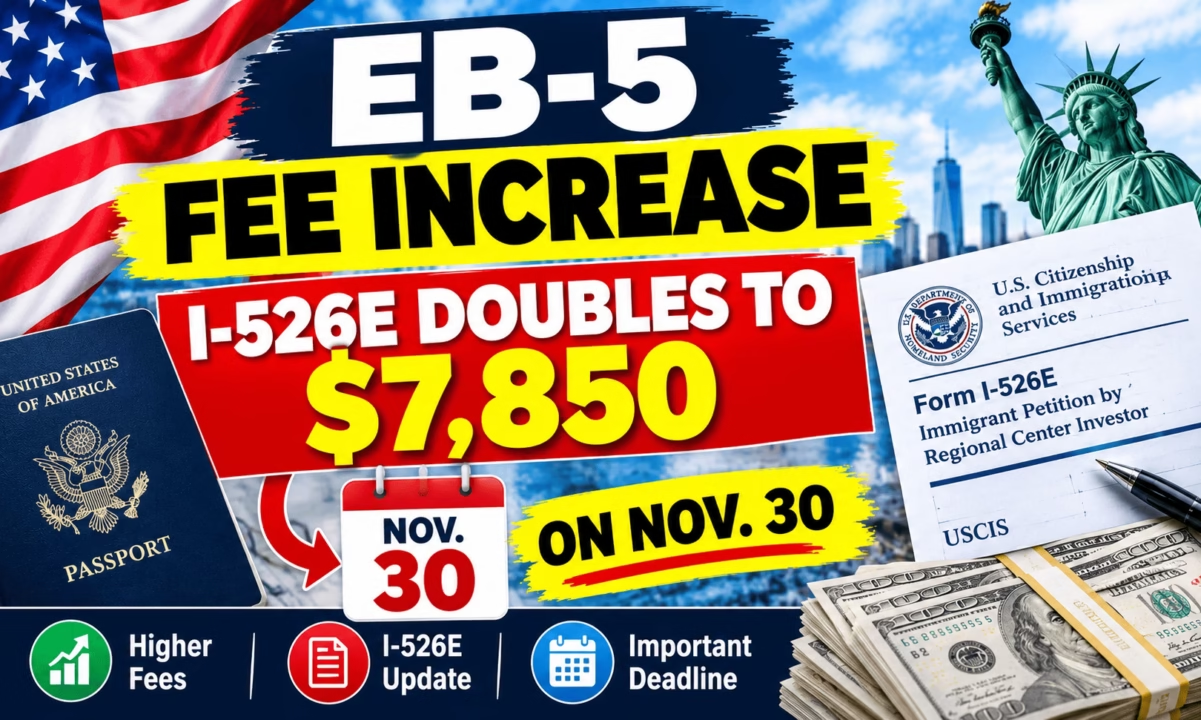
The EB-5 fee increase is now final, and the window to file at today’s prices is closing. Under a rule that DHS published in the Federal Register on September 30, any EB-5 petition postmarked on or after November 30, 2026 must carry the new fees. The Form I-526E for regional center investors rises from $3,675 to $7,850, the standalone Form I-526 goes to $7,615, and the Form I-829 to remove conditions goes from $3,750 to $5,000. Regional center investors also pay a separate Integrity Fund fee that rises from $1,000 to $1,100, so the total at the petition stage climbs from $4,675 to $8,950, a jump of $4,275. A package postmarked by November 29 still pays the old amount, which leaves about 30 days from today. We’ll be updating this article monthly as USCIS issues guidance.
For Indian investors, the timing is more than a fee story. Indian applicants in the unreserved category still face a visa queue, while the rural, high unemployment and infrastructure set-aside categories remain current, so project choice shapes the whole timeline. A second cost deadline follows quickly: the minimum investment amounts are scheduled to adjust for inflation on January 1, 2027. Meanwhile, a separate and much smaller set of USCIS fee changes took effect on October 16, and many headlines have blended the two. This guide separates them, shows the exact numbers, explains who is affected, covers the India specific issues, and includes a free calculator so you can see what filing before or after November 30 costs you.
EB-5 Fee Increase at a Glance: Old Fees vs New Fees
| Form or fee | Current fee | From November 30, 2026 | Change |
|---|---|---|---|
| Form I-526E, regional center investor petition | $3,675 | $7,850 | +$4,175 |
| Form I-526, standalone investor petition | $3,675 | $7,615 | +$3,940 |
| Form I-829, petition to remove conditions | $3,750 | $5,000 | +$1,250 |
| EB-5 Integrity Fund fee (regional center investors) | $1,000 | $1,100 | +$100 |
| Total at petition stage, regional center investor | $4,675 | $8,950 | +$4,275 |
| Form I-956 regional center application | $17,795 | $44,115 | +148% |
| New Form I-527 | None | $10,330 | New |
The I-526 and initial I-526E amounts include a new $75 EB-5 technology fee, according to most legal summaries of the rule. Check the final text on the USCIS fee page before you pay, because some firms list the technology fee separately.
Key Dates for the EB-5 Fee Increase and Related Deadlines
| Date | What happens |
|---|---|
| September 30, 2026 | EB-5 final fee rule published in the Federal Register |
| October 1, 2026 | Immigration court fee changes take effect, including a $1,060 appeal to the Board of Immigration Appeals |
| October 16, 2026 | Small H.R. 1 fee increases take effect for asylum, parole, TPS and some work permits |
| November 29, 2026 | Last postmark date to pay the current EB-5 fees |
| November 30, 2026 | New EB-5 fees apply to anything postmarked on or after this date |
| December 31, 2026 | Last day before the scheduled inflation adjustment to minimum investment amounts |
| January 1, 2027 | EB-5 minimum investment amounts scheduled to adjust |
Quiet IRS Rule Shift 2026: How the SALT Cap Increase Could Mean an Extra $800 for Some Americans
What Changed on October 16 and What Did Not?
Many readers saw headlines saying new immigration fees began on October 16 and assumed EB-5 was included. It was not. On that date, USCIS applied its yearly inflation adjustment to fees created by the H.R. 1 law, and the increases were modest, between $3 and $30.
| H.R. 1 fee | Through October 15 | From October 16 |
|---|---|---|
| Annual asylum fee | $102 | $105 |
| Immigration parole fee (Form I-131) | $1,020 | $1,050 |
| Initial work permit for asylum, parole and TPS applicants (Form I-765) | $560 | $570 |
| TPS application (Form I-821) | $510 | $520 |
The I-94 fee stayed at $24 and the initial asylum filing fee stayed at $100. Those changes apply to requests postmarked on or after October 16, and USCIS rejects filings that arrive with the old amount. The parole fee follows a different rule and applies to anyone granted parole on or after that date. None of this changes EB-5 petition fees. The investor fee increase comes from a separate rule that takes effect November 30.
Why EB-5 Fees Are Doubling Now
The 2022 EB-5 Reform and Integrity Act required USCIS to study what the program actually costs and set fees to cover it. The agency says that current fees fall short. It projects program costs of roughly $105 million a year for fiscal years 2026 and 2027, against about $56.6 million in revenue at current fee levels, a gap of around $48.4 million.
There is also a legal backdrop. In April 2024, USCIS raised EB-5 fees sharply through its general fee rule, with the I-526E set at $11,160. In November 2025, a federal court in Colorado found that the agency had skipped a required fee study, and the fees reverted to older amounts. That is why the I-526E costs $3,675 today. The new rule follows the required study, and its final numbers are lower than both the 2024 schedule and the October 2025 proposal, which had floated a $9,625 petition fee for the main investor form. So the accurate way to describe the change is that fees roughly double from today’s levels but remain below the 2024 schedule.
People who paid the higher 2024 fees before the court ruling will not receive refunds under the new rule, according to legal summaries. The rule says the fees are meant to recover costs and support the processing goals set by Congress, which are an average of 240 days for investor petitions and I-829 petitions, and 120 days for petitions in rural and high unemployment areas.
The Postmark Rule: How USCIS Decides Which Fee You Owe
The date on your mailing, not the date USCIS receives it, sets the price. A complete I-526 or I-526E package postmarked on November 29 pays the current fee, while one postmarked on November 30 pays the new one. USCIS normally rejects filings sent with the wrong fee, which means a rejected package that gets re-mailed after the deadline would cost the higher amount and lose weeks.
The same rule applies to the I-829. A properly filed petition postmarked on or before November 29 uses the $3,750 fee, while one postmarked on or after November 30 requires $5,000. The fee depends on the filing date, not on when you made the investment. Investors who are approaching the end of their conditional residence should check their I-829 window carefully, because filing timing has legal requirements beyond fees.
EB-5 Fee Calculator: Compare Filing Before and After November 30
Use the calculator below to see which fee applies to your filing date, how many days you have left, and how much you would save by postmarking before the deadline. For Indian investors, it also estimates your investment in rupees if you enter an exchange rate, and shows how many family members you would need for remittances under the Liberalised Remittance Scheme.
EB-5 Fee Calculator (Postmark Before or After November 30, 2026)
Shows the USCIS fee that applies to your postmark date, days left, savings and, for Indian investors, a rupee and LRS estimate. Planning tool only.
Fees: I-526E $3,675 to $7,850; I-526 $3,675 to $7,615; I-829 $3,750 to $5,000; Integrity Fund $1,000 to $1,100 (I-526E). Government fees only. Confirm on uscis.gov (Form G-1055).
The tool covers USCIS government fees for the petition stage only. It does not include legal fees, regional center administrative fees, adjustment of status fees or the investment itself.
The Real Cost of EB-5 in 2026: Fees Are the Smallest Part
A government fee of $8,950 is small next to the capital. The minimum investment is $800,000 for projects in a targeted employment area, meaning a rural or high unemployment area, or a qualifying infrastructure project, and $1,050,000 for everything else. On top of that, investors typically pay regional center administrative fees, legal and filing costs, and costs for each dependent, including adjustment of status, work permit, travel document and biometrics fees. This rule does not change those separate fees.
That is why the fee increase matters less as a cost and more as a signal about timing. It adds about $4,275 per principal investor. For a family planning a seven figure investment, that is a small percentage, but it is still a real amount that can be avoided by filing in time. The bigger financial question is the inflation adjustment due on January 1, 2027. The law adjusts minimum investment amounts using inflation data, and industry estimates for the new figures vary widely. Some projections put the TEA minimum near $900,000 to $937,500 and the standard minimum between about $1.2 million and $1.25 million, but these are projections and not official numbers. Investors should watch for the official announcement rather than rely on any single estimate.
CRA $2350 Relief Payment 2026: Fact Check, Real Payment Dates & Eligibility Explained
IRIS E-Filing System Becomes The Only IRS Channel For Form 1042-S And 1099s. FIRE Closes Nov. 19.
India EB-5 Queue: Unreserved vs Set-Aside Categories
The November 2026 Visa Bulletin kept the EB-5 cutoff dates steady. In the unreserved category, India’s Final Action Date is December 1, 2023 and its Date for Filing is May 1, 2024. China’s Final Action Date is December 1, 2016, and all other countries are current. The three set-aside categories, rural, high unemployment and infrastructure, are current for every country, including India. USCIS has said it will use the Dates for Filing chart for employment-based adjustment applications this month.
| EB-5 category | India Final Action Date | India Date for Filing |
|---|---|---|
| Unreserved (regional center and non-regional center) | December 1, 2023 | May 1, 2024 |
| Rural set-aside | Current | Current |
| High unemployment set-aside | Current | Current |
| Infrastructure set-aside | Current | Current |
The practical lesson for Indian applicants is that the project type can decide whether a visa number is available immediately or only after a long wait. Rural projects also receive priority processing under the 2022 law. Set-aside categories can change from month to month, and a single bulletin should never be treated as a guarantee, so check the State Department’s latest bulletin before committing to a project.
EB-5 for Indian Investors: LRS Limits, Source of Funds and Timing
Indian investors face constraints that applicants from many other countries do not. Under the Reserve Bank of India’s Liberalised Remittance Scheme, each resident individual can remit up to $250,000 per financial year. An $800,000 investment therefore cannot move out of India in one year through a single person’s limit. Families often spread transfers across several family members and across two financial years, but each remittance must be legitimate, properly documented and consistent with the source of funds. Tax collected at source applies to many overseas remittances, and the rules have changed in recent budgets, so confirm current rates with a chartered accountant.
USCIS also expects a clear paper trail showing that the money came from lawful sources, often over several years of tax returns, business records, property sale deeds or gift documentation. Money moved through informal channels, or funds that cannot be traced, can sink a petition. The fee deadline is not a reason to cut corners on this documentation. A rushed filing that is later denied costs far more than the fee difference.
How to Apply for EB-5?
The path has several stages, and the fee deadline affects only the first filing.
Step one: choose your route. A regional center investment is filed on Form I-526E. A direct investment in your own new commercial enterprise is filed on Form I-526. Regional center projects are usually pooled, while direct investments require you to create jobs yourself.
Step two: choose your project carefully, including whether it is in a rural or high unemployment area, because that sets both your investment amount and your visa category. Review the offering documents, the project’s USCIS approval status and the plan for job creation, ideally with an independent immigration attorney and a securities lawyer.
Step three: prepare source of funds and path of funds evidence, and plan how the money will be remitted from India within the LRS limits.
Step four: file Form I-526E or I-526 with the correct fee and evidence. Regional center investors pay the petition fee and the separate Integrity Fund fee. Make sure the package is postmarked no later than November 29 if you want the current fees.
Step five: after approval, apply for the green card. Depending on where you live and your category’s visa availability, that means adjustment of status inside the United States or consular processing abroad. You will receive conditional permanent residence for two years.
Step six: file Form I-829 in the 90 days before your conditional residence ends to remove the conditions. The new fee is $5,000 for filings postmarked on or after November 30.
Processing Time: What to Expect After You File
Congress set statutory goals of an average of 240 days for investor petitions and I-829 petitions, and 120 days for petitions in targeted employment areas. These are goals, not guarantees, and actual times have often been longer, so USCIS posts current processing times for each form on its website. Rural petitions receive priority, which can shorten the wait. After an I-526E is approved, the time to a green card depends on the visa bulletin. Investors in current categories can move quickly, while investors in the India unreserved category may wait for their priority date to become current. Keep your filing receipt, check your case status online, and respond to any request for evidence quickly, since a missed deadline can lead to denial.
Payment Schedule: When Each EB-5 Payment Is Due
EB-5 involves several payments at different times. The USCIS petition fee and the Integrity Fund fee are paid when you file, and the amounts depend on the postmark date. The capital investment is paid according to the project’s subscription agreement, often into escrow, and some projects release funds only after the petition is approved or after certain milestones are met. Regional center administrative fees are usually paid at or soon after subscription. Adjustment of status or consular processing fees come later, and the I-829 fee is paid when you file to remove conditions. For Indian investors, the remittance schedule is its own payment plan, because annual LRS limits and tax collected at source influence when each part of the funds can leave the country. Ask your attorney and your accountant to build a calendar that lines up these dates.
What the Fee Hike Means for Regional Centers and Project Sponsors
Regional centers face their own increases. The application to designate or amend a regional center, Form I-956, rises 148 percent to $44,115. The rule also sets other fees, including a new Form I-527 with a $10,330 fee that press coverage describes as aimed at situations where an investor’s project fails, though the exact scope is in the final rule text. Sponsors may pass costs through to investors in administrative fees, so investors should compare the total they are asked to pay and ask what portion is government fees. The new technology fee is meant to support USCIS’s move from paper filing to electronic case processing.
Medicare Enrollment Starts Today: Key Dates, 2027 Costs and How to Switch Plans Before December 7
Official Resources and Links
| Resource | What you can do there | Link |
|---|---|---|
| USCIS EB-5 Immigrant Investor Program | Program rules, forms and updates | https://www.uscis.gov/working-in-the-united-states/permanent-workers/eb-5-immigrant-investor-program |
| USCIS fee schedule, Form G-1055 | Confirm the exact fee for every form | https://www.uscis.gov/g-1055 |
| USCIS processing times | Check current wait times by form | https://egov.uscis.gov/processing-times/ |
| USCIS case status | Check status with your receipt number | https://egov.uscis.gov/casestatus/landing.do |
| myUSCIS account | Register, sign in and manage your case | https://my.uscis.gov |
| Federal Register | Read the final EB-5 fee rule (document 2026-20016) | https://www.federalregister.gov |
| State Department Visa Bulletin | Check the monthly EB-5 cutoff dates | https://travel.state.gov/content/travel/en/legal/visa-law0/visa-bulletin.html |
| Reserve Bank of India, LRS | Check current remittance rules | https://www.rbi.org.in |
EB-5 Fee Increase FAQs
How much is the EB-5 fee increase?
The I-526E rises from $3,675 to $7,850, the I-526 to $7,615, and the I-829 from $3,750 to $5,000, for filings postmarked on or after November 30, 2026.
When do the new EB-5 fees start?
They apply to petitions postmarked on or after November 30, 2026. A package postmarked by November 29 pays the current fee.
Is the Integrity Fund fee also increasing?
Yes. It rises from $1,000 to $1,100 for regional center investors.
Did the October 16 fee changes affect EB-5?
No. Those changes covered asylum, parole, TPS and some work permit fees and were small inflation adjustments.
Will my pending petition cost more?
The rule applies to filings postmarked on or after the effective date, and legal summaries say pending cases are not charged the new fee.
Is the EB-5 minimum investment changing?
It is scheduled to adjust for inflation on January 1, 2027. The official new amounts had not been announced at the time of writing.
Is the India EB-5 queue current?
Not in the unreserved category, where the Final Action Date is December 1, 2023. The set-aside categories are current.
How much does an EB-5 visa cost in 2026?
Beyond the $800,000 or $1,050,000 investment, government petition fees are $4,675 now for a regional center investor and $8,950 from November 30.
Why are EB-5 fees going up?
USCIS says current fees do not cover the program’s cost, and a required fee study supports the new amounts.
Can Indians apply for EB-5?
Yes. Indian nationals can apply, though those in the unreserved category face a queue, and remittances must follow RBI rules.
What is the cheapest way to get an EB-5 green card?
The $800,000 threshold applies to rural, high unemployment and infrastructure projects, which also benefit from set-aside visa numbers.
How long does EB-5 take for Indians?
Rural, high unemployment and infrastructure investors face no visa queue, while the unreserved India category has a cutoff of December 1, 2023.
What is the difference between I-526 and I-526E?
The I-526 is for direct investments, and the I-526E is for investments through an approved regional center.
How much money can I send abroad from India for EB-5?
Each resident individual can remit up to $250,000 per financial year under LRS, subject to documentation and tax rules.
Is EB-5 worth it?
It depends on your goals, risk tolerance and project quality, and the capital is at risk, so get independent legal and financial advice.
Conclusion
The EB-5 fee increase is real, but it is only one of three cost points investors need to track. The first is November 30, when petition fees roughly double. The second is January 1, 2027, when the minimum investment amounts are scheduled to adjust. The third is the visa queue, where project category matters more than any single fee. For Indian families, the timing of remittances under LRS and the quality of source of funds documentation are just as important as the postmark date. Use the calculator above to see your numbers, confirm each fee on the official USCIS pages, and speak with an independent immigration attorney before you commit capital. This article is general information and not legal or investment advice, and the capital in any EB-5 project is at risk.