SNAP Junk Food Ban 2026 is no longer just a proposal in 2026, it’s already a reality across 22 U.S. states. Under the Trump administration’s “Make America Healthy Again” (MAHA) initiative, the USDA has approved a wave of SNAP waivers that let states remove soda, candy, energy drinks, and sugary snacks from the list of items SNAP/EBT benefits can buy. This SNAP waiver states list now stretches from Arkansas to Virginia, and each state has its own implementation timeline and definition of what counts as “restricted.” But in June 2026, a major federal court ruling Aragon v. Rollins blocked the restrictions in five states, adding a new layer of complexity to an already fast-moving policy landscape. We’ll be updating this article monthly so you always have the most accurate picture of the latest USDA announcements and court decisions.
If you’re a SNAP recipient or use an EBT card, it’s important to know whether a SNAP soda ban or SNAP candy ban is actually active in your state, because the rules differ everywhere. Some states began enforcing restrictions as early as January 1, 2026, while others like Kansas, Nevada, Ohio, and Wyoming are rolling out their bans in phases through 2027 and 2028. In this article, we break down the complete, updated, and verified list of 18-turned-22 approved states, along with restricted food categories, court status, and official SNAP agency links, so you can navigate the changes without confusion.
What Is the SNAP Junk Food Waiver?
A SNAP waiver is a federal permission that USDA’s Food and Nutrition Administration (FNA) grants to a state so it can modify the definition of “eligible food” within its own SNAP program. Under standard federal SNAP rules, almost any grocery item — from chips to soda — could be purchased with SNAP/EBT benefits. Under the new waiver process, states submit a formal demonstration-project proposal to USDA, requesting permission to exclude specific “non-nutritious” categories (such as candy or sugar-sweetened beverages) from their state’s SNAP-eligible list.
This approval process typically begins with a governor’s executive order, after which the state’s Department of Social Services or Health Department files a formal waiver request with USDA. USDA reviews the request, and if approved, a two-year demonstration period begins (with an option for renewal). The difference between federal SNAP rules and state waivers is simple: the federal baseline is the same nationwide, while a waiver applies only to recipients within that specific state — so the same product can be legal in one state and banned in another.
Why Did USDA Approve These Waivers?
According to USDA Secretary Brooke Rollins, a large share of SNAP dollars is spent on sugary drinks, packaged desserts, and salty snacks, and changing that spending pattern is the core goal behind these waivers. Under Health Secretary Robert F. Kennedy Jr.’s MAHA initiative, all governors were encouraged to submit waivers aimed at removing sugary drinks from SNAP. USDA’s stated objective is to redirect taxpayer-funded benefits toward nutritious food rather than items linked to chronic disease.
The policy is built around several stated goals:
- Promoting healthy eating — steering SNAP back toward its original nutrition-support purpose
- Reducing sugary-drink purchases — since reports indicate soda is the single largest purchase category among SNAP recipients
- Cutting down candy purchases — by excluding chocolate, gummies, and hard candy
- State-level flexibility — letting each state design a waiver suited to its own population’s needs
- Chronic-disease prevention — addressing obesity and diet-related illness more broadly
Which Foods Could Be Restricted?
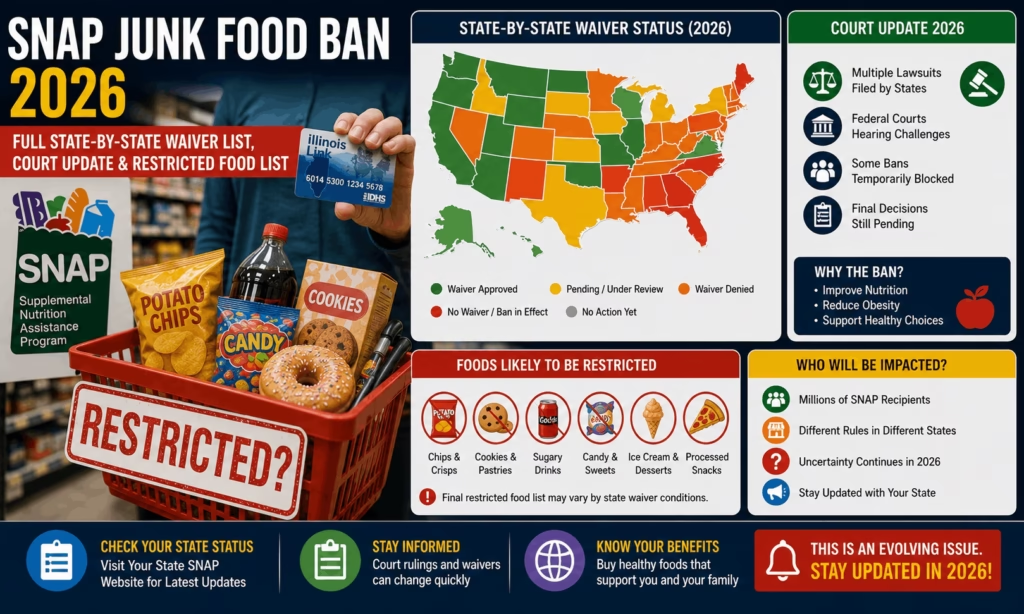
Every state’s waiver is a little different, but these categories are the most common restricted food categories:
| Category | What It Typically Includes |
|---|---|
| Soda | Carbonated soft drinks, cola, flavored fizzy drinks |
| Sugary Drinks | Sweetened lemonade, sweetened tea/coffee, punches with low natural-juice content |
| Energy Drinks | High-caffeine sweetened beverages (classified differently by state) |
| Candy | Chocolate bars, gummies, hard candy, toffee-based confectionery |
| Sweet Snacks | Packaged sweet snacks, restricted in some states |
| Certain Desserts | Prepared/ready-to-eat desserts, as in Missouri’s waiver |
It’s important to understand that the exact restricted list differs by each state’s actual waiver document. For example, South Carolina’s waiver excludes protein bars, granola bars, and baking ingredients from its candy definition, while Iowa’s waiver covers every food item subject to the state’s sales tax — a far broader scope than most other states.
Which Foods Are Still Allowed?
No matter how many new restrictions arrive, SNAP’s core purpose — basic nutrition support — remains unchanged. These categories stay fully eligible in every waiver state:
- Fruits and vegetables (fresh, frozen, canned)
- Meat, poultry, and fish
- Eggs
- Milk and dairy products
- Bread and cereals
- Rice, pasta, and beans
- Baby food and infant formula
- Frozen meals (non-dessert)
- Natural fruit/vegetable juice (50%+ juice content is exempt in most states)
State-by-State SNAP Waiver Status 2026
The table below shows the current status of all 22 approved states across the U.S. Status key: Approved & Active, Approved, Implementation Pending, Blocked by Federal Court, Phased Rollout Planned.
| State | USDA Approval | Implementation Date | Current Status | Restricted Items (Summary) |
|---|---|---|---|---|
| Arkansas | 2025 (1st wave) | July 1, 2026 | Active | Soda and candy |
| Colorado | 2025 (1st wave) | April 30, 2026 | Blocked (June 22, 2026) | Soft drinks |
| Florida | 2025 (1st wave) | 2026 | Active | Soda and candy |
| Hawaii | Dec 10, 2025 | 2026 | Pending rollout | Sugary drinks, candy |
| Idaho | 2025 (1st wave) | 2026 | ✅ Active | Soda and candy |
| Indiana | 2025 (1st wave) | Jan 1, 2026 | Active | Soft drinks and candy |
| Iowa | 2025 (1st wave) | Jan 1, 2026 | Blocked (June 22, 2026) | All state-taxable food items |
| Louisiana | 2025 (1st wave) | 2026 | Active | Soda and candy |
| Missouri | Dec 10, 2025 | 2026 | Pending rollout | Candy, prepared desserts, soda, low-juice drink mixes |
| Nebraska | 2025 (1st wave) | Jan 1, 2026 | Blocked (June 22, 2026) | Soda and energy drinks |
| North Dakota | Dec 10, 2025 | 2026 | Pending rollout | Sugary drinks, candy |
| Oklahoma | 2025 (1st wave) | 2026 | Active | Soda and candy |
| South Carolina | Dec 10, 2025 | Aug 31, 2026 | Phased rollout | Candy, energy drinks, soft drinks, 5g+ added-sugar beverages |
| Tennessee | Dec 10, 2025 | July 31, 2026 (scheduled) | Blocked (June 22, 2026) | Soda, energy drinks, candy |
| Texas | 2025 (1st wave) | 2026 | Active | Soda and candy |
| Utah | 2025 (1st wave) | Jan 1, 2026 | Active | Soft drinks |
| Virginia | Dec 10, 2025 | April 2026 | 🔄 Phased rollout | Sweetened carbonated beverages only |
| West Virginia | 2025 (1st wave) | Jan 1, 2026 | Blocked (June 22, 2026) | Soda |
| Kansas | March 4, 2026 | Feb 15, 2027 | Phased rollout | Candy and soft drinks |
| Nevada | March 4, 2026 | Feb 1, 2028 | Phased rollout | Candy and sugar-sweetened beverages |
| Ohio | March 4, 2026 | Oct 1, 2026 | Phased rollout | Sugar-sweetened beverages |
| Wyoming | March 4, 2026 | Feb 1, 2027 | Phased rollout | Sweetened carbonated beverages |
Arkansas: What You Need to Know
Arkansas was among the first 12 states to receive a waiver, and the state implemented its own ban starting July 1, 2026. Reports indicate Arkansas’s ban was unaffected by the recent court ruling, since it isn’t one of the five plaintiff states in Aragon v. Rollins. Recipients should check the latest retailer guidance through the state’s SNAP agency — the Arkansas Department of Human Services.
Colorado: Status After the Court Ruling
Colorado is one of the five states whose waiver was vacated by a federal court on June 22, 2026. Judge Amy Berman Jackson ruled that USDA acted beyond its statutory authority in approving the waiver and also skipped the required public notice-and-comment process. For now, SNAP recipients in Colorado can once again buy soda and candy, unless an appeal or a new USDA process reverses this decision.
The same structure — approval date, implementation status, restricted categories, and official agency link — applies to the remaining 20 states, all of which are already covered in the master table above.
States Where the Court Blocked Implementation
Aragon v. Rollins (Case No. 1:26-cv-00861, U.S. District Court for the District of Columbia) is a landmark ruling in which five SNAP recipients — one each from Colorado, Iowa, Nebraska, Tennessee, and West Virginia — sued USDA. Their argument was that USDA misused 7 U.S.C. § 2026(b) (a provision meant only for “program efficiency” pilots, not food restrictions) to approve the waivers, and also failed to follow the required notice-and-comment procedure.
On June 22, 2026, the court granted summary judgment in favor of the plaintiffs and vacated the waivers in these five states. This means:
- Colorado, Iowa, Nebraska, Tennessee, and West Virginia now allow SNAP recipients to purchase both soda and candy again
- The ruling applies only to these 5 states — the remaining 17 approved states’ waivers remain valid
- USDA may appeal this decision
- Nebraska’s case may raise additional issues, since it requested another waiver while litigation was still pending
- Legal experts note this ruling could serve as a “roadmap” for future challenges against other states’ waivers, since most relied on the same USDA process and the same statutory authority
States Rolling Out Restrictions in Phases
Several states didn’t launch their restrictions all at once, but instead planned a phased implementation:
- Virginia — restricts only sweetened carbonated beverages starting April 2026; the state first had to submit a retailer communication plan, an evaluation plan, and a budget
- South Carolina — effective Aug 31, 2026, with a two-year demonstration period and an option to renew for up to three more years
- Ohio — sugar-sweetened beverage ban begins Oct 1, 2026
- Kansas — candy and soft drinks restricted starting Feb 15, 2027
- Wyoming — sweetened carbonated beverages restricted starting Feb 1, 2027
- Nevada — the longest timeline of all, covering both candy and sugar-sweetened beverages, effective Feb 1, 2028
- Missouri — in 2026, will restrict candy, prepared desserts, soda, and drink mixes/concentrates with low natural-juice content
What Does This Mean for SNAP Recipients?
- Existing SNAP benefits continue as usual — the total benefit amount and eligibility are unaffected
- Only eligible purchase categories may change, and only in states where a restriction is actively enforced
- Your EBT card remains fully valid — no new card is issued
- At checkout, a restricted item will be automatically excluded by the point-of-sale system, or in some cases the entire transaction may be declined if not properly separated
Can You Still Buy Soda With SNAP?
This depends entirely on which state you live in:
- In states where the waiver is active (such as Arkansas, Florida, Indiana, Louisiana, Oklahoma, Texas, Utah, Idaho) — soda cannot be purchased with SNAP
- In the 5 states where the court has blocked the restriction (Colorado, Iowa, Nebraska, Tennessee, West Virginia) — soda is currently allowed again
- In states with a future-dated rollout (South Carolina Aug 2026, Ohio Oct 2026, Virginia April 2026, Kansas/Wyoming 2027, Nevada 2028) — soda remains allowed until the effective date
Can You Buy Candy?
The same logic applies to candy. States currently in active enforcement exclude candy from SNAP purchases, while court-blocked states have resumed allowing candy purchases. Some states — like Iowa — have a waiver broad enough to cover candy along with virtually every taxable food item, while a state like Virginia limits its restriction to soda alone and doesn’t touch candy at all.
What Foods Remain Eligible Nationwide? (Comparison Table)
| Allowed (In Every State) | Potentially Restricted (State-Specific) |
|---|---|
| Fruits & vegetables | Soda / carbonated soft drinks |
| Meat, poultry, fish, eggs | Candy & confectionery |
| Milk & dairy | Energy drinks |
| Bread, rice, pasta, beans | Sweetened tea/coffee/lemonade |
| Baby food | Prepared desserts |
| Frozen non-dessert meals | Low-juice-content drink mixes |
| 50%+ natural fruit/vegetable juice | Low-juice-content juices/punches |
How to Check Your State’s SNAP Rules
The most reliable approach is to check official sources directly:
- USDA Food and Nutrition Administration (FNA) — SNAP Food Restriction Waivers page: fna.usda.gov/snap/waivers/foodrestriction
- USDA SNAP eligibility and general program information: the official FNS/FNA SNAP homepage
- Your state’s Department of Social Services / Human Services website (e.g., South Carolina DSS, Missouri Department of Social Services)
- Ask your local grocery retailer for EBT checkout guidance
- Track USDA press releases and your governor’s executive orders
To check your registration or benefit status: verify your EBT card balance and eligibility through your state’s online SNAP portal or USDA’s ConnectEBT system — the link differs by state, so confirm it through your own state agency’s official website.
Will More States Join the Program?
Yes, this is entirely possible. USDA has already approved waivers in three separate waves — first 12 states, then 6 more, then 4 more — and several other states have submitted or are considering their own waiver requests (Ohio, for instance, explored similar measures early on before its waiver was formally approved). At the federal level, a bill called the Healthy SNAP Act proposes removing soda, candy, ice cream, cookies, and desserts from SNAP purchases nationwide, but the bill remains pending in Congress and hasn’t moved since February 2025. Until such federal legislation passes, states will likely continue submitting individual waiver requests.
FAQs
Which states have banned junk food from SNAP?
So far, 22 states have received USDA approval: Arkansas, Colorado, Florida, Hawaii, Idaho, Indiana, Iowa, Kansas, Louisiana, Missouri, Nebraska, Nevada, North Dakota, Ohio, Oklahoma, South Carolina, Tennessee, Texas, Utah, Virginia, West Virginia, and Wyoming.
Is soda banned under SNAP?
In some states, yes; in others, no. It depends entirely on that state’s specific waiver and implementation date — check the table above.
Is candy still allowed?
Also state-dependent. Where a waiver is active, candy is restricted; in court-blocked states, candy purchases are currently allowed again.
Which states are affected?
22 states are approved, and of those, 5 (Colorado, Iowa, Nebraska, Tennessee, West Virginia) currently have their implementation blocked by a court order.
Has my state implemented the rule?
Check your state’s row in the master table above, or visit your state’s official SNAP agency website.
What did the federal court decide?
On June 22, 2026, the D.C. district court ruled in Aragon v. Rollins that USDA had exceeded its legal authority in approving the waivers, and vacated the waivers in 5 states as a result.
Can I still use my EBT card?
Yes, your EBT card remains fully valid. Only the eligible item categories change — the card itself is not deactivated.
When do restrictions begin?
It varies by state — some began Jan 1, 2026, others start Aug 2026, Oct 2026, and some are scheduled as late as 2027–2028.
Will more states adopt the rule?
Very likely, since USDA continues to review new waiver requests and the MAHA initiative remains active.
How do I check my state’s SNAP policy?
USDA’s official FNA waiver page and your state’s Department of Social Services website are the most reliable sources.
Key Takeaways
- 22 states have received a SNAP food-restriction waiver from USDA (as of July 2026)
- 5 states — Colorado, Iowa, Nebraska, Tennessee, West Virginia — currently have their implementation blocked by a federal court order
- Restrictions mainly target soda, candy, energy drinks, and sugary/prepared desserts
- Fruits, vegetables, meat, dairy, grains, and baby food remain SNAP-eligible in every state
- Implementation dates range from 2026 through 2028, depending on the state
- EBT cards remain valid — only eligible purchase categories change