
The new FSA and HSA limits 2027 are official, and most workers can put more pre-tax money aside starting January 1. The IRS set the health FSA salary reduction cap at $3,500, up $100 from $3,400, in Revenue Procedure 2026-35, which employers and benefits advisers began circulating on November 5 and 6, according to M3 Insurance and EPIC Insurance Brokers. The HSA caps, set earlier in the year in Revenue Procedure 2026-24, rise to $4,500 for self-only coverage and $9,000 for family coverage, up from $4,400 and $8,750, according to Wex and OneDigital. The dependent care FSA stays at $7,500 because the amount is fixed in law and not adjusted for inflation. Open enrollment is running now, so you have a few weeks to choose your elections. We’ll be updating this article monthly.
Here is why it matters now. Most employers set 2027 FSA elections in the next few weeks, and many close enrollment before December 1, so the new numbers arrive just as workers decide how much to set aside. An HSA, by contrast, can be adjusted at any time. The jump is modest, but the combination is powerful: a family with a high deductible plan can now shelter $9,000 in an HSA plus $3,500 per working spouse in a health FSA, subject to some plan rules. One catch applies to people who want both. A general purpose health FSA can interfere with HSA eligibility, so check your plan documents. Below are every 2027 figure, the year over year changes, the rule changes from last year, a savings calculator and the dates to circle.
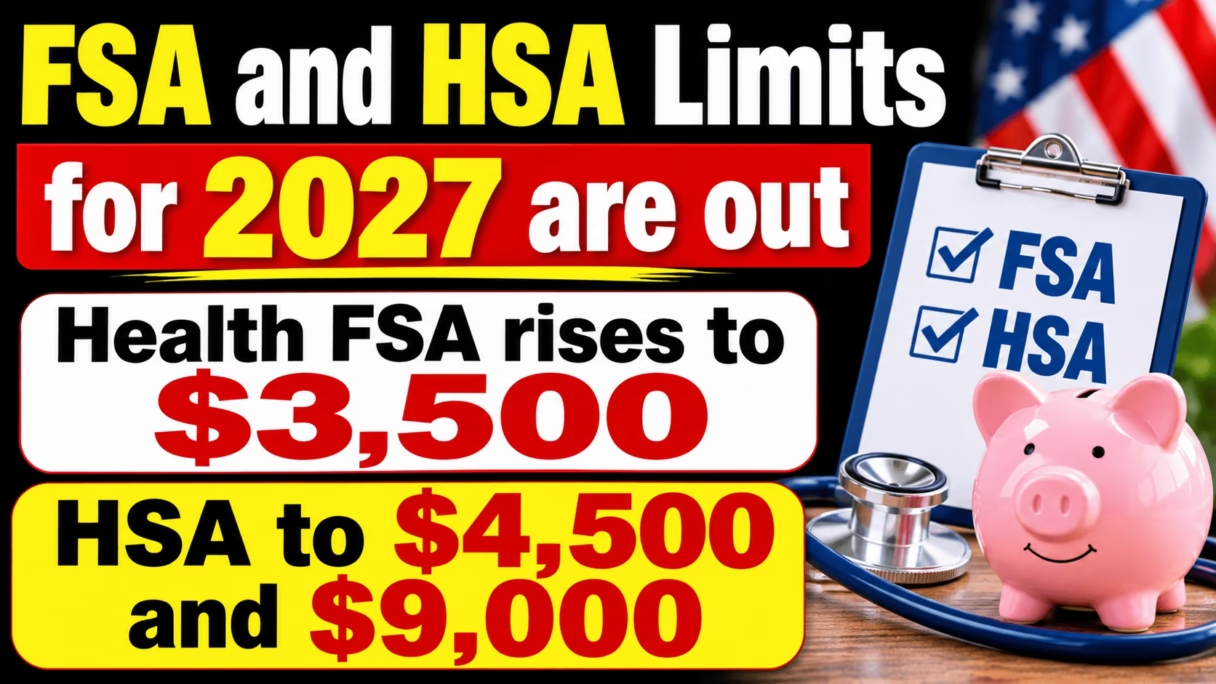
FSA and HSA Limits Rise 2027 Key Highlights
| Account or benefit | 2026 | 2027 | Change |
|---|---|---|---|
| Health FSA salary reduction | $3,400 | $3,500 | +$100 |
| Health FSA carryover | $680 | $700 | +$20 |
| Limited purpose FSA (dental and vision) | $3,400 | $3,500 | +$100 |
| Dependent care FSA | $7,500 | $7,500 | None |
| Commuter and parking benefits (monthly) | $340 | $350 | +$10 |
| HSA self-only | $4,400 | $4,500 | +$100 |
| HSA family | $8,750 | $9,000 | +$250 |
| HSA catch-up, age 55 and older | $1,000 | $1,000 | None |
| HDHP minimum deductible, self-only | $1,700 | $1,750 | +$50 |
| HDHP minimum deductible, family | $3,400 | $3,500 | +$100 |
| HDHP out-of-pocket maximum, self-only | $8,500 | $8,700 | +$200 |
| HDHP out-of-pocket maximum, family | $17,000 | $17,400 | +$400 |
| Excepted benefit HRA | $2,200 | $2,250 | +$50 |
The FSA figures come from NueSynergy, M3 Insurance and EPIC, and the HSA figures come from Wex, OneDigital and Wagner Law Group. Each describes the same IRS guidance. Confirm the numbers on irs.gov before you publish them in an employer handout.
Latest News: What the IRS Announced for 2027
The IRS published the health FSA, commuter and related limits in Revenue Procedure 2026-35. EPIC lists the release date as November 5 in its quick facts and November 6 in its article metadata, and M3 says Thursday, November 5, so use November 5 as the date unless the IRS page says otherwise. The new limits apply to plan years beginning on or after January 1, 2027.
The per employee health FSA cap is applied per employer. EPIC explains that a plan may offer a carryover of up to $700 or a grace period of up to two and a half months, but not both. Employers may add their own money on top of your salary reduction if the plan qualifies as an excepted benefit, and the total benefit cannot exceed the greater of twice your salary reduction or your reduction plus $500.
Employers are not required to raise their caps. M3 notes that companies that want to match the new $3,500 limit should ask their administrator. That means your plan may still show $3,400, and you should read your own enrollment guide.
The HSA numbers were released earlier in Revenue Procedure 2026-24. Wagner Law Group reported the announcement in June, and OneDigital summarized it in July. That guidance also fixed the high deductible health plan thresholds and the excepted benefit HRA limit of $2,250.
Health FSA Limit for 2027: What You Can Contribute
The health FSA limit for 2027 is $3,500 per employee. A married couple can each contribute up to that amount if both work for different employers whose plans allow it, which makes a possible $7,000 for the household. The limit is not per family, as EPIC points out, but per person.
An FSA is a use it or lose it account in most cases, so the plan’s carryover or grace period rule matters. If your employer offers carryover, up to $700 can move into 2028 without counting against the new year’s limit. A plan with a grace period instead gives you until mid March to spend the old balance, and a plan can choose either option or neither.
Which expenses qualify? Typical examples include copays, deductibles, prescriptions, dental work, vision care and some over the counter items. Your plan administrator keeps the official list, and the IRS explains eligible medical expenses in Publication 502. A good habit is to estimate predictable costs, such as glasses, orthodontia and regular prescriptions, and add a small cushion for surprises. Do not elect the maximum if you cannot predict spending, because unspent money above the carryover is generally forfeited.
Dependent Care FSA Limit: Still $7,500
The dependent care FSA stays at $7,500 per household, or $3,750 if you are married and file separately. According to Catapult Benefits, the amount is set by statute, Public Law 119-21 section 70404, and is not adjusted for inflation. The same source warns that the higher limit applies only if your plan document allows it. Some plans still cap elections at $5,000, and employers must amend the document before open enrollment.
This account pays for care that lets you work, such as daycare, preschool, after school programs and summer day camp for children under 13. It generally does not cover overnight camps or tuition for kindergarten and above. Both spouses usually need earned income, and dependent care FSA money cannot be used for your own medical bills.
HSA Contribution Limit for 2027: $4,500 and $9,000
The HSA contribution limit is $4,500 for self-only coverage and $9,000 for family coverage in 2027. Savers age 55 or older can add a $1,000 catch-up contribution, making the totals $5,500 and $10,000, according to Wex. The catch-up is set by law and does not change with inflation.
You must be covered by a qualifying high deductible health plan to contribute. For 2027, the HDHP must have a deductible of at least $1,750 for self-only coverage or $3,500 for family coverage, and out-of-pocket costs capped at $8,700 or $17,400. These HDHP amounts come from Wagner Law Group and OneDigital.
Contributions from your employer count toward the limit. If you go over, the excess is taxable income and may trigger a 6 percent excise tax, Wex explains. Fix excess contributions by withdrawing them before your tax deadline. HSA money never expires, you own the account and you can invest it, which is why many planners treat it as a stealth retirement account.
New HSA Rules to Know in 2027
Several rule changes came from last year’s tax law, known as the One Big Beautiful Bill Act, and they now matter for 2027 planning.
Bronze and catastrophic plans. The IRS says these marketplace plans now qualify as HSA compatible, even if they do not meet the usual HDHP deductible and out-of-pocket tests, according to RSM’s summary of Notice 2026-5. They do not need to be bought through an exchange to qualify, and off exchange purchases can work with an individual coverage HRA.
Direct primary care. Starting January 1, 2026, a qualifying arrangement no longer disqualifies you from HSA participation. The fee cannot exceed $150 per month for an individual or $300 per month for family coverage, and the arrangement must provide only primary care for a fixed periodic fee. Catapult reports that Revenue Procedure 2026-24 keeps those caps for 2027.
Telehealth. First dollar telehealth coverage before the deductible is now permanent, according to the same notice. In person care, equipment and drugs still follow the normal deductible rules.
How the Numbers Compare to Last Year?
| Item | Rise in dollars | Rise in percent |
|---|---|---|
| Health FSA | $100 | About 2.9 percent |
| HSA self-only | $100 | About 2.3 percent |
| HSA family | $250 | About 2.9 percent |
| HDHP family out-of-pocket maximum | $400 | About 2.4 percent |
| Commuter benefits, monthly | $10 | About 2.9 percent |
These percentages are calculated from the published figures. The increases are small but they add up across a household. A family that maxes an HSA at $9,000 and both spouses’ health FSAs at $3,500 sets aside $16,000 pre-tax, before dependent care.
Other 2027 Health Account Limits Worth Knowing
Two other limits matter for small employers. The excepted benefit HRA, which an employer can offer alongside group coverage, rises to $2,250 from $2,200. Catapult also lists qualified small employer HRA limits of $6,700 for self-only coverage and $13,550 for family coverage, though that is a single source, so check IRS guidance before quoting it.
The Affordable Care Act figures changed too. OneDigital reports that the 2027 out-of-pocket maximum for non-HSA marketplace plans rises to $12,000 for self-only and $24,000 for family, up from $10,600 and $21,200, and that the employer affordability percentage moves from 9.96 to 10.22 percent. These are single source figures. Check them against IRS and HealthCare.gov updates.
How to Enroll: Opening an HSA or Choosing a Health FSA
You do not apply to the IRS for either account, but you must make elections during your plan’s enrollment window.
- Check which plan you have. For an HSA you need a qualifying HDHP. Your plan summary or insurer portal will say whether it is HSA eligible.
- Choose your account. Employers with an HSA usually pick a bank or custodian. If yours does not, you can open one yourself at a bank, credit union or brokerage.
- Pick a contribution amount. Use the limits above, and remember employer contributions count.
- For a health FSA, set your annual election during open enrollment. Most elections cannot be changed mid year unless you have a qualifying life event, such as marriage, birth or a loss of coverage.
- Confirm your payroll deduction on your first January paycheck and keep receipts for expenses.
Processing Time: When Contributions and Claims Move
There is no waiting period for the IRS to approve anything. What matters is your employer’s timeline. HSA contributions generally post each payday, and you can usually spend the balance as soon as it appears. A health FSA is different. Your full annual election is typically available on day one of the plan year, even though your paycheck deductions come in installments. Claims reimbursed from either account depend on your administrator, and debit cards often settle within days while manual claims can take a week or two. The dependent care FSA works differently, since you can generally only be reimbursed up to what you have contributed so far.
Payment Schedule: Key Dates for 2027 Planning
| Date | What happens |
|---|---|
| November 5 to 6, 2026 | IRS releases the 2027 health FSA limits in Revenue Procedure 2026-35 |
| Now through early December | Typical open enrollment window for employer plans, so check your own deadline |
| December 15, 2026 | Common ACA marketplace deadline for January 1 coverage, check HealthCare.gov for your state |
| January 1, 2027 | New FSA and HSA limits take effect |
| Mid March 2027 | End of a grace period, if your plan has one |
| April 15, 2027 | Deadline to make 2026 HSA contributions for the 2026 tax year |
The April date is a common tax rule and is stated here from general knowledge, so confirm it with the IRS. The marketplace date is a typical deadline, and your state may differ.
2027 FSA and HSA Limits and Tax Savings Calculator
2027 HSA Room Calculator
2027 HSA limits: $4,500 self-only, $9,000 family, plus $1,000 catch-up at age 55 or older. Employer contributions count toward the limit.
Tax Savings Estimator
Enter what you plan to set aside. Health FSA is capped at $3,500 and dependent care FSA at $7,500 ($3,750 if married filing separately).
Estimate only. FSA FICA savings apply to payroll deductions, and some states, such as California and New Jersey, tax HSA contributions, so enter your own state rate with care. FICA savings apply only up to the Social Security wage base. A general purpose health FSA can make you ineligible for an HSA. Check IRS Publication 969 and your plan documents.
HSA vs FSA: Which Account Fits You?
| Feature | HSA | Health FSA |
|---|---|---|
| Requires a high deductible plan | Yes | No |
| 2027 limit | $4,500 self-only, $9,000 family | $3,500 per employee |
| Rollover | Balance never expires | Up to $700 carryover or grace period, if the plan offers it |
| Ownership | You own it | Employer plan |
| Investing | Often yes | No |
| Who can contribute | You and your employer | You and sometimes your employer |
If you have a qualifying HDHP, the HSA usually wins on flexibility because your balance can grow over time. If you have a traditional plan, the health FSA can still lower your tax bill for expenses you know are coming.
Mistakes to Avoid With Your 2027 Elections
Do not forget that the FSA is a use it or lose it account. Do not contribute to an HSA if you have disqualifying coverage, such as a general purpose health FSA, unless your plan is limited to dental and vision. Do not assume your employer adopted the higher caps, and do not count on a Medicare enrollee being able to keep contributing. Do not forget to keep receipts, since the IRS can ask you to prove that withdrawals were for qualified expenses. Finally, review your elections each year, because a plan that fit last January may not fit a new deductible, a new job or a growing family.
Official Resources for FSA and HSA Limits
| Resource | Link | Use it for |
|---|---|---|
| IRS Newsroom | https://www.irs.gov/newsroom | Announcements and revenue procedures |
| IRS Publication 969 | https://www.irs.gov/publications/p969 | HSA, FSA and HRA rules |
| IRS Publication 502 | https://www.irs.gov/publications/p502 | Qualified medical expenses |
| IRS Publication 503 | https://www.irs.gov/publications/p503 | Child and dependent care rules |
| HealthCare.gov | https://www.healthcare.gov | Marketplace plans and enrollment |
| U.S. Department of Labor, EBSA | https://www.dol.gov/agencies/ebsa | Employer plan rules and help |
| Medicare | https://www.medicare.gov | Medicare enrollment and HSA interaction |
| Treasury | https://home.treasury.gov | Tax law updates |
FAQs About FSA and HSA Limits Rise 2027
What is the FSA limit for 2027?
The health FSA limit is $3,500 per employee. The dependent care FSA stays at $7,500 per household.
What is the HSA limit for 2027?
It is $4,500 for self-only coverage and $9,000 for family coverage. People age 55 or older can add $1,000.
How much can I carry over from my health FSA?
Up to $700 if your plan offers a carryover. A plan cannot offer both a carryover and a grace period.
Can I have both an HSA and an FSA?
Generally not with a general purpose health FSA. A limited purpose FSA for dental and vision is usually allowed. Check your plan.
Did the dependent care FSA limit change?
No. It stays at $7,500, or $3,750 if you are married filing separately.
When do the new limits start?
January 1, 2027, for plan years that begin on or after that date.
Where can I find the official numbers?
The IRS website has the revenue procedures. Look for Revenue Procedure 2026-24 for the HSA and 2026-35 for the FSA.
How much should I put in my FSA?
Only what you expect to spend on predictable costs. Add a cushion for carryover if your plan offers one.
What happens to my FSA if I quit my job?
Most plans end coverage when employment ends, though some allow claims for expenses incurred before your last day. Ask your administrator.
Can I use my HSA for my spouse or kids?
Yes. Wex explains that funds can cover you, your spouse and your tax dependents.
Is an HSA worth it?
For people with a qualifying high deductible plan who can pay costs out of pocket, the tax savings and long term growth can be substantial. It depends on your health costs and cash flow.
What if I contribute too much to my HSA?
The excess is taxable, and you may owe a 6 percent excise tax, according to Wex. Withdraw it before the deadline.
Are bronze plans now HSA eligible?
Yes. Bronze and catastrophic marketplace plans are HSA compatible under the new guidance, according to RSM.
Do direct primary care fees count?
Qualifying arrangements up to $150 per month for an individual and $300 for a family are now compatible with HSA eligibility.
Can I change my FSA election mid year?
Only if you have a qualifying life event.
Conclusion
The new FSA and HSA limits for 2027 are a small but useful bump. The health FSA moves to $3,500, the HSA climbs to $4,500 and $9,000, and the dependent care FSA holds at $7,500. Open enrollment is the moment to act, because FSA elections are generally locked in. Start with your plan documents, check whether your employer adopted the higher caps and match your contributions to realistic spending. If you have an HSA, remember the rules around catch-up contributions and excess deposits. We’ll be updating this guide as the IRS and employers publish more details.