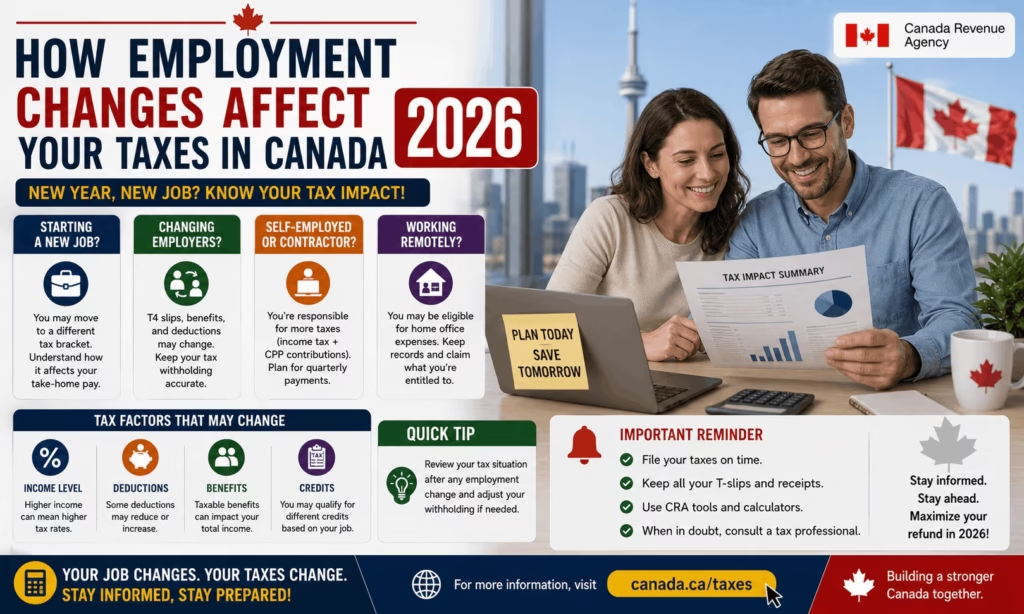
New Canada Revenue Agency Rules 2026: The Canada Revenue Agency (CRA) has rolled out one of its most significant rounds of changes in recent years for the 2026 tax year, touching everything from federal tax brackets and savings account limits to mandatory account security and how trucking companies report contractor income. Whether you’re an employee, retiree, self-employed professional, or small business owner.
Here’s a complete breakdown of what’s actually changing and how it affects your bottom line.

Lower Federal Tax Rate, Full Year
The most consequential shift for ordinary taxpayers is the full-year implementation of the federal middle-class tax cut. The lowest federal income tax rate dropped from 15% to 14%, effective July 1, 2025, but because that change landed mid-year, the effective rate Canadians actually paid on their 2025 returns was a blended 14.5%. 2026 is the first full calendar year the complete 14% rate applies, meaning Canadians in the lowest bracket will see the full benefit reflected in their paycheques and year-end filing for the first time.
Combined with annual indexation, the 2026 federal tax brackets now stand as follows: income up to $58,523 is taxed at 14%; from there to $117,045 is taxed at 20.5%; from $117,045 to $181,440 is taxed at 26%; from $181,440 to $258,482 is taxed at 29%; and anything above $258,482 is taxed at 33%. The CRA applied a 2.0% indexation factor for 2026, which also pushed the Basic Personal Amount the amount of income you can earn before paying any federal tax up to $16,452, from $16,129 in 2025. Canadians earning up to $181,440 receive the full Basic Personal Amount, with the benefit gradually reduced for higher earners above that threshold.
CPP Contributions Are Rising, Even as Income Tax Falls
While the federal tax rate cut is good news for take-home pay, it’s partially offset for many workers by higher Canada Pension Plan (CPP) contributions. The Year’s Maximum Pensionable Earnings (YMPE), also called the first earnings ceiling, rose to $74,600 for 2026, while the basic exemption amount holds steady at $3,500. Both employee and employer CPP contribution rates remain at 5.95%, but because the earnings ceiling itself increased, the maximum CPP contribution climbs to $4,230.45 per side, up from $4,034.10 in 2025.
Higher earners face an additional layer through CPP2 contributions the second tranche introduced as part of CPP expansion. The second earnings ceiling (Year’s Additional Maximum Pensionable Earnings) rises to $85,000 for 2026, up from $81,200. Both employee and employer CPP2 rates remain at 4%, bringing the maximum CPP2 contribution to $416 each, up from $396 in 2025. Self-employed Canadians, who pay both the employee and employer portions, see correspondingly higher combined maximums across both CPP tiers.
Updated Registered Account Contribution Limits
Several of Canada’s most widely used savings vehicles received updated limits for 2026, and understanding these changes is essential for anyone doing year-end or new-year financial planning.
The RRSP dollar limit rose to $33,810 for 2026, up from $32,490 in 2025. Remember, your actual personal contribution room is the lesser of this dollar limit and 18% of your 2025 earned income, plus any unused contribution room carried forward from prior years, minus any pension adjustment reported by your employer. Your exact personal limit appears on your latest Notice of Assessment or through CRA’s My Account portal.
SNAP Junk Food Ban 2026: Full State-by-State Waiver List, Court Update Aur Restricted Food List
USDA SNAP Waiver States 2026: Complete List, State-by-State Details, Court Update & Restricted Food List
SNAP Food Restrictions Still Enforced: Arkansas, Texas & Florida SNAP Junk Food Restrictions – State-by-State Rules, EBT Food List & Latest Updates
The TFSA annual contribution limit holds steady at $7,000 for 2026 the third consecutive year at that level. This is because TFSA limit increases only trigger once cumulative inflation adjustments push the indexed figure to the next $500 increment; the 2026 indexed amount reached $7,185, which wasn’t quite enough to cross into the next bracket. For Canadians who have been eligible since the TFSA’s 2009 inception and have never contributed, total cumulative contribution room now stands at $109,000.
The First Home Savings Account (FHSA) annual limit remains at $8,000, with a lifetime limit of $40,000, unchanged from prior years. The Registered Education Savings Plan (RESP) lifetime contribution limit remains at $50,000 per beneficiary, and the Registered Disability Savings Plan (RDSP) lifetime limit stays at $200,000.
Mandatory Multi-Factor Authentication for CRA Accounts
One of the more disruptive operational changes for 2026 involves account security rather than dollars and cents. Starting in February 2026, the CRA implemented mandatory multi-factor authentication (MFA) for accessing My Account, My Business Account, and Represent a Client portals. Taxpayers who haven’t set up MFA risk being locked out of their CRA accounts entirely, which could delay access to tax slips, benefit information, or the ability to file electronically. Given that paper correspondence is simultaneously being phased out for many filers, setting up MFA promptly has become less optional than it might initially appear.
Digital-Only Tax Documents
Closely related to the security overhaul is a significant shift away from paper correspondence. Beginning in February 2026, the CRA stopped automatically mailing paper duplicates of tax slips and Notices of Assessment (NOA) to many filers. Canadians must now retrieve these documents directly through My Account rather than waiting for them to arrive by mail. This change particularly affects taxpayers who have historically relied on physical paperwork for record-keeping or who lack reliable internet access, making early registration for My Account and MFA setup an important practical step before tax season arrives.
New T4A Reporting Requirements for the Trucking Industry
A more targeted but notable compliance change affects the trucking industry specifically. The CRA introduced new T4A reporting requirements for trucking companies, effectively ending a 14-year moratorium on enforcement in this sector. Trucking companies that engage owner-operators and independent contractors will now face stricter requirements to issue T4A slips reporting payments made, closing a long-standing reporting gap that had allowed substantial contractor income in the sector to go unreported to the CRA in prior years.
More Flexible Payment Arrangement Tools
On the more taxpayer-friendly side of the ledger, the CRA has expanded self-service payment plan tools. Individuals who owe tax or benefit debts exceeding $1,000 can now set up a payment arrangement directly through CRA’s online services without needing to call the agency or submit paper forms a meaningful convenience improvement for Canadians managing a balance owing.
NETFILE and Electronic Filing Enhancements
The CRA also streamlined access to the 8-character NETFILE access code directly within My Account, making it easier for taxpayers to retrieve the code required when filing electronically through certified tax software. Alongside this, the agency introduced tighter security controls on EFILE and ReFILE accounts used by tax professionals, part of a broader effort to reduce fraudulent filings processed through professional preparer channels.
What This Means for Seniors?
Seniors drawing income from multiple sources pensions, CPP, Old Age Security (OAS), and investment income should pay particular attention to how the 2026 bracket and threshold changes interact with the OAS clawback (recovery tax) threshold. Because thresholds have been indexed upward for 2026, some seniors near the clawback line may see slightly more room before the recovery tax begins reducing their OAS payments, though the precise impact depends heavily on each individual’s total income mix.
Practical Steps to Prepare for the 2026 Tax Year
Given the breadth of these changes, a few concrete steps can help Canadians avoid unpleasant surprises. Set up multi-factor authentication on your CRA My Account well before tax season, since waiting until the filing deadline approaches risks lockout delays at the worst possible time. Review your RRSP and TFSA contribution room through My Account rather than assuming last year’s figures still apply, particularly given the RRSP dollar limit increase. Gather digital copies of your tax slips proactively rather than waiting for paper mail that may no longer arrive automatically. And business owners working with independent contractors, particularly in trucking and similar sectors, should review T4A reporting obligations now rather than discovering a compliance gap during a future CRA review.
This article is intended for general informational purposes only and does not constitute tax or financial advice. CRA rules, contribution limits, and reporting requirements are subject to change, so Canadians should confirm current details directly through Canada.ca or consult a qualified tax professional before making financial decisions based on this information.
| CRA OFFICIAL SITE | CLICK HERE |
Top Searched Questions :-
What are the major CRA tax changes for 2026?
Some key CRA updates for 2026 include indexed federal income tax brackets, adjustments to the Basic Personal Amount (BPA), updated payroll deduction limits, and the implementation of the Canada Groceries and Essentials Benefit (CGEB) to replace the GST/HST credit starting in July 2026. These changes aim to account for inflation and modernize the delivery of benefits.
Will the 2026 CRA rules affect my taxes?
Yes. Changes have been made to federal tax brackets and certain tax credits for 2026, meaning the tax you owe—or the refund you receive—may change based on your taxable income. The exact impact depends on your income level, deductions, and the province or territory where you reside.
How might the new CRA rules affect my government benefits?
Many benefits administered by the CRA are income-based. Filing your tax return accurately and on time helps determine your eligibility for benefits such as the Canada Child Benefit (CCB), the Canada Groceries and Essentials Benefit (CGEB), and other federal or provincial programs. Changes in your family income could result in benefit payments increasing, decreasing, or ceasing altogether.
What are the key CRA tax filing deadlines for 2026?
For most Canadians, the deadline to file the 2025 income tax return is April 30, 2026. If you or your spouse or common-law partner are self-employed, the filing deadline is June 15, 2026; however, any taxes owed generally must still be paid by April 30 to avoid interest charges.
Do I need to apply separately for CRA benefits under the new rules?
In most cases, no. Once you file your income tax and benefit return, the CRA automatically determines your eligibility for most federal benefits and credits. Keeping your marital status, address, direct deposit details, and information about dependents up to date helps ensure you receive the correct payments without delay.
How can Canadians stay informed about future changes to CRA rules?
The best way to stay informed is to monitor official CRA announcements, sign up for ‘CRA My Account,’ enable direct deposit, and review updates issued during the tax-filing season. The CRA regularly releases tax-related tips, filing guidance, and updates regarding benefits throughout the year.
Also Read :-
SNAP Maximum Monthly Benefits 2026 by State: Full Payment Chart, Eligibility & Calculator Guide
SNAP Delay 2026: Payment Delays, Benefit Changes, Participation Decline & State-by-State Breakdown