
SSI Double Payment in December: SSI recipients get two deposits in December 2026. The regular December payment arrives on Tuesday, December 1, and the January 2027 payment arrives early on Thursday, December 31, because January 1 is a federal holiday. The second deposit is not a bonus. It is January’s money, and it is the first payment at the new 3.6% higher rate.
Supplemental Security Income recipients will see two payments in December and none in January, since the January payment lands on December 31 for New Year’s Day. That is the heart of this year’s SSI double payment, and it is the reason bank balances will look unusually healthy at the end of the month. The two dates are Tuesday, December 1 for the December payment and Thursday, December 31 for the advance January 2027 payment. The Social Security Administration follows a long-standing rule here. When the first of the month falls on a weekend or a federal holiday, it pays on the last business day before. Nothing about your eligibility changed, and nobody needs to report the extra deposit.
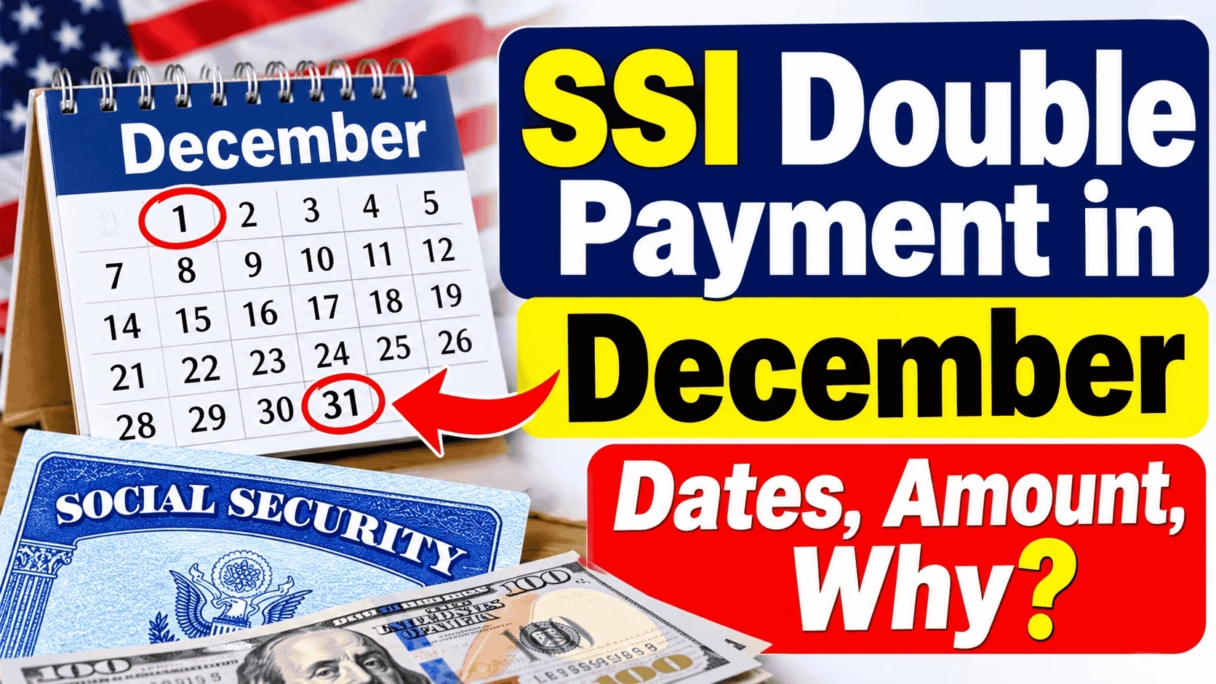
There is a second reason this December matters more than most. The December 31 deposit is the first to reflect a 3.6% benefit increase, according to reporting on the SSA’s announcement. One person can receive up to $1,029 a month at the new federal rate, which is $35 more than this year and the first single-person rate above $1,000. The catch is the calendar. Nothing more arrives until February, so the money has to last the whole month. In plain terms, if you spend the December 31 deposit as if it were extra cash, you could run short before the first week of February. This guide covers the dates, the new amounts, who gets paid when, the rules that can reduce a payment, how to apply, how long approval takes, and the official links you need.
SSI Double Payment in December 2026 Key Highlights
| Date | Day | What it pays for | Notes |
|---|---|---|---|
| December 1, 2026 | Tuesday | December 2026 | Regular payment at the 2026 rate |
| December 31, 2026 | Thursday | January 2027 | Early payment, first at the 2027 rate |
| January 2027 | None | Not applicable | No SSI deposit this month |
| February 1, 2027 | Monday | February 2027 | Next regular SSI payment |
Two earlier 2026 dates followed the same logic. The October 2026 schedule had a payment on October 1 and an early November payment on October 30, because November 1 fell on a Sunday. If you felt a double deposit in October, the same thing is happening again in December.
Why Do SSI Recipients Get Two Payments in December?
The rule is simple. SSI is paid on the first day of each month. When that date lands on a weekend or holiday, the SSA pays on the working day before. January 1, 2027 is New Year’s Day, a Friday and a federal holiday, so the January payment moves back one business day to December 31.
This is why the second deposit is better described as an early payment than an extra payment. Your total for the year stays the same. You simply receive twelve payments across a calendar that puts two of them in the same month. A person who looks only at December sees a double deposit, while the January column on the budget sheet reads zero. The SSA does not treat the early deposit as new income you must report, because it is the payment you were already due.
SSI Payment Schedule 2026 and Early 2027
The 2026 SSI calendar listed payments on January 30, February 27, April 1, May 1, June 1, July 1, July 31, September 1, October 1, October 30 and December 1. Adding the December 31 payment and the February 1, 2027 payment completes the picture for the next two months. If your state adds a supplement, the state payment may follow its own calendar, so check your state’s schedule as well.
| Month | Federal SSI date | Reason |
|---|---|---|
| October 2026 | Oct. 1 and Oct. 30 | Nov. 1 is a Sunday |
| November 2026 | No second deposit | Paid Oct. 30 |
| December 2026 | Dec. 1 and Dec. 31 | Jan. 1 is a federal holiday |
| January 2027 | None | Paid Dec. 31 |
| February 2027 | Feb. 1 | Regular date |
SSI Double Payment Amount: What the 3.6% COLA Means for You?
The SSA announced on October 14 that every benefit it pays will rise 3.6 percent in 2027, based on the Consumer Price Index for Urban Wage Earners and Clerical Workers. For SSI, the cost-of-living adjustment changes the federal benefit rate, which is the maximum monthly amount before other income reduces it.
| Category | 2026 federal rate | 2027 federal rate | Change |
|---|---|---|---|
| One person | $994 | $1,029 | $35 |
| Eligible couple | $1,491 | $1,544 | $53 |
The maximum for one person rises to $1,029, and couples who both qualify share up to $1,544, up from $1,491. These are maximums. Wages and other countable income are deducted from each SSI payment, so many people receive less than the top rate, and some states add their own top-up. The SSA lists the average SSI payment at about $736.54 a month. If your award is below the maximum, expect your increase to follow the federal rate change, assuming your other income stays the same. The calculator above uses that approach.
Remember that the Dec. 1 deposit still uses the 2026 rate. Only the Dec. 31 deposit carries the increase, which is why the two deposits will not match.
SSI Double Payment Calculator
The tool above estimates your Dec. 1 deposit, your Dec. 31 deposit at the 2027 rate, your total for December and a daily budget for the 32 days between Dec. 31 and Feb. 1. It also compares the money you expect to hold on January 1 with the SSI resource limit. It is an estimate, and your SSA notice is the final word.
SSI Double Payment Calculator
See your two December deposits, your new 2027 amount and a simple January budget.
Estimate only. Your SSA notice shows your exact 2027 amount. The calculator adds the federal increase ($35 for one person, $53 for a couple) and assumes your other income is unchanged. State supplements are not included.
When Will I Get My New SSI Amount Notice?
People with a my Social Security account can view their new amount in the Message Center from late November, up to three weeks before paper notices go out. Those who had not chosen paperless notices by November 18 will receive a letter by mail in December. If you have not made an account, doing so takes a few minutes and gives you the number before the deposit arrives.
Do I Get Two Social Security Payments Too?
Only SSI gets the Dec. 1 and Dec. 31 pairing. Regular Social Security retirement, survivor and disability checks follow the Wednesday schedule tied to your birthday, with one exception. People who receive both SSI and Social Security have a January payday on the 3rd, which falls on a Sunday in 2027, so that payment moves to December 31 as well. If you are in that group, you can see three deposits in December: your SSI on Dec. 1, your SSI on Dec. 31 and your Social Security on Dec. 31. Again, the third is January’s money arriving early.
How to Budget the December 31 Deposit?
Treat the second deposit as January’s rent, food and bills. A simple plan works better than a complicated one.
- Write down your fixed bills for January, such as rent, utilities, phone and insurance.
- Set those amounts aside first, or pay them early if your landlord allows it.
- Divide what is left by 32 days to get a daily spending number.
- Keep a small buffer for medical copays or a late-month surprise.
A rough example shows why this matters. If your January payment is $1,029 and your fixed bills are $600, you have $429 for everything else over 32 days, or about $13.40 a day. That figure is much tighter than the double deposit makes it feel in the last week of December.
SSI Resource Limits: Check Your Balance Before January 1
The countable asset limits did not change. One person can hold no more than $2,000, and a couple no more than $3,000, and both figures date back to 1989. SSA generally measures resources as of the first of the month. Because the Dec. 31 deposit lands one day before the new month begins, people with savings close to the limit should ask SSA how that balance will be treated. A call before January 1 costs nothing and avoids a surprise later. Items such as your home and one car are generally excluded, but the rules have details, so confirm with SSA if you are near the line.
SSI Eligibility 2026: Who Qualifies?
SSI is a monthly benefit for people with little money who are disabled, blind, or 65 and older. To qualify, you also need to meet income and resource limits and live in the United States. About 7.3 million people receive SSI, according to the same reporting. The program is separate from Social Security retirement and disability insurance, which depend on your work history.
How to Apply for SSI in 2026?
The steps are straightforward, though the paperwork takes patience.
- Gather documents. You will need proof of age, Social Security number, citizenship or immigration status, your address and details on income, bank accounts and living arrangements. For disability claims, add medical records and a list of doctors.
- Start the application at the SSA website or call 1-800-772-1213. You can also book an appointment at a local office.
- Complete the interview, which can be by phone or in person.
- Submit your forms and records. Ask for a receipt or confirmation number.
- Respond quickly to any requests from SSA or the state agency that reviews medical evidence.
- Create your my Social Security account so you can follow the case and see notices.
If you are applying for a child, a parent or guardian completes the process with the child’s records.
SSI Application Processing Time
Timing depends on the type of claim. An age-based claim can move faster than a disability claim, which needs medical review. SSA has said that disability decisions often take several months, commonly in the range of three to five months, though your case may be faster or slower. The SSA publishes current average wait times on its website, so check there for the latest figure. In some cases SSA can make presumptive disability payments while it finishes the decision. If your claim is denied, you have a limited time to appeal, so read the notice for the deadline and act on it.
SSI Payment Schedule: How and Where You Get Paid
SSI is paid by direct deposit or on a Direct Express card, and the federal government has been moving away from paper checks. Direct deposit is the most reliable option, especially around holidays. If you changed banks or your account number, update it through your my Social Security account or with SSA before December 31 so the early payment does not bounce back. Watch for payment timing at your bank too. Some banks post federal deposits on the morning of the payment date, and some post a day earlier.
What Can Reduce Your SSI Payment?
The maximum rate is only a starting point. Several things lower your monthly amount:
- Earned income, such as wages, after standard SSI exclusions.
- Unearned income, such as certain pensions or support.
- Living arrangements, such as receiving help with food or shelter.
- Other income received by a spouse who lives with you.
Report changes by the deadline SSA gives you, usually by the tenth day of the month after the change. Late reporting can create an overpayment that SSA later recovers from future checks.
SSI Scams to Watch For Around the December Deposit
Fake calls and texts tend to rise when big news about payments circulates. The SSA warns that its services are free and that no government body asks for fees by wire transfer or gift card. If someone claims your double payment is an error and asks you to send money back, hang up. Contact SSA through the official number or log in to your account directly instead of clicking links in a message.
Official SSI Resources and Links
| Resource | Use it for | Link |
|---|---|---|
| Social Security Administration | Main site, news and forms | https://www.ssa.gov |
| my Social Security | Login, view your 2027 notice, change direct deposit | https://www.ssa.gov/myaccount |
| Apply for benefits | Start an application | https://www.ssa.gov/apply |
| SSI program page | Rules, rates and eligibility | https://www.ssa.gov/ssi |
| SSI federal payment amounts | Current and upcoming rates | https://www.ssa.gov/oact/cola/SSI.html |
| COLA information | Annual increase details | https://www.ssa.gov/oact/cola |
| Local office locator | Find an office and book a visit | https://secure.ssa.gov/ICON/main.jsp |
| SSA Office of the Inspector General | Report fraud | https://oig.ssa.gov |
SSI Double Payment FAQs
Why am I getting two SSI payments in December?
January 1 is a federal holiday, so SSA pays January’s SSI on December 31. You still receive twelve payments for the year.
When is the second SSI payment in December?
Thursday, December 31, 2026. The first is Tuesday, December 1.
Is the SSI double payment extra money?
No. The second deposit is your January 2027 payment, paid early.
Will I get an SSI payment in January 2027?
No. Your next SSI payment after December 31 is on February 1, 2027.
How much is the new SSI payment in 2027?
Up to $1,029 for one person and up to $1,544 for a couple at the federal level, before any income reductions or state supplements.
Is the 3.6% increase included in the December 31 payment?
Yes. The Dec. 31 deposit is the first at the new rate, while the Dec. 1 deposit uses the 2026 rate.
Do I have to report the extra deposit?
No. It is the payment you were already due, so it is not new income.
Can the early deposit affect my resource limit?
It can matter if your balance is close to $2,000 for one person or $3,000 for a couple. Ask SSA how it will count your money on January 1.
Do SSI recipients get paid twice in December?
Yes in 2026. SSI is paid on December 1 and again on December 31.
What date will SSI be deposited in December 2026?
December 1 and December 31, 2026.
Why did SSI come early?
SSA pays on the prior business day when the first falls on a weekend or holiday.
Will Social Security checks also be paid twice in December?
Only people who get both SSI and Social Security on the 3rd see January’s Social Security paid on December 31. Most other beneficiaries follow the regular Wednesday schedule.
How can I find out my SSI amount for next year?
Log in to your my Social Security account and open the Message Center, or wait for your mailed notice.
How do I make the money last until February?
List fixed bills first, divide the rest by 32 days and keep a small cushion for emergencies.
Can I check my SSI payment status online?
Yes. Use your my Social Security account for payment history and notices.
Is SSI taxable?
SSI is generally not taxable federal income. If you have questions about your own return, ask a tax professional or the IRS.
Conclusion
The SSI double payment this December comes down to a calendar rule. Two deposits arrive, Dec. 1 and Dec. 31, and the second is January’s payment at the new 3.6% rate, not extra money. The best moves are practical ones. Check your amount in your my Social Security account, make sure your direct deposit information is current, plan a January budget that stretches 32 days, and keep your balance under the resource limit. If anything looks off on your notice, contact SSA through official channels only. We’ll be updating this article monthly.