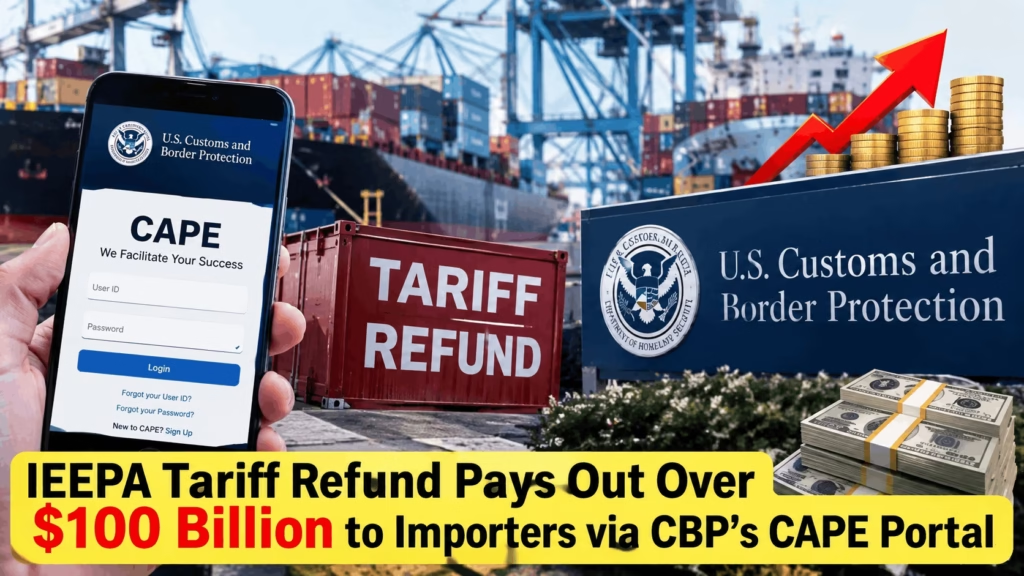
IEEPA Tariff Refund Process: The federal government has now returned more than $100 billion in unlawfully collected import duties to American businesses, and the pace of payments is accelerating just as a fresh legal fight over the program reaches a federal courtroom. A court filing this month confirmed U.S. Customs and Border Protection has refunded roughly 60 percent of the estimated $166 billion it collected under tariffs the Supreme Court struck down in February, with the largest companies in American retail, from Nike to Apple to Walmart, now reporting nine and ten figure windfalls in their own earnings statements. At the same time, thousands of smaller importers are still waiting, caught in a system that processes claims in stages and treats entries differently depending on when and how they were finalized by customs officials.
This is not a stimulus check story and it was never meant to be one. The IEEPA tariff refund process is a business-to-government transaction, built specifically to unwind duties that courts ruled the executive branch never had legal authority to impose in the first place. Understanding how it actually works, who qualifies, which companies have already been paid, and where the ongoing court battle stands matters enormously for the roughly 330,000 importers with money still sitting in the pipeline. We’ll be updating this article monthly as CBP releases new refund totals and as the appeals process moves forward.
The Supreme Court Ruling That Started It All
On February 20, 2026, the U.S. Supreme Court ruled 6-3 in Learning Resources, Inc. v. Trump that the International Emergency Economic Powers Act did not give the president authority to impose the sweeping tariffs that had been in place since April 2025, including the so called Liberation Day reciprocal tariffs and the fentanyl-related duties on China, Canada, and Mexico. The ruling did not touch tariffs imposed under other legal authorities, such as the Section 232 national security tariffs on steel and aluminum, but it wiped out the legal foundation for the IEEPA duties specifically.
According to court filings and CBP data, approximately 330,000 importers had paid or deposited an estimated 166 billion dollars in IEEPA duties across more than 53 million individual customs entries between April 2025 and February 2026. The ruling meant all of that money was owed back, but it left open a question the Supreme Court did not directly answer, how the refunds would actually be administered at scale.
How CBP Built the CAPE Refund System?
Rather than processing 53 million entries one at a time, Customs and Border Protection built a new digital tool called CAPE, short for Consolidated Administration and Processing of Entries, inside its existing Automated Commercial Environment portal. CBP opened Phase 1 of CAPE on April 20, 2026, allowing importers of record and their licensed customs brokers to upload a CSV file listing entry numbers, called a CAPE Declaration, rather than filing a separate claim for every shipment.
Each CAPE Declaration can include up to 9,999 entries, and an importer can file multiple declarations if needed. No supporting documentation is required at the time of submission beyond the entry numbers themselves, though CBP reviews each entry afterward for issues such as product classification errors, disputed country of origin, or transshipment concerns before finalizing payment. Refunds are consolidated into a single payment per declaration and include statutory interest calculated from the original payment date, at a rate of 7 percent for non-corporate filers and 6 percent for corporate filers for the quarter that began January 1, 2026.
The Three Phases of CAPE, and Why the Phase Matters
Not every entry qualifies for a refund at the same time. CBP rolled out CAPE in three distinct phases, and which phase applies to a given shipment depends entirely on its liquidation status, meaning whether customs had already finalized the duty calculation on that entry before the Supreme Court ruling came down.
| CAPE Phase | Launch Date | What It Covers |
|---|---|---|
| Phase 1 | April 20, 2026 | Unliquidated entries and entries liquidated within 80 days of the CAPE submission |
| Phase 2 | June 29, 2026 | Entries flagged for reconciliation and certain antidumping or countervailing duty entries |
| Phase 3 | Late July 2026 | Finally liquidated entries, available only to importers who filed a protective lawsuit at the Court of International Trade |
That last detail in Phase 3 is the one tripping up importers who assumed CAPE alone would cover everything. Entries that were fully liquidated before the refund process existed generally cannot recover money through CAPE unless the importer also has an active case at the Court of International Trade. Businesses that skipped filing a protest or lawsuit within the standard 180 day window under federal customs law risk losing access to that portion of their refund entirely, regardless of how clearly they were owed the money.
How Much Has Actually Been Paid Out
The dollar figures have climbed steadily and quickly since CAPE went live. By July 10, 2026, CBP had accepted roughly 121.75 billion dollars in claims for processing and had already repaid about 86.3 billion dollars to importers, including interest. A court filing in early August 2026 put the total even higher, showing the government had refunded more than 100 billion dollars, or roughly 60 percent of the full 166 billion dollar obligation. In the first six weeks of Phase 1 alone, CBP processed refunds tied to nearly 8.5 million individual entries.
50% US Tariffs on Canadian Goods: Full List and What Changes
Borrower Defense Student Loans: How to Apply for a Full Discharge?
IRS Business Tax Account New Features Give Small Businesses More Ways to Skip the Phone Line
SSA Payroll Information Exchange and New SSI Improvement Office: What the Report Actually Changes
Which Companies Have Received the Biggest Refunds
The scale of individual company payouts has become a story in its own right. Citi’s April 2026 analysis projected Walmart was due roughly 10.2 billion dollars, Target roughly 2.2 billion dollars, and Nike as much as 1 billion dollars, with smaller but still significant amounts flowing to Kohl’s, Gap, and Macy’s. Several of those projections have since been confirmed or updated directly by the companies involved.
Nike recorded a 986 million dollar tariff refund in its fiscal fourth quarter earnings report, a windfall large enough to help drive a nine hundred basis point jump in the company’s gross profit margin for the quarter. Apple disclosed a 2.2 billion dollar refund in its third quarter earnings. Amazon confirmed on July 30, 2026 that it received about 600 million dollars in IEEPA refunds during the second quarter alone. Smaller businesses are collecting real money too. Basic Fun, the toy company behind Tonka Trucks and Care Bears, received a 6.5 million dollar wire transfer from the Treasury Department in late June, covering about 95 percent of what it was owed.
| Company | Refund Amount | Status |
|---|---|---|
| Walmart | Approximately $10.2 billion projected | Claim filed, payment stages ongoing |
| Apple | $2.2 billion | Confirmed in Q3 earnings |
| Target | Approximately $2.2 billion projected | Refund in process |
| Nike | $986 million | Confirmed in Q4 earnings |
| Amazon | $600 million (Q2 alone) | Confirmed by company |
| Kohl’s | Approximately $550 million projected | Refund in process |
| Gap | Approximately $400 million projected | Refund in process |
| Macy’s | Approximately $320 million projected | Refund in process |
| Basic Fun (small business example) | $6.5 million | Paid, roughly 95% of amount owed |
Where Does the Refund Money Actually Go
By law, CAPE refunds go only to the importer of record named on the customs entry, meaning the business that physically paid the duty at the border, not the end consumer who may have paid a higher retail price because of it. This has drawn criticism from lawmakers on both sides of the aisle. Senator Elizabeth Warren sent letters in early August 2026 to Apple, Amazon, Energizer, Motorola, Nike, Target, and Walmart demanding disclosure of refund amounts and asking the companies to pass savings on to customers. Senator Edward Markey sent similar letters earlier in the year to Amazon, Walmart, Costco, FedEx, UPS, and DHL.
The response from retailers has varied widely. Amazon said it identified a limited set of cases where it will proactively refund affected customers directly, with no claim required. Costco has pledged to compensate members if a separate company lawsuit succeeds. Walmart, BJ’s Wholesale Club, and E.l.f. Beauty have said they are using refund money to help lower prices going forward rather than issuing direct customer refunds. Apple has said it plans to direct its refund toward U.S. manufacturing investment rather than price cuts. Some smaller retail brands, including American Eagle Outfitters and The Children’s Place, have opted to sell their rights to future tariff refunds to third parties for immediate cash rather than wait out the CAPE process.
The Legal Fight Is Still Not Over
Even as billions of dollars move out the door, the underlying legal battle over how refunds should be administered remains active. The Department of Justice filed a notice of appeal with the U.S. Court of Appeals for the Federal Circuit on June 2, 2026, challenging the Court of International Trade’s authority to order refunds for importers who never filed their own lawsuit, arguing the lower court’s order amounted to an improper universal injunction. In August 2026, the Federal Circuit affirmed the Court of International Trade’s underlying ruling that the tariffs were unlawful, but it also stayed enforcement to allow the government to seek Supreme Court review, and it sent part of the case back to the trial court to reconsider whether refunds should extend beyond the original plaintiffs to every affected importer.
That unresolved question sat at the center of an August 6, 2026 hearing at the Court of International Trade in New York, where the advocacy group Liberty Justice Center argued for class certification on behalf of importers whose entries were finally liquidated before CAPE existed, the same group of businesses currently shut out of Phase 3 unless they have their own active lawsuit. The group argues thousands of businesses should not be forced to file duplicative individual suits to obtain refunds the government already owes them under the Supreme Court’s ruling.
What Importers Should Do Right Now
Businesses still waiting on a refund, or unsure whether they qualify, have a narrow set of practical steps available. An importer of record or its authorized customs broker, and only that party, can submit a CAPE Declaration, which requires an active ACE Portal account with bank information on file. Entries that are unliquidated or were liquidated recently generally move through Phase 1 or Phase 2 without much friction. Entries that were finally liquidated well before April 2026 are the highest risk category, and businesses in that position should confirm with their customs broker or trade counsel whether they have filed, or still can file, a protest within 180 days of liquidation under federal customs law, or a lawsuit at the Court of International Trade if that window has already closed.
CBP has also warned repeatedly about scams targeting importers during this process, urging businesses to verify all refund-related communications through official CBP channels and to use only verified ACE Portal accounts rather than third parties claiming to expedite payment for a fee.
Maryland SNAP Cost-Sharing Rules: Why the State Faces a $300 Million Bill Starting 2027
Official Resources for Importers
| Resource | Purpose | Link |
|---|---|---|
| CBP ACE Secure Data Portal | File CAPE Declarations, check account status | https://ace.cbp.dhs.gov |
| CBP CAPE Guidance and Trade Bulletins | Official filing instructions and phase updates | https://www.cbp.gov/trade/automated |
| U.S. Court of International Trade | Case filings and hearing schedules for IEEPA refund litigation | https://www.cit.uscourts.gov |
| CBP Trade Outreach Webinars | Recorded guidance sessions on CAPE filing | https://www.cbp.gov/trade/stakeholder-engagement |
FAQs
Who can file an IEEPA tariff refund claim through CAPE?
Only the importer of record listed on the original customs entry, or that importer’s authorized licensed customs broker, can submit a CAPE Declaration. A third party consultant or accountant cannot file unless they are formally the broker of record on the entry.
How long does it take to receive a refund after filing?
CBP has said valid refunds are typically issued within 60 to 90 days after a CAPE Declaration is accepted, though claims flagged for a compliance review, such as questions about product classification or country of origin, can take longer.
Can consumers get any of the $166 billion IEEPA tariff refund?
No. The refund process is legally structured to return money only to the businesses that paid the duties at import, not to individual shoppers who may have paid higher retail prices as a result. Any consumer benefit depends entirely on whether a given retailer chooses to lower prices or issue its own customer refunds.
What happens to entries that were already finally liquidated before CAPE existed?
Those entries generally fall outside CAPE Phase 1 and Phase 2 and are only eligible for Phase 3, which requires the importer to have an active protective lawsuit filed at the Court of International Trade. Businesses that missed both the 180 day protest window and litigation deadlines risk losing access to that refund permanently.
Is the government still fighting the refund order in court?
Yes. The Department of Justice has appealed the scope of the Court of International Trade’s refund order to the Federal Circuit, which affirmed that the tariffs were unlawful in August 2026 but stayed part of its ruling while the government seeks Supreme Court review, leaving open how broadly refunds must apply to importers who never filed their own lawsuit.
Are IEEPA tariff refunds taxable?
Refunded duties are generally treated as a recovery of a prior business expense and may have tax implications depending on how the original duty payment was deducted. Businesses should consult a tax professional or their customs counsel about how a refund affects their specific filings.
Conclusion
The IEEPA tariff refund process has already moved more than 100 billion dollars back into the hands of American businesses, from toy makers to the country’s largest retailers, making it one of the largest reversals of a federal revenue collection effort in recent memory. But the story is far from finished. Tens of billions of dollars remain in the pipeline, an entire category of finally liquidated entries hangs on the outcome of ongoing litigation, and the government’s own appeal could still reshape who is entitled to a refund at all. For the hundreds of thousands of importers still navigating CAPE, the practical work now is less about waiting and more about making sure every entry, and every legal deadline tied to it, has actually been accounted for. We’ll be updating this article monthly as CBP releases new payment totals and as the Federal Circuit and Court of International Trade issue further rulings.
New $20,000 Visa Bond Program: What It Means for Travelers Entering the U.S.
VA Health and Benefits App: Every Feature You Can Use From Your Phone