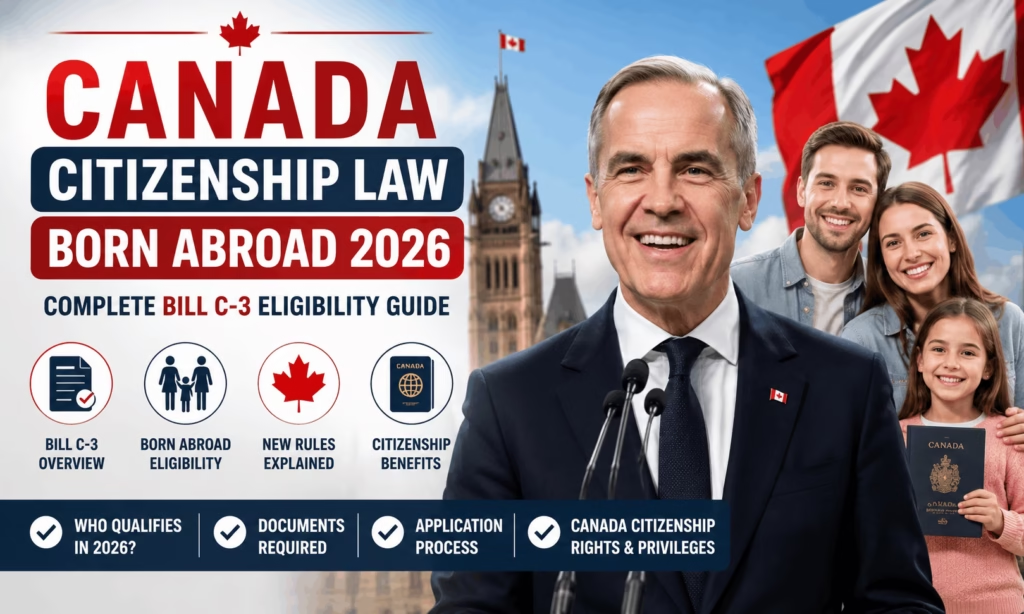
The Canada citizenship law born abroad 2026 update has become one of the most searched immigration topics this year, as thousands of families across the United States, United Kingdom, India, and beyond discover they may already be Canadian citizens without ever knowing it. This sweeping change comes from Bill C-3, officially titled An Act to Amend the Citizenship Act (2025), which received Royal Assent on 20 November 2025 and came fully into force on 15 December 2025. The law opens the door to Canadian citizenship by descent for potentially tens of thousands of people born outside Canada who were previously excluded by an outdated generational restriction.
What makes this update so significant is its reach — citizenship can now flow through an unbroken chain of descent covering a parent, grandparent, or even a great-grandparent, provided every generational link is properly documented. Families of Indian, American, and British origin with even a distant Canadian ancestor are now racing to provincial archives to trace their roots. This guide explains exactly how Bill C-3 works, who qualifies, what documents are required, and how the process differs depending on how many generations back your Canadian connection sits.
The First-Generation Limit That Existed Before
To understand why Bill C-3 matters so much, it helps to understand the rule it replaced. Since 2009, Canada’s Citizenship Act restricted citizenship by descent to only the first generation born outside Canada. In practice, this meant a Canadian citizen born in Canada could pass citizenship to a child born abroad — but if that child later had children of their own outside Canada, those grandchildren were automatically excluded, regardless of how strong the family’s ongoing connection to Canada remained.
This restriction, known as the first-generation limit (FGL), created a well-documented class of people referred to as “Lost Canadians” — individuals with legitimate, traceable Canadian ancestry who were denied citizenship purely because of when and where their parent happened to be born.
$450K Student Debt Relief: Here Are The Restrictions Behind The Sweet v. McMahon Settlement
The Court Ruling That Forced the Change
The first-generation limit’s days were numbered after a major legal challenge. On 19 December 2023, the Ontario Superior Court of Justice, in Bjorkquist v. Attorney General of Canada, ruled that the restriction was unconstitutional, finding it created an unequal class of citizenship for Canadians born abroad. The federal government chose not to appeal the ruling, effectively acknowledging the law’s unfair outcomes. This led directly to the introduction of Bill C-3, which cleared Parliament and became law by the end of 2025.
Canada Citizenship Law 2026: Key Highlights at a Glance
| Particulars | Details |
|---|---|
| Law Name | Bill C-3 – An Act to Amend the Citizenship Act (2025) |
| Royal Assent Date | 20 November 2025 |
| Came Into Force | 15 December 2025 |
| Key Change | Removes the first-generation limit on citizenship by descent |
| Who Benefits | Descendants of Canadian citizens born abroad (parent, grandparent, great-grandparent chain) |
| New Requirement (Future Births) | 1,095 days (3 years) “substantial connection” for births on/after 15 Dec 2025 |
| Government Filing Fee | CAD $75 per applicant |
| Current Processing Time | Roughly 9–15 months (varies by case complexity) |
| Official Website | canada.ca (IRCC – Citizenship Act Changes) |
How Bill C-3 Actually Works
The core of Bill C-3 is its retroactive provision. The law grants citizenship retroactively to anyone born before 15 December 2025 who would already have been a Canadian citizen if the first-generation limit had never existed. This effectively removes the generational cap entirely for all past births, allowing citizenship to flow through an unbroken chain of descent — starting from an original Canadian ancestor, whether they became Canadian by birth in Canada or through naturalization.
Two Separate Pathways, Depending on Birth Date
Bill C-3 operates through two distinct mechanisms:
- Automatic Restoration — If you were born before 15 December 2025 and would have been a citizen but for the first-generation limit, your citizenship is generally restored automatically and retroactively, with no requirement to prove your Canadian parent’s time spent in Canada.
- The Substantial Connection Test — If you were born on or after 15 December 2025 to a Canadian parent who was also born or adopted abroad, your parent must demonstrate at least 1,095 cumulative days (three years) of physical presence in Canada before your birth or adoption.
This distinction matters for planning: families with children already born generally qualify under the more generous restoration rule, while those expecting children abroad in the future need to actively track physical presence days.
Citizenship Through a Grandparent or Great-Grandparent: How the Chain Works
One of the most searched questions under this new law is whether citizenship can pass through a great-grandparent. The answer is yes — but only if every link in the chain is intact.
Bill C-3 does not allow citizenship to skip a generation. A Canadian great-grandparent alone is not enough if the parent-to-child link anywhere in the chain is missing or undocumented. Instead, the law works by recognizing citizenship retroactively at each link: the great-grandparent’s citizenship flows to the grandparent, which flows to the parent, which flows to the applicant — provided every birth in that chain occurred before 15 December 2025 and can be documented.
Canada FMCSP Study Permit: 2,970 Spots Open August 26, See Eligibility, PR Pathway & How to Apply?
What Documents Are Needed for a Multi-Generation Claim
Because these claims can span three, four, or more generations, the documentary requirements are substantial. Generally, applicants need:
- The original Canadian ancestor’s birth certificate or citizenship/naturalization certificate
- Birth certificates for every generation in between, showing the parent-child link at each step
- The applicant’s own long-form birth certificate
- Marriage certificates wherever a name change occurred across generations
- Alternative historical evidence where original civil records are unavailable — including hospital records, baptismal records, census entries, and even boat manifests, which a 25 May 2026 parliamentary response confirmed are acceptable to meet the legal “balance of probabilities” standard
Given the complexity of tracing records across provinces (and sometimes across countries), many applicants are turning to licensed immigration lawyers or Regulated Canadian Immigration Consultants (RCICs) for help building a complete, defensible application.
Why This Matters So Much for the Global Indian and International Diaspora
Beyond North American families, Bill C-3 carries particular significance for the Indian diaspora and other international communities with Canadian-origin family members. Many Canadians of Indian origin who studied, worked, or settled abroad — in the United States, United Kingdom, or elsewhere — previously found that their children born outside Canada could not inherit citizenship, creating a generation of children with undefined or “stateless” status relative to their Canadian heritage. Bill C-3 directly addresses this gap, allowing diaspora parents to pass Canadian citizenship down to children born or adopted outside the country, so long as the substantial connection or automatic restoration criteria are met.
Surge in Demand: Why Provincial Archives Are Overwhelmed
The practical impact of this law change is already visible at provincial vital records archives. At Bibliothèque et Archives nationales du Québec (BAnQ), certified copy requests jumped from just 32 requests in January 2025 to over 1,000 requests in January 2026 — the overwhelming majority from Americans tracing Canadian ancestry. Archives in New Brunswick, British Columbia, Newfoundland, and Ontario have reported similarly sharp increases. As of early 2026, IRCC confirmed it expects tens of thousands of new citizenship certificate requests over time, with tens of thousands of applications already in the processing queue.
Recent IRCC Document Review Concerns
Applicants should be aware of a developing situation: on 13 June 2026, IRCC contacted a number of self-represented applicants who had recently received citizenship-by-descent certificates, asking them to surrender their documents pending a file review. This affected roughly 4,075 individuals, about half of them born in the United States. If you receive such a notice, do not surrender your documents without legal advice — a parliamentary response has confirmed that alternative evidence is acceptable, and established Federal Court precedent holds that applicants are entitled to rely on IRCC’s own published instructions. Anyone affected should contact licensed Canadian legal counsel promptly.
What Canadian Citizenship Actually Provides
For newly eligible applicants, confirmed Canadian citizenship brings meaningful, lasting benefits:
- The right to live and work anywhere in Canada without immigration restrictions
- Eligibility for a Canadian passport, offering broad visa-free travel access
- The right to vote in federal and provincial elections and to run for public office
- Access to Canadian healthcare when residing in the country
- The ability to sponsor family members, including a spouse or common-law partner, for Canadian immigration
- No automatic tax obligation — Canadian taxation is generally based on residency, not citizenship alone
Official Links for Applicants
(Always confirm links through the official Government of Canada website before submitting personal documents or payment.)
| Purpose | Where to Go |
|---|---|
| Official Citizenship Act Updates | canada.ca – IRCC Citizenship Act Changes section |
| Proof of Citizenship Application | IRCC official application portal |
| Application Status Check | IRCC online account / MyCIC portal |
| Provincial Vital Records | Respective provincial vital statistics agency (e.g., BAnQ for Quebec) |
| Home Page | govtschemes.org |
The Canada citizenship law born abroad 2026 update represents one of the most significant expansions of citizenship rights in the country’s modern history, correcting what courts determined was a genuinely unconstitutional exclusion. Whether your connection to Canada runs through a parent, a grandparent, or a great-grandparent, 2026 offers the most realistic opportunity in decades to formally reclaim that heritage — provided the documentary chain can be built. Given the surge in applications and evolving IRCC review practices, applicants are strongly encouraged to start early, gather records methodically, and seek professional guidance for multi-generational claims.
FAQs
What is Bill C-3 in simple terms?
Bill C-3 is a 2025 amendment to Canada’s Citizenship Act that removes the first-generation limit, allowing citizenship by descent to pass beyond one generation born outside Canada.
When did Bill C-3 come into force?
Bill C-3 received Royal Assent on 20 November 2025 and came into force on 15 December 2025.
Can I claim Canadian citizenship through a great-grandparent?
Yes, as long as there is an unbroken documentary chain of descent connecting you to your great-grandparent through your grandparent and parent, and each birth occurred before 15 December 2025.
Does citizenship skip a generation if only the grandparent is Canadian?
No. Citizenship cannot skip a generation — every link in the parent-to-child chain must be documented and recognized.
What is the 1,095-day rule?
It requires a Canadian parent born or adopted abroad to show at least three years of cumulative physical presence in Canada before the birth of a child born on or after 15 December 2025.
How long does a proof of citizenship application take in 2026?
Processing times currently range from roughly 9 to 15 months, depending on case complexity and current backlog.
Is there a fee for a Canadian citizenship certificate?
Yes, the government filing fee is CAD $75 per applicant, with additional costs for certified vital records.
What should I do if IRCC asks me to surrender my citizenship certificate?
Do not surrender any documents without first consulting licensed Canadian legal counsel, as applicants are legally entitled to rely on IRCC’s own published instructions.
USCIS E-Filing Mandate: New DHS Rule Gives Agency Power To Retire Paper Immigration Forms
Denaturalization Cases Surge As DOJ Files Record 25 Complaints In Just Two Weeks