Education Freedom Tax Credit States: Thirty states have now opted in to the Education Freedom Tax Credit, and the list is no longer a guessing game. On October 2, the IRS released proposed and temporary rules that spell out how states must join, how donors claim the credit and how scholarship groups operate. A tracker updated on October 5 counts 30 states as opted in, one more as announced, 14 as undecided, four as declined and two where a governor vetoed an opt-in bill. The program starts on January 1, 2027, and a state that has not filed an advance election by that date will sit out the first year. Families in those states cannot receive scholarships, even if they live next door to a participating one. Under the new rules, married couples filing jointly can claim up to $3,400, double the $1,700 individual limit. We’ll be updating this article monthly as governors decide and the IRS finalizes its rules.
The tally depends on who is counting. Some trackers include states that have only made an advance election, while the rules say a state completes its decision by submitting a list of approved scholarship groups by February 15, 2027. That two step process also gives newly elected governors a window to change course, and 19 of the 30 opted in states hold governor elections in November. This guide gives the full state list in plain tables, shows which states are still undecided, explains what opting in actually requires, and walks through how much credit a taxpayer can claim. A free calculator at the end checks any state’s status and works out your credit in under a minute. If you only want to know whether your own state is on the list, jump to the full list below, then come back for the deadlines.
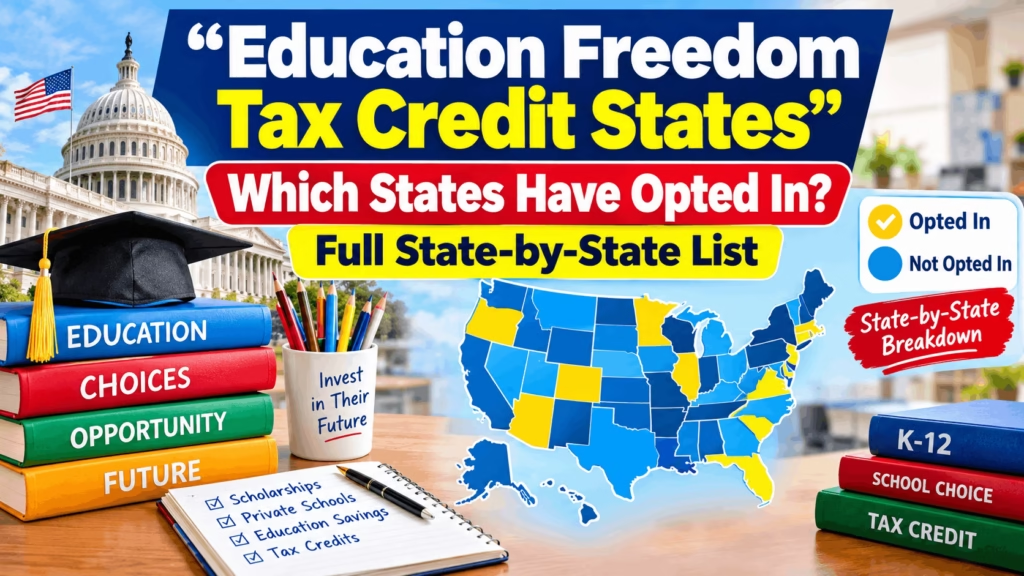
Education Freedom Tax Credit States Key Highlights
| Item | Detail |
|---|---|
| Program start date | January 1, 2027 |
| Maximum credit, individual | $1,700 |
| Maximum credit, married filing jointly | $3,400 (each spouse claims $1,700) |
| States opted in | 30 (as of October 5, 2026) |
| States that announced they will opt in | 1 (New York) |
| States undecided | 14, including the District of Columbia |
| Governors who vetoed an opt-in bill | 2 (Arizona, Wisconsin) |
| States that declined | 4 (Hawaii, Minnesota, New Mexico, Oregon) |
| Deadline for an advance election | January 1, 2027 |
| Deadline to submit scholarship group list | February 15, 2027 |
Which States Have Opted In? Full List of 30
These 30 states have opted in. Grouping them by who controls state government shows that participation is not strictly a party line decision.
| Political control | States | Count |
|---|---|---|
| Republican controlled government | Alabama, Arkansas, Florida, Georgia, Idaho, Indiana, Iowa, Louisiana, Mississippi, Missouri, Montana, Nebraska, New Hampshire, North Dakota, Ohio, Oklahoma, South Carolina, South Dakota, Tennessee, Texas, Utah, West Virginia, Wyoming | 23 |
| Divided government | Alaska, Kansas, Kentucky, Nevada, North Carolina | 5 |
| Democratic controlled government | Colorado, Virginia | 2 |
The alphabetical list is simple: Alabama, Alaska, Arkansas, Colorado, Florida, Georgia, Idaho, Indiana, Iowa, Kansas, Kentucky, Louisiana, Mississippi, Missouri, Montana, Nebraska, Nevada, New Hampshire, North Carolina, North Dakota, Ohio, Oklahoma, South Carolina, South Dakota, Tennessee, Texas, Utah, Virginia, West Virginia and Wyoming.
A few of these states arrived by unusual routes.
| State | How it opted in |
|---|---|
| Colorado | Governor Jared Polis opted in on December 5, 2025, the first Democratic governor to do so |
| Virginia | Opted in by former Governor Glenn Youngkin on January 1, 2026, then inherited by his Democratic successor |
| Kentucky | Legislature overrode the governor’s veto on March 17, 2026, and the state completed its filing on July 22 |
| Kansas | Legislature overrode the governor’s veto on April 13, 2026 |
| North Carolina | Legislature overrode the governor’s veto on June 3, 2026 |
| Tennessee | Opted in by statute on May 5, 2026 |
Which States Have Not Opted In Yet?
Here is where the remaining 21 states and the District of Columbia stand, based on the same October 5 tracker.
| Status | States |
|---|---|
| Announced they will opt in (1) | New York |
| Undecided (14) | California, Connecticut, Delaware, District of Columbia, Illinois, Maine, Maryland, Massachusetts, Michigan, New Jersey, Pennsylvania, Rhode Island, Vermont, Washington |
| Governor vetoed an opt-in bill (2) | Arizona, Wisconsin |
| Declined (4) | Hawaii, Minnesota, New Mexico, Oregon |
New York deserves a closer look. Governor Kathy Hochul has said she supports the federal tax credit scholarship, and her office has said it wants to review the details before an official decision. As of the latest tracker, the state has publicly committed but has not filed. If New York joins, the number of participating states would rise to 31, which matches the figure some outlets have used for states that have opted in or plan to.
Several Democratic governors had said they would wait for the IRS rules before deciding, and the rules arrived on October 2. Ballotpedia reported on October 7 that no governor had opted in since the week before the release.
What Does Opting In Actually Require?
Opting in is a two step process, and many headlines skip the second step.
- The advance election. A state tells the IRS through a new state portal that it intends to participate in 2027. Under the temporary rules, this must happen by January 1, 2027.
- The scholarship group list. The state submits the names of qualified scholarship granting organizations, known as SGOs, to the IRS. States may file this list as late as February 15, 2027, and the list is what completes the decision.
A state must elect again every year. States cannot impose rules on SGOs that are stricter than the federal requirements, and they must list every SGO that meets the federal tests and asks to take part. SGOs with pending nonprofit status can be placed on a state’s list, though they appear on the federal list only after the IRS approves their status.
The timeline creates a real possibility of reversals. Thirty six states hold governor elections in 2026, and 19 of the 30 states that completed an advance election are among them. A governor taking office in January who wants out could simply decline to submit an SGO list by February 15. That is why the number can move even in states that are listed as opted in today.
Why Different Lists Show Different Numbers
If you have seen the number 23, 30, 31 and 42 in the last few months, none of them is wrong. They measure different things at different times.
| Number | What it counted |
|---|---|
| 23 | States on the Education and Treasury departments’ joint fact sheet in January 2026 |
| 30 | States that had completed an advance election as of early October 2026 |
| 31 | The 30 plus New York, which has announced but not filed |
| 42 | A forecast from a school association of how many states could opt in during the first year |
SSI Payment Schedule October 2026: Two Deposits Are Coming, and Here Is When Your Benefits Land
Social Security Payment Dates for November 2026: SSI, SSDI and Retirement Schedule
How the Credit Works: Amounts, Limits and Examples
The Education Freedom Tax Credit gives individual taxpayers a federal credit for donations to approved SGOs. It is a credit, not a deduction, so it reduces tax owed dollar for dollar. The key rules from the new IRS proposals:
- The maximum credit is $1,700 per person, or $3,400 for a married couple filing jointly.
- The credit is nonrefundable, meaning it can reduce your tax to zero but will not produce a refund by itself.
- Unused credit can be carried forward for five years.
- Any state tax credit you receive for the same donation is subtracted first, then the federal credit is calculated on what is left.
- The same donation cannot also be claimed as a charitable deduction.
- Donations made through a business or partnership do not count toward an individual’s credit.
Here are three simple examples.
| Taxpayer | Donation | State credit received | Federal tax owed | Credit this year | Carried forward |
|---|---|---|---|---|---|
| Single filer | $1,700 | $0 | $4,000 | $1,700 | $0 |
| Single filer | $1,700 | $0 | $900 | $900 | $800 |
| Married couple | $3,400 | $500 | $6,000 | $2,900 | $0 |
In the second row, the donor owes less than the credit, so the unused part carries into next year. In the third row, the $500 state credit reduces the amount eligible for the federal credit from $3,400 to $2,900. These are simplified illustrations, and your own result depends on your full return.
What the New Rules Change for Donors?
The October 2 rules matter most to people who plan to give. Before them, donors had to guess how the credit would interact with existing state programs and with ordinary charitable deductions. Now three points are clearer.
First, the order of operations favors the donor. Because state credits are subtracted before the federal credit is figured, a donor in a state with its own scholarship credit does not lose the federal benefit on the same dollars, but the two do not stack on top of each other either. A resident of a state that gives a 50 percent credit on a $2,000 gift would have $1,000 left to count toward the federal limit, which stays under the $1,700 ceiling.
Second, the same dollar cannot be used twice. A gift that earns the federal credit cannot also be taken as an itemized charitable deduction, so donors who usually itemize should compare the two paths before they give.
Third, the credit belongs to individuals. A gift routed through a company, partnership or similar entity does not count toward a person’s credit, which matters for small business owners who often give through their firms. These are points from the proposed rules, and the IRS is accepting comments until early December, so details could shift before the rules are final.
Who Qualifies for a Scholarship?
The credit supports scholarships for students from households within an income limit based on area median gross income. Under the new rules, SGOs can use the federal housing assistance definition of area income, counting cash income only. Some students are categorically eligible, including those in foster care and those receiving need-based benefits, and certain students at schools in low income areas. Children of SGO officers and families who gave large donations to the SGO are not eligible.
Scholarships can cover K-12 expenses such as tuition, tutoring and other qualified costs, and students may use funds in the summer if enrolled for the following fall. Whether homeschool or microschool students qualify depends on how each state defines a school.
How to Apply: For Families and for Donors
There is no single federal application for a scholarship. The path depends on who you are.
For families:
- Check your state’s status in the tables above.
- Watch for your state’s published list of SGOs, due by February 15, 2027.
- Apply directly to an SGO on the list, following its income and eligibility rules.
- Keep records of enrollment and expenses, because SGOs must verify that funds go to qualified costs.
For donors:
- Confirm that your gift goes to an SGO on a participating state’s list.
- Ask for the written acknowledgement the SGO must provide for qualified contributions.
- Claim the credit on your federal return once the IRS publishes the form and instructions.
Do not send money to any group that cannot show it is an approved SGO. New credits attract imitators.
Processing Time and When Scholarships Start
The program begins on January 1, 2027, but scholarships will not flow instantly. States have until February 15 to submit lists, SGOs must register on an IRS portal, and each SGO must set up a separate account for the program. The IRS has not published a date by which a given family should expect an award, so we are not guessing one. Expect the first awards to depend on how quickly SGOs in your state become approved and open applications.
Key Dates and Deadlines
| Date | What happens |
|---|---|
| July 4, 2025 | Law creating the credit signed |
| October 2, 2026 | IRS publishes proposed and temporary regulations in the Federal Register |
| December 1, 2026 | Temporary regulations take effect, with a 60 day comment period |
| December 15, 2026 | Public hearing on the proposed regulations |
| January 1, 2027 | Program begins and deadline for a state’s advance election |
| February 15, 2027 | Last day for states to submit SGO lists for 2027 |
Supporters and Critics: Why the Debate Continues
Supporters, including school choice groups, say the credit gives families more options and could reach about 28 million children in participating states, according to ABC News. They also point to protections in the rules, such as annual audits and reporting requirements for SGOs.
Critics, including teachers unions and public school advocates, argue the credit diverts public money from state funded schools. Some regional education groups have urged governors not to opt in. Others on both sides note that the rules leave states room to shape which SGOs participate, within federal limits.
We present both views because the facts, such as who has opted in and what the rules say, do not settle that debate.
Social Security Claiming Age 62, 67 and 70: What the New Claiming Age Names Mean for Your Benefits
Social Security Administration 2027 Adjustment: Latest COLA Forecast and October 14 Announcement
What to Do If Your State Is Undecided
If your state is on the undecided list, the window is narrow. A state must file an advance election by January 1, 2027, so the practical deadline for a decision is under three months away.
- Find out who in your state has authority to opt in. It can be the governor, the legislature or another entity under state law.
- Contact your governor’s office and your state legislators directly.
- Follow the IRS comment process and the public hearing if you want to weigh in on the rules.
- Check back monthly, because the list is moving.
Official Resources and Links
| Resource | Use it to | Link |
|---|---|---|
| Internal Revenue Service | Official guidance and forms | https://www.irs.gov |
| Federal Register, proposed rule | Read the October 2 proposed regulations | https://www.federalregister.gov/documents/2026/10/02/2026-20277/federal-scholarship-tax-credit |
| Federal Register, temporary rule | Read the temporary regulations | https://www.federalregister.gov/documents/2026/10/02/2026-20264/federal-scholarship-tax-credit |
| U.S. Department of Education | Joint fact sheet with Treasury | https://www.ed.gov |
| U.S. Treasury | Announcements and guidance | https://home.treasury.gov |
| Ballotpedia state tracker | Independent state participation page | https://ballotpedia.org/State_participation_in_the_Education_Freedom_Tax_Credit |
| EFTC state tracker | Independent state by state tracker, not a government site | https://eftccredit.com/states |
Education Freedom Tax Credit Calculator
The calculator published with this article has two parts. First, pick your state to see whether it has opted in, announced, declined or not decided. Second, enter your filing status, expected federal tax, planned donation and any state credit to see how much federal credit you could claim this year and how much would carry forward. It follows the rules in this article and is a planning aid, not tax advice. Confirm details with a tax professional once the IRS finalizes the rules.
Education Freedom Tax Credit: State Status and Credit Calculator
Check your state’s opt-in status (as of October 5, 2026) and estimate your federal credit. Planning aid only, not tax advice. The IRS rules are still proposed.
FAQs
Which states have opted in to the Education Freedom Tax Credit?
Thirty states have opted in: Alabama, Alaska, Arkansas, Colorado, Florida, Georgia, Idaho, Indiana, Iowa, Kansas, Kentucky, Louisiana, Mississippi, Missouri, Montana, Nebraska, Nevada, New Hampshire, North Carolina, North Dakota, Ohio, Oklahoma, South Carolina, South Dakota, Tennessee, Texas, Utah, Virginia, West Virginia and Wyoming.
Has New York opted in?
Not formally. Governor Hochul has announced support, but the state had not filed as of October 5.
How much is the Education Freedom Tax Credit worth?
Up to $1,700 for an individual and $3,400 for married couples filing jointly.
When does the credit start?
January 1, 2027.
Can I get a refund from the credit?
No. It is nonrefundable, but unused credit carries forward for five years.
What is the deadline for a state to opt in?
An advance election is due by January 1, 2027, and the SGO list is due by February 15, 2027.
Can a state change its mind?
Yes. States elect annually, and a governor who takes office in January could decline to submit a list.
Do I have to live in a participating state to get a scholarship?
Yes. Scholarships go to students who live in a state whose list the SGO is on.
Can I donate to an SGO in another state?
Under the proposed rules, donors in any state can give to an SGO in a participating state, though you should confirm this once the rules are final.
Does a state credit reduce the federal credit?
Yes. State credits are subtracted from your donation before the federal credit is calculated.
What is the Education Freedom Tax Credit?
It is a federal tax credit of up to $1,700 for donations to scholarship granting organizations that fund K-12 education costs, starting in 2027.
Is the Education Freedom Tax Credit refundable?
No. It can reduce your tax to zero, and unused amounts carry forward for five years.
How many states have opted into the federal school choice tax credit?
Thirty, as of early October 2026, with New York announced.
Which states have declined the federal scholarship tax credit?
Hawaii, Minnesota, New Mexico and Oregon have declined, and the governors of Arizona and Wisconsin vetoed opt-in bills.
Can homeschoolers use the Education Freedom Tax Credit?
It depends on whether your state’s law defines homeschooling or microschooling as a school.
Can a married couple claim $3,400?
Yes. Each spouse can claim up to $1,700 for qualified contributions.
Where is the official list of participating states?
The IRS publishes the list of states it has received elections from, and independent trackers also follow it.
What is an SGO?
A scholarship granting organization, a nonprofit that collects donations and awards scholarships under the program.
Conclusion
The Education Freedom Tax Credit states list now has a clear shape: 30 opted in, one on the way, and a large undecided group with a short window to act. The IRS rules released on October 2 answered many open questions, including the $3,400 joint limit, the five year carryforward and the February 15 deadline for scholarship group lists. They also confirmed that a state can only finish opting in once it submits that list, which leaves room for change after the November elections.
For families, the practical step is to check your state’s status and watch for SGOs in your state. For donors, wait for final forms before claiming anything, and give only to approved organizations. We will keep this guide updated each month as states file, governors decide and the rules are finalized.
TSCL COLA Prediction of 3.5% for 2027: Why the Final Number Could Still Land at 3.6%